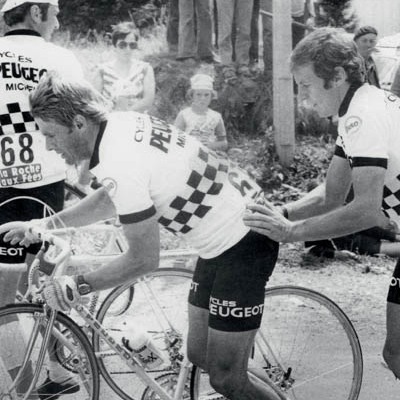
The course that changes Hennie
Perhaps that acceptance also has something to do with the ‘new’ Kuiper. José has so often sighed: ‘Hennie is a good rider. But he ought to have a bit more guts, a bit more self-confidence. Then he’d be an even greater rider.’ Through his sister Paula, De Cauwer is put on to a ‘self-confidence’ course attended by people from all walks of life. Under the promising title Leading Success People (LSP), participants are first stripped bare mentally, after which comes a ‘rebuilding programme’ from which the participant is supposed to emerge reborn. José, challenged to do so by his sister, signs up, and afterwards pulls the other half of the partnership, Hennie, along in his wake. ‘A lot of the people who take part are from the business world – people, for instance, who find it hard to speak in public. I thought to myself: it’s good for your self-confidence, and it might help Hennie with his stutter.’
Hennie knows De Cauwer’s view: that he does not stand up for himself enough. Kuiper does everything he can to avoid conflict. He would rather suffer defeat than bang his fist on the table. ‘I can’t stand quarrels. To my mind, war is the most foolish thing there is. Whether it’s Russia against America or you against your neighbour: to me that’s war. I avoid that kind of war. But I have fought wars with my legs.’ He concedes that José is right. You cannot solve everything with your legs, with feats on the bike. So he agrees to José’s proposal that he follow the same course in Antwerp. ‘José had already been and had told me a bit about it.’ The participants are asked what they hope to achieve by taking the course. It can be anything at all. It ranges – as in Hennie’s case – from ‘being a good family man’ to ‘being a better employer to my staff’. With Hennie, the other participants soon find out that he is a cyclist, and naturally Hennie would love to win the Tour de France, even though that is not the goal that brought him to the course. But his fellow participants think it is wonderful. They promise to support Hennie morally and all to come to Paris. Almost forty years later Kuiper is still positive about the course. In an interview in 1979 he says: ‘You learn to be more yourself. You feel that you are the most important thing, without being selfish. When they ask you how you are, your answer is: fantastic.’
Kuiper prepares for the new season with great conscientiousness, not only mentally but physically too. He knows what is expected of him: at the very least a place on the podium in the Tour de France. For the French, and for the sponsor Peugeot in particular, everything revolves around the Tour de France. Hennie goes at it hard from the start of the season. ‘That course had lit a fire in me. I had been asked to lead a French team. I was very proud of that.’ ‘Kuipertje’ (little Kuiper) is determined to prove himself worthy of that leadership. ‘On the course,’ says De Cauwer, ‘they take you from a low point to an absolute high. The idea is that you end up somewhere around halfway. But Hennie doesn’t end up in the middle at all. He stays close to the high, and that leads to all sorts of absurd situations.’
It looks like a kind of brainwashing. But Hennie sees it differently. ‘It’s about cultivating a different attitude to life.’ For almost everyone, the effects of the course wear off after a while. Kuiper is already extreme in his zeal for training and preparation, but in the year after the course he goes over the top. ‘With me it’s different,’ Hennie responds. ‘I have a sacred goal: winning the Tour. So in my preparation I ride every race I can.’ It later emerges that in the 1979 season Hennie Kuiper clocks up the impossible total of 180 racing days, counting the winter months when there is little racing.
On the course Kuiper learns slogans such as ‘I will, I can’ and similar phrases meant to gee him up. Even now, on a stand in his study in Enschede, you will find the words ‘I will, I can’; they chime with his own philosophy of life: a mentality of always keeping going, whatever happens – Champion Willpower.
The ‘new’ Kuiper, who keeps stepping outside his own normal bounds, as will become clear later that season, is also confronted with a directeur sportif who is developing a kind of Hinault complex. It has to do with the ‘race behind the race’: the cockerel posturing among the directeurs sportifs. Cyrille Guimard is busy knocking De Muer off his throne as France’s most successful directeur sportif. In 1976 Guimard’s team leader, Lucien Van Impe, wins the Tour; in 1977 De Muer ‘answers’ with Thévenet, but a year later, in 1978, Guimard has a ‘rejoinder’ in the form of victory for the Breton Bernard Hinault. What worries De Muer more is the suspicion that in this Breton rider a new absolute ruler has arisen, one of the Merckx type. That means that it is no longer he, De Muer, who is number one in the pecking order, but Guimard. And so, day after day, the name Hinault comes up in the Peugeot squad. He is the man who must not win. The Peugeot riders, and team leader Kuiper above all, are under orders to get the better of Bernard Hinault.
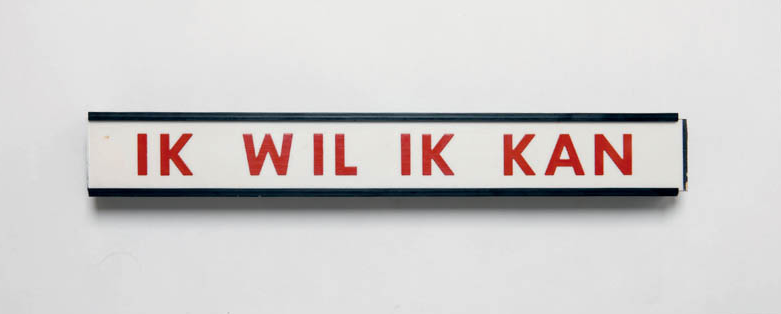
The mentality of Champion Willpower summed up in a homespun motto: I will, I can
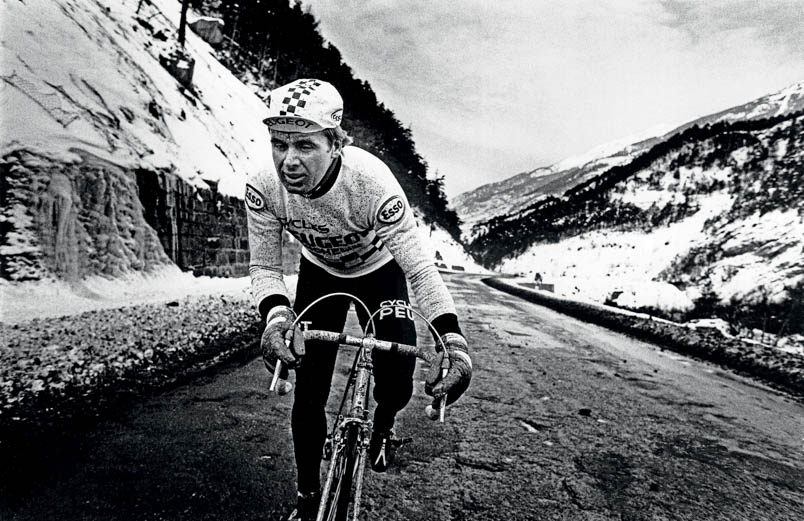
La Norma lies in the middle of the Moûtiers – Val-d’Isère – Montgenèvre triangle. With the Parc National de la Vanoise close at hand, it is a beautiful, unspoilt setting in which Hennie Kuiper can put in his training kilometres, come rain or shine
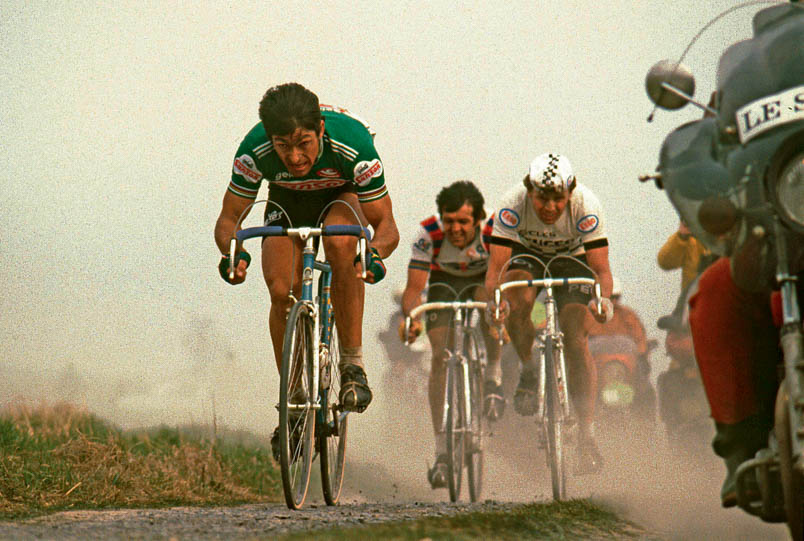
The Hell of the North in its dry version in 1979. Eating dust all day long. That is why you had better stay as near the front as you can. And so, in the finale of Paris-Roubaix, Francesco Moser imposes a murderous pace on Roger De Vlaeminck and Hennie Kuiper
Anti-Hinault complex
When Hennie Kuiper starts his fifth Tour de France, not only are the effects of the assertiveness training still clearly noticeable, but he also feels the pressure of De Muer’s anti-Hinault complex. At first all goes well for the Peugeot riders. Hennie comes through the Pyrenees very well, rides a surprisingly strong uphill time trial between Bagnères-de-Luchon and Superbagnères, and after the first team time trial, over 86 kilometres from Captieux to Bordeaux, in which the strong Peugeot squad finishes third behind TI-Raleigh and IJsboerke, Kuiper is only 31 seconds behind Hinault. Once again he misses the yellow jersey by a whisker. But Hennie gets a second chance in the second team time trial. The whole squad, staff included, is keyed up. Here – in those 90.2 hilly kilometres between Deauville and Le Havre – history is to be made: for the first time in his life Hennie will be hoisted into the yellow jersey, or at least that is what everyone thinks. On paper the Peugeot team is stronger than the teams of Renault (Hinault) and Miko-Mercier (Zoetemelk).
De Muer has got hold of some ultra-light tubulars that are supposed to give an extra edge. But he makes a cardinal error: the lighter the tubular, the thinner the casing, and the sooner a sharp little stone cuts through the tyre. He makes a second mistake. Any rider who has been around for more than a year knows that it is better to fit an aged tubular to the rim than a fresh one. Aged tubulars are tougher and less easily punctured by stones. And when you fit ultra-light tyres, the choice of aged tubulars matters all the more.
The team time trial is a catastrophe for the Peugeot riders. At the three-kilometre mark the first rider punctures. Four more will follow. One of those punctures even causes a crash. Hennie refuses to wait. Better to reach the finish with fewer men. His teammates do not thank him for it. Afterwards Jacques Bossis and Yves Hézard are scathing about their team leader Kuiper. ‘He should have waited,’ they say, ‘and not put the hammer down even harder.’ There is unrest in the team. That never helps performance. That Hinault takes the yellow jersey after this stage puts the man with the Hinault complex, Monsieur De Muer, in an exceedingly bad mood.
Just how negatively the assertiveness training can work out becomes clear the day after that disastrous team time trial. The ninth stage of the Tour runs from Amiens to Roubaix. In cycling, say Roubaix and you say cobbles. In the Tour, a stage over those lumps of stone is considered treacherous. And so it proves. A lead group forms including Joop Zoetemelk, Bernard Hinault, Michel Pollentier, Didi Thurau and the ‘cobble-eater’ Ludo Delcroix. Kuiper misses the move. Hennie orders José to close the gap to the leaders. All his Peugeot teammates lend a hand. Luck seems to be with the chasers when Hinault punctures. The Breton drops back into Kuiper’s group, goes straight to the front and expects support in the pursuit of the lead group. Their interests run in parallel, after all. José De Cauwer thinks so too when Hinault turns to him. ‘He asks me and my teammate Yves Hézard to work with him: Step on it, because we have to get up to the lead group.’
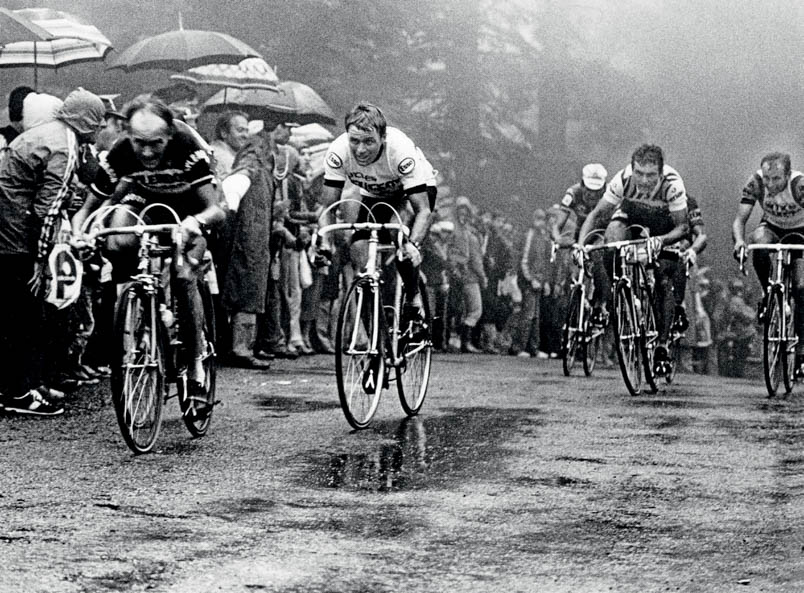
The 1979 Tour de France is a battle right from the start. As early as the second stage, between Fleurance and Luchon, the Portillon has to be conquered. Michel Pollentier and Hennie Kuiper lead, followed a few metres behind by Bernard Hinault and Joop Zoetemelk
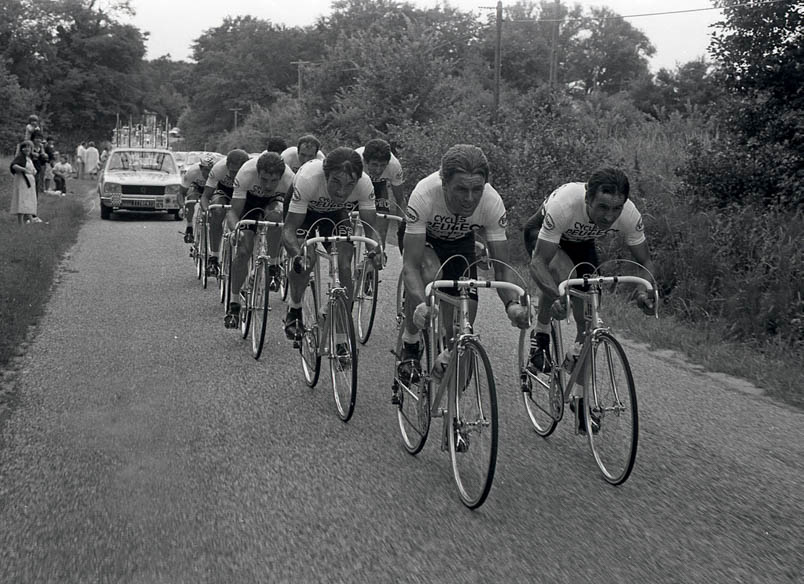
Hennie Kuiper can almost smell the yellow jersey during the 86-kilometre team time trial between Captieux and Bordeaux. The Peugeot riders finish third behind the specialists of TI-Raleigh, with, from left to right: Roger Legeay, Gilbert Duclos-Lassalle, Jacques Bossis, Hennie Kuiper and Jacques Esclassan. Bernard Hinault stays in yellow, with Hennie Kuiper 31 seconds behind
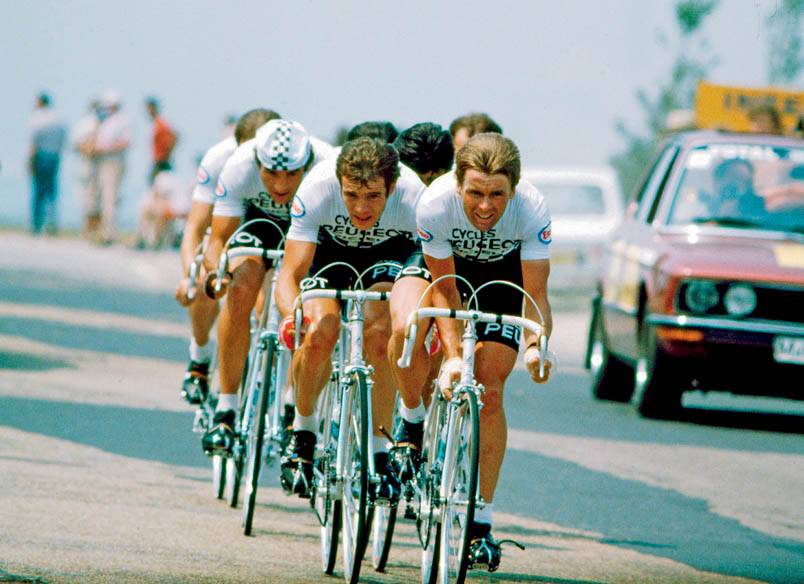
For the second team time trial of the 1979 Tour, between Deauville and Le Havre over a good 90 kilometres, Monsieur De Muer has come up with a trick: he has the Peugeot team ride on new, ultra-light tubulars. The result: one puncture after another. The result of the result: sixth on the day, 3 minutes 53 seconds behind TI-Raleigh. Hennie Kuiper – with an aerodynamic haircut – changes gear so that he can keep pushing on at full speed. Roger Legeay is about to take over
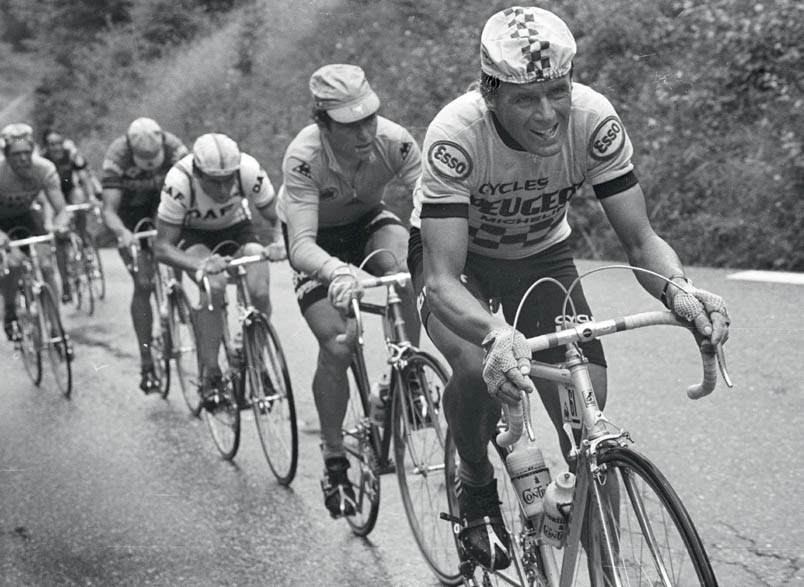
The 1979 Tour starts straight away with hard mountain stages. In the third stage, between Luchon and Pau, the eventual stage winner Bernard Hinault climbs on Hennie Kuiper’s wheel. The day before, Hinault had made sure of the yellow jersey in an uphill time trial
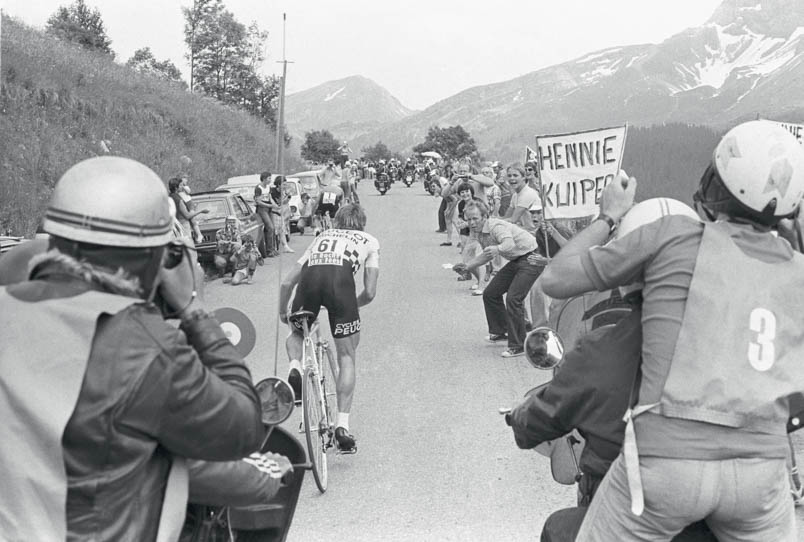
Stage number 15. Between Evian and Morzine Avoriaz. 54 kilometres, mostly climbing. Decked out in green, Bernard Hinault overtakes Hennie Kuiper and hands him a beating of almost five minutes, for all the encouragement from Hennie’s (since deceased) brother Johan. What is more, the Breton takes the yellow jersey back from Joop Zoetemelk
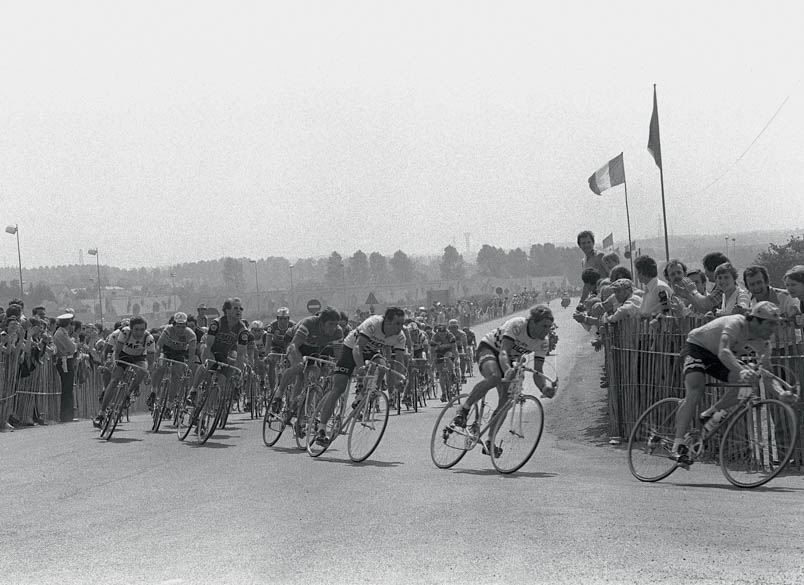
Stage six of the 1979 Tour thunders into Saint-Brieuc in Normandy. The Belgian Jos Jacobs will win by one second from two-thirds of the peloton. Saint-Brieuc lies next to Yffiniac, Bernard Hinault’s home town. No wonder the race leader is first round the bend, followed by Hennie Kuiper. Behind them, Jacques Esclassan and Marc Demeyer. Jan Raas sits up to see whether he can still launch a jump
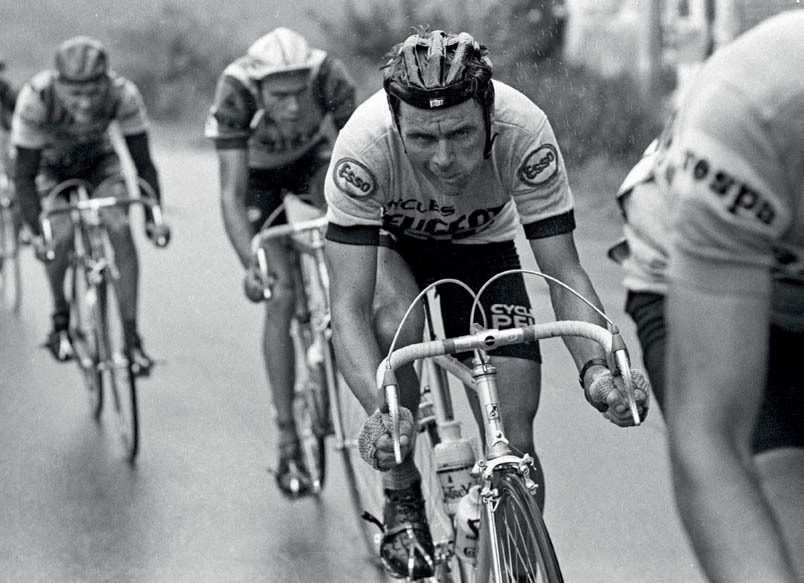
In the twelfth stage of the 1979 Tour, between Rochefort and Metz, Hennie Kuiper understands that he must keep eating. Christian Seznec looks for Kuiper’s wheel
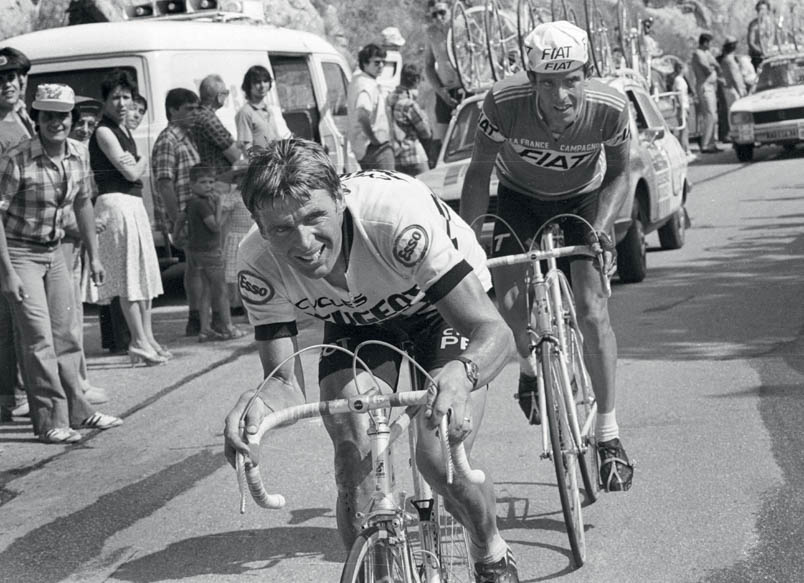
When it really comes down to it, there is too little support for Hennie Kuiper, seen here toiling away with Michel Balbuena on his wheel
‘Hinault must be broken’
Hennie will not hear of it. ‘Don’t work with him, because Hinault must be broken.’ José is dumbfounded. ‘Break Hinault? But that’s no use to us. We have to get up to the lead group.’ Kuiper shakes his head again. ‘He must be broken.’ Hinault tries once more. ‘If you help me now, I’ll do something for you in return later.’ Kuiper sticks to his refusal. Hinault throws everything into the chase. The rest of the group hangs passively on his wheel. The Frenchman closes in, gets closer and closer, but at some point Hinault’s tank is empty too. He has to give up the chase. At that moment Kuiper attacks, which is not so difficult, because Hinault has ridden himself into the ground in a 50-kilometre pursuit. ‘I was so wound up by De Muer’s words that I was riding to make someone else lose. When you do that, you usually end up losing yourself.’
Hennie has not been on his own for long on his way up to the lead group when he too punctures. He is overtaken by the man who ‘had to be broken’, and then has to ride very hard indeed to finish in the same group as Hinault. After the finish he has absolutely no sense that he has handled it badly. No, Hennie regards himself as the winner. ‘It’s fantastic. I made Hinault suffer.’ The normally level-headed Tukker, as people from Twente are known, has lost all sense of reality. In Roubaix Delcroix eventually wins the stage and Joop Zoetemelk takes the yellow jersey. Looking back, Hennie can analyse that period soberly enough. ‘I was overwrought. If I had been working for a boss, he would have said to me: “You go home for a couple of weeks.” But in the Tour that isn’t possible. There you live in the prison of the Tour, not in ordinary society.’
After the cobbled stage De Cauwer asks Kuiper for an explanation. ‘At that moment he was so wound up that he couldn’t see the logic of working with Hinault earlier in the stage. If he does that, then not only Hinault but he himself is in the lead group too. At that moment Hennie’s behaviour is a big problem.’ The question is: did Kuiper benefit from that course at all? José, who took the course himself, thinks he did. ‘Since that course he stands up for his own interests more. More than before, he puts himself in the foreground now and then. There’s a touch more healthy selfishness.’
Even after the team time trial and that highly questionable stage to Roubaix, Kuiper goes on following his own unfathomable tactical line. In stage 12, from Rochefort to Metz, Kuiper attacks more or less from the start. That breakaway does not last long. The Peugeot team leader may be a long way – more than six minutes – behind the yellow jersey Zoetemelk at this point, and four minutes behind Hinault, but a rider of Kuiper’s calibre is brought to heel all the same, even if you think it is madness for him to attack this early. So the attack does not get far. Not long afterwards Hennie sets off on another adventure. He takes with him, among others, Christian Seznec (the eventual stage winner), Bert Pronk and the Italian Aldo Donadello. The work on the front is done overwhelmingly by Hennie Kuiper. Donadello takes a turn now and then; the others simply sit in.
Hennie really puts the whip in. The lead grows visibly: two minutes, three, and eventually as much as eight minutes. Hennie is the virtual yellow jersey, but then the French teams – minus Peugeot – decide enough is enough, form a united front and steadily nibble minutes off the lead. Hennie, who in the end finishes sixth and last of the lead group, battles for 190 kilometres to gain 111 seconds. It is nice to be named the most combative rider of the day. It is nicer still to end up being named the most combative rider of the whole Tour. And it is an honour to be congratulated by the entire Tour management on this ‘fantastic’ stage, but when will you pay the price for this enormous effort?
The very next day Hennie has already lost what he gained in the 12th stage. Despite the bad experiences with the light tyres in the team time trial, De Muer and the mechanic again opt for those extremely fragile tubulars for the climb of the Ballon d’Alsace, the finale of stage 13. All the top riders are saving themselves for the finale. This is where it has to happen. But before the climb has really begun, Kuipertje punctures… He gets a wheel change, but after that no longer has the strength in his legs to make up the lost ground. After this stage the gap to the race leader Joop Zoetemelk has grown to an unbridgeable seven and a half minutes. The gap to the even more dangerous opponent, Hinault, is six minutes. For those following the race it is clear: once again the fairy tale of a Tour win lies in pieces for Hennie Kuiper.
In the time trial to Avoriaz Hinault puts the entire opposition in the shade, including Joop Zoetemelk, who loses the yellow jersey as a result. Hinault even catches Kuiper, who started three minutes ahead of him. The humiliation is great. It hits Hennie hard. After the battles in the remaining Alpine stages (Les Menuires and l’Alpe d’Huez), Hennie is still third in the classification, but his deficit to Hinault has grown to more than 21 minutes. And worse still: his place on the podium is under threat. The up-and-coming French talent Jean-René Bernaudeau and the experienced Portuguese Joaquim Agostinho, the impressive winner of the first climb of l’Alpe d’Huez, are direct threats to Ennie Kwiepèr, as the French pronounce his name.
As team leader, Hennie Kuiper feels responsible for the Peugeot team’s results. The disappointing performances gnaw at his self-confidence. Henk Lubberding, of the rival Raleigh team at the time, recognises that. ‘Every team leader has his doubts. But with Kuiper it really is to an extreme degree.’ Hennie has sleepless nights over it. The man who always falls asleep instantly, anywhere, now lies tossing and turning and brooding in bed through the dark hours. He gets up, gets out the classifications and dreams up all sorts of scenarios to secure at least his place on the podium. That will have to happen in Dijon, the city where two years earlier he lost the Tour de France for good. And just as in 1977, a time trial around that city will be decisive.
Two years before, in 1977, the Tour victory had been at stake; now it is the last place on the podium. It is the only way left to salvage some of his prestige. Just over six months earlier De Muer had brought him into the team to win the Tour. Against this Bernard Hinault, who rules the Tour like Merckx, there is no competing. Second place is already far out of his reach. But if he does not make the top three, the Dutch team leader’s showing will still be a failure in French eyes.
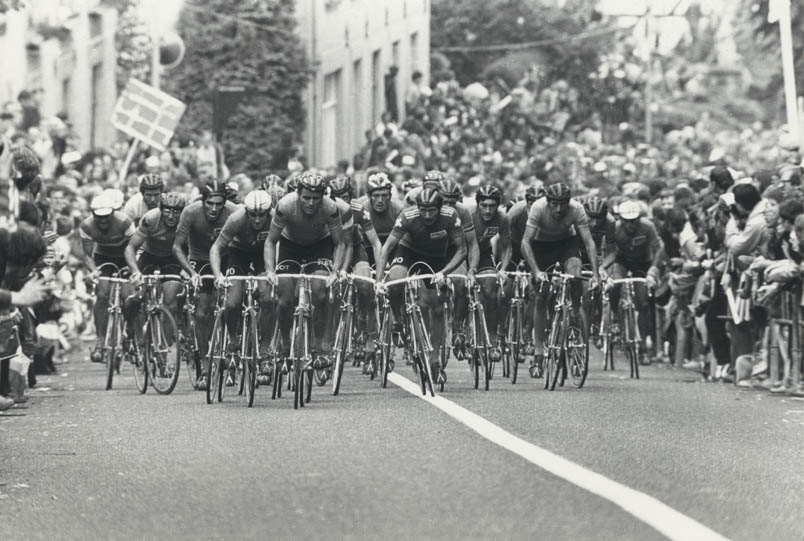
The 1979 World Road Championships are held in Valkenburg. Hennie Kuiper is first up the Cauberg. From left to right can be seen: Yves Hézard, Didi Thurau, Jan Raas, Giovanni Battaglin, Leonardo Mazzantini, Hennie Kuiper, Bruno Wolfer, Giuseppe Saronni and Daniel Willems
‘Ago’: the indomitable hard man
The great danger comes from Portugal, from a 36-year-old rider known for his many crashes as an accident-prone daredevil: Joaquim Agostinho. In this Tour, too, the leader of the Belgian Flandria team has lived up to his reputation for crashing. In stage 6, from Angers to Saint-Brieuc, Agostinho comes down heavily on a traffic island. He is quite badly hurt.
The Portuguese lies in the road for a long time with a serious thigh injury. The ambulance is already waiting to take him away, but then Agostinho makes it clear to the Tour doctor that, despite his serious injuries, he wants to carry on. A thick bandage is wrapped round his left leg, he is helped back onto his bike and, surrounded by six teammates, he begins his way of the cross towards Saint-Brieuc.
Agostinho’s left leg is so badly injured that he can barely pedal with it. He is pushed along by his teammates and reaches the finish a long way down. There, his face twisted with pain, he is loaded into a car and driven to hospital. ‘No fractures,’ the radiologist concludes. The Portuguese has suffered a massive haematoma. A doctor draws off the blood, because once that blood starts to clot, the pain becomes unbearable. ‘Ago’ is an indomitable hard man. The next morning he is hoisted onto his bike and pushed off. He will not hear of abandoning. In the cobbled stage to Roubaix – stage 9 – Agostinho loses a lot of time, but when he finishes in the top ten two days later in the time trial in Brussels, the worst of the suffering is over. ‘I’m still going to finish in the top ten,’ he tells his roommate Jos De Schoenmaecker, who shakes his head in disbelief. But the miracle happens. In the Alps he climbs dozens of places in the classification every day. It goes so well that he declares, full of confidence: ‘I’m not just going to make the top five, I’m going to get on the podium.’
On the eve of the time trial only 38 seconds separate him from Hennie Kuiper, the man in third place. ‘Ago’ is brimming with confidence; Hennie awaits the time trial in fear. He is a bundle of nerves, completely overwrought. Kuiper has the classifications spread out in front of him. He calculates and calculates and calculates. But he cannot make things look any better than they are. Sleep? No, it will not come. ‘The Tour is won in bed,’ Joop Zoetemelk likes to say. Well, not in Hennie’s bed. It stands on the Avenue Albert in Dijon. The rider sleeping in it has a very bad night. A few metres further along the corridor where Hennie is staying is the room of Rudy Bergmans, the Peugeot team’s Dutch soigneur. At the start of the season Bergmans trains exhaustively with Kuiper. Three times a week he drives from his home town of Ospel in Limburg to the Kuiper family’s house in Putte in Brabant. When he turns up in the morning, Hennie has already been training for an hour. Everything is ready for him: a moped, a ski suit, thick gloves, a helmet. The soigneur climbs onto a moped, opens the throttle, and Hennie rides now behind, now in front of the machine. Sometimes De Cauwer joins them too.
Those endless training sessions have forged a bond between the soigneur and Hennie. During that 1979 Tour Bergmans tries to give Hennie courage. But it is as if the team leader is living in another world. He cannot be reached. That night, at around half past three, the door of Bergmans’ room is gently pushed open. To his astonishment he sees Hennie looming at his bedside. Hennie is looking for support. ‘Rudy, I need you. I want to talk to you,’ the team leader says hurriedly. Bergmans gets out of bed and motions to Hennie to lie down. ‘We went through everything, from the classification and the time-trial course to his leadership at Peugeot. An hour later he did go to sleep after all, and he was able to start that time trial feeling good.’ That may be Bergmans’ view of Kuiper’s state of mind immediately before the time trial, but Hennie himself remembers it differently. He has no strength left in his legs. All sense of speed has gone. The Peugeot team leader does not make the top ten in the time trial. He loses more than two minutes to Agostinho, who a few days later steps triumphantly onto the podium as number three in the 66th Tour de France. ‘In that first Peugeot year Hennie was far too nervous,’ says Bergmans. ‘He didn’t have authority over the team either.’
That season Hennie Kuiper is not himself. Supporters who hear him talking into TV journalists’ microphones cannot believe their ears: ‘That’s not Hennie.’ He himself says: ‘I was over-positive that year.’ All that season Hennie is still under the spell of the LSP course he took at the start of the year. He is undeniably somewhat more assertive than in the past and no longer accepts everything. Kuiper himself counts his blessings. ‘It made a lot of things clear to me about my little self. I began to see things more broadly. Since that course I have the feeling that I am living, rather than being lived. Since then I have seen through people better than I ever did before.’
Has it also made him a team leader? In terms of performance, yes – though he already was one – but not in terms of character. He is not a man who is brash, who hands out a slap. He is no dictator. ‘Now and then you have to dare to be a bastard,’ says Jan Janssen. That is not Hennie. He does not want to hurt anyone, does not want to make himself a little less likeable now and then. Hennie does not have it in him. It is not his character. Nor should you want to change that. That despite lacking these qualities, which evidently go with leadership, he still rode his way to such an honours list marks him out as a great champion, and a very human one.
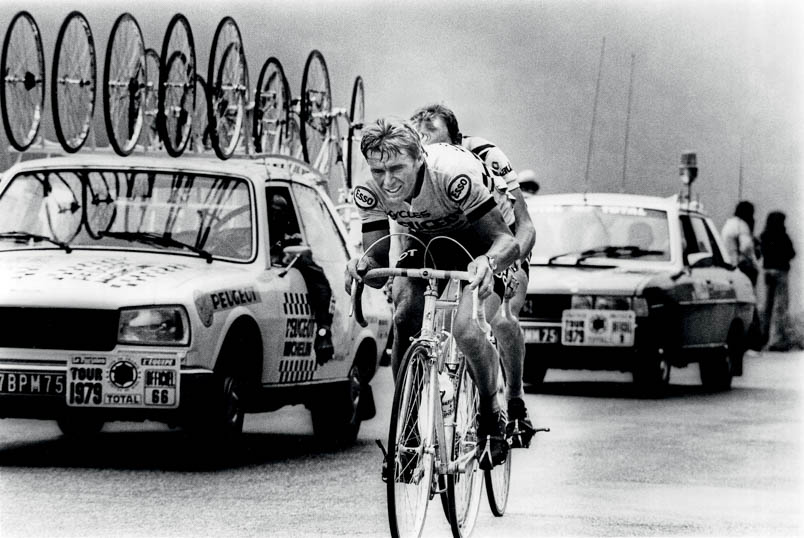
What the Italians call ‘grinta’ is written all over Hennie Kuiper’s face. The Luxembourger Lucien Didier is almost completely hidden behind Kuiper
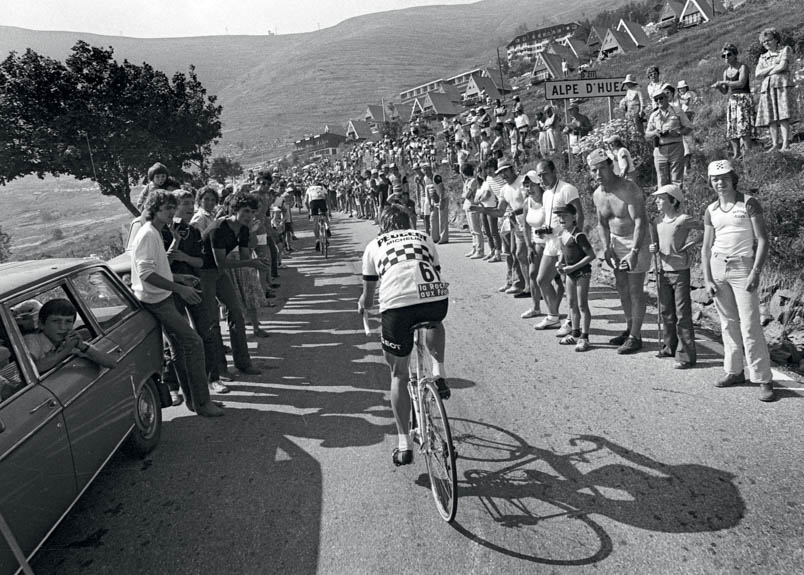
Riding into Alpe d’Huez, Hennie Kuiper still has a gap to close on Eddy Schepers
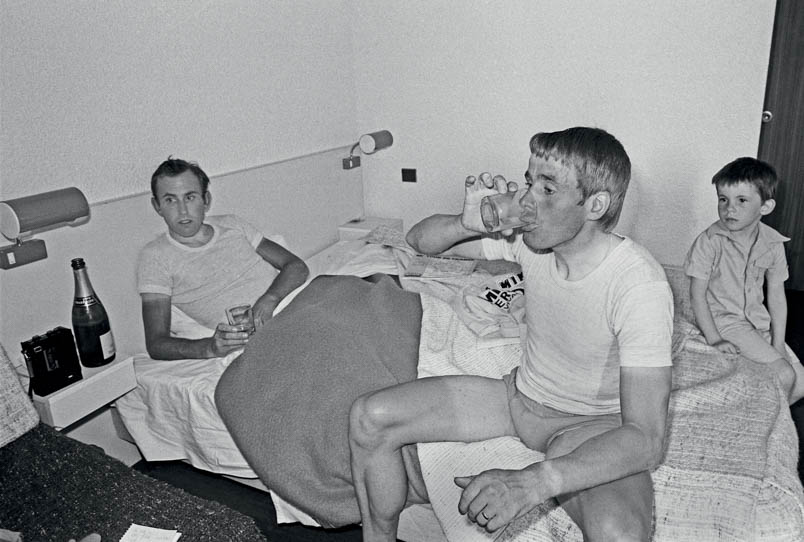
When Joop Zoetemelk takes the yellow jersey from Bernard Hinault on the stage to Roubaix in the 1979 Tour, Hennie Kuiper drops in at the Novotel to drink champagne from a toothbrush mug. Sitting on the bed with Joop is his son Karl Zoetemelk, later a professional rider himself
The spark is gone After the time trial in Dijon Kuiper longs for the finish in Paris. He is completely spent, mentally and physically. He grinds out the last few hundred kilometres almost mechanically. Every spark of inspiration is gone. When the riders ride to the start of the final stage on Sunday 22 July, Hennie Kuiper is already waiting at the start line. It is as if he wants to force race director Albert Bouvet, who gives the start signal with a whistle, to get the riders going as soon as possible.
Hennie wants to get away from this world as he has experienced it over the last few days. He longs to be home. He rides the first criteriums listlessly. He tells Ine: ‘If it doesn’t get better, I won’t ride the Acht van Chaam.’ Chaam, where in those years between fifty and a hundred thousand enthusiastic spectators line the course every year. Chaam, where riders always love to bask in the warm bath of the exuberant crowd. Chaam, which the whole peloton enjoys, and Hennie Kuiper certainly does. For six weeks he goes through life as if in a daze. He rides his laps around the church all right, but without any spark at all, burnt out as he is after this Tour de France that has been so hard on him, above all mentally. He realises: ‘When I’m myself, I finish this Tour second or third. But no, I come fourth, a long way behind number three; completely drained, mentally broken.’ Of course he does ride in Chaam. He even finishes third there, but it is a podium place without lustre. The season gutters out like a candle. Only in the winter does he find the peace to recharge for a new cycling year.
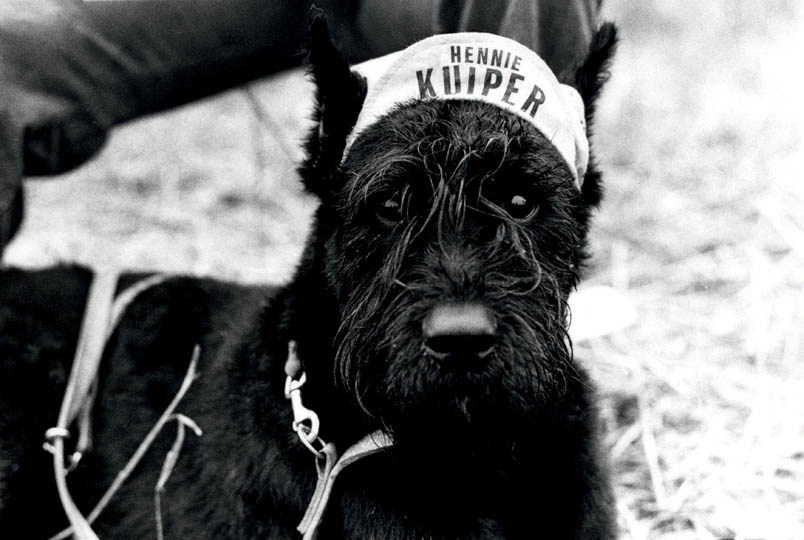
Hennie Kuiper is hugely popular in the Netherlands. So popular that at the 1979 World Championships in Valkenburg one fan even dresses his dog up in a Hennie Kuiper cycling cap