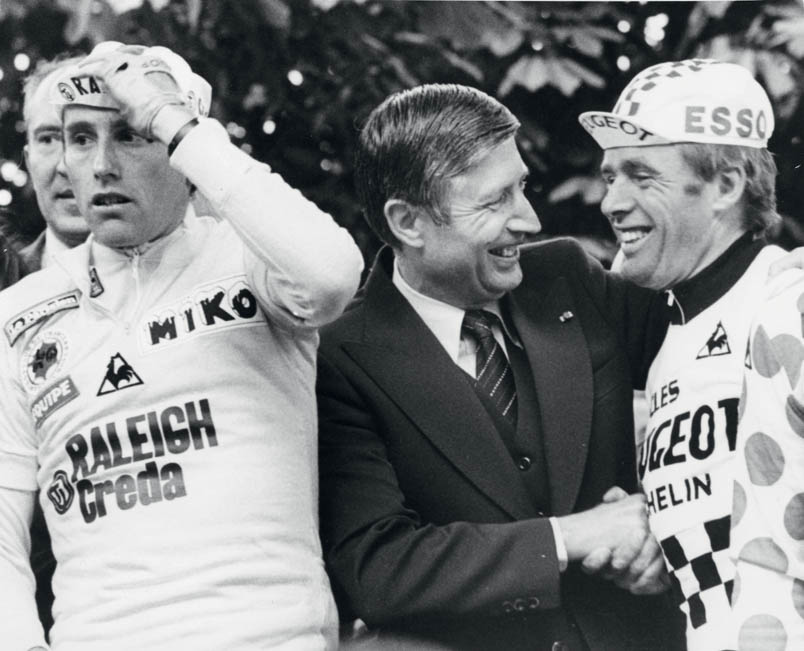
On the Paris podium of the 1980 Tour de France, Prime Minister Dries van Agt warmly congratulates Hennie Kuiper on his second place overall behind Joop Zoetemelk
Preface
There is a likeness between Hennie Kuiper and Piet Hein. Centuries later, the old naval hero is still celebrated in the song ‘His name is small but his deeds are great, he captured the Silver Fleet’. The man this book is about is small too, and his deeds are great too, but to this day they have not been sung nearly enough. That is why this splendid book now sounds the trumpet.
Hennie has always been a quiet lad. He lacks Gerrie Knetemann’s gift of the gab, never threw his weight about like Jan Raas, never shot his mouth off like Gerben Karstens. In the Raleigh team he remained the mostly silent philosopher, reasonable and modest. He still shows that quality today, many years later. Even about Peter Post, the directeur sportif who denied him the recognition – and the money – he was entitled to, his judgement is mild and self-critical. He won almost everything, but it could have been more still, because – so he says – he underestimated himself.
Hennie’s honours list is phenomenal: Olympic gold, world champion, twice only just short of overall victory in the Tour de France, but a string of glorious wins in Belgian and Italian classics and, here again, a host of near-victories. Too many to list in the introduction to this book.
In 1976 Hennie Kuiper lost the Vuelta after all, through a crash on the final day. Shortly afterwards he took his revenge by winning the Tour de Suisse. A year later he won the stage to the summit of l’Alpe d’Huez, and finished only seconds short of overall victory in the Tour.
Then comes the disastrous year of 1978. That year too, Hennie was declared the winner at l’Alpe d’Huez (after it emerged that the Belgian Pollentier had been guilty of doping fraud). After the rest day that followed came the queen stage: eight Alpine cols! I followed that stage together with the race director, Félix Lévitan, in his car. The Tour boss told me he was convinced that Kuiper (‘Kwiepèr’) would take the yellow jersey ‘today’ and so win the Tour. Then disaster struck. On the descent of the Col du Granier, the front wheel of the man everyone had tipped to win ran into a concrete gully at the side of the road. A crash, an ambulance, hospital in Chambéry. I went to see him there that same day with my son Frans. He was in a sorry state, but bearing up bravely. In 1980 Hennie (then riding for a French team) crossed the Tour’s finish line in Paris in second place. Right behind Joop Zoetemelk, but naturally it was Joop who got all the attention.
Cycling has become enormously popular in our country, and a good thing too. The rapid spread of the sport through every layer of the population has changed our society for the better: the class-ridden society that still existed in my youth has all but gone. Our top riders have become heroes to everyone. Naturally the finest performers deserve the greatest honour. Jan Janssen and Joop Zoetemelk have long occupied the top step of the podium. Since his victory in this year’s Giro, Tom Dumoulin may join them there. And our modest friend Hennie Kuiper? This book proves beyond doubt that he too belongs among our greatest stars.
August 2017
Dries van Agt