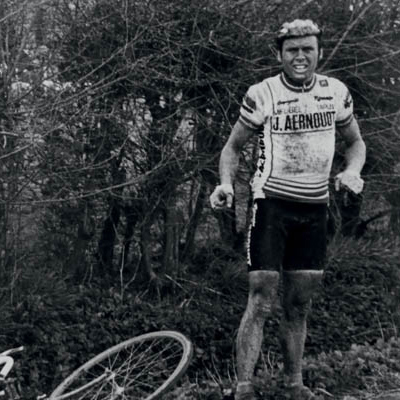
‘The real graft suits Hennie’
In 1981, with his move to DAF, a second career begins for Hennie Kuiper. He is 32 by then and, as a rider for the big stage races, he is starting to get on a bit. He can still put together a good overall placing, but really competing for first place is no longer on the cards. He knows that better than anyone. José De Cauwer – who else? – had already set him on the right track a year earlier. When Hennie came into his teammate’s room, disappointed after a Tour stage through the Vosges that had been a struggle, José said: ‘You need to put the overall out of your head and concentrate on the big one-day races: you’re good at those.’ De Cauwer had already seen that things were going a little less well in the Tour de France. ‘In the time trials he was still good, but not world-class. In the mountains he was good too, but again not world-class. In short, he was going to come up short at the sharp end of the overall.’ Mentor De Cauwer sees it clearly: Hennie is ripe for a change. ‘He had already built up a certain reputation in one-day races. He had become Olympic, national and world champion, and had posted good results in any number of classics without ever preparing for them specifically. Six hours in the saddle, gruelling races over tough courses, preferably in bad conditions, suffering: the real graft. That suited him.’
De Cauwer has already seen it: Hennie has reached the turning point of his career. ‘He was already on the way down in his career when he started on the classics. Had he concentrated on them earlier, he could have built up a far bigger palmarès.’ He has a natural gift for the work the classics demand. Just look at his results. He can already point to a string of placings that many a specialist might envy. Between the start of 1973 and the end of 1980, the era before his change of career, he finishes in the top ten no fewer than 35 times in big one-day races such as the Tour of Flanders, Ghent-Wevelgem, Paris-Roubaix, the Flèche Wallonne, Liège-Bastogne-Liège, the Amstel Gold Race, the Championship of Zurich, the Henninger Turm, Paris-Brussels, Paris-Tours, the Tour of Lombardy, the world championship and the Dutch national championship. A list that leaves no doubt about his talent for that kind of one-day race.
From the start of his Raleigh years in 1976, Hennie Kuiper is labelled exclusively as a ‘stage racer’. Post knows full well, of course, that Kuiper can hold his own in one-day races too, but he already has men for that speciality: first Roy Schuiten (which comes to nothing) and later Gerrie Knetemann and, above all, Jan Raas. What he lacks is a man for the overall classification. Kuiper can fill that vacancy perfectly. Hennie is a successful stage racer. He may not win the Tour, but he is invariably to be found near the top of the overall standings. What is more, he makes a name for himself in the Tour de Suisse, which he wins in 1976. After his Raleigh years, Peugeot boss De Muer accordingly brings Kuiper into the team as his trump card for the Tour. And once again the one-day races take a back seat. Following De Cauwer’s advice, the big one-day races become the main goal.
A different approach to training
Kuiper is advised to change his approach to training and to ride bigger gears in the early spring, so that in the finales of those big races he will also be able to turn the big chainring over. With a typically Flemish turn of phrase, De Cauwer makes clear what else is lacking if Kuiper the stage racer is to become Kuiper the classics rider. ‘In the past he was carrying too much timber in the early spring. He always came to the start of the first classics too heavy.’ Hennie knows his limitations. He is not fast. In almost every final sprint he comes off worst. Hennie has to rely on solo breaks. He has to shake off his rivals before the finish. And that means he must have the power to push big wattages in the spring classics. Up to and including 1980, everything has revolved around the big stage races, and the Tour in particular. All those years his training was geared to them too. Now things are different, Hennie knows. ‘Because in the last hour of racing the classics men go into an even bigger gear. In the finale the pace goes above 50 kilometres an hour.’
Those who know him notice another metamorphosis as well: Hennie radiates more self-confidence and stands a little more firmly with both feet on the ground. The atmosphere at DAF fits him like a glove. In Willy van Doorne he has a director at the sponsor with whom he gets on excellently; José De Cauwer – his great friend – leaves a clear mark on the technical management of the team; he gets on well with Roger De Vlaeminck, one of the great Belgian stars; and within the team he is recognised as the rider who, for all his shortcomings as a sprinter, has nonetheless built up a respectable honours list. In short: he feels at ease, and it shows in a more self-assured bearing.
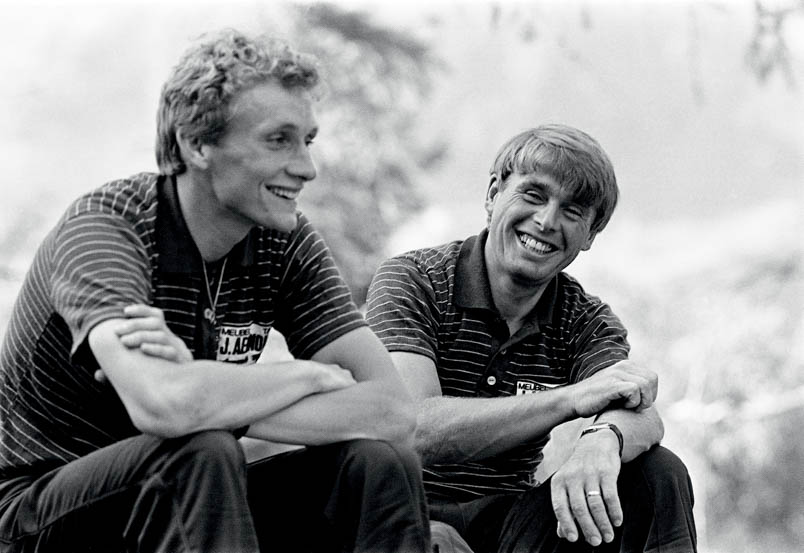
In the run-up to the 1983 cycling season Adrie van der Poel and Hennie Kuiper don’t just train hard; there is time to relax as well
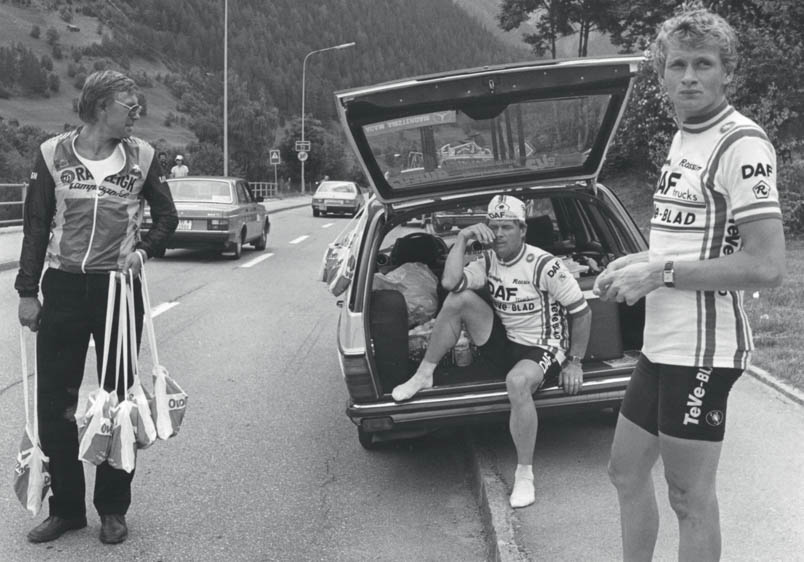
Hennie Kuiper and Adrie van der Poel have abandoned the Tour de Suisse and wait in the feed zone, sitting in the boot of Ruud Bakker’s car
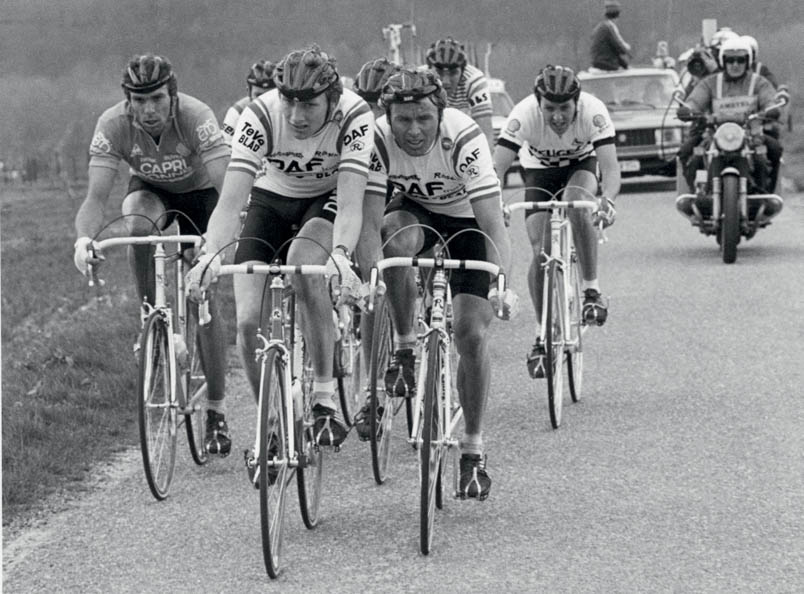
Gregor Braun, Adrie van der Poel, Hennie Kuiper and Stephen Roche on the Keutenberg
The greatest victory
Hennie was once in contact with the Amsterdam therapist Len Del Ferro, who claims to have cured Kuiper of his stutter. But Hennie puts that claim into perspective. ‘At most he contributed to it. Above all, I overcame it myself.’ It is true that he had help from others along the way. The LSP personality course he took in the depths of autumn 1978 may – as he says himself – have played a part, but the credit is above all his own.
‘It has been,’ he says, ‘perhaps the greatest victory of my life.’
Adrie van der Poel
At DAF Kuiper meets Adrie van der Poel, a farmer’s son like himself; not a born Tukker, as people from Twente are known, but a Brabander born and bred, from Hoogerheide. In 1973 Hennie moved from Oldenzaal to Brabant, first to Ossendrecht and later to Putte, where he is practically Jan Janssen’s neighbour. Van der Poel and Kuiper got to know each other a little on training rides in the late seventies; Adrie as an amateur with the Van Erp brigade, Hennie as a professional with Peugeot. The contact grows closer when Van der Poel breaks a collarbone in the Tour of Overijssel in 1980. The Brabander fears for his chances of Olympic selection. Then Kuiper comes to the rescue. He is still grateful to Hennie for it, he says at his villa in Kapelle in Belgium. ‘He took me to Dr Johan Derweduwen in Mol, in Belgium, who had once helped him with a broken collarbone himself. The doctor operated on me, joined the two pieces of bone with a screw, and that was that. I rode a very good race at the Olympic Games in Moscow. That was followed by fine results in the Ster der Beloften. The next season I was in Hennie’s team.’
In the autumn of 1980 Van der Poel is a sought-after rider among the professional teams: he has staying power, and he has a good sprint. He chooses DAF. ‘The fact that Hennie was going there will have played a part. As did the fact that DAF is a company from around here. What also helped in that choice was that Dutch was spoken in this team. There was no language barrier.’ In his first stage race of any importance, Paris-Nice, he wins a stage straight away and finishes second overall. He has been assigned to keep Hennie Kuiper out of the wind, but on the third stage, to Saint-Étienne, he rides up to Kuiper 30 kilometres from the finish and says: ‘You can manage on your own now, can’t you?’ Kuiper replies: ‘Yes, but why?’ ‘I want to try something myself,’ says Adrie. He tries, and he wins. He is one of the best at the training camp, shows himself at the front in the Omloop Het Volk and is soon given a free role, unheard of so early for a neo-pro.
José De Cauwer, his directeur sportif in that first phase, quickly realises: I should just let Van der Poel get on with it. Van der Poel is irritated by remarks such as ‘I never get a chance’. ‘You don’t get chances, you take them.’ The slim Brabander does that in other respects too. During that Paris-Nice he begins his first French lessons on the massage table. ‘Soigneur Willy Voet, who speaks perfect French and Dutch, started practising with me while he gave me my massage: learning words, building sentences. Thanks to him I learned French, although of course it takes a while before you can get by on your own in a language like that.’ He will later marry Corine, the daughter of Raymond Poulidor, alias Poupou. Van der Poel respects Kuiper, a neighbour from his own part of the country. ‘He had achieved a great deal already, of course. But look up to him? No. And even then I felt they didn’t need to look up to me either. I always tried to do my job as well as I could, with all the pluses and minuses Mother Nature gave me.’
Adrie and Hennie: polar opposites
Van der Poel read a race better than Hennie, and he had to. ‘He was much stronger than me. The longer a race went on and the harder it was, the better he performed. With me it was exactly the other way round. I had to keep something in reserve and I had to know my opponents very well. Then if they followed a certain tactic, I would do things just a little differently.’ Very different from Hennie, then. ‘Yes, after 200 kilometres he was still riding just as fast as in the first fifty. Of course, on certain days Hennie was superb. Towards the end of the race he would get better, not so much because he could raise the pace even further, but because his rivals were running out of petrol. Hennie could always keep going. That strength, that strong body: that was his class.’
What Van der Poel learns from his experienced teammate is to rest in good time. ‘Rest, eat and then rest again. Hennie often shared a room with me. You adapt to that. I had that with Hennie and later with Joop Zoetemelk and with Marc Dierickx, who later became my personal helper. What De Cauwer was to Hennie, Marc was to me. After the race Hennie would lie down on the bed and fall asleep. I wasn’t sleepy, but I lay down anyway. And after five times I adapted to Kuiper’s habit and went to sleep as well. That way you do get your rest.’ De Cauwer had already found out in the Frisol years how strong Kuiper is in training. Adrie experiences the same on the training rides he goes on with Hennie. ‘When he was having one of those days, I mustn’t make the mistake of trying to stay with him, because that would leave me in bad shape for two weeks. Now and then I did need a session like that, but I had to measure it out very carefully. But there were also times when I said: “You’re on your own from here, I’m not going any further with you.”’
More than Kuiper, Van der Poel, with his finishing kick, seems destined to play a leading role in the classics. He builds up a splendid honours list that boasts two Monuments: the Tour of Flanders (1986) and Liège-Bastogne-Liège (1988); he is the best in the Championship of Zurich (1982), in the Clásica San Sebastián, Paris-Brussels and the Brabantse Pijl (1985) and in the Amstel Gold Race (1990); he wins three Tour stages, wears the yellow jersey for a day and becomes cyclo-cross world champion, but to his sorrow he never wins Paris-Roubaix, his favourite race. He comes close once, in 1983, but first he fails to get across to the lead group, and afterwards he has to hold back so as not to jeopardise the chances of the eventual winner, his teammate Hennie Kuiper. ‘I always loved Paris-Roubaix most. It is a unique race. The Tour of Flanders is beautiful too, but not unique. You come across the little climbs of Flanders in the Omloop Het Nieuwsblad, the E3 Prijs and the Three Days of De Panne as well. Before you start the Tour of Flanders, you’ve already been up those little hills a few times that same season.’ Paris-Roubaix comes only once a year. ‘At most you ride over part of the course again when the Tour de France passes through the area. But every time you’ve failed to win Paris-Roubaix yet again, you have to wait another year before you’re on the start line of the most beautiful classic of them all.’ Adrie van der Poel and Hennie Kuiper: two farmers’ sons who share the same dream. But in the end only Hennie manages to make that dream come true.
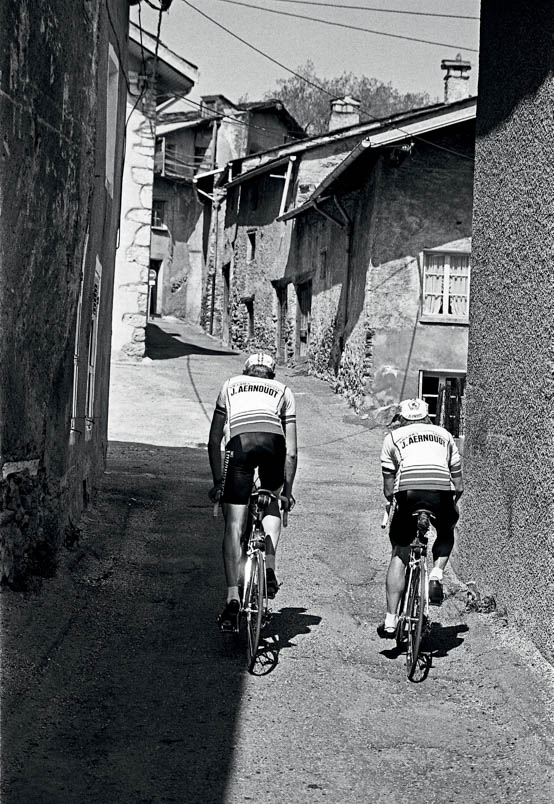
Hennie Kuiper and Adrie van der Poel training together in the French Alps in preparation for the 1983 season