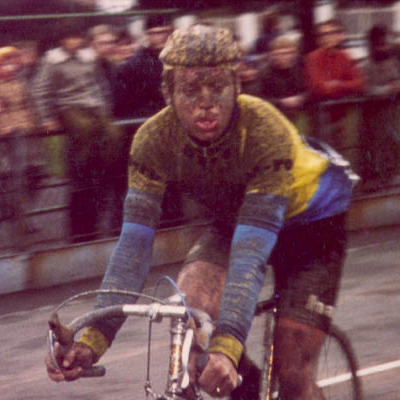
The weapons of a farmer’s son
This is where it all began. It was here, on the narrow Schotbroekweg that runs ruler-straight beside the drainage canal, that the foundations of Hennie Kuiper’s great cycling career were laid half a century ago. It is as it so often is here: a stiff westerly wind blowing a chill across land and water. He talks about the old days, when he and his brother Bennie ground out the kilometres day in, day out on their ordinary bikes on the way to school in Enschede. Twenty-five kilometres there, twenty-five kilometres back. ‘However hard it rains, however fiercely the wind blows, it doesn’t bother us. Snow or lightning? We just keep cycling, and we actually enjoy it.’
Those kilometres are the foundation of his career
On this cold February day the rain draws a chill curtain of water across the Twente fields and the scattered farms. At Erve Kuiper, the farm where Hennie (in full, Hendrikus Andreas) was born on 3 February 1949, the family shelter in the warmth of the farmhouse. The fields lean against the German border. Noord Deurningen, the place is called: a speck in an endless landscape. This is farming country, a land of toil and graft. People here do not know the riches of a full purse, but they do know the riches of togetherness. Happiness does not lie in wealth, they know. It lies in being together, and in setting goals together. The Kuipers are good at that. ‘Once they get something into their heads, nothing will shift it,’ says Ine, the woman behind the rider throughout Hennie’s career. Perseverance and willpower are their strongest weapons. That is how they make their way in life. All of them. Each in his or her own way. Hennie is the most striking example.
Hennie Kuiper treasures his great triumphs, every one of them proof of that willpower. The 1975 world title, snatched in impressive fashion at the very gates of Belgian hell; l’Alpe d’Huez in 1977, the high point of the attacking spirit so often celebrated across his twelve Tours de France; the fifteen-kilometre solo ride to victory in the 1981 Tour of Flanders; the unchallenged lone break in the glorious Tour of Lombardy that same year; the triumph that perhaps most captured the public’s imagination, in the mud-caked Hell of the North in 1983; and of course the wholly unexpected encore in the much-debated finale of Milan-San Remo in 1985. Yet for him the ultimate victory remains the gold in the 1972 Olympic road race. ‘If you know where I come from, you’ll understand that,’ says Hennie Kuiper. It is his first great revenge on those who had wronged him in the years before: on the coaches and selectors who had passed him over year after year when the final teams for the various world championships were picked; on a peloton that did not believe in the extraordinary potential of this ever-driven man from Twente. Plenty of loudmouths thought it unlikely that a cycling great could ever grow up in that provincial corner of Twente. Many more scores would be settled after that Olympic title: scores with others, but also with himself. It is the thread that runs through the thrilling career of Champion Willpower, Hennie Kuiper. After his two years as a novice (the youth category) – the official start of his racing career with the Royal Dutch Cycling Union (KNWU) – the modest Tukker, as people from Twente are known, moves up to the amateur ranks in 1968.
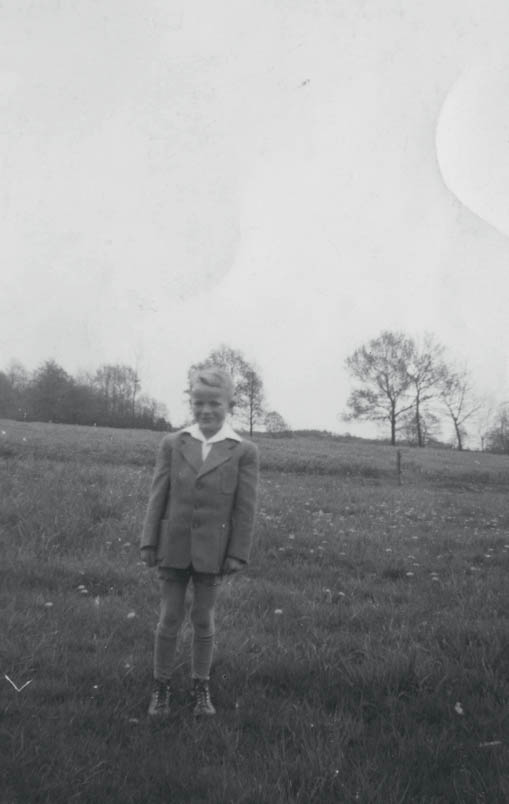
Hennie in the wide open spaces of Noord Deurningen
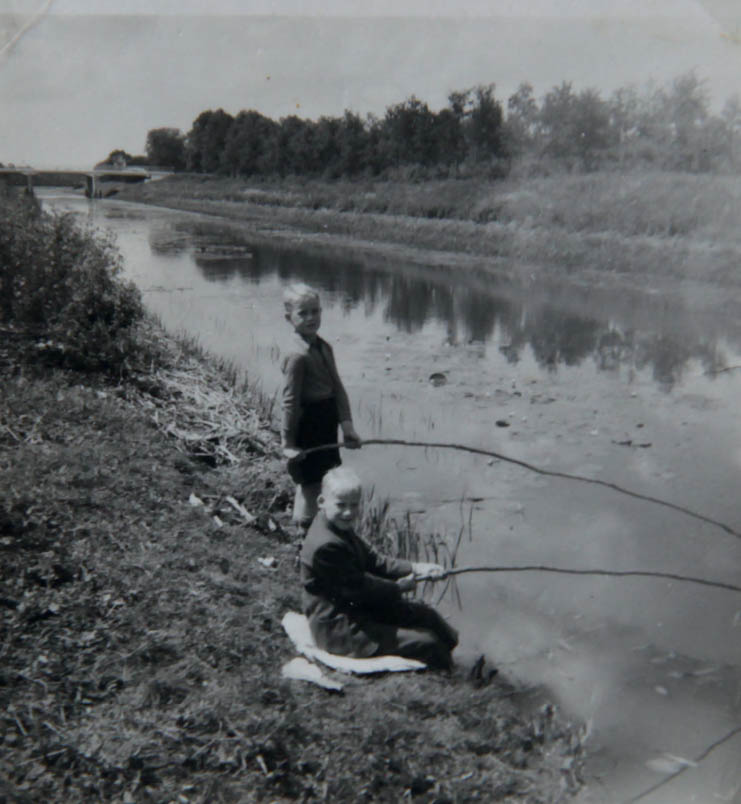
Hennie’s brothers Frans and Bennie fishing with home-made rods in the Almelo-Nordhorn canal beside the Schotbroekweg. It was here, along this canal, that Hennie Kuiper the cyclist was born
Now it gets serious.
At first the adjustment is a real struggle. Cycling is about more than just pushing hard on the pedals. Tactics and technique play a big part. You have to be able to ‘read’ a race. But it is also a matter of pulling tricks and having tricks pulled on you. Drop the starting flag in front of an amateur peloton and war breaks out at once; all the more so when echelons form, offering shelter from the wind. The riders fire from every side, from left and right, head-on and from the hip. When the wind blows, the first kilometres decide your chances. So there is pushing, pulling and swearing, all to get into that first echelon. It is a ferocious scrum; no place for a rider like Hennie Kuiper, who is too well-mannered for that kind of cowboy stuff. At first he solves the problem his own way, settling in behind the echelon or sometimes riding alongside it for kilometres on end. Soul-destroying for an ambitious rider, even one as dogged as Hennie Kuiper. National coach Joop Middelink urges him to ride in the echelon, and because the other riders can see that in Hennie they have someone who never shirks his turn on the front, now and then they grant him a place in it.
When Hennie finishes second behind Tino Tabak in the 1970 Tour of North Holland after an impressive ride, the national coach selects him for the Tour of Belgium. He explains himself in a radio interview. ‘I heard the interview back afterwards and it gave me the fright of my life. Is that me? Do I really stutter that badly? I made up my mind to do everything I could to get rid of it.’ Yet it will be years before he can reach the finish line of a sentence almost without snagging on a word. Riding the Tour of Belgium marks the start of a long run of selections, but it takes time before his rivals take him seriously. Even when, riding for the Ketting team in Olympia’s Tour – the highlight of the Dutch amateur calendar – he wears both the orange jersey for the general classification and the green jersey for the points classification, his Ketting teammates barely give him the time of day. To them he is the rider who – most unusually – turns up at the breakfast table every morning with Bambix baby cereal and Protifar protein powder.
His teammate Klaas Balk – one of the top amateurs of the day – makes fun of it. Hennie lets his tormentors carry on. He has grown calluses on his soul. He goes his own way, keeps his ears wide open and makes up his own mind. When the attacks go in the day after the teasing and Kuiper gets into trouble, not one teammate comes to help him. Hennie knows he will mostly have to fend for himself. In both 1970 and 1971 he can show a list of results that few riders can match. True, there are riders with far more victories to their name; but when he wins, he wins in style. He has no devastating attack, no blistering final sprint. He is like a diesel engine: slow to get going, but once he is moving there is no stopping him, and he keeps going at the same scorching pace. It is not only the races he wins that are 24-carat; the way he rides to victory is impressive too. And the harder the race, the better Hennie Kuiper rides. Whether in Yugoslavia, Bulgaria, England or the Tour de l’Avenir, the Twente rider shows he is a good deal more than some humble little racer from a forgotten corner of Overijssel. No – let it be said again – he is no sprinter. If he is in a lead group of four, fourth place is usually reserved for Kuiper. But in the races that matter, he is always there.
Sacked
Kuiper will give anything for cycling. He even puts his job on the line to ride the Tour of Yugoslavia. Hennie works as a production planner at Hollandsche Signaal (now Thales) in Hengelo, a company that makes radar equipment for the Dutch armed forces, among other things. When he asks for time off to ride the race in Yugoslavia, he is given a warning.
Yugoslavia, which under President Tito still binds the countries of the region together as one state, belongs to the communist Eastern Bloc, the great adversary of the capitalist West. ‘My employer told me: travel through Yugoslavia and you’re sacked. As an employee of this company, which works for defence, you can’t travel through a communist country.’ Hennie is faced with a choice: his working career or his sport. After careful thought he chooses the sport, and goes on to shine in the Tour of Yugoslavia. When he gets home, his letter of dismissal is waiting in the letterbox.
The national coach picks him neither for the 1970 World Championships (in Leicester, England) nor for the 1971 edition (Mendrisio, Switzerland). ‘I was deeply disappointed.’ Even then it is clear that Hennie is not the kind of man to bang his fist on the table and demand his place. He refuses to listen to people from his own region who claim he is left out because he lives not in the west of the country but in provincial Twente. No, Hennie grimly keeps his own counsel. His answer? To live for his sport even more intensely than he already does. He chastises his body without mercy, all year round. He very rarely allows himself time to relax. Hennie knows that iron discipline is what he has to rely on. The former altar boy knows that without passing through the cleansing fires of purgatory, you will never reach (cycling) heaven.
Milk Race
A glimpse of that heaven comes into view in the first half of June 1972, in the Milk Race, the stage race on British soil in which the Dutch often do well. First, though, comes a fierce purgatory. The final stage, which finishes on the seafront, on Queen’s Promenade in Blackpool, turns into open warfare between the riders of the French and Dutch teams. At stake: overall victory in this prestigious race. Saddles are grabbed, punches thrown, riders shoved. Afterwards five riders are penalised for their misconduct: the Dutchmen Jan Aling and Jo de Boer, and the Frenchmen Georges Talbourdet, Eric Laloueppe and Charles Alguesparges.
Jan Kuiper from Opmeer (no relation) has for years been directeur sportif and soigneur to the Dutch squad. He knows the race inside out. In 1972 he again has a strong team at his disposal, whose main trump cards, besides his namesake Hennie Kuiper, are Cees Priem, Jan Aling and Cees Bal. The Dutch dominate the race. Jo de Boer (twice), Jan Aling (twice), Cees Priem and Cees Bal take the individual stage wins. Victory in the team time trial makes it plain that Jan Kuiper has the strongest team. Going into the last day Hennie Kuiper has not won a single stage, but he has proved the most consistent rider. He lies second overall, behind the Frenchman Marcel Duchemin. Jan Kuiper calls the riders together. ‘I told Hennie: you can win this race. There are double time bonuses on offer in this stage. If you cross the line in the first four and Duchemin doesn’t pick up any bonus seconds, you’ll be the winner.’ The riders are astonished: ‘Hennie, finishing up there in a sprint? That’s never going to work.’ But the directeur sportif has worked out a plan. ‘I know that finish. Before you get onto the seafront, where it’s 800 metres dead straight to the line, the riders go round two roundabouts. That’s where it has to happen.’
From the very first kilometre it is war between the French, defending Duchemin’s position, and Jan Kuiper’s men. The Dutch keep the bunch together as best they can. One Swede, Tord Filipsson, slips away unnoticed. He gets a hundred, two hundred metres, and then turns out to have so much in the tank that he keeps extending his lead. As the seafront and the roundabouts come into sight, the Dutch gather at the head of the bunch. They set a hellish pace, repeatedly letting gaps open in front of Duchemin, who has to pull out all the stops to stay in the group. He manages it at the first roundabout, but at the second it is total chaos – just the thing for Jan Aling and Cees Priem in particular. They wear the French down as much as they can.
Henk Poppe, who had abandoned the Milk Race, watches it all unfold from a distance as a spectator. ‘Duchemin was a much better sprinter than Hennie. Whenever Duchemin accelerated, Cees Bal put his hand on the Frenchman’s saddle and pulled on his own brakes. Afterwards there was a tremendous slanging match. And to be fair, it really wasn’t on.’ The holy laying-on of hands, as riders call it, as the ultimate ‘weapon of war’. Directeur sportif Kuiper says it was not as bad as all that, but Poppe’s testimony and the furious reaction of the French tell a different story.
Hennie has no part in any of it. With Cees Bal’s help he works his way to the front. He may be no sprinter, but a finish like Blackpool’s, 800 metres dead straight, is more about sheer power than about sprinting. And Hennie can certainly ride hard. Once again he surpasses himself. Directeur sportif Jan Kuiper has seen his namesake win on a similar finish once before, in Skopje in Yugoslavia. The dream scenario unfolds before his eyes. Hennie: ‘We sprinted across the full width of the promenade. It really was man against man. You saw more and more riders drop back. This was just my kind of thing. What was going on behind me, I never knew.’ Hennie wins the bunch sprint, and with it the Milk Race. The French are livid. Their directeur sportif, Robert Oubron, lodges a protest against the Dutch tactics. ‘They tried every trick in the book. They hung on to Duchemin’s saddle and almost rode our riders into the verge.’
The protest is rejected. ‘None of the commissaires was able to observe the irregularities of which the Dutch stand accused,’ the ruling reads. Oubron takes his revenge afterwards. In an official letter from the French federation to its sister organisations he sets out what, in his view, happened in the finale of the Milk Race. It went no further than the letter. Nobody ever heard any more about it – certainly not the proud winner, Hennie Kuiper, who, with two major events in sight – his wedding and the Olympic Games – has won a big stage race of international standing.
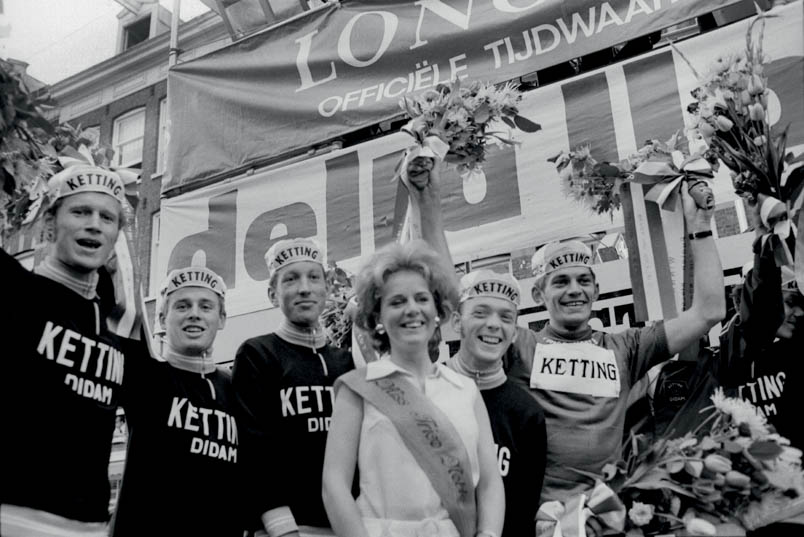
The Ketting team on the podium at Olympia’s Tour. From left to right: Klaas Balk, Hennie Kuiper, Aad van den Hoek, Piet van Katwijk, Jan Aling and – only just visible – Jan Lenferink
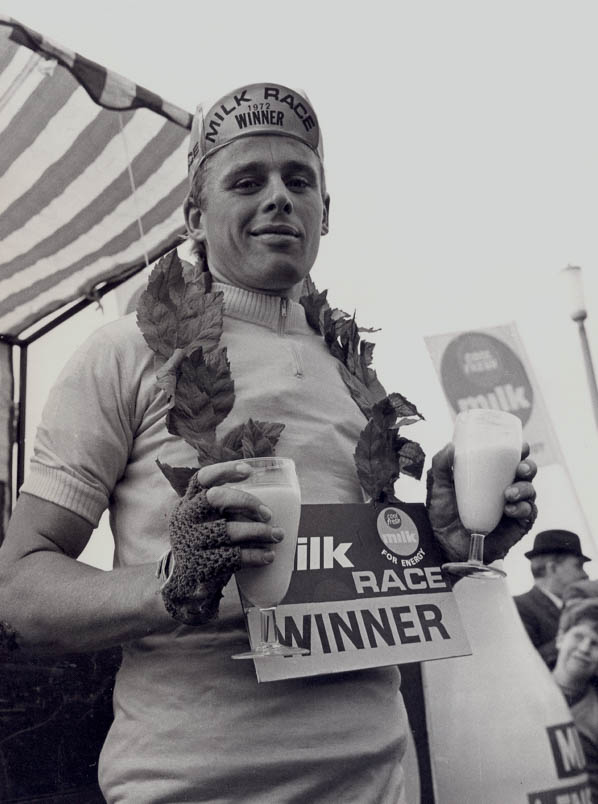
After a tumultuous finale in Blackpool, Hennie Kuiper, winner of the overall and combined classifications in the Tour of Britain (Milk Race), gets to advertise milk – ‘Cool, fresh’ and ‘For energy’, according to the victory garland around his neck