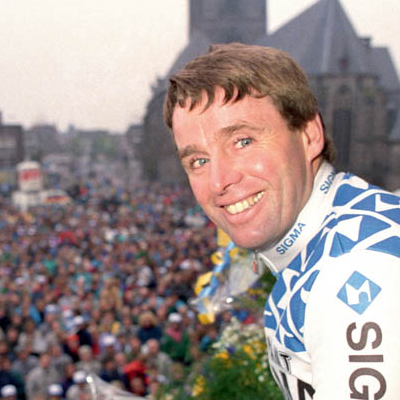
Three years too long?
With hindsight we can say that 1985 was Hennie Kuiper’s last year of glory. That year he triumphs in Milan-San Remo, is the strongest rider in the Tour of Flanders, where he finishes third, and on 28 April shows something of the Kuiper of old once more in the Grand Prix Europabrücke in Innsbruck, which – just as in 1982 – he rounds off with a win. After that, the decline seems to have set in for good. In the three seasons that follow we catch glimpses, now and then, of the great Kuiper of yesteryear. But he no longer manages a big result anywhere. ‘Hennie went on three years too long,’ says his friend and adviser José De Cauwer.
But Hennie cannot stop. He still loves racing too much.
It is faintly reminiscent of the end of the career of one of the greatest speed skaters the Netherlands has ever known: Ard Schenk. After his triumphant Olympic year of 1972 in Japan (three golds!) and that year’s World Championships in Oslo (four distance wins), Schenk never again reached the level of his great years. Nonetheless he kept on skating his laps in the big championships. ‘I’ve lived through the top; I want to live through the decline as well,’ he invariably replied when asked why he was stitching such a modest sequel onto his glorious career. He simply could not stop; mentally, he was not yet ready for it. Something similar is going on with Hennie. When the sponsor Verandalux runs into serious financial trouble after the successful 1985 season, Hennie is approached by Henny Libregts, the brother of Piet, directeur sportif at Frisol, the team with which Kuiper became world champion in 1975. Libregts has two backers, Skala and Skil, who are putting a lot of money into a cycling team. He believes the old Kuiper is still capable of a great deal. Didn’t this fighter win Milan-San Remo only last year? Wasn’t he near the top of the results in other races too? No, Kuiper must surely still have a surprise or two in him. The old fox, with those ever-rosy cheeks, is still a rider to be reckoned with.
The reality is different. He takes a few criterium wins and holds a reasonable place in the overall standings of the Giro d’Italia (22nd), but otherwise rides round fairly anonymously. He has no choice but to let the Tour de France pass him by: Tour director Félix Lévitan does not select Kuiper’s team. Anyone who thinks that after the failed 1986 season Hennie will hand in his professional licence for good does not know the ambitious Kuiper. Hennie simply will not say goodbye. He loves his sport so much that he wants to carry on. Now, for the third year in a row, Kuiper is one of Roger Swerts’s trump cards: in 1985 under the banner of Verandalux-Dries-Rossin, in 1986 he defends the colours of Skala-Skil, and now it is Roland-Skala on the jerseys.
In February 1987 Hennie has no fewer than 38 candles to blow out on his birthday cake. Countless times over the past month he has had to answer the same question: ‘When are you stopping?’ It even starts to irritate him a little. Stop? You must be mad! Hennie still has days when he can stay with the best. In an interview with Het Parool he says at first: ‘I’m not counting on anything this year.’ But a moment later: ‘This year I still want to compete at the top level.’
He sees his sport differently from the way he used to. ‘I experience it all more intensely. They ask me whether I’m thinking of winding down. But you can’t do that at all in cycling. If you’ve been given a contract, you have to want to perform at the top level. Taking it easy is for the veterans or the fitness riders.’
He is still as fiery as in the days when, as a little lad, he stood rain-soaked at the start of the wild Ronde van Wierden. ‘As long as I enjoy the sport I still want to throw all my temperament into the fight; attack the old-fashioned way and then just see where it all ends up. That’s what makes for the finest bike racing, after all.’
He tests himself in the Omloop Het Volk, the race now called the Omloop Het Nieuwsblad. When the peloton reaches the foot of the Wolvenberg, he tears into it the way he used to. He puts all his power into the climb. Behind him he hears riders creaking and groaning. At the top the ‘elderly’ rider surveys the havoc he has wreaked. The peloton has been shattered. The great American Greg LeMond has simply been dropped. Hennie himself has barely felt the pedals, but from the faces of the riders around him he can see that he has hurt them. It is a pity he only realises now how good he still is; otherwise he would have saved his strength for the finale. But allez: ‘den Kuiper’ is back. He shows his class in Paris-Roubaix too, where he finishes just outside the top ten (11th), and on 1 May, when the German classic Rund um den Henninger Turm is on the programme. Fifth place, in the same time as the winner, the Norwegian Dag Otto Lauritzen, is a result to be proud of. In the Giro d’Italia he does not stand out, but he is riding that race as preparation for the Tour de France. Meanwhile the sponsors have big plans for the team. They ask Hennie to come in for a private meeting. The seasoned rider lays his plans on the table. ‘Should Roger Swerts be the one to oversee all this?’ is the sponsors’ question. Hennie does not want to let Swerts down, so he praises his qualities, but he nonetheless lets it be understood that a better directeur sportif is available: José De Cauwer.
Swerts takes his revenge
Kuiper is counting on what was discussed staying behind closed doors. But the reality turns out otherwise. Eight days before the Tour starts in Berlin, he is told that there is no place for him in the team. Roger Swerts has been secretly informed of Kuiper’s plea for De Cauwer after all. Swerts takes his revenge. He leaves his most experienced Tour rider out of the team for the world’s biggest cycling event. Publicly, Swerts gives as his reason that Kuiper has failed to convince him over the past months. Kuiper, he claims, is no longer capable of riding the Tour at the required level.
Yet Swerts is not entirely wrong. In the Giro the former lieutenant of Eddy Merckx saw how deep into the red Hennie had to go to get over the mountains. Too often he was the first to be dropped when the road went upwards. He presents leaving Kuiper out of the Tour team as an act of self-protection. Be that as it may, the seasoned rider is left out. Dismay in the Kuiper household, incomprehension in the peloton and among the public. For Hennie the world caves in. From the start of the season he had been determined to make something special of his twelfth Tour. And now he has to threaten legal action to force his way into the Tour after all. On reflection, though, he lets the matter drop. Hennie follows the Tour from the sidelines. In columns he gives his view of the race. And so the 1987 season, so promising at first, comes to an inglorious end for him.

Although in 1986 the will is still there, the big wins elude him at Skala-Skil. Hennie Kuiper has to settle for a handful of victories on the criterium circuit

Hennie Kuiper in the third Profronde van Friesland, between Gert-Jan Theunisse (left) and his teammate Adri van Houwelingen (right). The wind stays calm, so the race is not very selective. Hans Daams wins in Joure. Hennie Kuiper rides a tidy race into the top seven