The world of DAF and Willy van Doorne
In 1979 DAF is a new name in the professional peloton. The driving force behind the Dutch car maker’s cycling project is its director, Willy van Doorne. The golden DAF era, which had begun in 1958 with the introduction of the automatic, the innovative Variomatic system, had been brought to an end in 1973 by the energy crisis. On the one hand the company was saddled with huge stocks; on the other it had to invest in developing new models. That was beyond the group’s financial means.
Sweden’s Volvo came to the rescue and gradually acquired a majority of the shares. DAF had become Volvo. ‘After that we carried on independently with lorries, DAF Trucks,’ Willy van Doorne explains at his villa in Schilde, near Antwerp. ‘We were looking for a way to draw attention to our lorries.’ At the end of the seventies DAF chooses cycling as its publicity medium. That had everything to do with Van Doorne’s own interest. He has been a cycling fan since he was a boy. ‘I had to convince the other members of the family. Cycling suits us. It’s a very popular sport that ties in with the interests of the people in the factory, the mechanics, the drivers, the dealers and the people in the transport cafés.’ Van Doorne brings in Fred De Bruyne as directeur sportif. ‘We couldn’t put together the team we had in mind straight away. We had to make do with the riders who were out of contract.’ Even so, the DAF squad has success in 1979. The Limburg rider Jo Maas in particular scores for the team in the Tour. He wins the stage to Brussels and finishes seventh overall. That upward trend is not continued in 1980. The DAF director decides to build a team that can really compete at the top. ‘I wanted Hennie Kuiper on board. Hennie already had a huge name, not only in the Netherlands but, because of his successes in the Tour de France, in France too. And for us it was very important to make headway in France.’
Willy van Doorne asks De Bruyne to try to get Hennie round the table. But when the DAF director turns up at Kuiper’s room on the Tour’s rest day, Hennie is not sitting at the table but resting on the bed. The director stretches out on the second bed in the room, and in this somewhat unusual position the two men conduct the negotiations. The DAF boss Van Doorne is a man after Hennie’s own heart. The two men hit it off from the moment they start talking. It soon leads to a – provisional – contract. Between themselves they call it from then on the ‘Treaty of the Bed of Morzine’. At first that ‘treaty’ is not put down on paper. The two men seal their verbal agreements with a handshake. Hennie sets two conditions. ‘If I were to win the Tour after all, I wanted to give Peugeot the chance to extend my contract. At that moment I was second in the general classification.’ A Tour winner automatically means publicity, and Hennie feels he owes it to Peugeot to grant that publicity to this sponsor, should it come to that. Van Doorne agrees. And of course a place is found for José De Cauwer too, Kuiper’s business partner.
Van Doorne has clear plans for the team: Hennie is to be the big man for the stage races. When, in the autumn, Roger De Vlaeminck leaves the Boule d’Or team after a row, the DAF director sees it as a golden opportunity. He phones Hennie, tells him of the plan to sign De Vlaeminck and then says: ‘I think it would be good for you to bring him in. Then we take him to the Tour as a lightning conductor and you won’t be under so much stress.’
Monsieur Paris-Roubaix, as De Vlaeminck has been known since his fourth win in the Hell of the North, has fallen out with his old employer Boule d’Or and so eagerly takes up the offer from the friendly Van Doorne. Kuiper calls it ‘a tactical masterstroke’ by his sponsor’s director. He also has great respect for Roger De Vlaeminck, and so he agrees to Van Doorne’s proposal. But De Vlaeminck in the Tour? Hennie has his doubts. Van Doorne nevertheless thinks he can persuade De Vlaeminck to ride the Tour. At the very beginning of 1981 he invites him to the Parkhotel in Lokeren. When the guests are already seated and waiting, Roger De Vlaeminck walks into the restaurant. Before the meal has even been ordered, De Vlaeminck says: ‘I’m not coming to the Tour, you know?!’ Kuiper: ‘It was as if he could smell it.’ Van Doorne, too, fails to talk Roger round. Months before all this comes to pass, there is another far-reaching change in the structure of Kuiper-De Cauwer Ltd. It has everything to do with the duo’s move to DAF.
On 25 September 1980, his birthday, the telephone rings at José De Cauwer’s home in Temse. It is Hennie on the line with a surprising question: ‘José, would you like to be assistant directeur sportif next season?’ The question takes De Cauwer by surprise. José wants to build up to a peak one more time in his career, in his last year as a rider. And now this question comes. ‘I thought about it for a moment and then I answered: “All right.”’
Metamorphosis
Only a few members of the DAF team know about the metamorphosis of De Cauwer the rider into De Cauwer the directeur sportif. He officially becomes assistant to Fred De Bruyne, the former top rider who has also made a name for himself as a reporter. In practice De Bruyne will serve mainly as the team’s public face, while the technical and tactical racing decisions will be taken mostly by De Cauwer. When the team holds its first get-together, Van Doorne steps forward and says: ‘Lads, we have a new assistant directeur sportif; someone who is going to concentrate entirely on the racing itself.’ Everyone looks expectantly at the door: who is going to walk in? José: ‘And then the DAF director points at me and says: “José De Cauwer.” Hilarity in the group. José? This’ll be a laugh. He’s a joker. Every day’s going to be a party now.’ But De Cauwer the directeur sportif turns out to be a completely different person from De Cauwer the rider. The DAF riders will find that out soon enough.
One of the first group training sessions is in Beveren. It is pouring with rain that day, not exactly pleasant weather. Kuiper goes up to his friend. ‘Hey José, we’re not really going out on the bikes today, are we?’ But the brand-new directeur sportif responds at once: ‘We are going out on the bikes.’ ‘But you never used to want to ride in the rain, and now we have to?’ De Cauwer explains: ‘Hennie, we’ve paid for and organised everything for this training session. We’re riding.’ And again: ‘But you can’t do that.’ ‘Oh yes I can. We’re riding a team time trial: the older riders against the younger ones. And flat out, mind. Well, that worked. My image as a joker was gone at once. They knew now that they were dealing with a directeur sportif.’ For Kuiper, the DAF team feels like a warm bath, especially after his experiences at Raleigh. ‘It’s unbelievable: the wives were allowed to come to the training camp. The atmosphere was wonderful and the team was flying.’ At Post’s, women were regarded as poison. They were a distraction, they tempted the riders into sex, and that damaged their form: for a very long time that was the mantra in cycling.
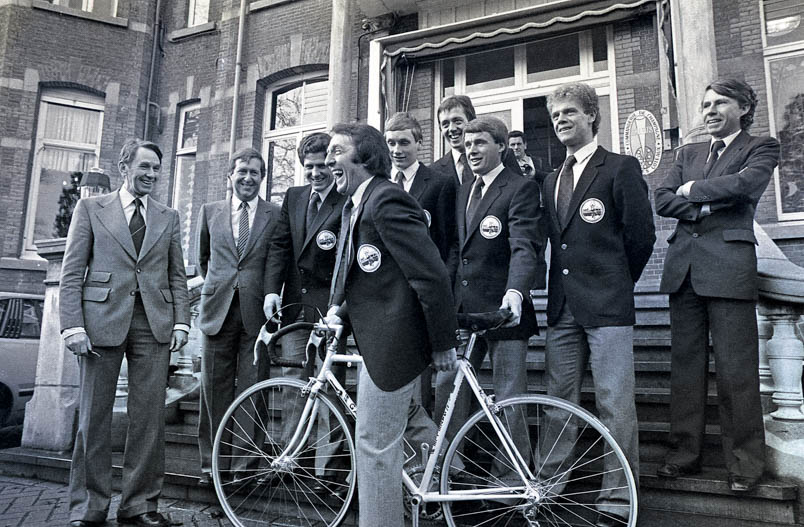
The DAF team for 1981 is presented in Aartselaar, and the five Dutchmen of DAF – Cote d’Or – Gazelle are photographed separately. From left to right: Wim Breukink of Gazelle, Willy van Doorne of DAF, Gerrie van Gerwen, Adrie van der Poel, Hennie Stamsnijder, Hennie Kuiper, Hans Langerijs and the manager of the local establishment. Directeur sportif Fred De Bruyne is laughing hardest of all at his own jokes
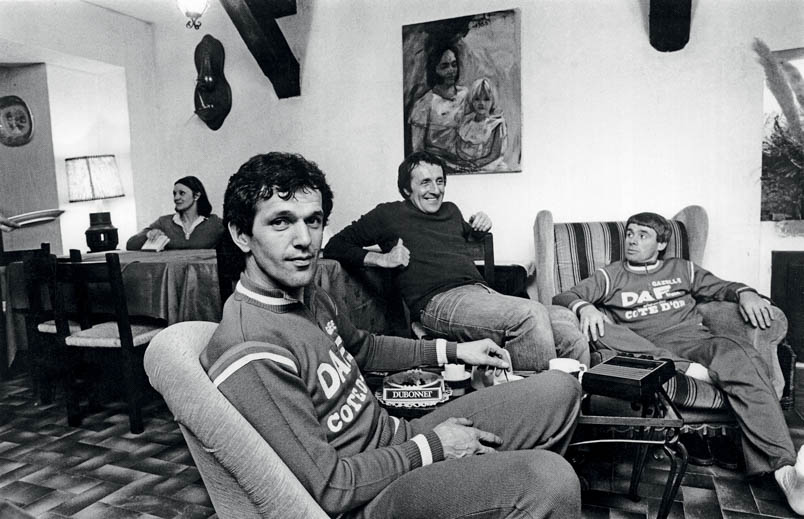
Roger De Vlaeminck and Hennie Kuiper understand each other. At the first training camp, in Valbonne on the Mediterranean, Fred De Bruyne sees a sunny future ahead
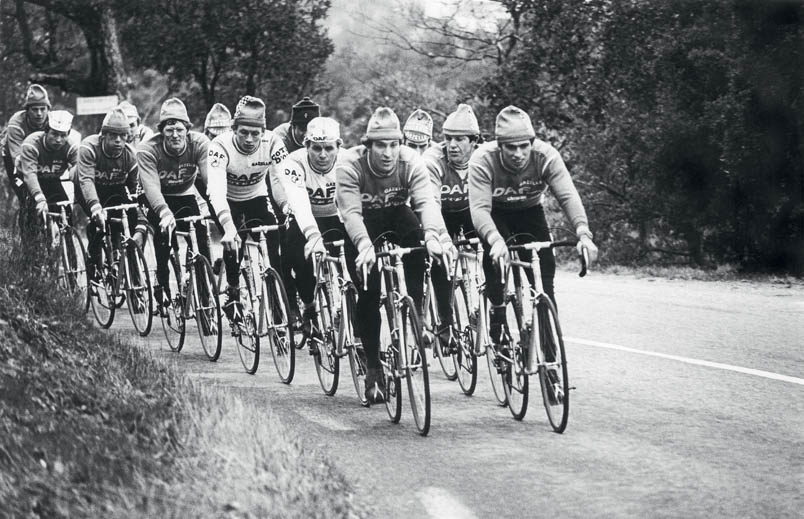
The DAF squad on a training ride near Valbonne in 1981. In the front row: Guy Nulens and Luc Colijn. Second row: Hennie Kuiper and Roger De Vlaeminck. On Kuiper’s wheel is Adrie van der Poel, who in turn has Ronan De Meyer on his wheel
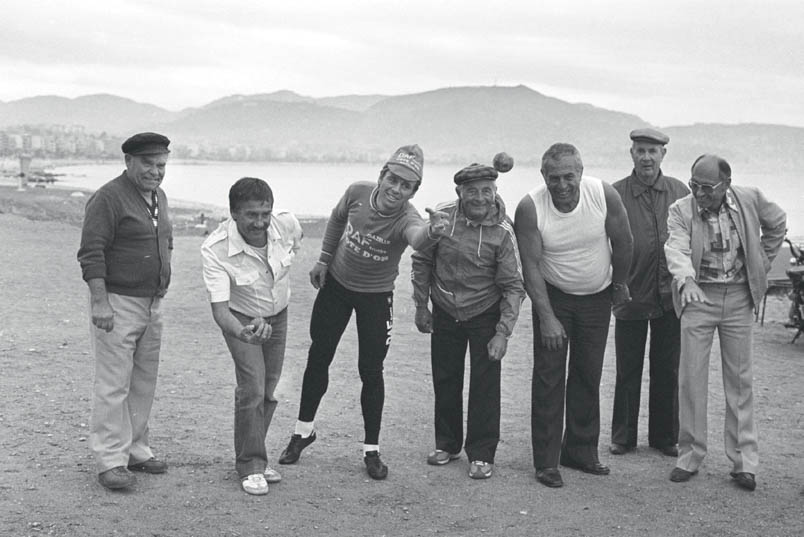
Relaxing at the start of the 1981 Tour de France in Nice. Hennie Kuiper plays a game of pétanque on the beach with the locals
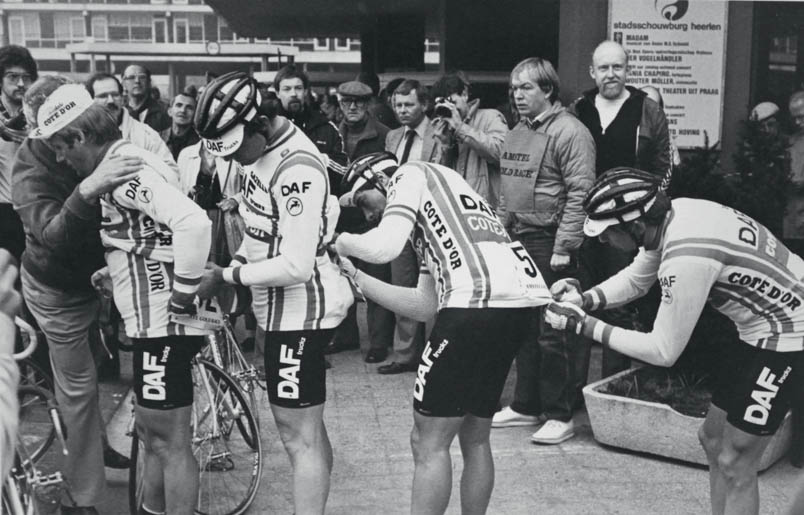
Before the start of the 1981 Amstel Gold Race, on the steps of the Stadsschouwburg theatre in Heerlen, the DAF riders pin on each other’s race numbers. Hennie Kuiper is helped by René Martens, who is helped by Luc Colijn, who is helped by William Tackaert
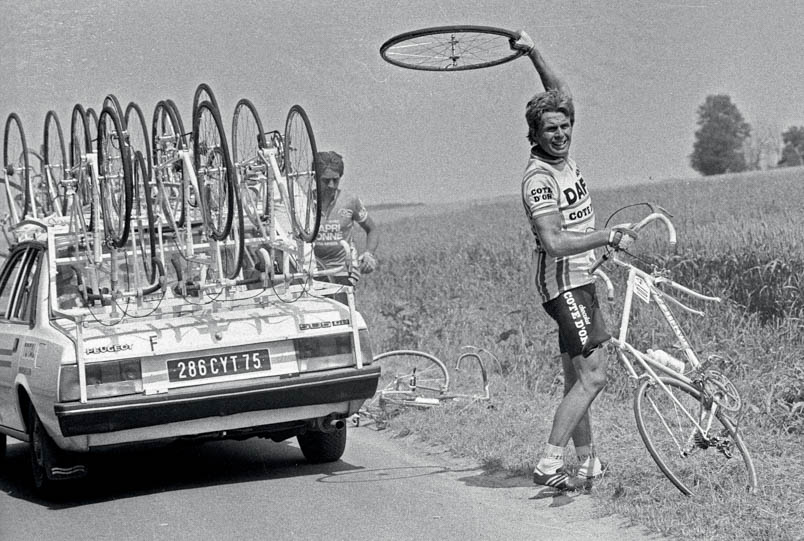
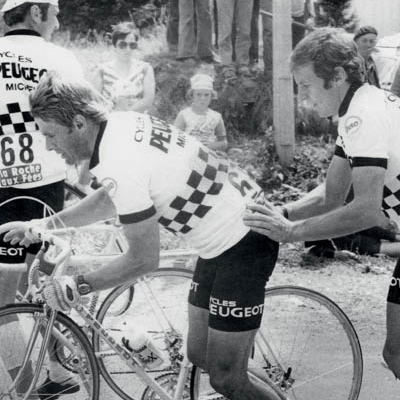
Hennie Kuiper waits for a new wheel, while in front of him Ludo Delcroix is already being helped out by his directeur sportif
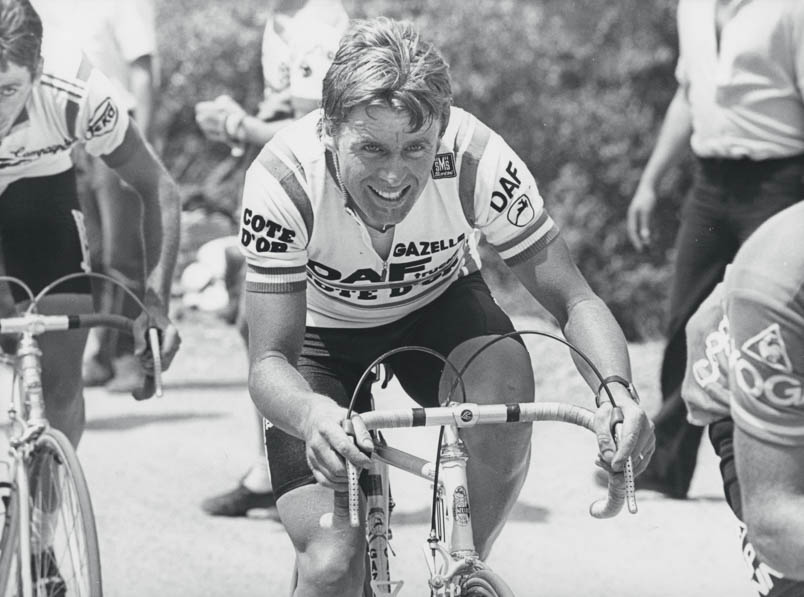
The switch from successful stage racer to successful king of the classics is visible in the 1981 Tour de France too, though Hennie Kuiper continues to take his craft seriously. It is written all over his face
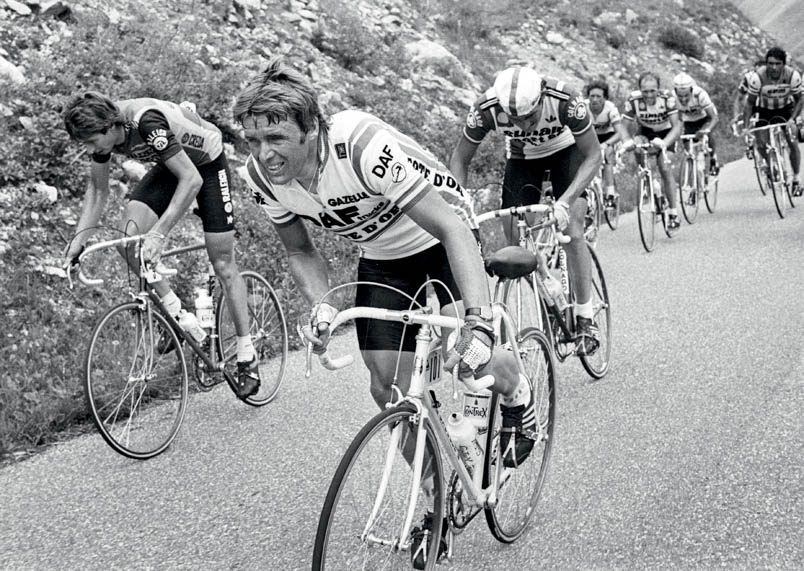
Hennie Kuiper is struggling on l’Alpe d’Huez too. The day belongs to Peter Winnen. Hennie finishes the stage in 25th place. To Hennie’s left: Johan van der Velde. In the background Joaquim Agostinho is standing on the pedals, with Eddy Schepers to his left
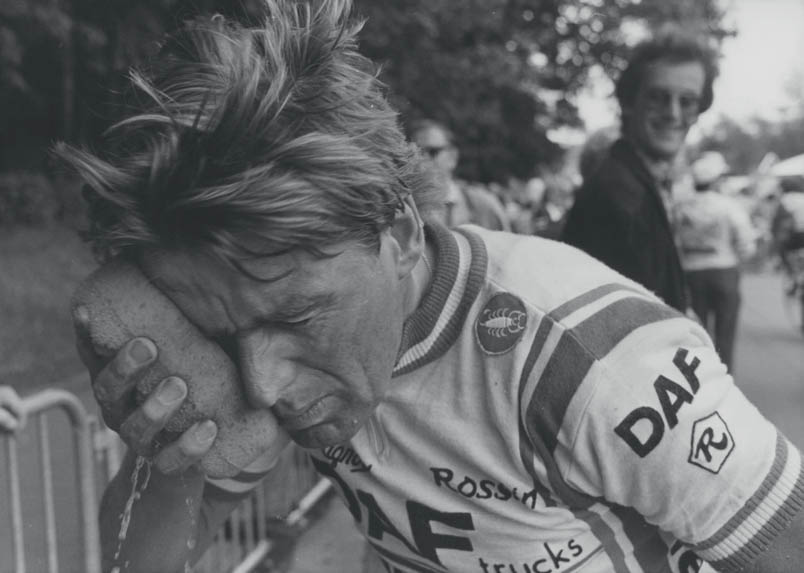
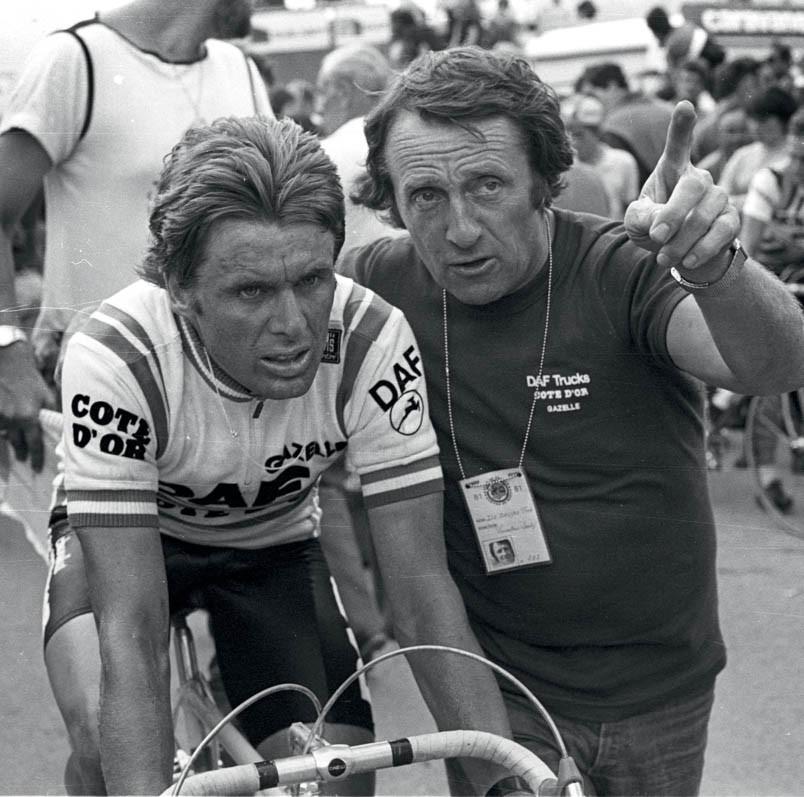
Hennie Kuiper’s face is thunderous, but ‘directeur sportif De Bruyne, Fred’ – as it says on accreditation 203 – will no doubt tell him all about it and show him the way