Games amid gunfire
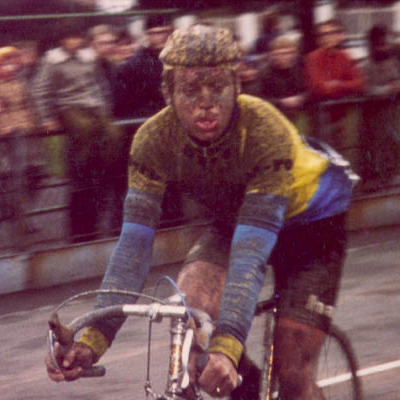
For sportsmen and women, 1972 is a special year. The Olympic Games in Munich are on the calendar. Every top athlete wants to be at that four-yearly event, and Hennie Kuiper more than most. ‘That year I prepared more seriously than ever. The Games: I was absolutely determined to go. I had to ride so well that the people at the federation couldn’t leave me out. The Olympic arena: that was what I dreamed of.’ Besides the Games, there is another important event in his life: that year he wants to marry his childhood sweetheart, Ine Nolten (born 1948; in full, Geziena Maria Theresia). The young couple choose Wednesday 28 June as the date, right in the middle of the season. The selectors will not be pleased. When he tells Joop Middelink of his plans, the national coach grumbles. Even so, the stocky Amsterdammer agrees. Anyone else he would have dropped from the squad, but the conscientious Kuiper keeps his place among the chosen few. On the wedding day the whole squad, who have raced earlier that day, come along to grace the celebrations. ‘That was wonderful.’ The following weekend the new bridegroom shows that marriage has done his form no harm at all: he rides to second place in a criterium in Beltrum, behind Albert Scheffer from the Achterhoek.
There are two ways for a road rider to take part in the Games: the road race and the 100-kilometre team time trial, with four places in each discipline. In the weeks before the Games it soon becomes clear that only two places are still up for grabs. Fedor den Hertog, Cees Priem and Aad van den Hoek are certain of their places in the team time trial. For the road race, Den Hertog, Priem and Piet van Katwijk have already been chosen. The fourth man for the team time trial is to be decided by a handful of trial races. Hennie wins the national coach over. He does it in the last selection race, a straight contest between Hennie and Frits Schür. ‘Every time I came to the front, I made sure I did about fifty metres more than the others. Never in my life had I been so shattered. My muscles ached all over.’ The pain pays off: his selection is confirmed. Hennie will ride the team time trial. During the Olympic 100 kilometres the team is followed by a car carrying the coach and, among others, the chef d’équipe – the former sprint champion Arie van Vliet. Early on the team loses Aad van den Hoek to a mechanical problem and has to carry on with three men. Normally that would be hopeless. But Hennie in particular drives so hard on the front that the team still rides into the medals: bronze.
A blunder
Van Vliet checks with Middelink: ‘You have picked that Hennie Kuiper for the individual race, haven’t you?’ This time the coach cannot get round it. The ticket is his. The 100-kilometre team later runs into trouble, because the team doctor Ab Rozijn has made the blunder of putting Coramine, a substance banned by the IOC, into the bidons, but that has no bearing on the selection for the individual road race. Coramine is a product that combats fatigue. Aad van den Hoek, who had been forced out of the race by bad luck, tests positive for the banned product afterwards. Strangely, no banned substance is found in the urine of the trio who did finish the race – Kuiper, Den Hertog, Priem. Aad van den Hoek is certain that the other three riders’ bidons had the same contents. ‘After I’d dropped out I drank a bit from my bidon. So there was Coramine in it, though I didn’t know that at the time. Dr Ab Rozijn had put it in, with instructions to drink from the bidon halfway through the race. But I never even got halfway. So in my case it stayed in my body. The effort the others had to put in must have meant that the traces of that Coramine had largely gone by the time of the test, so they weren’t picked up.’
The problem was that Coramine was not on the banned list of cycling’s world governing body, the UCI, but it was on the IOC’s. Dr Rozijn had gone by the UCI list and had not consulted the IOC list: an unforgivable blunder.
Incidentally, four years earlier, at the Games in Mexico, a similar affair had involved the 100-kilometre team. There the Limburg soigneur Sjeng Collard gave the winning quartet – René Pijnen, Joop Zoetemelk, Jan Krekels and Fedor den Hertog – the banned hormone preparation Deca Durabolin. The four passed the doping test, but a few days later it came out that Collard had knowingly injected the riders with Deca Durabolin. The chef de mission of the Dutch delegation, A.F.H. Dokkum, sent Collard home. The IOC was informed that Deca Durabolin had been administered. The question was: would the IOC disqualify the Dutch? The head of the IOC medical commission, Prince Alexandre de Merode, consulted the leaders of the Dutch team and afterwards issued a statement. ‘The definition of doping in current use makes punishable only the use of those stimulants that are detected by the testing methods employed. A logical consequence of this position is that the medical commission of the IOC can take no measures against the administration of hormone preparations, not even in cases where these have not been administered with the premeditated intention of effecting a cure.’
The golden quartet of Mexico went unpunished. And the four of Munich? None of it is very clear. The Munich quartet is struck from the results, as is the Spaniard Jaime Huélamo, who loses his third place in the individual road race won by Hennie Kuiper for using Coramine. Yet six weeks after the Games the riders are sent an official diploma by the IOC. Van den Hoek: ‘And a diploma means you’ve passed, doesn’t it? The medal still hangs in my house, just as it does in the homes of my three teammates from back then. We weren’t such great sinners.’ From the team time trial onwards, the four riders selected for the road race have their sights set on that one race. For Hennie, being selected at all is a dream come true. In the week that still separates him from the starting gun he trains with the team morning and afternoon. In the evenings he goes with the team to watch the track events. ‘I saw a tremendous pursuit, with Knut Knudsen among others. That would come in handy later on, in the road race.’
Hennie is on cloud nine. The normally introverted man from Twente is building towards peak form, not only physically but mentally too. Fellow Twente man Bert Boom – world motor-paced champion in 1969 – works in those years as fitness coach to the Twente cyclists. He describes Hennie as a formidable fighter, someone who measures himself against others and takes from his colleagues’ lessons whatever can make him better. ‘Kuiper was very serious. He always made sure he got his rest, and he benefited from that throughout his career.’ Half a century later Hennie recalls the words of Sanne Wevers, the gymnast who won gold at Rio de Janeiro 2016: on the eve of the decisive day she told her father and coach, full of confidence, ‘I’m ready.’ Hennie recognises that feeling from his own Olympic days. Not that he is sure of victory, because in a race with 162 rivals that is impossible to predict. ‘But I was so looking forward to it…’
Black September
But then. On the night of 4 to 5 September 1972, men from the Palestinian terrorist organisation Black September climb over the fences of the Olympic village and take members of the Israeli team hostage. Shots are fired; people are killed. Images of the tragedy go round the world. Everyone is in shock.
Most of the competitors only learn when they wake up that something shocking has happened. Some heard shots; many others slept right through the gunfire. On the way to the dining hall the bizarre reality slowly but surely dawns on the riders. They see heavily armed, masked men, who urge them to hurry. Keep moving, there may be shooting. In the dining hall they are told: there was a raid in the night, and there has been fighting. National coach Middelink wants to keep his men’s minds on their sport. ‘Come on, lads, just train as usual.’ He is also thinking of his own mission: to get the best possible performance out of the team. And so as little as possible is said about the tragedy unfolding a few hundred metres away. They go out on their bikes, but when the selected riders return, the Olympic village has become a fortress. Tanks and soldiers everywhere. Security checks are strict.
Bit by bit the riders hear something of what has happened. A wrestler has been shot dead. ‘Terrible, of course,’ Hennie thinks, ‘but what happens now with the Games? Will the whole thing be called off? Has all that training, all that sacrifice, been for nothing?’ The cyclists – and not only they – are so focused on the Games that everything happening outside sport seems a world away. They lose sight of reality. The death of a second Israeli is reported. The hostage-taking of nine Israelis ends that night in a bloodbath at the military airfield of Fürstenfeldbruck. In the end eleven members of the Israeli team lose their lives. Five Arab terrorists are fatally wounded in a gunfight. A German policeman is killed during the operation. In the Dutch camp there is talk of competitors who want to go home. Like the great majority of the Dutch delegation, Hennie would not dream of going home. He has not fought so hard to get here only to give it up.
Back in the Netherlands, meanwhile, a storm of criticism breaks. A large part of the Dutch public believes the Games should be stopped. And if they are not, the Dutch competitors should withdraw. Palestinian groups have carried out attacks before, but this kind of terrorism is out of all proportion. Pressure is put on the Netherlands Olympic Committee to bring the team home, but the NOC leaves the decision to the individual competitors. Six Dutch team members go home early: the athletes Jos Hermens and Wilma van Gool-van den Berg, the hockey players Flip van Lidt de Jeude and Paul Litjens, the boxing coach Rienus Krüger and the wrestler Bert Kops. One athlete, Bram Wassenaar, withdraws from competition but stays with the team in the Olympic village. The rest of the Dutch contingent waits anxiously to see what the IOC will do. Most of them feel there is little understanding of the situation back home. They point out that it is the Israelis themselves who want the Games to go on. ‘Leaving means giving the Arabs what they want,’ is the feeling among those who stay.
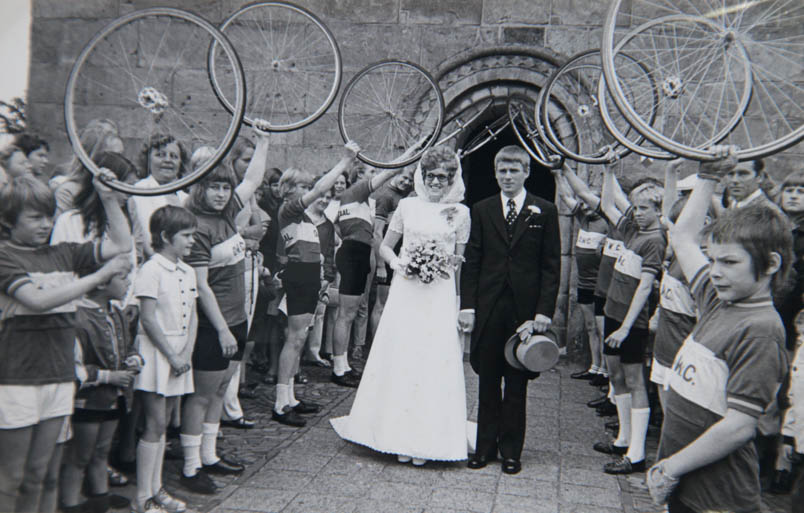
The wedding day of Hennie Kuiper and Ine Nolten – 28 June 1972 – is graced by young members of the Oldenzaal Cycling Club (OWC)
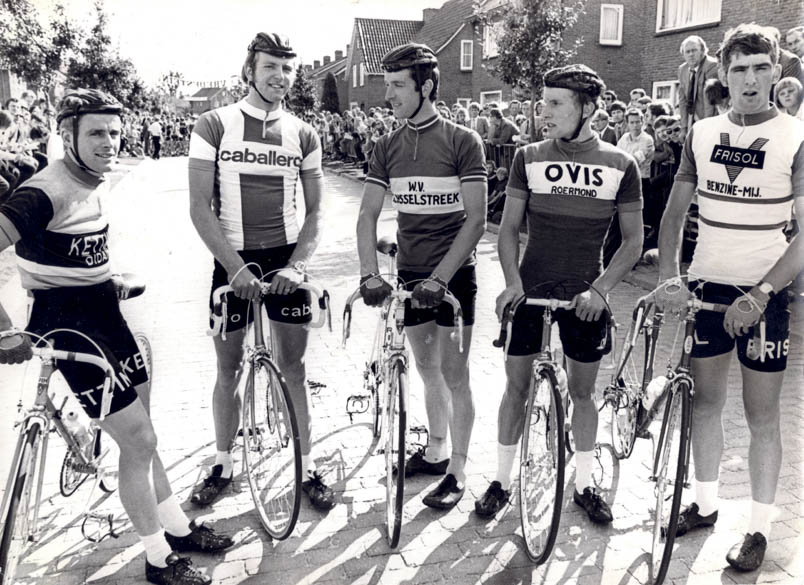
Five future Olympians line up at the start of the 1972 Meesterronde in Denekamp. From left to right: Hennie Kuiper, Henk Poppe, Fedor den Hertog, Ben Koken and Cees Priem
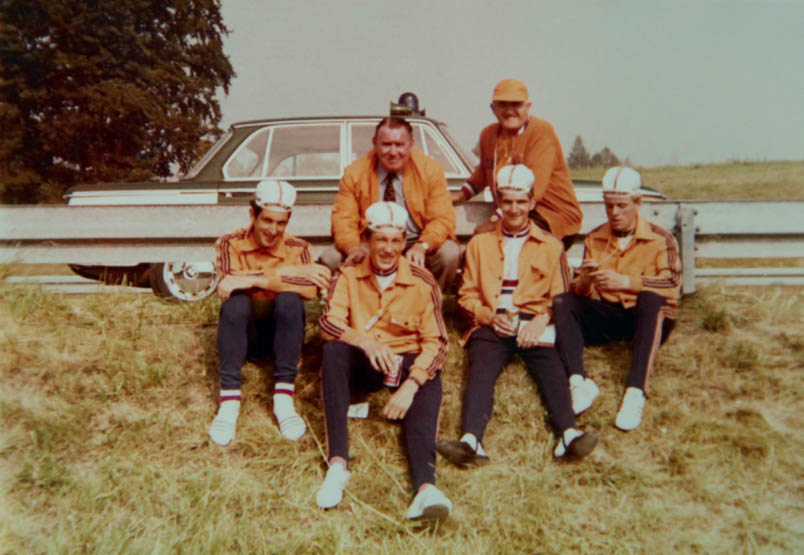
Roadside gathering in Munich after the Olympic team time trial. Joop Middelink plays father to, from left to right, Fedor den Hertog, Aad van den Hoek, Cees Priem and Hennie Kuiper. Top right is the American Dennis Klopper, who lends the team a helping hand
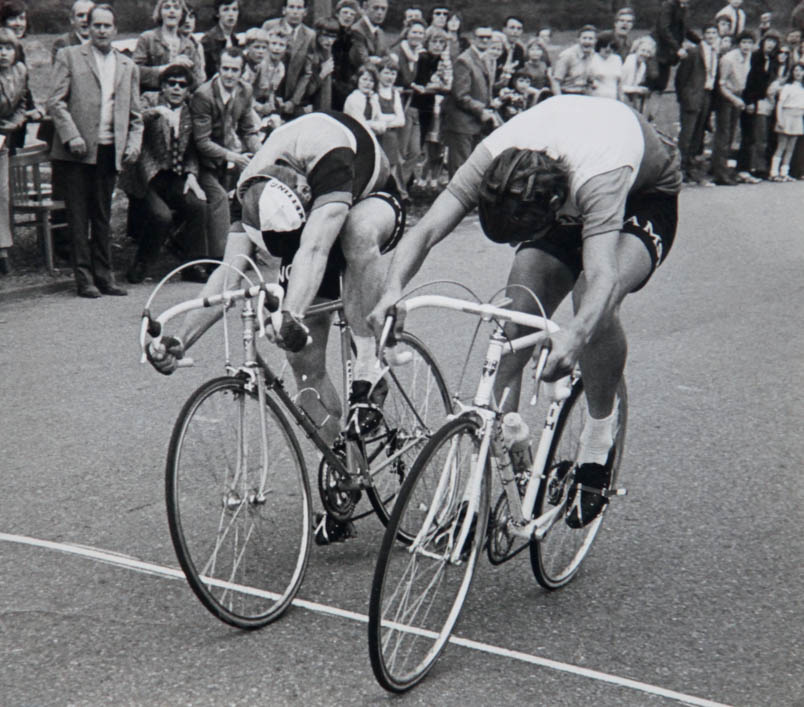
Hennie Kuiper is no sprinter but a fighter. On sheer willpower he almost gets the better of Arie Hassink in the final sprint of the Ronde van Oldenzaal on 7 May 1972
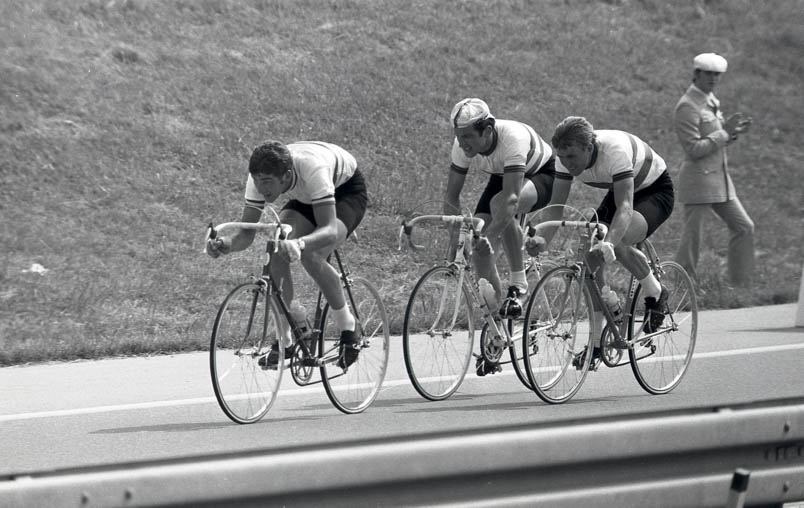
What is left of the Dutch team – after Aad van den Hoek’s exit – in battle order on the way to Olympic bronze. Cees Priem puts the hammer down; Fedor den Hertog and Hennie Kuiper grit their teeth. Behind them on the right, an Olympic volunteer in the typical Munich outfit
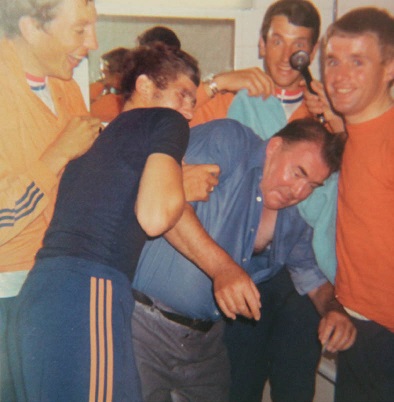
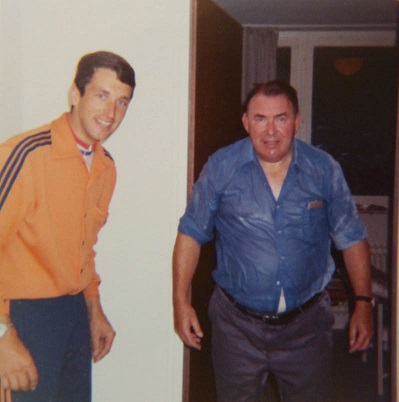
The Olympic bronze is in the bag. Joop Middelink is in for it. Van den Hoek, Priem, Den Hertog and Kuiper are about to give the national coach a soaking. Fedor already has the shower head at the ready, and beams when Middelink is soaked to the skin
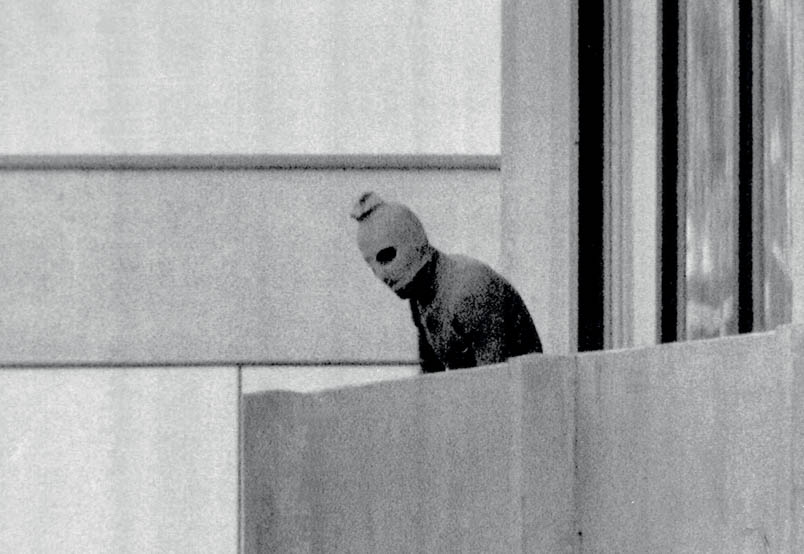
On the night of 4 to 5 September 1972, terrorists from the Palestinian movement Black September attack the Israeli delegation in Munich: eleven Israelis and a German policeman are killed. Hennie Kuiper and the other cyclists still to compete are largely kept in the dark
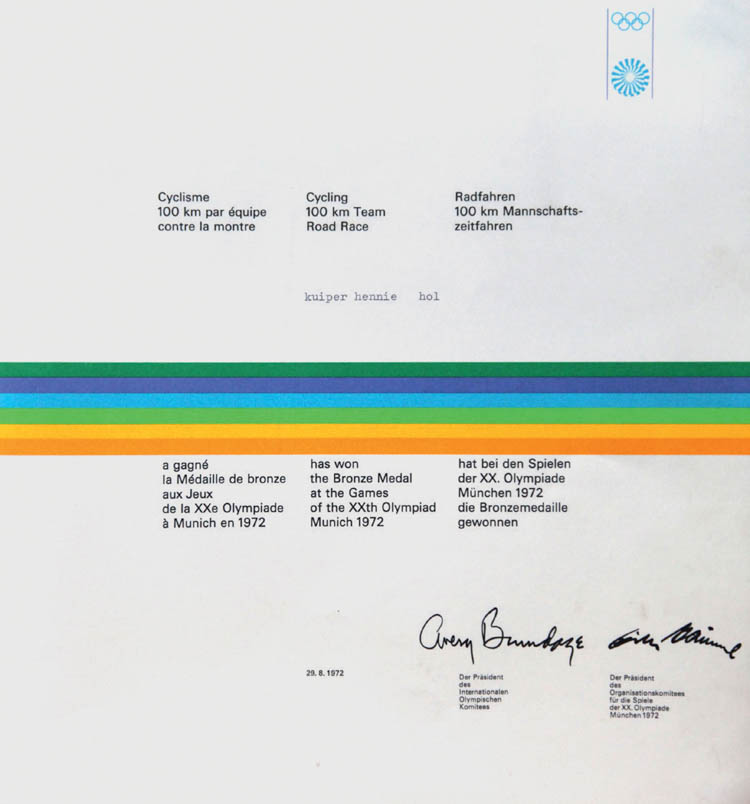
Six weeks after the 1972 Munich Games – where the 100-kilometre team time trial squad was disqualified – Kuiper, Den Hertog, Priem and Van den Hoek are sent the International Olympic Committee’s certificate that goes with Olympic bronze