At last: a sponsor
These days, with an Olympic title in your pocket you are sure of a professional contract. In 1972 things turn out very differently, although the fact that the title is buried, in terms of publicity, by the horrific terrorist events will certainly have played a part. True, Hennie does not have the charisma of some of those he beat for the title, such as Francesco Moser or – to a lesser extent – Freddy Maertens. But it is strange that not a single sponsor comes forward in the months after his Olympic win. He himself has no firm plans to turn professional. Fedor den Hertog, who has been ripe for the professional ranks for years, is still hesitating. And Hennie has his reservations too. ‘Professionals are too often associated with things like doping and fixed races.’ Those who know nothing of the sport put cyclists in the category of ‘untrustworthy folk’. Kuiper’s plan at first is to study for a position as a production planner at the company where he works. Besides that, there will surely be time left over for cycling. He thinks about it long and hard. He is a thoughtful Tukker, as people from Twente are known.
An offer comes from the jovial directeur sportif Ton Vissers, who, for all his optimistic nature and cheerful manner, does not have a very good reputation among riders. At the presentation of Herman Krott’s Amstel amateur team, attended in force by the cycling press, Vissers tries to bounce him into it. He pushes a contract under Hennie’s nose: all he has to do is sign. The press are there anyway: instant publicity. But Hennie does not give in. He wants some things in the contract changed. He does not take Vissers’ promise – ‘we’ll sort that out later’ – seriously, and sticks to his refusal. Not long afterwards a letter from Vissers full of legal jargon drops through the Kuipers’ letterbox, stating that for the time being he will not be offered a contract. As if he had begged for one…
Later Kuiper runs into Krott, directeur sportif of the renowned Amstel team. Which team will he be riding for next year? When Hennie replies: ‘Ketting’s amateur team,’ Krott nearly falls off his chair in astonishment. For, Krott reasons, Kuiper is ready to join the professional ranks. He rings round everyone he can think of, but all the teams are full. Until, in Germany, Krott gets a bite from Robert Kahl. Kahl runs a successful mattress business. Under the name Rokado he has put together a professional team with top riders such as Herman Vanspringel, Georges Pintens, Tony Houbrechts and Gerben Karstens. He also decides to form a team of up-and-coming talents, mainly from Germany. Hennie, who lives so close to the German border, is added to the Ha-Ro team, a name made up from the first names of the sponsoring couple: Hannelore and Robert.
A pro debut with an attack
The directeur sportif is Rolf Wolfshohl, who made his name above all as a cyclo-cross rider. The debutant laps up Wolfshohl’s lessons like gospel. He soaks up all the knowledge he can, hungrier than ever before. He wants to race, to show what he can do. His entry into the professional world is anything but grand. Whereas contemporaries such as Maertens and Moser are offered serious money when they turn professional, Hennie – a rider with an Olympic title, after all – lands a contract only by the skin of his teeth. But the Tukker is not taking that lying down: he is determined to prove himself.
In his first Paris-Nice he tells his teammate Karl-Heinz Muddemann: ‘I’m going to attack.’ His attack is countered by riders from Eddy Merckx’s all-powerful Molteni team. An hour later Hennie goes clear again, and again the Molteni men reel him in. When he gets ready to attack for a third time, the seasoned Molteni man Vic Van Schil rides up to him. This frisky young buck needs a calming word. Van Schil tells him: ‘Easy does it, lad, your time will come.’
Things cannot move fast enough for Hennie, hungry as he is for success. He soon turns out to be the only rider from Ha-Ro’s development team who can hold his own among the professionals. His first big result – fifth place in the Amstel Gold Race – is a sensation. Not just because of the placing, but above all because of the way he achieves it.
While all the big teams report to South Limburg the day before the start, there turns out to be no budget for the Ha-Ro team to stay overnight. Hennie gets out of the marital bed before dawn. Ine has taken over his mother’s role of looking after him, but the tradition lives on. So the trusty old blue pot comes along, containing rice with raisins, a chicken leg and a thermos of tea. It is his pre-race food parcel, the fuel for the race. In his Renault 4 he then sets off from Oldenzaal, where he has lived since his marriage, for his parents’ farm, from where his brother Jos drives him to the start in Meerssen.
The weather is foul and wintry: sleet, cold rain. A group of forty breaks away from the peloton. The debutant Kuiper attacks on a climb and quickly builds a lead. Then the car of race director Herman Krott and national coach Joop Middelink appears behind him. The pair are wildly enthusiastic. Joop Zoetemelk and Eddy Merckx set off in pursuit of the debutant. He quickly eats a Mars bar, and then the Merckx-Zoetemelk duo catch him on the Fromberg. From that moment Merckx calls the shots. The pace is so high that Zoetemelk has to let go. Hennie is amazed. For a while he is racing in second place. ‘That was something. Number two in the race, behind the great Merckx.’ In the end he is overtaken by Walter Godefroot, Herman Vanspringel and Frans Verbeeck. No disgrace. Fifth place is an outstanding result for a debutant.
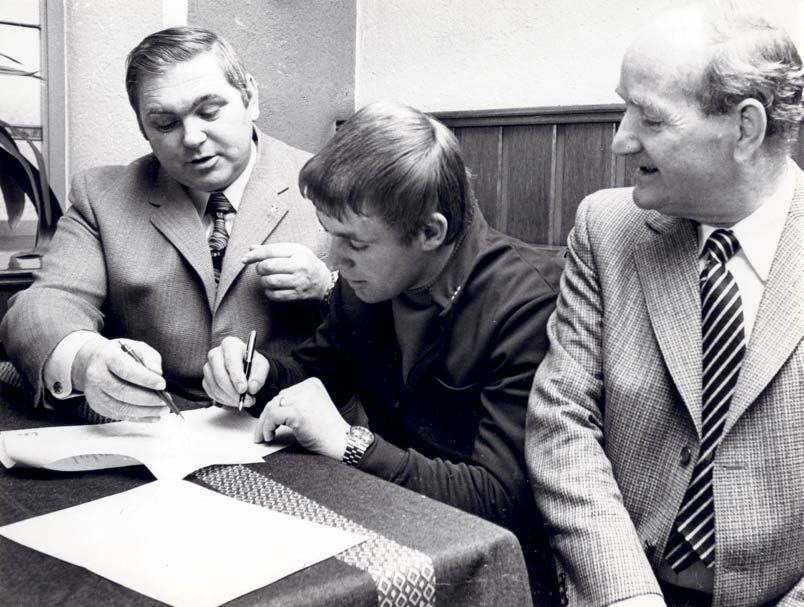
On 19 December 1972 Hennie Kuiper signs his first professional contract. He is to ride for Ha-Ro, the team of Robert Kahl, who, on the left of the photo, shows Hennie where to sign. Broer Oude Keizer, Hennie’s first trainer, looks on approvingly at where his coaching has led
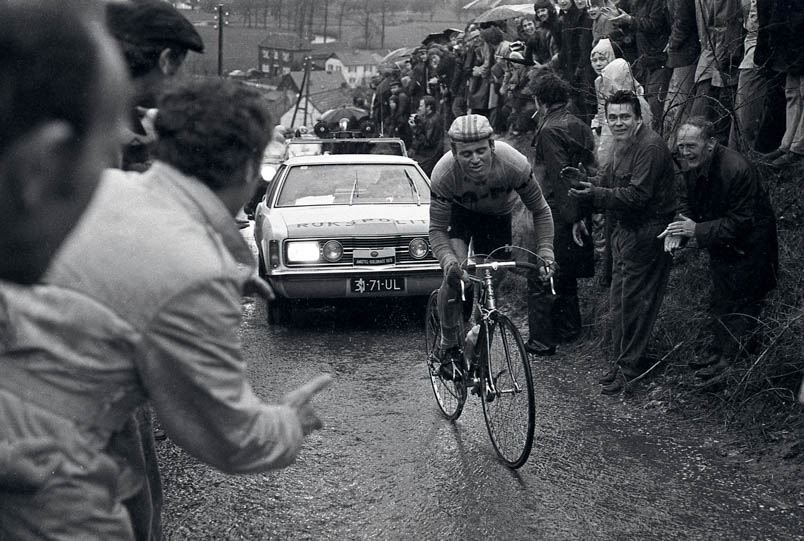
In the 1973 Amstel Gold Race, Hennie Kuiper makes his mark straight away as a first-year professional. He goes on the offensive ahead of the ‘Rijkspolitie’ (national police) car
First pro win: a storm of whistles
Straight after the Gold Race Hennie finds his clothes gone. His directeur sportif Rolf Wolfshohl has driven off with them. Wearing a tracksuit borrowed – of all people – from Joop Zoetemelk, he gets a lift in the Mini of Peter Ouwerkerk, the journalist from Het Vrije Volk, and hurries to the showers, where a soigneur is waiting for him. The plan is for him to take a scheduled flight from Brussels to Carcassonne for the Tour de l’Aude, which starts in that town the following day. Because the Gold Race finishes so late, Hennie cannot make the flight. Something will have to be improvised. That same evening Kuiper leaves for Dortmund, home of his sponsor. His team director, Robert Kahl, has a private plane in which he is to fly to the south of France the next day. Hennie gets out of bed at the crack of dawn. At the airfield he has to help the pilot scrape the ice off the windows. Hennie takes the seat next to the pilot in the tiny aircraft. The pilot drops maps in his lap and says: ‘You’re my co-pilot now.’ That is how the newly minted professional travels to Carcassonne for the Tour de l’Aude, a four-day stage race that starts that very day. The French organisers are delighted that the Olympic champion is coming. His participation is announced in big letters in the streets of Carcassonne.
In the first stage of the race a puncture puts him out of contention: he has to wait so long for a new wheel that he instantly loses any chance of a high overall placing. Kuiper plots his revenge. ‘Outwardly I’m calmness itself; inside I’m a volcano. I can really fire myself up.’ On the second day, in the stage to Bram, a 193-kilometre road stage, he attacks and takes the Belgian Wilfried David and the local favourite Pierre Martellozzo with him. David is dropped. In the tumultuous final sprint through the streets of Bram, home rider Martellozzo is just as desperate for victory as Kuiper. Neither of them is a sprinter. Martellozzo keeps veering from left to right towards the barriers. But there is no holding Kuiper; the anti-sprinter rides gloriously to victory. When he finally crosses the finish line first, he is greeted by a hellish storm of whistling from the crowd, who have turned out in force and are bitterly disappointed. The local hero has been beaten; Hennie remains stoical amid the whistling.
It is 9 April 1973, and his first professional win is in the bag. Wonderful, of course, but when he thinks back to the Paris-Nice stage a few weeks earlier, from Manosque to Draguignan, he realises that his first win could have come even sooner. There in Draguignan, just before the finish line, he had a comfortable lead over the rest and was already raising his arm in triumph, but at the last moment he was flashed past by the Belgian sprinter Rik Van Linden: a costly lesson for the debutant Hennie Kuiper. He also gets his first taste of the famous classic Paris-Roubaix. His directeur sportif Rolf Wolfshohl promises Hennie a bonus of a hundred Deutschmarks if he finishes in the top thirty. For the young Tukker it is one great voyage of discovery. It is hard. The weather is bad. So bad that of the 138 riders who start, only 35 reach the finish. It is suffering. But oh, how Hennie relishes every metre he covers. It is glorious! Hennie misses out on Wolfshohl’s bonus. But he celebrates his 31st place, 27 minutes 36 seconds behind Eddy Merckx, as a triumph. The famous Luis Ocaña, in 29th place, crosses the line less than two minutes ahead of Hennie. It is fantastic!
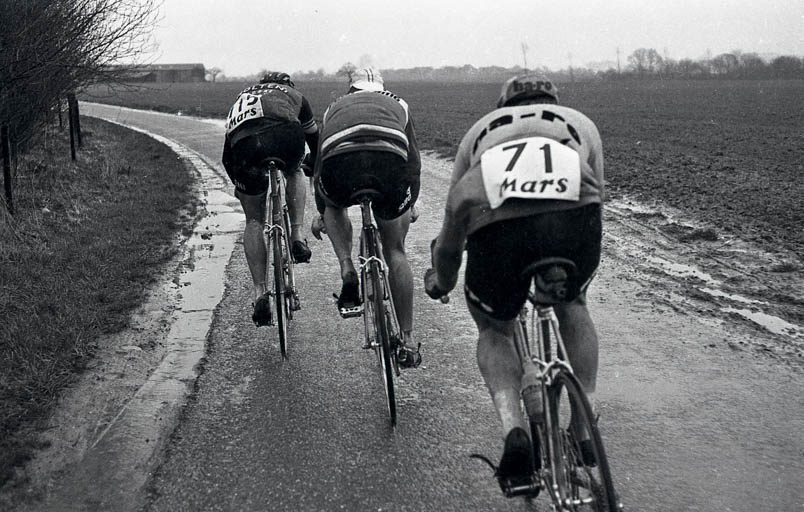
Eddy Merckx and Joop Zoetemelk catch Hennie Kuiper (71) in the 1973 Amstel Gold Race. Later Merckx will put the hammer down and cross the line in Meerssen as a glorious winner
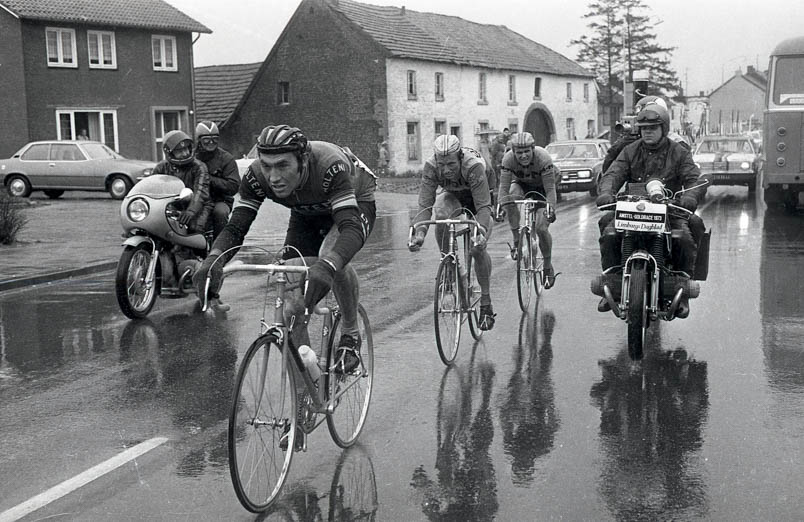
Eddy Merckx presses on in the 1973 Amstel Gold Race. Joop Zoetemelk and Hennie Kuiper hold his wheel
Cold shower
In the Championship of Zurich – in those days a tough and highly regarded race – he rides to second place. Only the Belgian André Dierickx, in a four-man sprint, can keep him from victory. The weather is foul and the riders cross the finish frozen stiff. What awaits them is – literally – a cold shower. There is no hot water. But whoever else may mind, Hennie does not. When Hennie’s fellow Twente man Wim Albersen hears the story, he is not in the least surprised. In the early months of 1973 he sees a lot of the neo-pro and trains with him regularly. He remembers that after the central training sessions at Papendal Hennie always turns the shower to cold. ‘Because, as Hennie reasons, when you’re at the top of a mountain and have to start the descent, you get freezing cold.’ And he wants to be armed against that. He is training his body, already thinking about ‘later’.
Henk Poppe recognises that. In his eyes Hennie is a very serious lad. After training Poppe might well grab a bottle of milk from the fridge, but Hennie does not want that cold stuff in his stomach. ‘He wants hot tea. Hennie really does everything he can to become a better cyclist. When it comes to thinking about racing, he is already ahead of everyone,’ says Poppe. Around the turn of the decade, between the sixties and the seventies, Poppe is the great hope: blessed with a razor-sharp final sprint, a lung capacity that also lets him ride solo, good race sense and a style that is a delight to watch. National coach Joop Middelink describes Poppe as a ‘round’ rider: someone who rides fluidly, who seems to let the kilometres flash effortlessly beneath his wheels. Hennie, by contrast, is labelled by Middelink a ‘square’ rider: a grafter.
‘An awkward style’
Poppe, who now lives in Nijverdal with his partner, an artist, remembers that at first people in the peloton would say disparagingly: ‘that little fellow can’t ride a bike.’ He has what Poppe calls ‘an awkward style’. But Henk Poppe certainly recognises the qualities of his fellow Twente man. It may not look pretty, but Hennie gets there all right. And very fast too. Poppe points to the farmer’s son’s impressive honours list. Kuiper’s fellow Twente man is himself a member of the professional peloton, riding for Frisol, and in 1974, no less, he wins in Plymouth the first Tour stage ever held on British soil, ahead of the top sprinters Jacques Esclassan and Patrick Sercu. In Poppe’s second Frisol year, 1975, Hennie is now and then his teammate, and sometimes his roommate too. Poppe knows from experience how hard it is to hold your own in the professional peloton, both physically and mentally.
As an amateur, Poppe also rides stage races abroad with Hennie. It is there, he recalls, that Kuiper really finds his way to the top. He follows Joop Zoetemelk’s credo: races are won in bed. When Poppe gets on the bus after a stage in one of those foreign stage races, he is dead tired but cannot sleep. Every time, the bus has barely pulled away before Hennie has sunk into an enviably deep sleep. He is already working on his recovery while most of his rivals still have race adrenaline coursing through their bodies. Henk Poppe leaves the peloton for good in his second year as a professional. He is sick of the doping culture. He sometimes talks to Hennie about the dubious practices in the peloton. But where Poppe goes under, Kuiper draws the curtain and goes his own way. Forty years on, Henk Poppe sees things differently from how he saw them in 1974. Now he would do just as his fellow Twente man did back then: let nothing get to him. If he could do it all again, he would give it three years, and if he still had not made it as a rider by then, he could always stop. ‘I wouldn’t turn my back on the peloton as impulsively as I did in 1975.’
In his first year as a professional Kuiper is used more and more as a rider for the main team, Rokado. There is little left for him at the Ha-Ro development team. When a squad has to be put together for the Giro d’Italia, Hennie is in the selection. At first he acts mainly as a domestique, but as the stage race goes on, Hennie proves cut out for the work. He rises far above the level of a domestique. Kuiper radiates health and never lets up for a moment. Yet his starting position is very different from that of the Italian Francesco Moser or of Freddy Maertens, his rivals from the Olympic road race a year earlier. In Italy Moser is seen as the great hope for the future. From the start of the season every sports page carries stories about Francesco. From day one he is surrounded by helpers. It is no different for Freddy Maertens. At the Belgian Flandria team he is given domestiques at the start of 1973. The renowned Walter Godefroot is given a kind of mentoring role.
Hennie – the Olympic champion, after all – mostly has to fend for himself.
The experts in and outside the peloton soon realise that the little Tukker has a lot in him. While Francesco Moser has a whole team supporting him, he finishes fifteenth in the Giro d’Italia, only one place ahead of Hennie Kuiper. And when, a year later, Hennie performs even better in that same Giro d’Italia, the peloton knows that Kuiper is a rider who can play a leading role in any stage race. He would certainly have finished in the top six had he not landed on his back on a concrete kerb when he crashed in a tunnel near Limone sul Garda on Tuesday 4 June, in the stage to Sella Valsugana. Three days later, in the stage to Bassano del Grappa, on the penultimate day, the effects of that crash become too much to bear and he is forced to abandon.
Merckx’s offer: Hennie says no
Eddy Merckx sees Kuiper as an ideal helper. Merckx has gathered around him an elite corps of riders so physically strong that they could be team leader in any other team. They regard racing for ‘Eddy the Great’ as an honour. And who would not want to ride in the service of the best cyclist the world has ever known? Firmin Verhelst is the manager who handles Merckx’s affairs. After the Giro he approaches Hennie Kuiper and invites him to join Merckx’s elite corps.
‘That was something. I felt very honoured. Racing with Merckx, the best cyclist in the world…’ Even so, it does not take the Dutchman long – to Verhelst’s bewilderment – to express his gratitude for the honour of the offer and yet to decline. No, Hennie goes his own way. He first wants to see how far he can get in this sport under his own steam.
At the end of 1974 it is all over for Hennie’s team, Rokado. Riders and staff have to look for a new home. Hennie Kuiper finds one with the oil company Frisol, which, after sponsoring a cycling team in the amateur category for a number of years, has in that same year of 1974 built a professional team around the top international amateur Fedor den Hertog. For Nico de Vries, who has made his fortune in the oil trade, Fedor is an idol who – so De Vries is convinced – is on a par with Eddy Merckx. Fedor’s first year as a professional ends in great disappointment. He does not win a single race and plays no part in any important one. But De Vries’s faith in the apple of his eye is unbroken. Reinforcements are needed, he tells Piet Libregts in mid-1974 – the man De Vries invariably refers to as ‘my directeur sportif’. Those reinforcements are meant above all to help Fedor in his rise to the top ranks of the peloton. And one of those intended helpers is Hennie Kuiper. At least, that is what De Vries has in mind, though he says not a word about it in the contract talks. De Vries receives the Tukker on his flashy yacht on the French Riviera. At that point Hennie is Olympic champion, has two exceptionally creditable debut years behind him and is regarded by the experts as a great prospect. The Frisol team director offers him a contract with a basic salary of twenty-five thousand guilders. That is not much for an Olympic champion, but cyclists in that period are generally poorly paid. It is roughly half of what the apple of his eye, Fedor, was given in his first Frisol year, but Hennie does not know that. He asks De Vries how much a win in a classic will earn him. But De Vries brushes the question aside. For a salary like that, De Vries expects Kuiper to win a classic in any case. ‘But what if I become world champion?’ asks Hennie. De Vries snatches the contract off the table. In pen he writes the following text, which reads word for word (spelling mistake included): ‘If Kuiper becomes World Champion then Frisol payes Kuiper fl. 15.000,=.’
There, that’s settled.
Frisol is a team made up mostly of young, inexperienced riders, with a team leader, Fedor, who has spent his best years in the amateur ranks. Besides him there is a great prospect, Hennie Kuiper, who is not recognised as such by the sponsor’s boss, De Vries. For however surprisingly strongly the men sometimes race, if Fedor does not win, De Vries is disappointed in the team. And because Den Hertog wins nothing in his first season as a professional, Nico de Vries is in a bad mood. Frisol’s first training camp of 1975 is set up in Bardolino, on the south-eastern shore of Lake Garda. At the start of the new cycling year eighteen road riders are under contract with Frisol; only six of them are chosen for the training camp in Bardolino: Cees Priem, Henk Poppe, Theo Smit, José De Cauwer, Gerard Kamper and Hennie Kuiper. Den Hertog is allowed to prepare for the road season in France with the soigneur Rudy Bergmans, hired by De Vries specially for Fedor. The others have to put in their training kilometres in the Netherlands and Belgium.
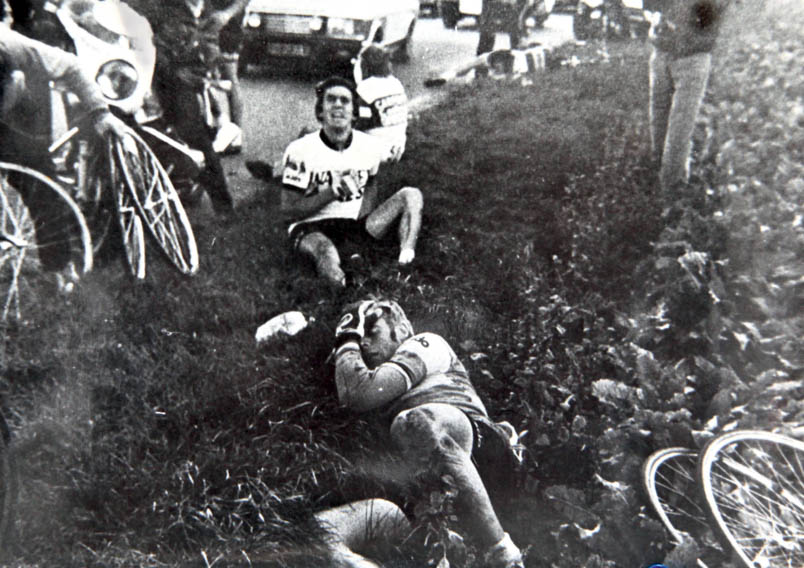
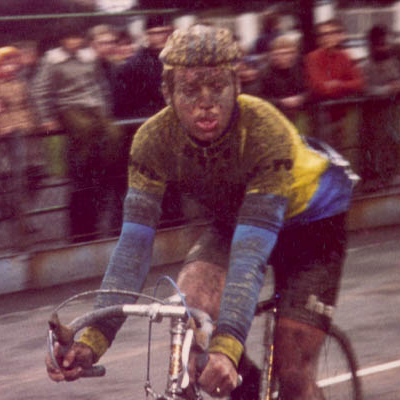
In September 1974 Gerben Karstens wins Tours-Paris. Hennie Kuiper does not make it to the finish but ends up in a beet field. So do Lieven Malfait of Watney and – sitting at the side – Michel Pollentier. A year later Hennie ends up in a beet field in Tours-Paris again, but this time in the rainbow jersey
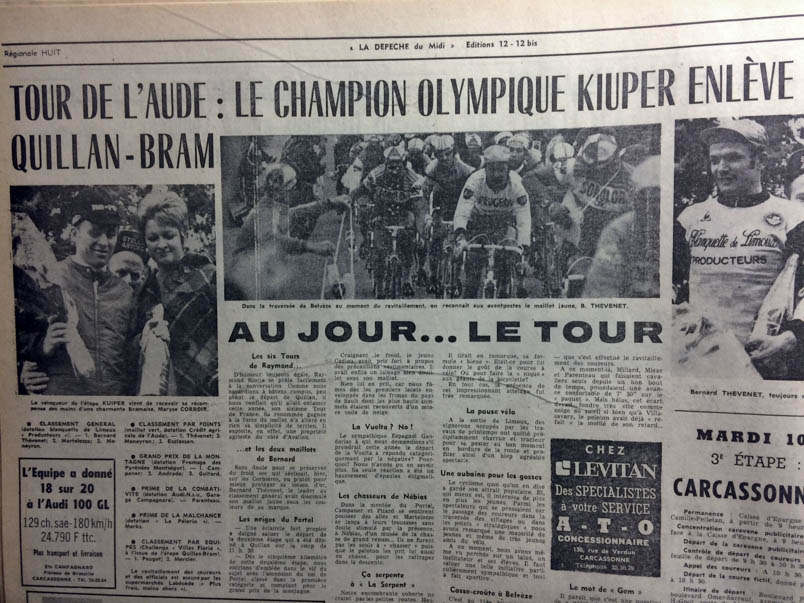
On 9 April 1973 Hennie Kuiper takes his first professional victory, in Bram, in the second stage of the Tour de l’Aude. The French newspaper La Dépêche du Midi has yet to get used to it. Its headline: Olympic champion ‘Kiuper’
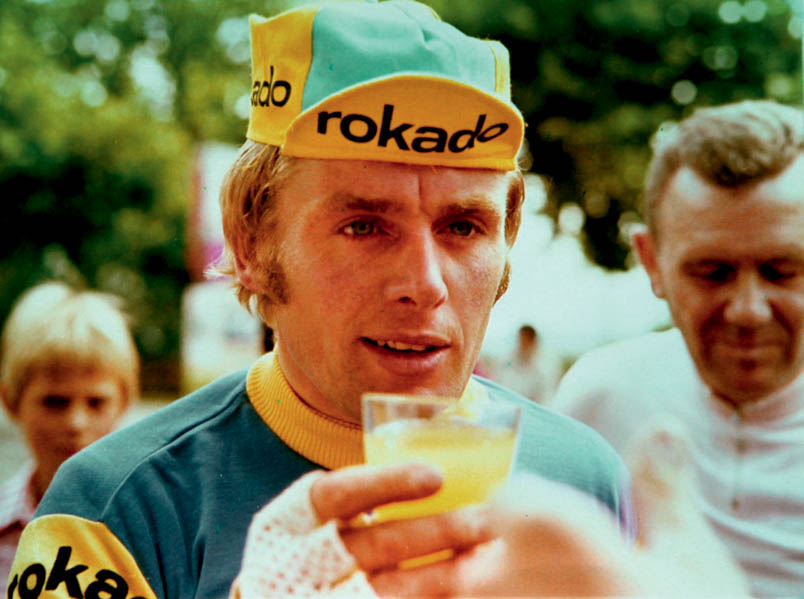
‘José must have thought…’
There are three double rooms for the six riders. Kuiper is put in with the Belgian José De Cauwer. The two barely know each other. Hennie has wrapped up warm, has pulled a woollen hat down low over his head and looks at his roommate from his bed a little suspiciously. ‘José must have thought: what kind of bloke is this?’ he realises afterwards.
At that moment José is not thinking much at all; he knows Hennie Kuiper is Olympic champion, and he has come across him at the odd race. He has already found that Hennie is no ‘dikke nek’ – no ‘fat neck’, as they call a big-head in Flanders. At any rate the Olympic title has not made him play the star.
José and Hennie are opposites in many respects, but they turn out to have things in common too. Neither of them is a city person; both are fascinated by nature. José is a great bird-catcher, forever busy with his clap nets; Hennie we already know as someone who loves tramping through the countryside. It also helps that José, like Hennie, has a speech impediment. A trouble shared is a trouble halved. Not nearly to the degree that Hennie wrestles his way through sentences, admittedly, but José too sometimes snags on a word. José is extremely assertive. Anyone who goes 1-0 up against the Fleming in a verbal exchange can expect an instant reply from the Belgian; he trumps his opponent, and the score becomes 1-2. He is just as modest in stature as Hennie, only one metre seventy-three tall. And whereas it does not bother the little Tukker in the least that people call him ‘the little one’, it drives José wild. He feels humiliated when people taunt him about his lack of height. In sporting terms he holds his own: he is sharp and nimble, but call him ‘little one’ to needle him and you are in for it. Then he bites back, not only figuratively but sometimes literally too. He simply sinks his teeth into his tormentor’s arm or hand.
Like Hennie, he does not come from a cycling family. His family, living in the shadow of Antwerp, have no time for cycling. It is a sport they do not want to be associated with. It is something for the lower orders who frequent the café. When he is 14 he has to go out to work, to help support the family. Later he trains as a cabinetmaker and then takes a course in technical drawing. But by then he has long been hooked on the racing bike he bought with financial help from his sister Paula. ‘Against my father’s wishes.’ But there is no holding José the rider. At first he has little success, but later, as a junior, he finishes in the top three 37 times in the hundred-odd races he rides. He gets his first professional contract with the modest Hertekamp team and wins two races in his first year, one of them a real sensation. In a final sprint he beats two big names: Roger De Vlaeminck and Rik Van Linden. He moves for one season to Jean Stablinski’s French team Sonolor before Piet Libregts recruits him for Frisol. Libregts knows him from his amateur days, when the Belgian made a good impression on him.
‘Do you know how fast you can ride?’
José and Hennie hit it off in that first week in Bardolino. Although they are completely different, they complement each other well. De Cauwer may loathe ‘fat necks’, but he thinks the Olympic champion could present himself a little more as one to the outside world. He lets people, as De Cauwer puts it, ‘walk all over him’, and now and then he is made a fool of. José cannot bear that. He defends Hennie, and also shows him the way in the world of cycling and beyond. He has a better feel for a race than Hennie. Reading a race is still one of José De Cauwer’s great strengths, as he shows in his work for Flemish television. As Michel Wuyts’s sidekick, he is the undisputed master of analysis. De Cauwer is impressed by Kuiper’s qualities from the very first training rides. It is he who says: ‘Do you know how fast you can ride, how good you are?’ The penny drops for Hennie. He becomes convinced of his own potential. José sees that Hennie has more stamina and tenacity than all the others. Especially when the kilometres start to mount up, the course is gruelling and the weather is against them, his Dutch roommate turns out to be considerably stronger than he is. Not that De Cauwer has no qualities of his own. It has sometimes been said of him: more head than legs. But that does De Cauwer an injustice. He is a rider of head and legs, even if, where legs are concerned, he has to give best to the very top riders. Anyone who can do his job for someone who grows into a great rider like Kuiper, anyone who, thanks to the advice of his team leader Hennie, gets into the leader’s jersey in a stage race like the Vuelta, and anyone who has beaten both Rik Van Linden and Roger De Vlaeminck in a sprint must have great qualities himself. He may not be as strong as the big stars, but he is clever; very clever indeed.
In the big opening race of the 1975 season, the Omloop Het Volk, José De Cauwer finishes a creditable third behind the winner Joseph Bruyère and Patrick Sercu, after a race in which he spends the whole day at the front. In Paris-Roubaix, the Queen of the Classics, De Cauwer stands out again, this time with twelfth place. And each time Kuiper finishes far behind the man who has by now become his regular roommate. ‘That’s not right,’ De Cauwer thinks. ‘He’s better than me, but he can’t position himself. Something has to be done about that.’ He puts Kuiper in touch with Luc Vandecavije, a very calm and reliable sports doctor. Together, doctor and teammate support the man from Twente. It becomes ever clearer to the army of professionals: De Cauwer is Kuiper’s domestique. Roger De Vlaeminck and his cronies laugh at him. ‘Pffft… Kuiper’s no team leader, is he? He’s no leader, surely?’ No, José thinks, a leader he is not, but he can certainly race. And the more people mock Hennie, the more willing José becomes to defend him.
The domestique who is no domestique
Nobody has told him how he should relate to Hennie. Hennie has never asked him to be his right-hand man, but José soon sees that Hennie is better than he is – above all, stronger. De Cauwer naturally has considerably more pure speed, but in a big race Hennie is the stronger of the two the longer it goes on. Hennie has a powerful engine. De Cauwer draws his conclusions: ‘Hennie is better suited to the big jobs than I am, but I can help him make the right decisions.’ He never feels like a domestique. Some people ask him how it feels to be Hennie Kuiper’s domestique. But José has never regarded himself as one. Together they have a business – a kind of company – in which each has a separate task. They work together and sell themselves together.
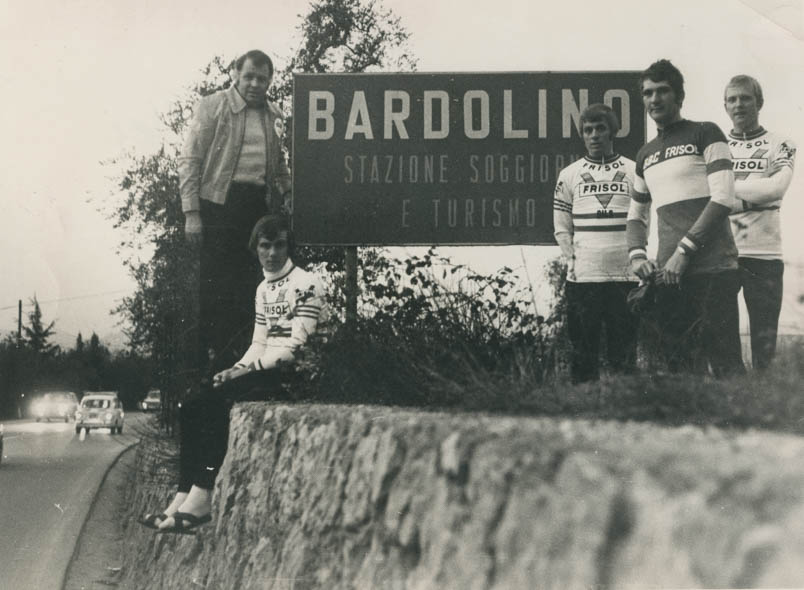
At Frisol’s first training camp Hennie Kuiper is among the chosen few who travel to Bardolino. The rest of the team stays behind in the Netherlands and Belgium, while Fedor den Hertog has gone to France with the soigneur Rudy Bergmans. From left to right: Theo Smit, Piet Libregts, Hennie, Cees Priem and Henk Poppe
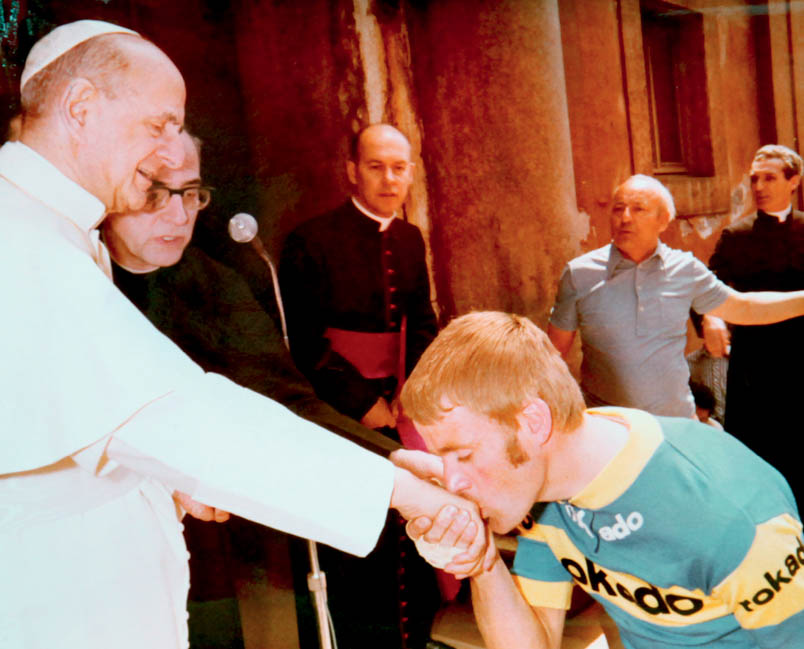
Before the start of the 1974 Giro d’Italia, Hennie Kuiper receives the blessing of Pope Paul VI. It helps. Kuiper rides so impressively in 1974 that Eddy Merckx’s manager asks him whether he would like to come and strengthen Merckx’s team. Kuiper turns the offer down
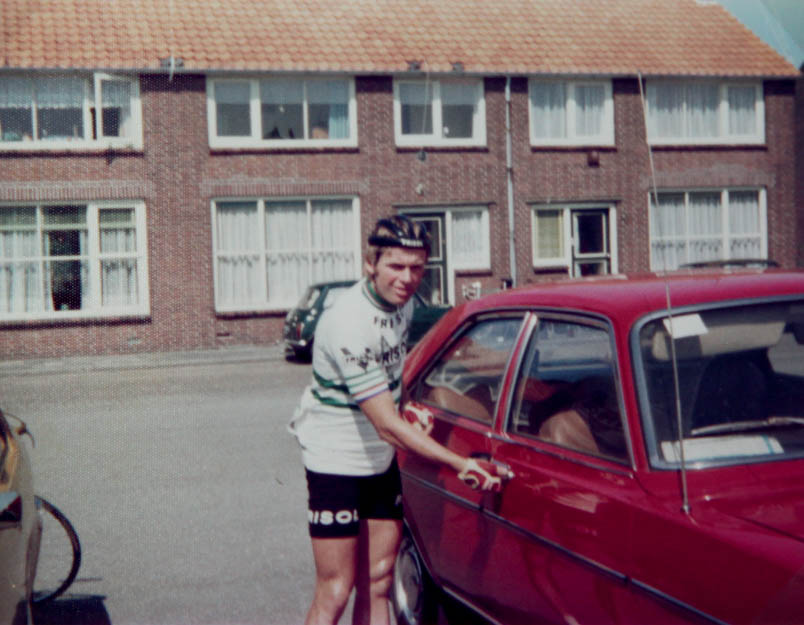
Hennie Kuiper, racing cyclist. Only his Frisol kit gives it away, for the setting hardly speaks of stardom
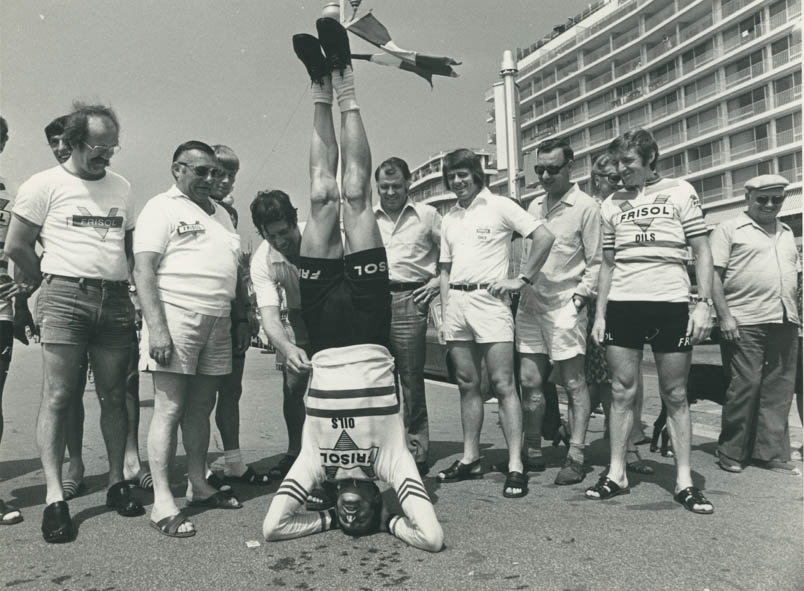
Fedor den Hertog’s famous pose: standing on his head. Hennie Kuiper is half hidden behind assistant directeur sportif Edgard De Maere. To the left of De Maere, soigneur Lambert Toebak beams. Rudy Bergmans, the soigneur hired specially for Fedor, holds Fedor’s Frisol shirt in place. To the right of Fedor, directeur sportif Piet Libregts, and on the far right José De Cauwer