‘The Games must go on’
When the president of the International Olympic Committee, Avery Brundage, makes his fiercely criticised pronouncement ‘The Games must go on’ on 6 September 1972, the day before the road race, a ‘hurrah’ goes up among the cyclists. ‘We stood cheering in front of the television. We could race,’ Hennie recalls. And how they race. The start is anything but promising for Hennie. On the first lap a near-crash sends him into a ditch, bike and all; he hauls the bike out and sets off in pursuit of the main peloton. On the way he passes the first riders to have been dropped: lads from Africa and Asia who can offer no help at all. Even so, he makes it back to the peloton. Then there is another crash. This time luck is on his side. He comes across another of its victims: Knut Knudsen. It is the Norwegian he watched become Olympic pursuit champion only a few days before. ‘He could ride a bit. I’d seen that for myself.’ Knudsen gives chase. Hennie is able to latch on and lets the strong Norwegian tow him back into the leading bunch.
Self-assured as he is, he then moves up to the front and attacks, and in doing so forms a lead group in which, besides his teammate Cees Priem, he finds big names such as the Italian Francesco Moser, the Belgian Freddy Maertens and the Swiss Ueli Sutter. The lead group quickly builds an advantage of more than a minute, but then the pace falters. Nobody wants to do the work for anybody else. When Hennie looks round, he sees the peloton closing in in the distance, led by… Fedor den Hertog, a teammate who ought to be defending the interests of his compatriots in the lead group. Fedor has extraordinary ability. Hennie calls him the greatest amateur cyclist the world has ever known. With good reason. But Fedor is also headstrong and selfish. Always and everywhere, he rides his own race first and foremost. Team discipline is generally foreign to him.
Hennie’s attack
Hennie knows he has to get away before the lead group is swallowed up by the peloton. The lead group, realising the peloton is about to make contact, eases off. The Tukker, as people from Twente are known, moves over to the left-hand side of the road and rides right on the edge. He winds up the pace and opens a small gap on the rest of the lead group, which is caught by the peloton a kilometre further on. The riders have started the last 40 kilometres. After the fierce chase everyone needs a moment to catch their breath. Kuiper is able to extend his lead. Every so often a scooter appears alongside him, with a man on the pillion holding up a board to keep him informed of his advantage. 20 seconds, 30 seconds, 40 seconds. It takes a while before the chase after the lone escapee gets under way. The lead shrinks. But Hennie holds on, thanks in part to his teammates: Cees Priem, who nips in the bud every attempt by the Belgian Maertens to close the gap to Kuiper, and Fedor, who now does ride for the team and keeps the Italian Francesco Moser on a tight leash.
Diesel Kuiper is unstoppable on his way to a great victory: a solo of almost 40 kilometres in a battle for an Olympic title, crowned with gold. At the time he does not get the recognition and publicity that his impressive performance deserves. Understandably, it is not the sport but the attack by the terrorist group Black September that takes centre stage. The joy over the medal winners of those days – among them the judoka Wim Ruska – is tempered as a result. There is no room for exuberant festivities, though the gold is certainly celebrated in a small circle. Reactions to the gold are mixed. Most people feel admiration, but there are also those who make their disapproval known, who feel there is blood on the medals. At home in Oldenzaal the reactions arrive by the sackful. The new bride Ine concludes: ‘A few negative reactions, but most of them are positive.’
Some comments are downright hostile. As if Hennie were to blame. ‘I thought the attack was terrible too, but surely it has nothing to do with sport?’ He has achieved the highest honour an amateur could achieve in those days: Olympic gold. To this day he remains the only Dutchman ever to win gold in the men’s individual road race. He feels no guilt at having carried on with his sport after the attack. Is there no room, too, for understanding the motives of someone who has worked towards these Games for so many years? And is it all not in the spirit of what the Israelis said after the massacre: by all means, carry on with the Games? Hennie cares too much about his fellow human beings not to share in their shocking loss. His family and friends, at any rate, are proud. Hennie is honoured by the Oldenzaal Cycling Club (OWC) and by the municipality of Oldenzaal, where he has lived since his marriage to Ine Nolten. And it is no small thing, riding to the title with such an impressive solo. Who else can say the same? No one. And certainly not someone from a family as far removed from cycling as Hennie’s. Later he will find that his Olympic gold keeps its lustre throughout his career.
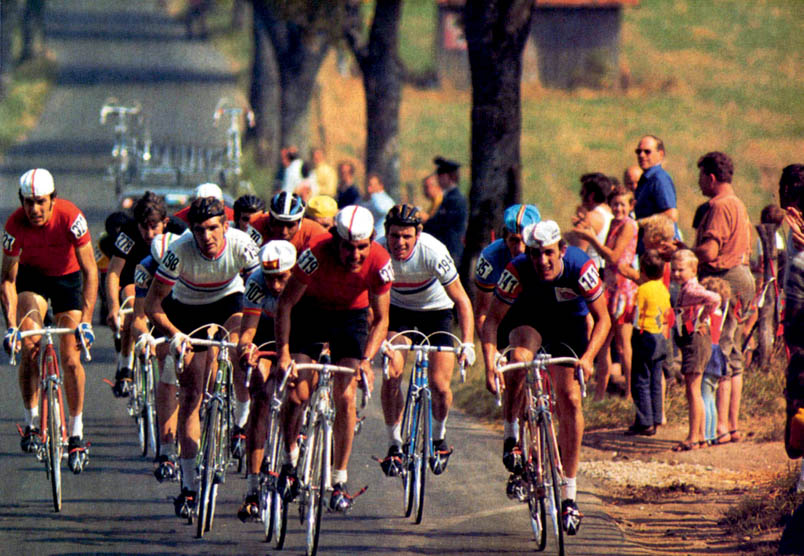
After 80 kilometres of the Olympic road race a lead group forms, with the Swiss Ueli Sutter (321) on the far left and his compatriot Ivan Schmid (319) on the front. To Schmid’s left is Cees Priem (198), to his right Hennie Kuiper (194). Between Priem and Schmid rides Jaime Huélamo (102), who will finish third. On the right: Freddy Maertens (35) and the Briton Phil Bayton (141). Fedor den Hertog has not yet bridged across to this group, but will join it later and play an important part in the finale
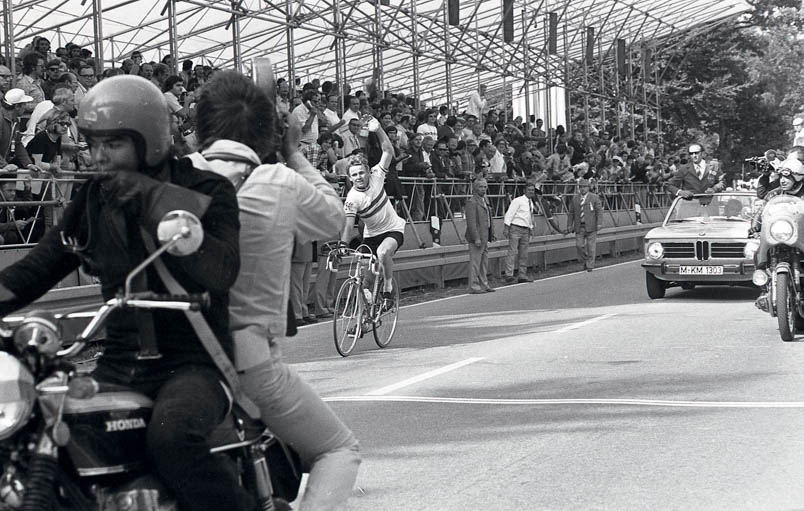
There is little enthusiasm to be seen in the stands as Hennie Kuiper crosses the line in triumph, the only Dutchman ever to win Olympic cycling gold in the road race
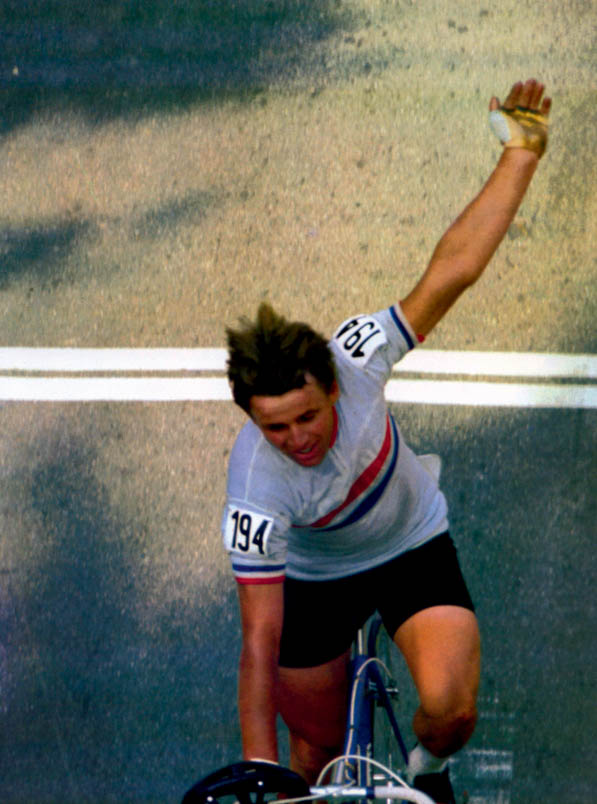
Number 194 is Olympic champion! Hennie Kuiper crosses the finish line in Munich with his arm raised. Look closely and you can see he is wearing a Ketting jersey under his Olympic top. The letters ‘Ketting’ are partly visible behind the red and blue bands of the Dutch jersey
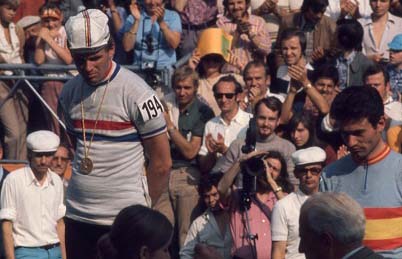
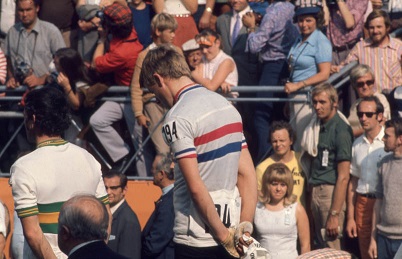
On the podium Hennie Kuiper humbly bows his head after the Olympic gold has been hung around his neck. On the right is the third-placed Spaniard Jaime Huélamo, who will be disqualified after a positive doping test. For the national anthems Kuiper and silver medallist Clyde Sefton make a quarter-turn (photo below), so that suddenly it looks as if the Australian is standing to Hennie’s left
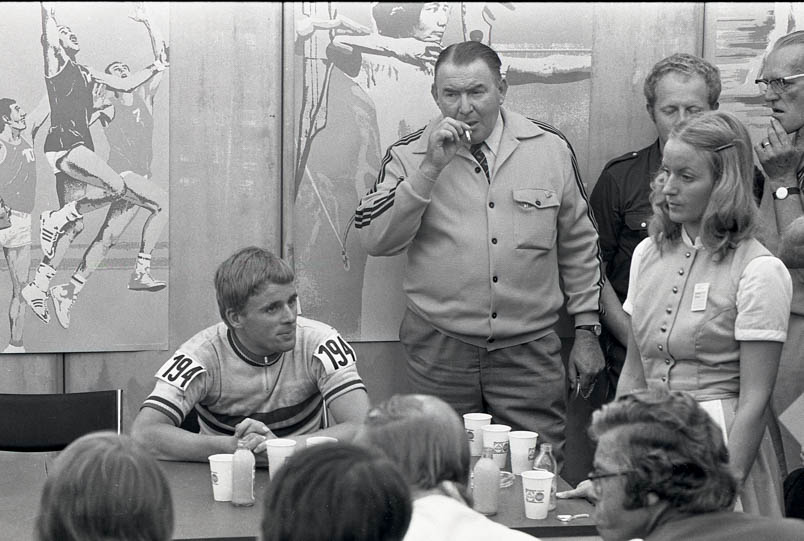
The Olympic champion talks to the international press. Behind Hennie Kuiper, Joop Middelink draws on a cigarette. In his left hand he holds Hennie’s gold medal. Standing on the right are the masseur Jan Kuiper and the Dutch mechanic Jan Spenkelink. Bottom right: Frans van der Mespel of the Eindhovens Dagblad
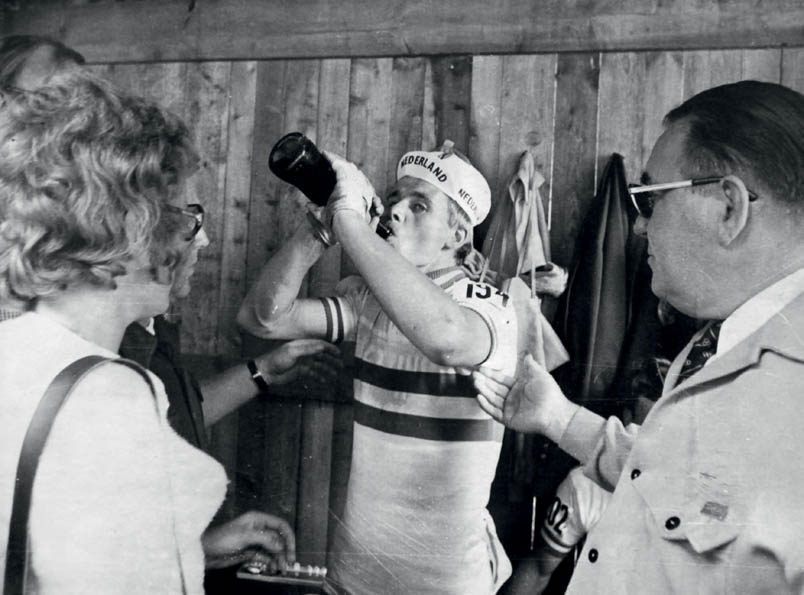
Straight after the Olympic road race Hennie Kuiper quenches his thirst with a big bottle of cola. On the left his wife Ine, on the right Joop Middelink
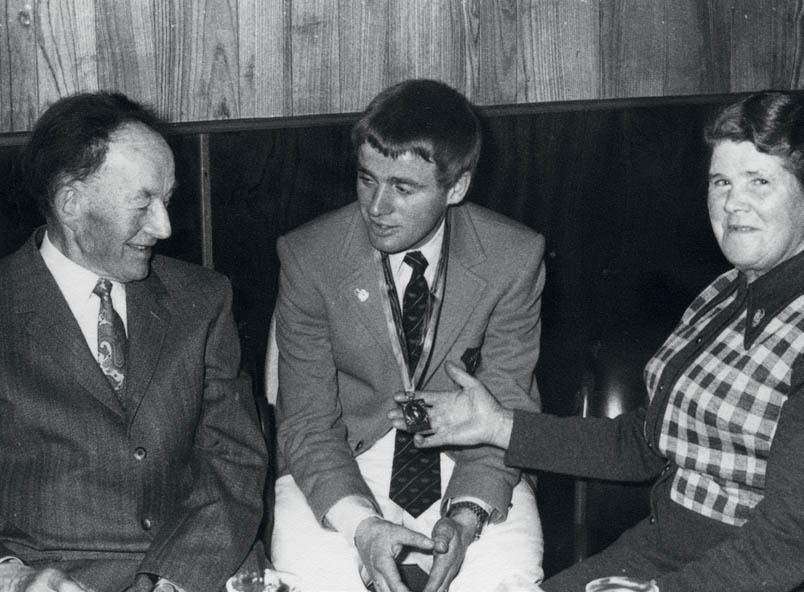
His father Gerard and mother Johanna are immensely proud of Hennie’s gold medal, without wishing to put their son above their other children
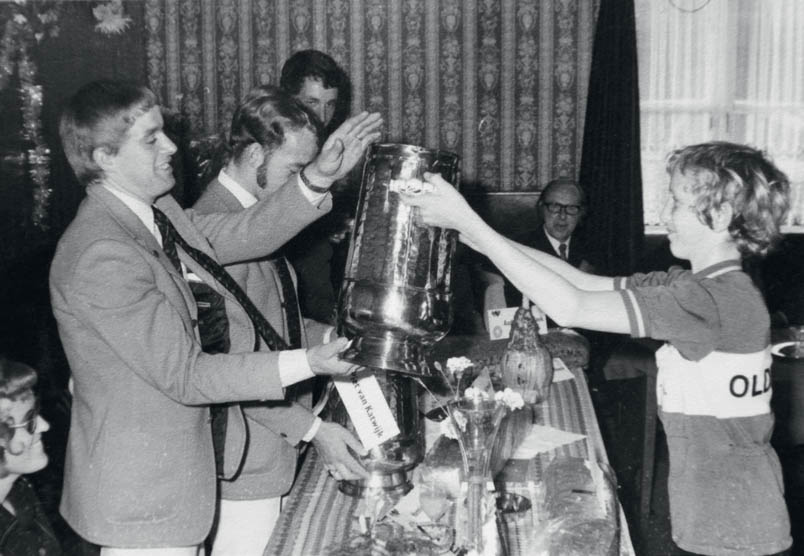
At the reception held in honour of the Olympic achievements, Hennie Kuiper, Piet van Katwijk and Fedor den Hertog are showered with gifts. Here the riders receive a copper kettle from the young riders of OWC in Oldenzaal
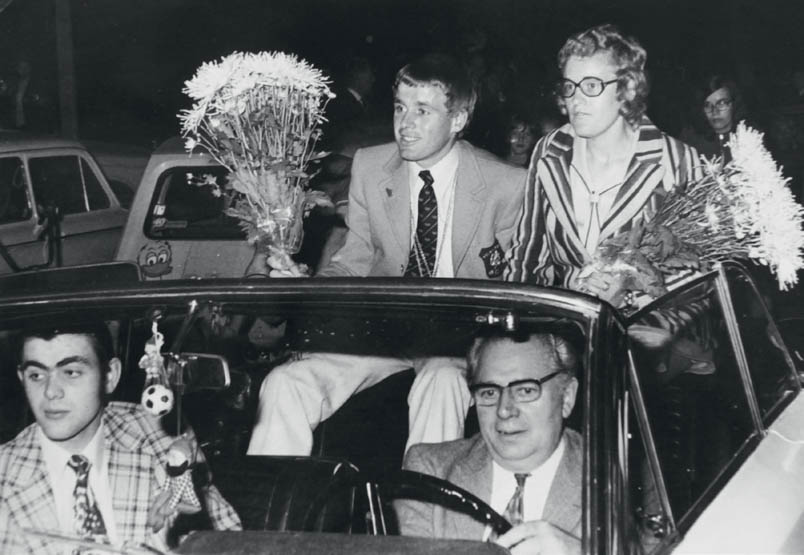
A little awkwardly, Hennie and Ine submit to a drive of honour. In the front on the left sits Gerard Kamphuis, with whom Hennie sometimes goes out training. At the wheel is Johan Mulder, owner of the hotel Het Landhuis in Oldenzaal
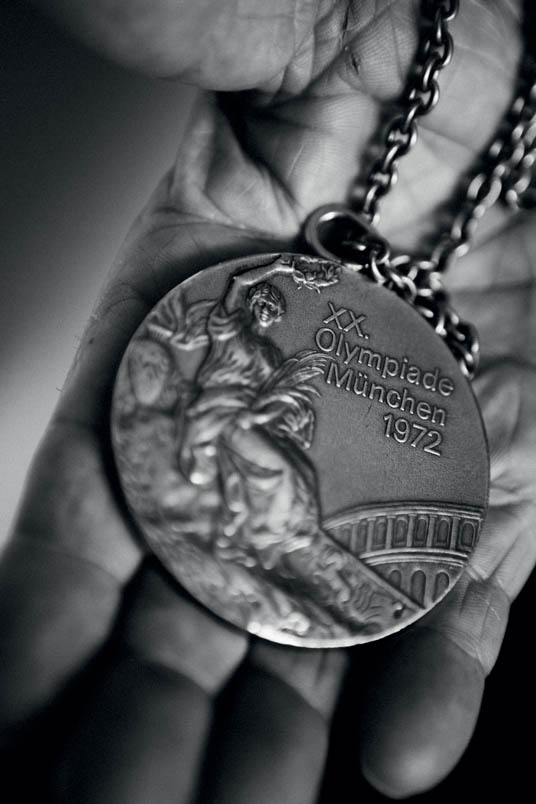
Hennie treasures his relics, such as his Olympic gold from Munich 1972