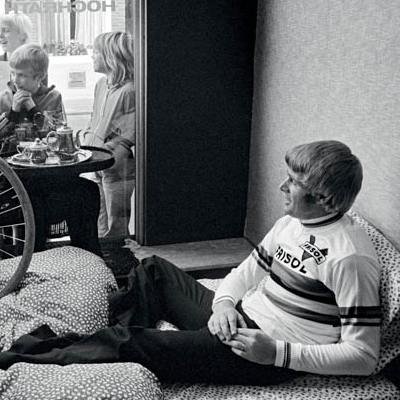
An eventful spring
Raleigh begins the 1977 season as usual: with the Ruta del Sol (Tour of Andalusia). As in the year before, Hennie finishes second. Yet there is a big difference from his second place of 1976. That year the winner was Gerrie Knetemann; in the new season it is Didi Thurau who finishes ahead of him. The German wins everything in Andalusia – apart from the prologue and the final stage. Post is confirmed in his view: Thurau must be his man; unlike his current team leader, Hennie Kuiper, Thurau is a rider with charisma and, thanks to a razor-sharp finishing sprint, a winner too.
Hennie has a mediocre early season. One result stands out: his third place in the Amstel Gold Race. On paper that is a fine result, but team boss Peter Post sees it as one of the bitterest defeats of the Raleigh years. That has everything to do with the way the gripping finale of this classic unfolds. Three Dutch riders (what luxury…) light up that finale. Two of them wear the Raleigh jersey: Gerrie Knetemann and Hennie Kuiper. The third is their former teammate Jan Raas. The Zeelander walked out on Post in anger at the end of the previous year. He had been given neither the position nor the financial reward he felt he was entitled to. Raas moved to Piet Libregts’s Frisol team and, to Post’s annoyance, won the prestigious St Joseph’s Day classic, Milan-San Remo, in that sponsor’s jersey.
With Raas in the finale against two Raleigh men, Post counts on a win for his riders. Kuiper may be known as a ‘flat iron’ in a sprint, and Knetemann may come off second best to Raas for pure speed too; but in the kilometres the trio still have to cover to the finish, those two seasoned riders should surely be man enough to outwit the lone Zeelander. It has to be said: the pair throw everything at it. They attack again and again. ‘Kneet’, as Knetemann is known, puts everything into a searing acceleration. ‘Kuip’, not explosive by nature, goes as hard as he can. Knetemann tries again, then Kuiper, and so on, and so on. In all, Raas has to deal with fifteen attacks: six from Hennie, nine from Gerrie. But each and every time Jan Raas shows that he is the undisputed king of the classics. Raas is more determined than ever to beat these two Raleigh men. It is his ultimate revenge on the directeur sportif who did not put enough faith in him. And he succeeds. To the fury of Post, who that spring is still without a major win. Criticism comes from outside. Post is banking too heavily on Thurau, who cannot yet live up to the high expectations. But Post waves the criticism away. He points to the top-ten places the German goes on to rack up after the Gold Race: eighth in Paris-Roubaix, third in Liège-Bastogne-Liège. Says Post: ‘A rider like Didi has to be given the best chance. I’ve always believed in his class. And even if he hasn’t won his big race yet, I’m going to keep building around him.’
Henninger Turm
Post and Thurau have set their sights above all on victory in the German classic, Rund um den Henninger Turm, which, as tradition in those years dictates, is held in Frankfurt on 1 May. The Raleigh team rides the race for Thurau, but Gerrie Knetemann does not give a fig for team orders. With 38 kilometres to go he launches a devastating attack and stays out of the chasers’ clutches. Thurau feels trapped. He is not allowed to chase down a teammate. After a solo effort of his own, all that is left for him is second place. The German is bitterly disappointed and makes no secret of it.
That very evening Didi is approached by a representative of the IJsboerke team. Not long afterwards, in the utmost secrecy, he signs a contract for several years with the Belgian sponsor. He takes Bert Pronk with him as his domestique and Ruud Bakker as his soigneur. The following year Raleigh has lost all three.
Post, who has an extensive network of informants, is told before the Tour that Thurau is about to leave. He keeps the information to himself, hoping first to score in the Tour with the charismatic German, for his faith in Thurau’s qualities is still unbroken.
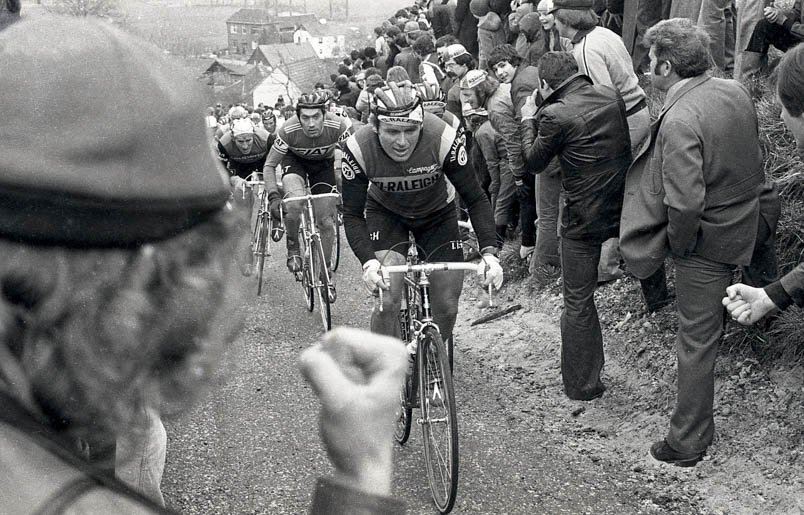
In the 1977 Amstel Gold Race, Peter Post’s Raleigh riders once again show their superiority. Hennie Kuiper climbs the Keutenberg ahead of Eddy Merckx
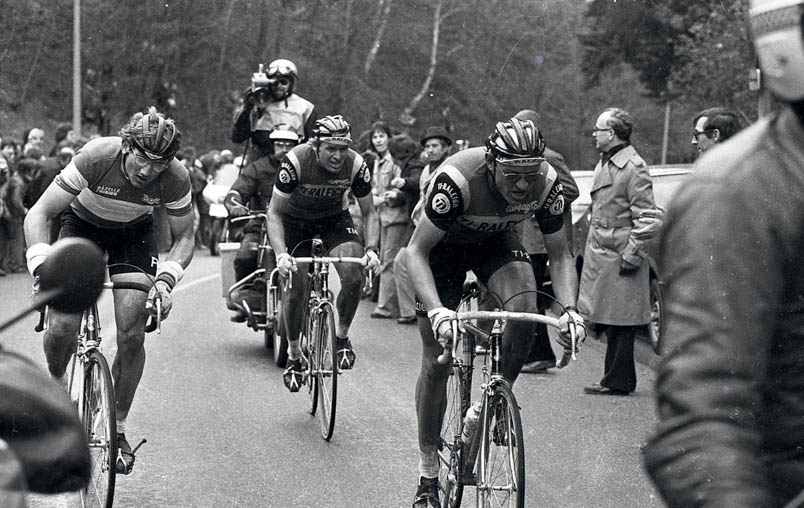
In the finale of the Gold Race Post has two trump cards left: Hennie Kuiper and Gerrie Knetemann (right). The most dangerous man of the three, however, is riding on the left of the road in the Frisol jersey: Jan Raas
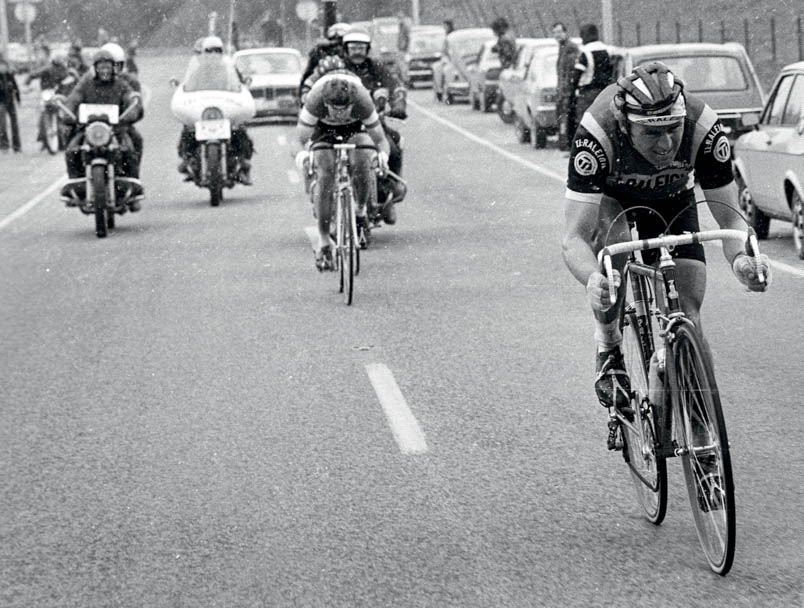
In the Gold Race, Knetemann and Kuiper take turns trying to wear Raas down, attacking and making him close the gap each time. And Raas does: he is desperate to put his name to the Amstel
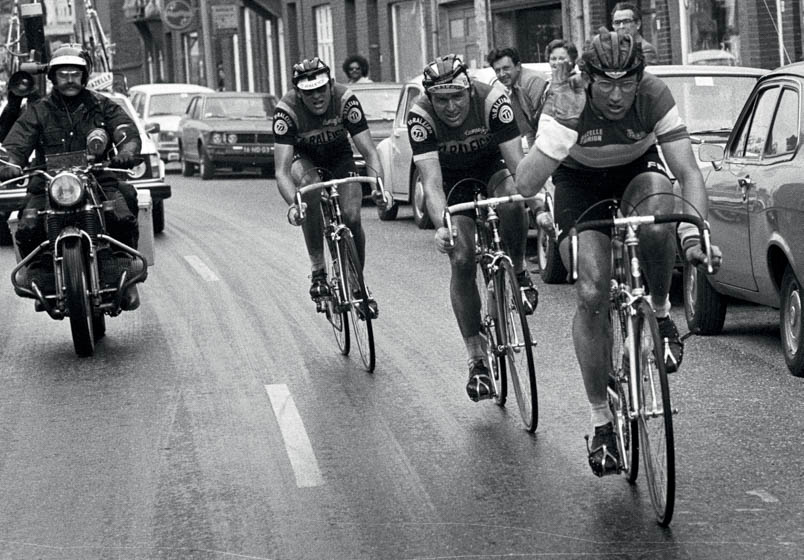
Tension mounts in the closing kilometres of the Amstel Gold Race. With hand signals, Raas tries to keep photographer Tonny Strouken’s motorbike at a safe distance
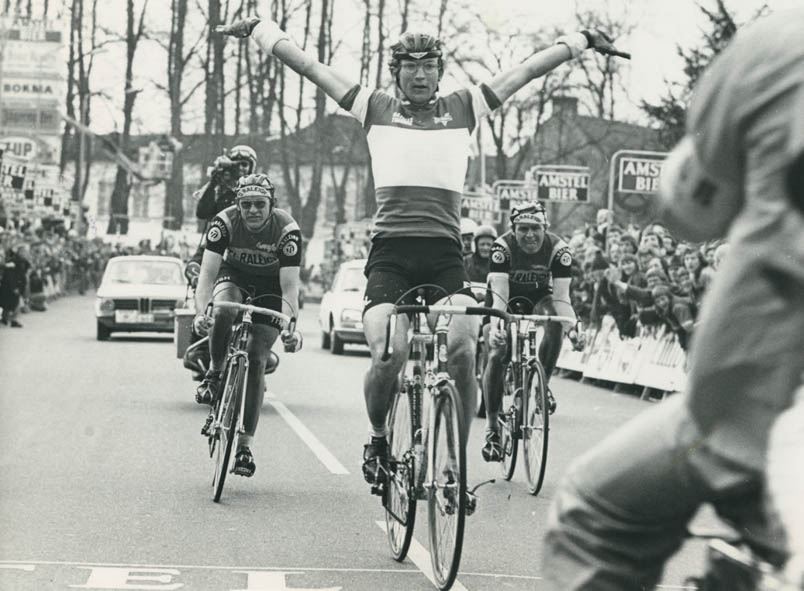
Peter Post is fuming when Jan Raas easily beats Knetemann (left) and Kuiper in the sprint of the Amstel Gold Race
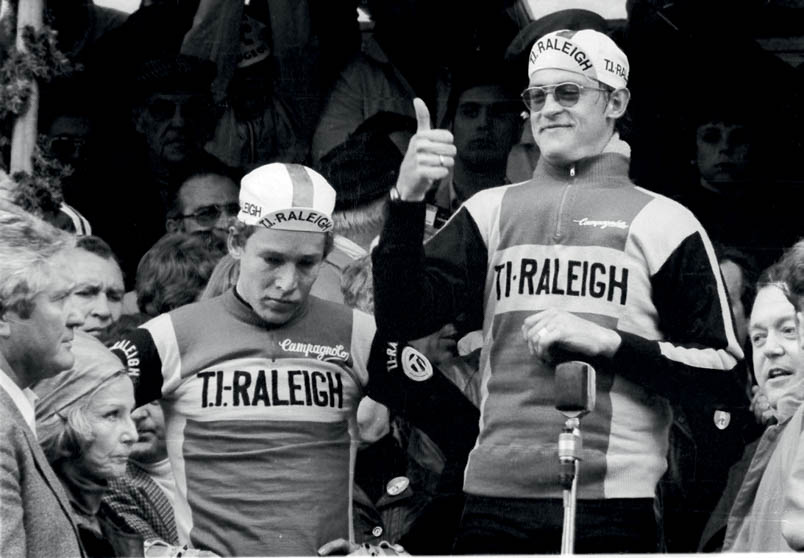
The podium photo from Rund um den Henninger Turm in Frankfurt speaks volumes about relations within the TI-Raleigh team. Gerrie Knetemann wins after a solo. Didi Thurau’s face is like thunder. That very evening he secretly signs a contract with IJsboerke
The Stimul affair
Apart from his third place in the Gold Race, Hennie has no list of results that spring to impress anyone. Two factors play a part: he is laid low by a stubborn bout of flu, and… Kuiper’s name comes up in a doping affair. In the spring of 1977 doping is the issue in cycling. In the laboratories where athletes’ urine is tested, technicians had come across a substance years earlier that they could not identify. It is suspicious, but they cannot put their finger on exactly what it is. Professor Michel Debackere, a pharmacologist and toxicologist, is director of the faculty of veterinary medicine at Ghent University. In his laboratory, the urine samples of top athletes are tested for banned substances.
Debackere has already built up something of a reputation. In 1974 he succeeded in detecting the use of Ritaline and Lidepran, two drugs popular in the peloton. He kept his discovery quiet until the spring races came round. In the Tour of Flanders Walter Godefroot was the first to be caught out. He would later be caught using banned substances again, in the Flèche Wallonne. That earned him a four-month suspension. It proved to be the forerunner of a whole list of riders who were caught. The Dutchman Theo van der Leeuw (Amstel Gold Race), the Belgians Ronny De Witte and Wilfried David and the Frenchman Raymond Delisle (Liège-Bastogne-Liège), and the Belgians Eric Leman, Freddy Maertens and Joseph Bruyère (Tour of Belgium). Belgian cycling fans reacted furiously. They thought it a disgrace that the great stars should be shown up like this. ‘Even on your deathbed you should not be forgiven for everything you have done,’ wrote one fan who had evidently lost the plot. But the parents of a young rider wrote in a note: ‘Keep it up, professor. Because doping is a terrible thing. We’ve seen enough of it.’
That was in 1974. But in the meantime the Ghent laboratory kept searching for the other drug which – as the tests showed – was also in widespread use. In 1977 the moment has come. ‘We now have a watertight test with which we can prove the use of Stimul scientifically,’ said Debackere. ‘And we’re going to start in the spring races, just as in 1974.’ Stimul is a product from the amphetamine group and, according to Debackere, it can damage health. Until 1974 laboratories were quite prone to tipping off athletes when they could detect products in their urine, along the lines of: ‘Watch out, stop using such-and-such a product, or you’ll be caught.’ Debackere, however, works in secret, and in 1977 too he forbids his staff to tip off the peloton.
A staggering effect
The effect is staggering. When the results of the doping controls in races such as the Tour of Flanders, the Flèche Wallonne and the Tour of Belgium are made public, it turns out that a large number of riders have been using Stimul. The Ghent laboratory has waited until all the classics are over before announcing the first positive cases. The ‘catch’ – to the fury of the peloton – is a big one. And it is no small names who are nailed to the cross: Eddy Merckx, Freddy Maertens (three times: in the Tour of Flanders, the Flèche Wallonne and the Tour of Belgium respectively), Willy Teirlinck, Guy Sibille, Walter Planckaert, Michel Pollentier, Karel Rottiers and, yes, Hennie Kuiper too.
It is the first and, as it would turn out, the only time in his career that Hennie’s name is linked with doping. He is utterly thrown when a letter drops through his letterbox from the Royal Dutch Cycling Union, stating that he has tested positive in a control. The news – ‘Hennie Kuiper is positive’ – reaches the outside world. TV reporter Fred Racké turns up with a camera crew at a race in Zeeland. Hennie is utterly thrown when a microphone is thrust under his nose. The camera is rolling, but Hennie stutters, worse than ever before. For part of the public he tumbles from his pedestal. Hennie? Him as well?
Kuiper says he is innocent. He wants a counter-analysis, hoping that the second urine sample will show him to be blameless. The Raleigh team leader engages an expert of standing at the time to guide him through the counter-test: Professor Jacques van Rossum. And… the counter-analysis is negative. Hennie Kuiper is cleared. The only one on the list.
All the same, the episode takes a heavy mental toll. Add the flu, and it is clear that Hennie stays far from his best form that spring. As the season goes on, however, he feels more and more himself again. His physical condition (the after-effects of the flu) and his mental condition (the trouble over the doping control) improve. In the Tour de Suisse he is not yet at the level of the year before, but on the stage to Bellinzona he shows that he is back on the right track. In a breakaway he finds himself with none other than his great idol, Eddy Merckx. In the final sprint Kuiper naturally stands no chance, but it is a second place that counts all the same. He is looking ahead again, and is determined to ride his way at least onto the podium in the coming Tour de France.
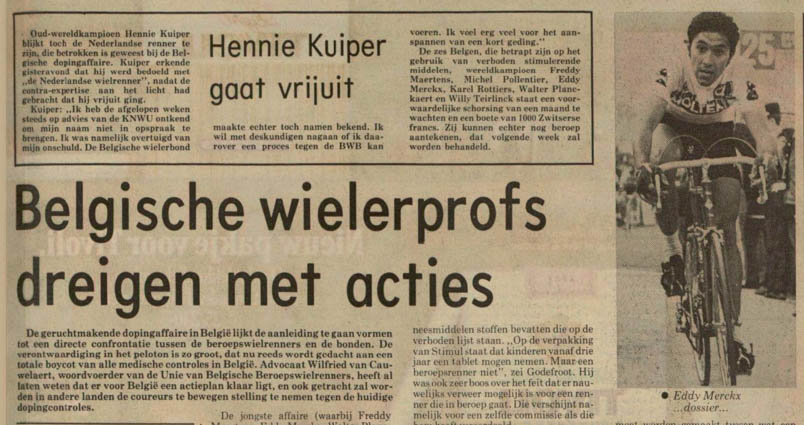
The headline leaves no room for doubt when his name is cleared of alleged doping. ‘Kuiper cleared’, runs the headline in the Nieuwsblad van het Noorden