‘Hennie, Hennie, say something…’
And then, at last, it is 9 July, the day of the 13th Tour stage. In Denekamp the whole Kuiper family has put on its Sunday best, its ‘goeie grei’, as they say in Twente. The great day has come: the 40th wedding anniversary of Gerard Kuiper and Johanna Heerink. The celebration is held in the Knippers function room. Naturally everyone there is a Hennie supporter. As the large party sits down to eat, a radio is playing somewhere, not too loud, so as not to disturb the celebrations, but loud enough to keep up with the race.
In Denekamp they know how much Hennie has been living for this day. He himself knows only too well that it will not be easy, for on that 9th of July the caravan does ride through the Pyrenees, from Font-Romeu to Saint-Gaudens, but stage 13 lacks the gruelling character Hennie needs for a solo win. It is a course without too many difficulties, crossing a third-category col, the Col du Puymorens (altitude 1,916 metres), 28 kilometres after the start in Font-Romeu, and then a second obstacle, a second-category climb, the Col de Port (1,249 metres), 88 kilometres from the finish. There are few chances to force an early decision. After all, an attack on the Col de Port leaves the peloton plenty of time to come back. He has weighed all this up beforehand, but now he is right in the thick of the finale. In the Knippers room grace has been said and the soup served, when suddenly someone shouts: ‘Hennie’s crashed!’ Consternation all round. The radio is turned up to full volume. Theo Koomen’s dramatic commentary spreads dismay. ‘Ooohhh. Hennie Kuiper is lying in the road. Motionless. Hennie, Hennie, say something…’
For the time being, Hennie says nothing. He has gone down mid-sprint.
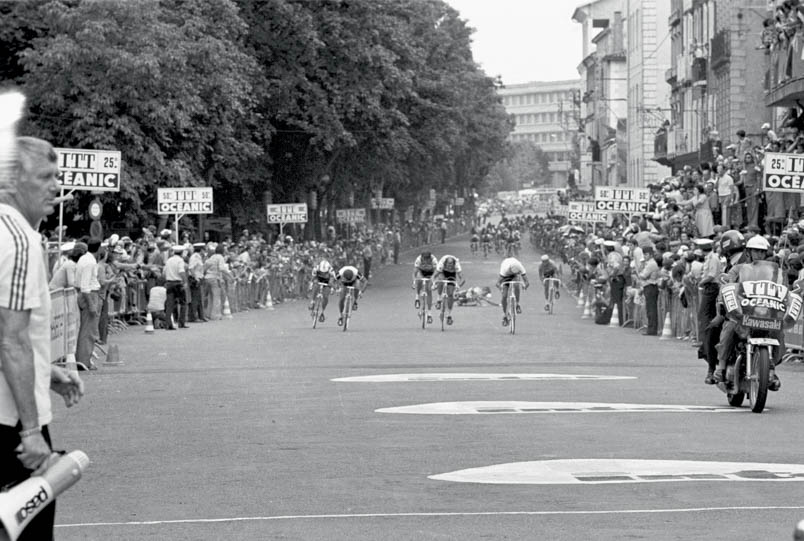
For Hennie Kuiper the stage to Saint-Gaudens ends in outright drama. Instead of a victory on his parents’ fortieth wedding anniversary, the stage ends in a crash. In battle order, from left to right, heading for the finish: Mariano Martinez, Wladimiro Panizza, André Chalmel, Willy Teirlinck, Régis Ovion and Raymond Poulidor
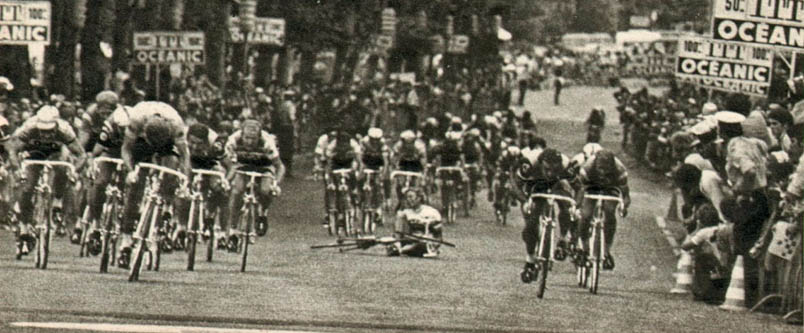
Sitting on the road, Hennie Kuiper grits his teeth against the pain, but above all against the disappointment. The first six on the stage have already gone past. Now the peloton thunders by. On the left of the road Freddy Maertens sprints to eighth place on the stage. Despite his crash, Kuiper is classified seventh
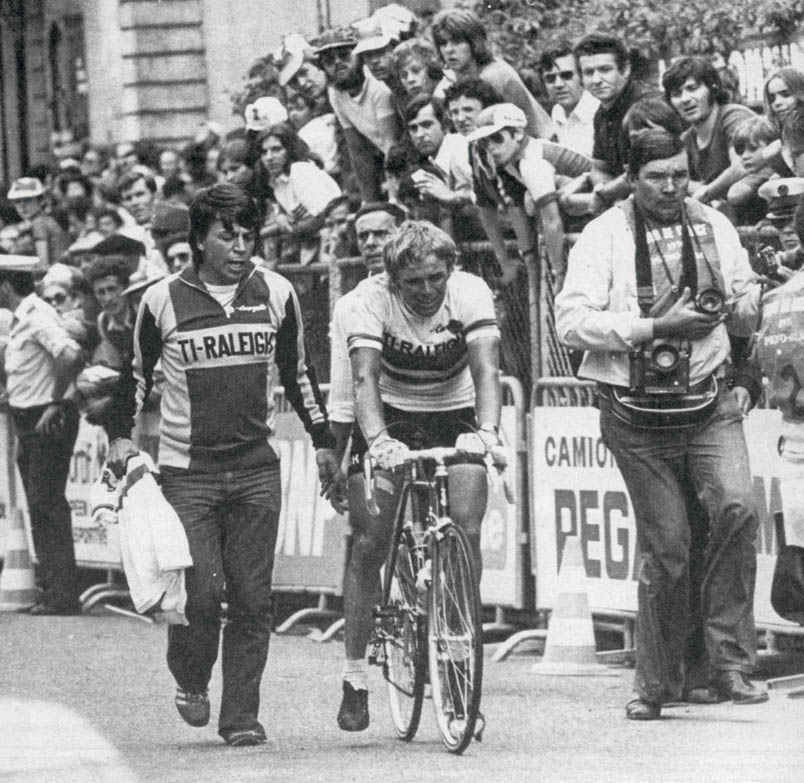
Hennie Kuiper is utterly dejected as he hobbles to the finish in Saint-Gaudens with Peter Bonthuis (left)
Shortly before, he had reeled in four breakaway riders: the Belgian Marc Demeyer, the Italian Wladimiro Panizza, the Frenchman Jean-Pierre Genet and the Dutchman Gerard Vianen. Hennie has studied the route book closely. He knows that a little under three kilometres from the line there is a short climb. He hammers up it with everything he has and opens a small gap, but it is not enough to stop the Belgian sprinter Willy Teirlinck, the Frenchmen Régis Ovion, Mariano Martinez, André Chalmel and Raymond Poulidor, and the Italian Panizza from getting back on terms. In his hunger for victory – the ‘wedding present’ for his father and mother – Kuiper attempts the impossible. He tries to dive into the gap between Ovion and Teirlinck, brushes an elbow and, trying to correct himself, pulls the bike out from under his body. He slides across the rough tarmac, which is strewn with grit. Only much later does he find out that Teirlinck went on to win the stage. Hennie is inconsolable. His dream lies in ruins. ‘A stage win in Saint-Gaudens on my parents’ wedding anniversary would have been the finest victory of my career as a Tour rider.’ In Denekamp, dejection settles over the festive table. The soup might as well go back in the pot. Fortunately, a little later the reporter announces that Hennie is murmuring a few words again. Ine, Hennie’s wife, can breathe again. It may be serious, but not as serious as it first looked. The celebration goes on, but the spirit has gone out of it. The fall of the family hero casts a veil over the festivities. Only in the evening do Ine and Hennie’s parents manage to speak to him on the phone from France. And only then do they really recover from the shock.
The whole of sport-loving Netherlands shares Hennie’s every moment. Through the way he races, he has already overtaken the best Dutch rider, Joop Zoetemelk, in popularity. Whereas Zoetemelk is known for his defensive riding – or, to put it less kindly, for hanging on – Hennie has won the hearts of the wider public, in this Tour above all, with his attacking style. There is something endearing about the way he cannot always find his words in front of a microphone. His manner – always polite, never an unkind word about a rival, always friendly – melts hearts all over the Netherlands. And not only in the Netherlands, incidentally. Since his victory in Bornem the French sports daily L’Équipe, in those days the organiser of the Tour de France, has been calling Hennie the ‘champion of attack’.
‘Kuipertje’ (little Kuiper), as he is fondly called everywhere, following Theo Koomen’s lead, throws himself into the fray, preferring to go down fighting rather than ride passively to an anonymous place of honour. It may not always be well thought out, but it is spectacular. Even directeur sportif Post has to admit that. But by now Post is already far more taken with the trump card he is still keeping up his sleeve in this Tour, the stylish West German Didi Thurau, than with the scrapper Kuiper. Hennie has broken nothing in the crash, a small mercy amid the misfortune. He is loaded into an ambulance and dropped off at the riders’ quarters. Until well into the seventies riders by no means always slept in a proper hotel, as would later become the norm; sometimes they had to make do with camp beds set out in a school gymnasium. Imagine: you have just delivered an inhumanly hard performance, and afterwards you are given a camp bed in a gym, among more than a hundred fellow riders. The next day the Tour management drives you over hard cols all over again.
The doctor who acts like a butcher
In this case the makeshift ‘sleep factory’ is on the Route de Toulouse in Saint-Gaudens and is part of the Lycée d’État Mixte. Hennie is in pain, a great deal of pain. He is covered in blood. But Geert Simons, the doctor with Post’s team at this Tour, will soon sort that out. Simons is married to Olga de Haas, prima ballerina of the Dutch National Ballet. For months he has been trying to carve out a position for himself in cycling. His first concern is not the riders; above all he is out for his own glory. Hennie does not know that at the time. Among those looking after Kuiper is Peter Bonthuis, Post’s right-hand man. Bonthuis sees the state Hennie is in, and how much pain he is suffering.
First Simons picks dozens of bits of grit out of Kuiper’s battered body. That in itself is a necessary but extremely painful process. Then, without anaesthetic, Simons cuts into the wounds to clean the dirt out of them too. ‘I can take a knock,’ says Hennie 41 years later, ‘you won’t hear me squeal in a hurry, but I screamed the place down.’ Soigneur Ruud Bakker sits on the injured rider with all of his hundred kilos to hold down the physically and mentally broken man. To make matters worse, Simons shouts: ‘Don’t be so soft. Stop making such a fuss, man!’ Simons does not understand the first thing about top-level sport. He goes about it like a butcher, as if he were treating not a human being but an animal or a piece of equipment. It beggars belief. To this day the scars left by what this ‘doctor’ did can still be seen on Kuiper’s hip.
Of course Hennie is glad that nothing is broken after a crash like that, but the mental pain is many times greater than the physical. Everything – and that means literally everything – has been geared to this stage on his parents’ wedding anniversary. He has had to miss the party, but a stage win would have been a magnificent present. He knows how happy he makes his mother every time he comes to her with a bunch of flowers. The dream, a stage win in Saint-Gaudens, remains a dream that never comes true. Even now the memory brings tears to his eyes. After Simons’s ‘treatment’ he can go to his bed in the gym. Hennie does not mind that much. Whether he is lying in a five-star hotel or in a school like this one makes no difference to him. The only thing that matters to him is a good mattress to rest on. Unlike most people, Hennie can sleep anywhere, whatever the circumstances.
But assistant directeur sportif Peter Bonthuis cannot bear to see it. An injured rider deserves a decent place to sleep. And so he clears out the little room set aside for him as directeur sportif, puts the injured team leader in it and pulls the blankets on Hennie’s camp bed over himself.
Like a soldier back from the front
Early the next morning De Cauwer turns up at Hennie’s bedside. When all the bandages have been peeled off, out comes a man who looks as though he has just returned from the front line. Any sensible person would say: that’s it, I’m stopping. But riders, and Hennie Kuiper most of all, are different. On the programme is the stage to Saint-Lary-Soulan, a crucial stage that goes over the Col de Mente and the Portillon to the Peyresourde before finishing at Pla-d’Adet in Saint-Lary-Soulan: two second-category cols and two brutes of first-category climbs. Madness, of course, for an injured rider. And so it proves. On a dead-straight road, shortly before the village of Aspet in the Haute-Garonne, Hennie goes down. To this day it is not clear exactly how this crash happened. Possibly, after 13 kilometres, Hennie touches the wheel of the rider in front, loses his balance and smashes his unprotected head against the tarmac. The era in which professionals, too, are obliged to wear a helmet has not yet arrived. Hennie briefly loses consciousness. The whole team waits for him. By the time they see that waiting any longer is pointless, the peloton has long since vanished from sight. The Tour, after all, waits for no one.
The number 13 plays a leading role in all these events. ‘That’s no coincidence,’ the superstitious Gerrie Knetemann will say afterwards. On the day of the sprint in Saint-Gaudens that ends so unhappily for Kuiper, the riders are completing the 13th stage – on a Friday, no less. The head wound he suffers there is closed with 13 stitches, and the crash the next day happens at the 13-kilometre marker… After the delay, the Raleigh riders at first turn it into a team time trial in an attempt to catch the peloton. It proves a hopeless task. The team reaches the finish line well after the time limit has expired. Only Bert Pronk, who is a better climber than his teammates, has managed to latch on to a small group that comes in before the control closes. When Jules De Wever, Peter Post’s French-speaking assistant, makes an impassioned plea to Tour director Félix Lévitan, for once Lévitan shows his human side and relents. The team is allowed to start the next day after all.
Stray cats on the sickbed
After this last crash Peter Bonthuis takes Hennie under his wing. He hands the wheel of the second car to mechanic Paul Soetekouw and goes with the injured rider to the Centre Hospitalier Comminges Pyrénées in Saint-Gaudens. The whole hospital is in uproar when word gets round that the world champion has been carried in. ‘Everyone came running into my room.’
Bonthuis sees half the hospital come traipsing into the world champion’s room in no time at all. He steps in, makes a sign reading ‘visite interdit’ (no visitors) and hangs it on the door. Bonthuis grabs a white doctor’s coat from the peg, puts on his sternest face and firmly turns back anyone who dares to come in. Who would dare to disobey a doctor’s orders? That way, at least, Hennie can lie in peace, Bonthuis thinks. But in practice things turn out differently. Just about everything in this hospital breathes chaos. The place is grubby, and when stray cats jump through the open window onto Hennie’s bed, he knows for certain: ‘I wanted to get out of that hospital as fast as I could.’
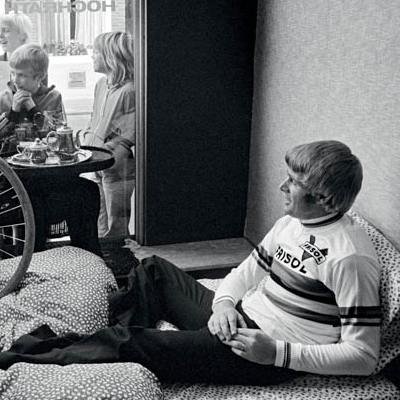
Cycling photographer Cor Vos turns up. Could he quickly take a picture of Hennie in his sickbed? Bonthuis, keen on publicity for the sponsor, agrees. But then Hennie will have to put on a Raleigh shirt. Kuiper protests. Pull a shirt over his head? That is too painful. But Bonthuis insists, and with great pain and effort Hennie pulls on the sponsor’s shirt. Vos presses the shutter release, and at that very moment the hospital director walks in. What on earth do these gentlemen think they are doing? No photographs may be taken in the hospital! He demands the film from the photographer, who turns round, pretends to take out the film and then presses a still unexposed roll into the director’s hand. Jackpot for Cor Vos, jackpot for Raleigh. For a day later the photo is printed in newspaper after newspaper.
Although Kuiper really wants to leave the hospital, the doctor treating him makes it clear that he absolutely must stay one more night for observation. Bonthuis, however, insists on an extra bed being put in the room so that he can spend the night there. On no account does he want to leave Hennie alone. He gets his extra bed, climbs into it and, after a day full of emotion, falls asleep at once. In the middle of the night he wakes with a start. A nurse is sticking a needle into his arm. The injection is meant not for the assistant directeur sportif but for Hennie. Hennie gets his jab later. Peter Bonthuis turns over and goes back to sleep.
The day after, Hennie is taken to Pau, the next stage town on the road to Paris. Jan Raas bounds cheerfully into his teammate’s room, delighted that the mountain stages he so hates are now behind him. He gives him a friendly slap on his badly injured shoulder, as if to say: ‘Hey, Kuip, how’s it going?’ But Kuip doubles up in pain. Post chases Raas out of the room. A day later Hennie leaves for the Netherlands, together with Gerrie Knetemann, who has also left the Tour. The pair are dropped off at the station with their luggage. ‘No,’ says Hennie, ‘no plane ticket; there was no money for that.’ High summer: so the train is packed, above all with pilgrims to Lourdes. The duo ‘Kneet and Kuip’ (Knetemann and Kuiper) cannot find a seat on the overcrowded train. So they plant themselves in the gangway between two carriages and use their suitcases as seats. And so they trundle on towards Paris, where, after changing at the Gare du Nord, they catch the connection to the Netherlands.
After the Tour comes the criterium circus, where the riders earn the jam on their bread. In his contract talks with riders Post always uses these laps round the village church as an extra trump card. His employee Peter Bonthuis wears another hat too, as manager for the criteriums in the Netherlands. To a large extent he decides which riders get a start in that lucrative circuit. When the criterium season is over, attention turns to the World Championships. For many riders the Tour of the Netherlands then serves as the prelude to the battle for the world title. Hennie will soon have to hand over his rainbow jersey. For him and his companion José De Cauwer, it is time to set their course for the near future. Financially the first Raleigh year has gone well, for De Cauwer too. Reason enough, then, to sit down with Peter Post again to discuss a contract for the 1977 season. This happens during the Tour of the Netherlands, somewhere in Zeeland. Hennie goes into the talks full of confidence. ‘I’d had an excellent season. So I could expect a pay rise.’ He has worn the rainbow jersey with honour and can show a list of results that more than 95 per cent of the peloton would envy.
The highlights alone show that Hennie Kuiper has taken his place among the greats for good. Winner of the Tour de Suisse, plus a stage win. A stage win in the Tour de France, second in Paris-Nice, second in the Omloop Het Volk, fourth in Paris-Roubaix, fifth in both the Amstel Gold Race and Liège-Bastogne-Liège, sixth in the Vuelta, in which he wins stage 4 and spends four days in the leader’s jersey.
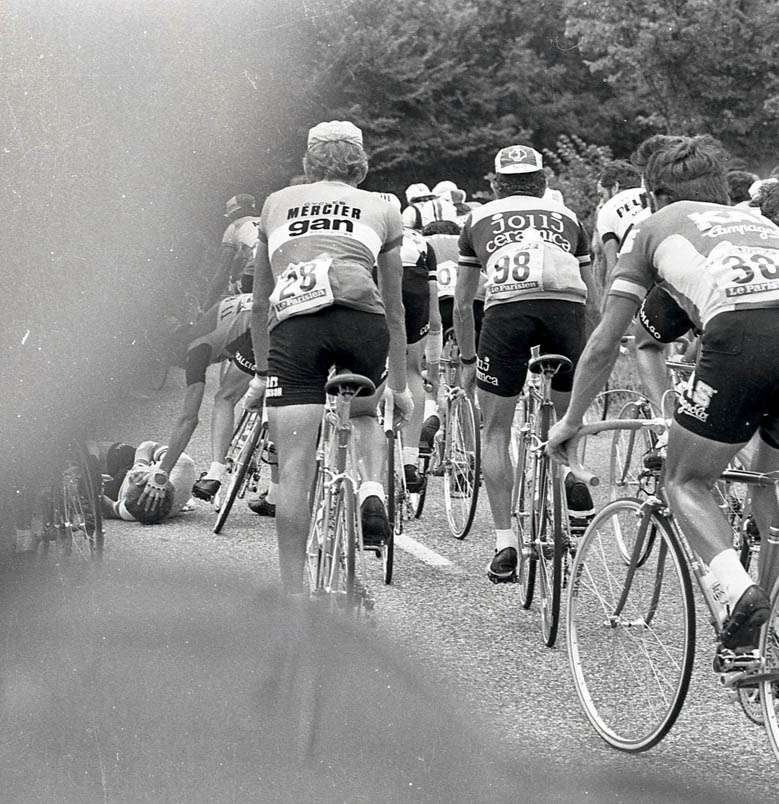
The day after Saint-Gaudens. The stage to Saint-Lary-Soulan is only 13 kilometres old when Hennie Kuiper slams into the road. Gerrie Knetemann gets off his bike to give first aid
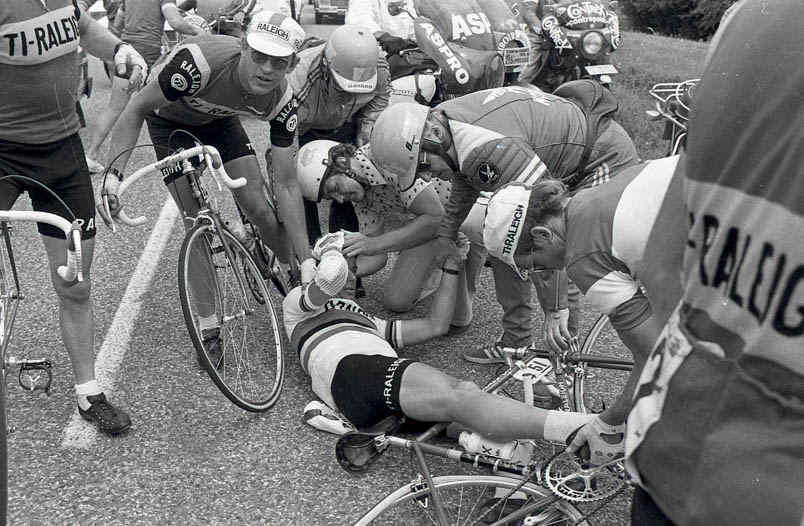
The TI-Raleigh team take care of the fallen world champion. Jan Raas tries to free Kuiper’s right foot from the toe clip
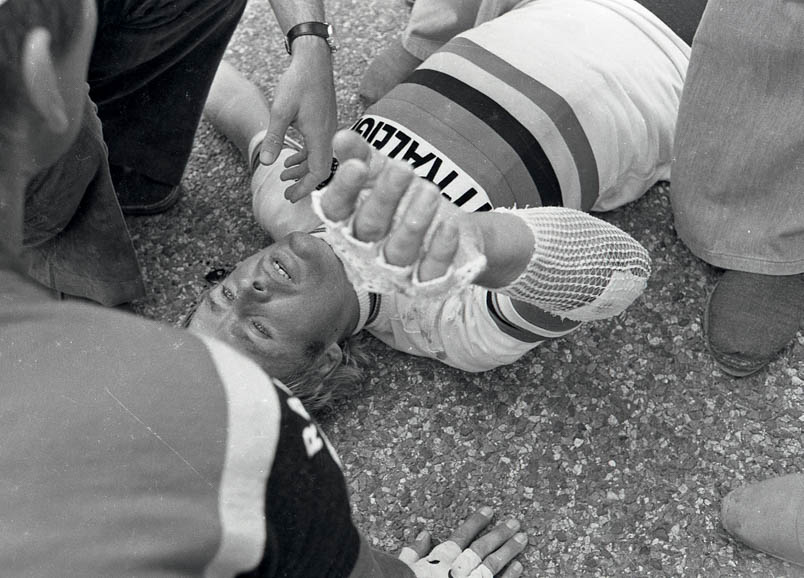
The world champion raises his right hand in despair
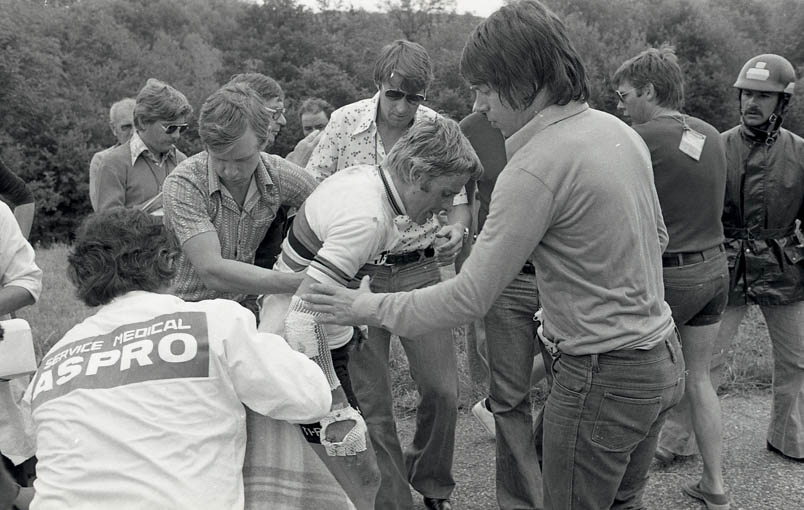
Tour doctor Gérard Porte puts both arms around Hennie Kuiper to help him to his feet. Peter Post (in sunglasses) also lends a hand. Journalists come to see how things stand: behind Kuiper on the left, Leo van de Ruit of the ANP news agency, next to him Theo Koomen and, on the far right (with his accreditation on his back), Gerard Koel, Olympic bronze medallist in Tokyo and driver for the Dutch broadcaster NOS
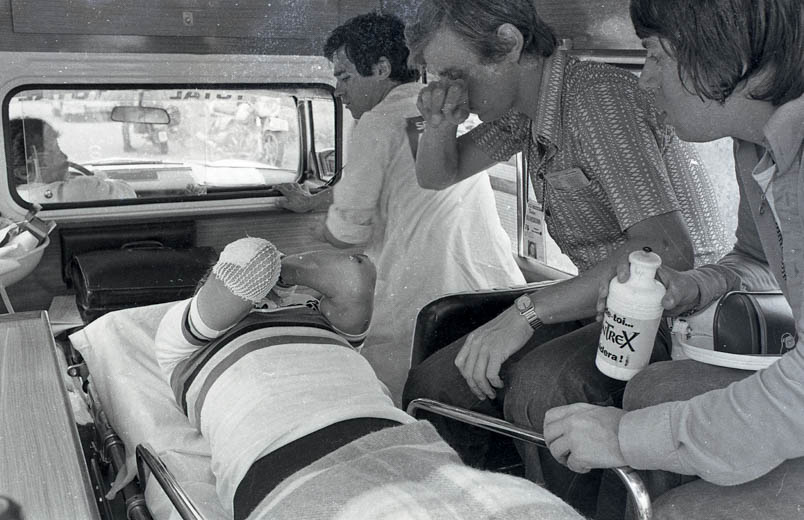
Gérard Porte, wiping the sweat from his face, and Peter Bonthuis, on the far right, go with Hennie Kuiper in the ambulance
Hennie talked down and let down
De Cauwer, the talker of the pair, has worked out a tactic. ‘I wanted to negotiate with Post first and get so much out of him that Hennie and I would both be a good deal better off. I could hold my own against Post.’ But Post sees through the Belgian, beckons Hennie in first and puts him under heavy pressure. Hennie must understand that he, Post, has a very expensive team to fund, that his budget is not made of elastic, and that next year Hennie will no longer be riding in the peloton as world champion. In short: he can no longer pay him the eighty grand he is getting this year. In short: Hennie will have to take a cut. Post sees the dismay in Kuiper’s eyes and brings another argument to bear. Hasn’t Hennie earned good money these past months? Hasn’t the team won a great deal, and doesn’t it look as though it will win even more next year, and so pick up more prize money?
Hennie is talked into the ground. The era in which managers wring the best terms out of teams for their clients (and for themselves) has not yet arrived. The less shrewd types let themselves be talked round by silver-tongued dealers like Post. In the end Hennie meekly nods ‘yes’. Worse still, he also agrees to an extra clause in the contract, which not only ties him to Raleigh for 1977 but also gives Post an option on a contract for the 1978 season. ‘It didn’t feel right, but I was no match for him,’ says Hennie.
It gets even worse. Hennie pleads for a pay rise for his great helper, José De Cauwer, who has a basic contract of fifteen thousand guilders for a whole year’s riding. Three thousand guilders more hardly seems excessive, but Peter Post thinks otherwise. ‘De Cauwer is your domestique, isn’t he? If you think he ought to earn more, you can pay him yourself.’ It hurts Hennie to hear his directeur sportif reason like that. Post is not one for pats on the back at the best of times, but an employer can also show his appreciation through a rider’s pay. But Post will not budge. And so Hennie closes the door behind him with nothing to show for it and a bitter taste in his mouth.
As Kuiper comes down the hotel stairs to the floor where De Cauwer is waiting, the Belgian can already sense the storm brewing. Well? Yes, Hennie has signed for two years. And what about him, José? ‘It’s up to you now,’ Hennie replies. The Belgian has little choice but to put his own signature to a two-season deal for the same meagre salary as the past year. After all, they both want Kuiper-De Cauwer Ltd to carry on. Hennie because he needs De Cauwer, and José because Kuiper always negotiates a start in the criteriums for him too. Both of them feel more or less short-changed, and they make a pact: ‘We’re out of here. This is the last time we sign for this team.’ That is the final decision of Kuiper-De Cauwer Ltd that evening.