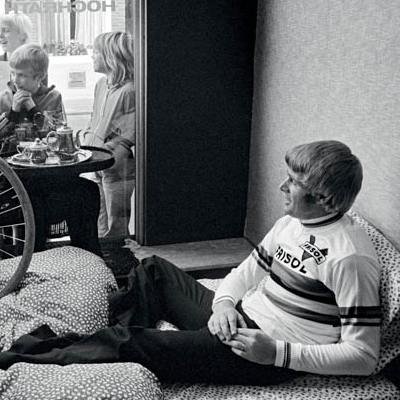
Hennie’s day of vengeance
On the evening before the World Championships Hennie rings his friend José to ask what he expects. ‘The way you’re riding at the moment, you should be able to make the top ten.’ Hennie has his answer ready at once. ‘Top ten? Then I can win it, too.’
Blimey.
Kuiper has days when he manages to push his limits towards the impossible. 31 August 1975 is one of those days. For Hennie it is the Day of Vengeance, just as 7 September 1972 was. On that September day – during the Games – he took his revenge on the coach and the selectors who in the years before had refused to pick him for the world championship team. He would damn well show them what he could do. And show them he did, on the Olympic course in Munich.
Now, three years later, he has another score to settle, this time with the cycling federation, which a year earlier had quite unjustly kept him out of the race on the gruelling world championship course in Montreal, a course that seemed made for him. He has swallowed the pain, but nursed his anger, and for a whole year he has worked tirelessly towards his revenge. Hennie has no intention of creeping quietly into the finale. As early as the first lap he is part of a four-man lead group, which does not last long. He can afford to sit tight while his teammate Karstens is up the road for a long time, but when the decisive lead group forms, he is right there at the front. Three Belgians (Merckx, De Vlaeminck and Van Impe), three Frenchmen (Thévenet, Jean-Pierre Danguillaume and Régis Ovion) and three Dutchmen (Kuiper, Zoetemelk and Gerrie Knetemann) make up the great power blocs within the group; the Italian Francesco Moser is the dangerous outsider. The Spaniard Pedro Torres completes the eleven-man break.
Three laps from the end Michel Pollentier sets a scorching pace on the front. On his wheel: Hennie Kuiper. The group is savagely thinned out. At the top Pollentier and Kuiper have a slight lead. Pollentier swings off; Hennie keeps going and opens a gap, which he steadily extends. Joop Zoetemelk sees it all happen. ‘I thought: let Kuiper make the first move. You never know how it’s going to turn out. If they catch Hennie, there’ll be chances for De Kneet [Gerrie Knetemann] and for me.’ In the little group behind him they look at one another. Nobody is dawdling, the pace is still high, but everyone is watching the favourites, the Belgians. Van Impe rides his own race, the French tailor theirs to De Vlaeminck and Merckx, and the remaining Dutchmen in the lead group do nothing but neutralise every counter-attack. And there are counter-attacks aplenty: from Merckx, from De Vlaeminck and from Moser. Every time, either Knetemann or Zoetemelk slips onto the wheel of whoever wants to launch the chase after Kuiper. Every time, the pace is driven up by those attacks, and every time it stalls again as soon as the attacker sees Zoetemelk or Knetemann hanging on his wheel.
There is no organised chase behind Kuiper. Merckx will not let De Vlaeminck have the world title, and vice versa. Roger De Vlaeminck is at his wits’ end. Surely this is his World Championships? Surely he has more claim to the title than anyone? There is only one rider with the qualities to help him into the rainbow jersey: Eddy Merckx. But the outgoing champion wants to go for his own chance. The other Belgian in the lead group, Lucien Van Impe, is so angry about the humiliation on the eve of the race that at first he refuses to turn a pedal to help Roger.
Then help arrives. The three Frenchmen in the lead group, Thévenet, Danguillaume and Ovion, realise that they stand no chance in this fight for the title. Any attempt of their own to get away will be nipped in the bud by the Dutch as well as by the Belgians, or at any rate by De Vlaeminck. But either you are a professional or you are not: you still want to go home from a World Championships like this with a well-filled wallet.
There is a deal to be done, for De Vlaeminck wants so badly to be champion, doesn’t he? He needs help in his pursuit of Kuiper, doesn’t he? And that help is offered to him, as photographer Tonny Strouken hears from Bernard Thévenet the next day. Nothing comes for nothing. And a great deal comes only for a great deal of money.
The exact sums remain shrouded in mist. Roger thinks it is a lot, but not prohibitive. There is, however, another problem. The agreement is that the Belgian teammates will be paid if one of their men becomes champion. So on top of that comes at least the same bonus again for the other Belgians, who have in no way behaved like teammates. All in all, that makes an unimaginably large sum. What is more, De Vlaeminck cannot bear the thought of having to pay Merckx (who finished 8th), Van Impe (9), Verbeeck (13), Dierickx (20) and Maertens (21) for his rainbow jersey when not one of them has lifted a finger to help him. And so he tries on his own, but time and again he finds Knetemann or Zoetemelk on his wheel, snuffing out every individual attempt and so shielding Kuiper’s break to perfection.
The Dutch ride as a team, true to the agreement made the evening before. Zoetemelk and Knetemann would of course rather win themselves, but they would sooner see Kuiper win than Merckx or De Vlaeminck. Besides, as they see it, it is good for Dutch cycling. At the start of his break Hennie is not thinking about winning at all. ‘I wanted to make the race hard.’ He still has 28 kilometres to go when he leaves the rest of the lead group behind. In his familiar angular style Kuiper drives up the climbs at a furious pace. Behind him they are anything but idle. Merckx, Moser, De Vlaeminck, Danguillaume: every one of them hopes to close the gap to Kuiper in one mighty surge. De Vlaeminck comes closest, but he cannot shake Joop Zoetemelk off his wheel. Hennie holds on all the way to the line. He can hardly believe it. And the Belgian fans won’t believe it. There is a deathly silence at the finish. Belgium is in mourning. De Vlaeminck, runner-up in the title race, crosses the finish line with tears in his eyes. Afterwards De Vlaeminck and Moser make it known that they do not think much of the idea that someone with such a modest record will now wear the rainbow jersey for a whole year.
Pilgrimage
Every cycling fan in the Netherlands follows the championship on Dutch or Flemish television. In the Kuiper family, too, nearly everyone is glued to the box. But father Gerard and mother Johanna know nothing about it. At the very moment their son crosses the line victorious in Yvoir, they are attending Benediction in the church at Kevelaer. That service marks the end of the annual pilgrimage to Kevelaer, on which Gerard and Johanna always go. That their son Hennie is riding the World Championships is all very well, but it is no reason to miss the pilgrimage. When the coach carrying the pilgrims arrives back in Denekamp at the end of the day, the Kuiper parents are told the news. ‘Heard, have you? Hennie’s world champion.’ Only when everyone, the parish priest included, confirms the news do the parents believe it. ‘Oh, nooo…?’
Of course the parents are enormously proud of their son Hennie. But his mother stresses that all her children are the same to her. ‘If you’ve been given a gift by Our Lord, you have to use it. World champion? Wonderful, but he mustn’t go thinking he’s bigger than Our Lord now. I’ve always taught my children not to forget their prayers. The parish priest sometimes says: “That son of yours has stayed so down to earth.” Then I answer: he gets that from his father and me.’
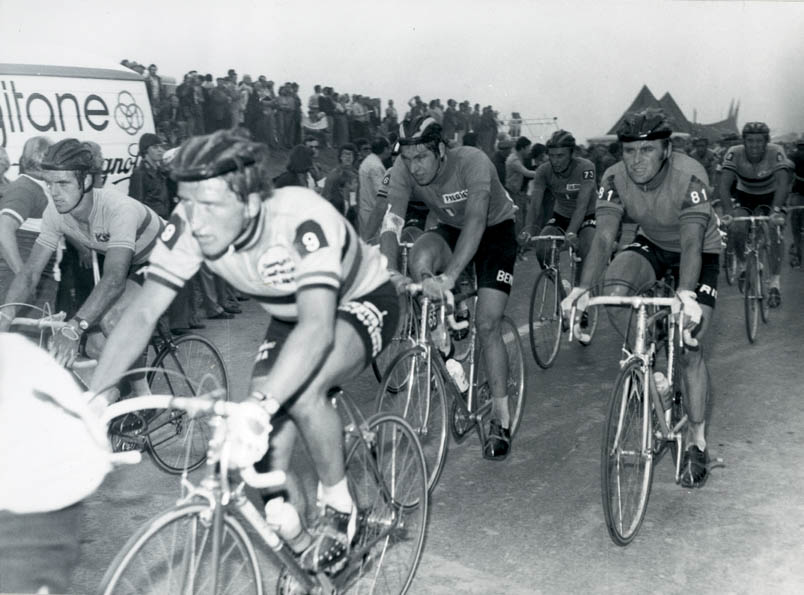
The big names of the race seek each other out at the 1975 World Championships. From left to right: the Spaniard Domingo Perurena, Freddy Maertens, Francesco Moser, the Italian Roberto Poggliali, Hennie Kuiper and Roger De Vlaeminck
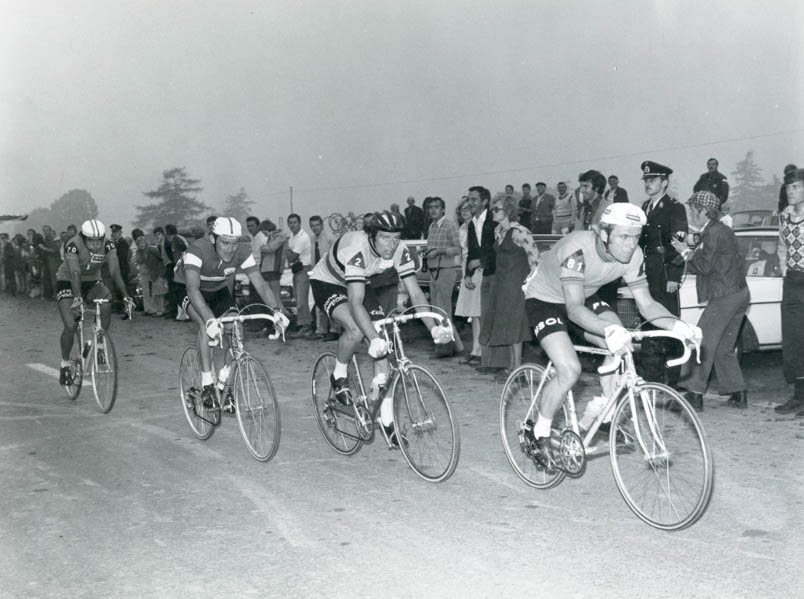
During the world championship road race Hennie Kuiper rides past his wife Ine (wearing glasses, just behind Kuiper on the left). The little group also includes the Belgian Willy Teirlinck, the Frenchman Yves Hézard and the Italian Giovanni Cavalcanti. Hennie is on the attack from the very first lap
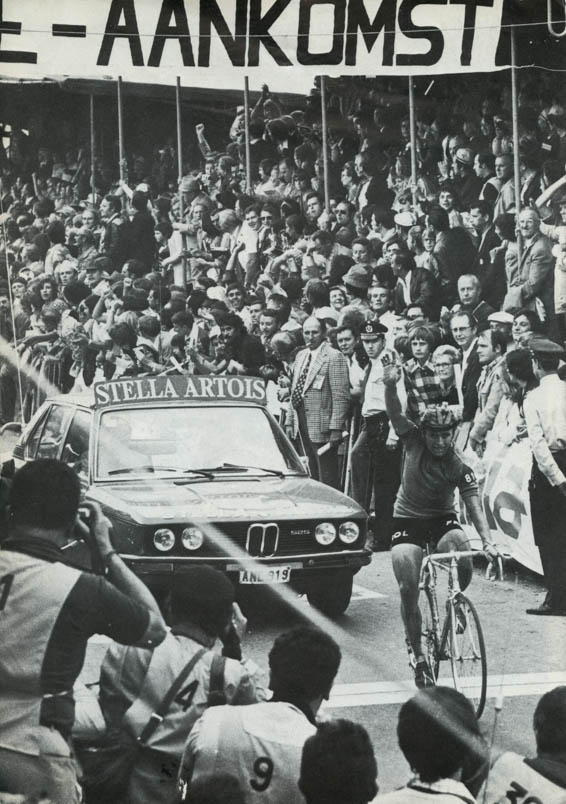
Hennie Kuiper crosses the line in Yvoir with his arm outstretched. But the mainly Belgian spectators do not exactly share in the new world champion’s joy
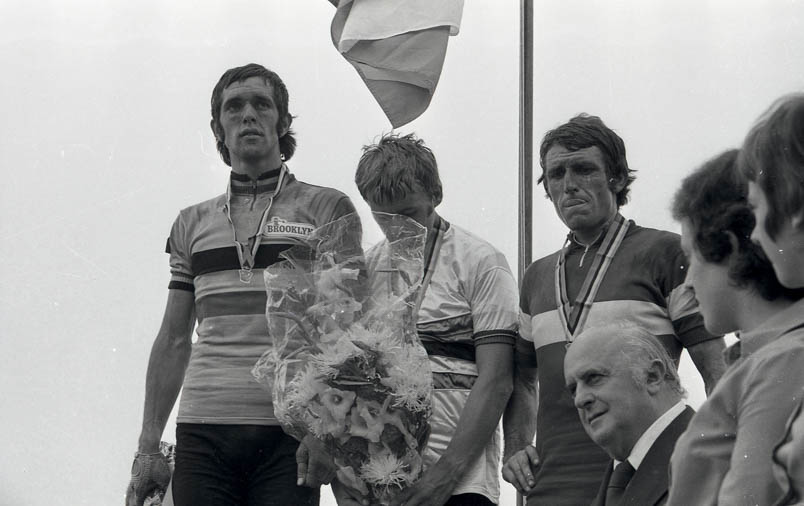
The disappointment does not just drip but pours off the podium in Yvoir. While world champion Hennie Kuiper listens to the Wilhelmus, the Dutch national anthem, Roger De Vlaeminck (left) stares at a point somewhere beyond infinity, and Jean-Pierre Danguillaume (right) is evidently still running a very different scenario through his head
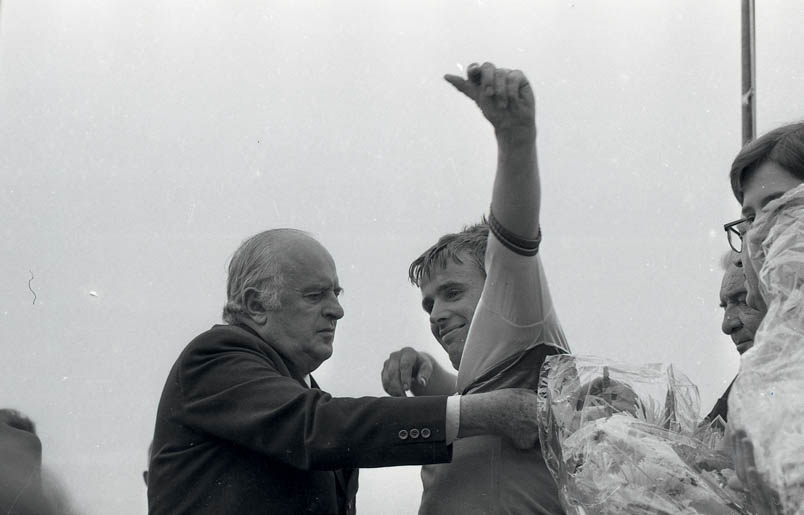
Hennie Kuiper is helped into the rainbow jersey by Adriano Rodoni, president of the international cycling union, the UCI
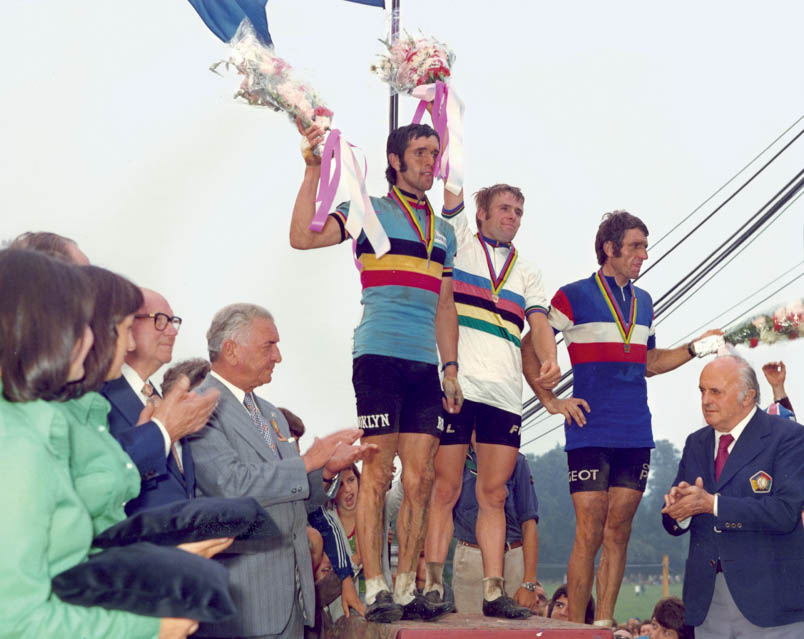
In the middle of the fields, on a podium by the roadside, it finally sinks in for Hennie Kuiper, in the form of a smile. Flowers, a gold medal and the rainbow jersey: it really is true – world champion!
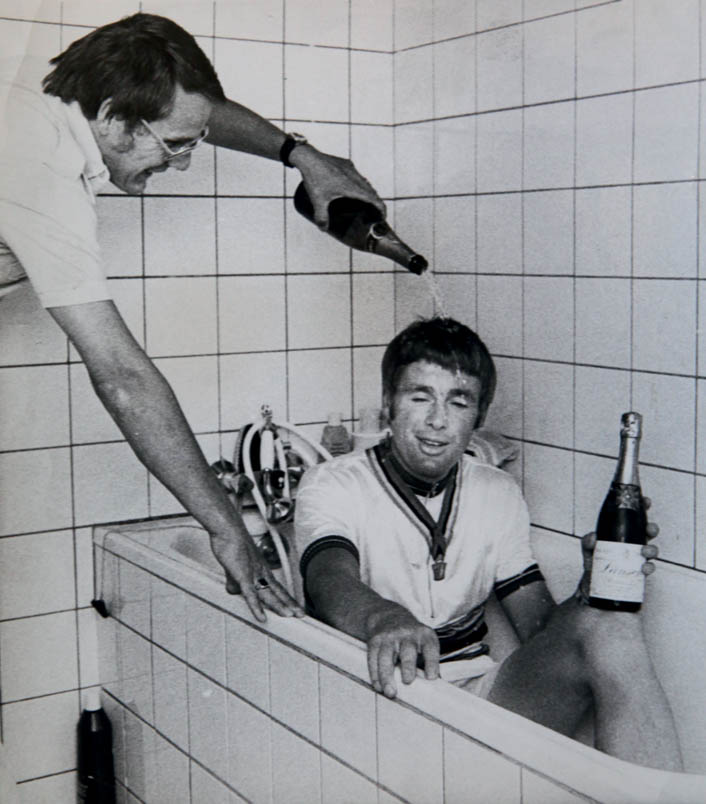
The world champion takes a bath, and national coach Jan Janssen is not sparing with the champagne
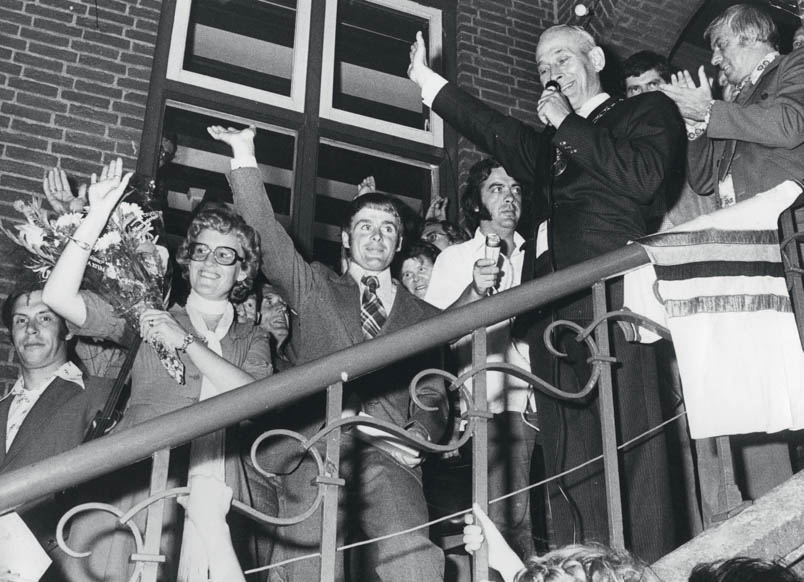
On the steps of Ossendrecht town hall Hennie Kuiper is addressed by mayor André van Gils (right) and cheered by the local people. To Kuiper’s right, the head of his mother Johanna can just be seen. To her right, Frits Bom, reporter for VARA’s Dingen van de dag
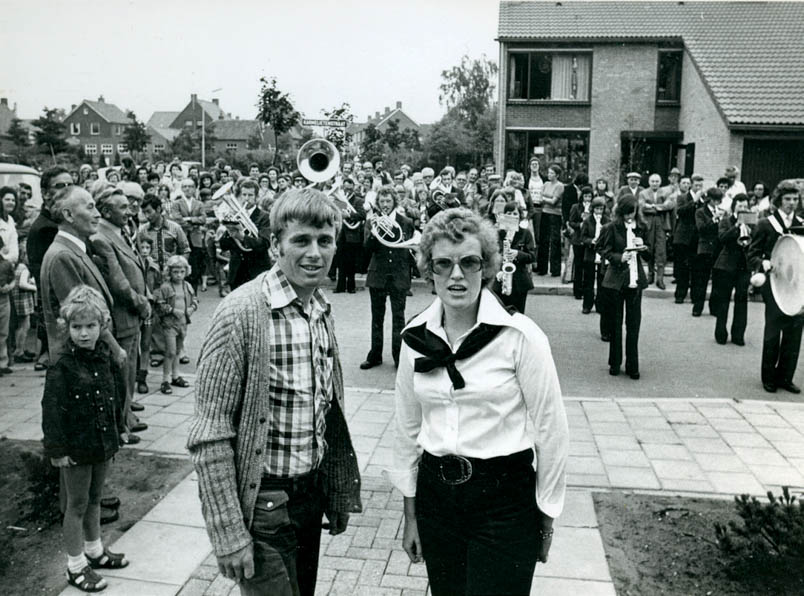
On their return home to Ossendrecht, Hennie and Ine Kuiper are treated to a musical tribute
José and the cognac
José De Cauwer is at home in Temse with his father, the two of them glued to the television, while his team leader is fighting out his world championship race. Between the two men stands a bottle of cognac. By the time José’s team leader crosses the finish line in triumph, the bottle is just about empty. Afterwards De Cauwer listens to what the television reporters and rival riders have to say. The next day he pores over the reports in the Flemish papers, where the verdict soon runs: ‘Kuiper was only able to hold on because Merckx and De Vlaeminck raced against each other in this championship.’ But José knows better: this title is no gift. This title is Hennie Kuiper’s by right. He has put in a colossal amount of work to get this far. And on race day he is the best. The very best. The day after, De Cauwer tells the new champion that he does not yet grasp everything his new status involves. ‘It’s only just beginning. A year from now, when Hennie takes off the rainbow jersey and someone else is riding in it, he’ll realise what it all meant. Then he’ll say, a little amazed: was I the one who rode around in that jersey for a whole year?’ For Hennie, José knows, ‘that’s inconceivable.’
The Belgian media tear Hennie Kuiper to pieces. They brand him the new Harm Ottenbros, the Dutch rider who sprinted for the title against the Belgian Julien Stevens in 1969. Ottenbros is regarded as the biggest surprise of any post-war World Championships: a rider who, in the eyes of many, had absolutely no claim to the rainbow jersey. In the opinion of many Belgians, Hennie is no more worthy of the title. There is no surer way to fire Kuiper up than to belittle him. He, Hennie Kuiper, not a worthy world champion? Well, he will show them.
In the 1975 Paris-Brussels, an autumn classic, a stiff wind is blowing. The field breaks up into echelons, and echelon riding is not exactly Kuiper’s speciality. José De Cauwer knows that too. He picks Kuiper up somewhere at the back of the field, steers him onto his back wheel and for kilometres on end acts as a windbreak for the brand-new world champion, racing meanwhile from one echelon to the next. In the end De Cauwer neatly delivers his team leader to the first echelon, where, alongside the stars Maertens, Merckx and Verbeeck, teammate Cees Priem has also found a home. Hennie eventually finishes seventh and has achieved what he set out to do. The new world champion has shown his jersey.
Flanders and Twente
Sponsor director De Vries, who at first denies that only a few months earlier he wanted to be rid of Kuiper, hopes all the same to cash in on some publicity from the rainbow jersey before Kuiper’s transfer to Post’s TI-Raleigh team. He has a letter written to Hennie, asking him to pay rather more attention to his clothes. Teammate José can see the point. Not that Kuiper’s clothes look worn out – no, it is all perfectly sound and neat – but they are clothes that went out of fashion five to ten years ago. That does not befit the stature of a world champion.
In those days De Cauwer wears a dark brown, fitted leather jacket. Under it, a navy suit with a light blue shirt and a navy tie. All in the fashion of the day. Hennie looks his teammate up and down and says: ‘I like that. Where did you get it?’ Well, at such-and-such a place. ‘Then I’ll go and buy the same.’ José protests loudly. They are already the same height, and now they are going to turn up everywhere in the same clothes as well? The Belgian thinks that is out of the question. ‘Then we’ll be the Spick and Span duo.’ But Hennie sticks to his plan. Two or three years later De Cauwer no longer thinks the leather jacket is quite so perfect. It has gone a little out of fashion, and he buys himself a new one. Not so Hennie. Five years later he is still walking around in that same jacket. After all, it is nowhere near worn out, is it? It is the cultural difference between a pleasure-loving Belgian and a rather stiff Tukker, as people from Twente are known – and there is, José believes, nothing wrong with that. That cultural difference between Flanders and the Netherlands – or rather, between Flanders and Twente – had already struck De Cauwer on earlier visits. When tea or coffee is served in Flanders, there is a big dish of all sorts of things on the table. You take whatever you like, and when the dish is empty it is filled up again.
In Twente things are done very differently, as José finds out on his very first visit. There the biscuit tin is opened briefly, you take one out, and before you know it the lid is back on the tin. He still remembers opening the tin again himself after his first biscuit and taking out a second. He can still see Hennie’s face, a look that betrayed both bewilderment and disapproval. ‘What do you think you’re doing, in front of my family?’ Well, it takes some getting used to. In Twente you wait until the tin comes round again; in Flanders you help yourself for as long as you are hungry. For a long time De Cauwer is under the impression that the Netherlands, all the way to the far corner of Twente, is a land of oysters and mussels. Even before his first trip up there he is looking forward to it. After all, Flanders imports that seafood from Zeeland by the ton. The idea turns out to be completely wrong. In Twente he finds none of it: no mussels anywhere, and not a single oyster.
When Hennie’s youngest brother Jos gets married in the winter after the World Championships in Yvoir, José is among the guests. There is also a reporting team from the Belgian sports magazine Sport 70, among them Rik Van Looy, the undisputed emperor of cycling in the sixties. In Catholic Twente the day begins with Holy Mass. De Cauwer and the Sport 70 team cannot believe their eyes when, during the Mass, the world champion steps forward and, together with his brother Gerard, sings the Ave Maria perfectly in tune. ‘Unthinkable where we come from,’ they say. But for Hennie it is the most natural thing in the world, just as earlier, at his brother Frans’s wedding, he served as altar boy together with Bennie. After the Mass the bride and groom and their guests move on to the function room. To the Belgians’ astonishment the room empties towards five o’clock. ‘What’s this, then?’ It turns out that the farming families have to go home to milk the cows. Towards nine in the evening they come back to the party. They drink a beer, and another, and another, and then one more. Just as the Belgians start rubbing their hands – now the party is really going to get going – the room empties again. By midnight everyone has gone. The farm, after all, is waiting the next morning: the cows need milking again. And that is the end of the party. In Flanders they party on until four or five in the morning.
Twente turns out to be a different world altogether
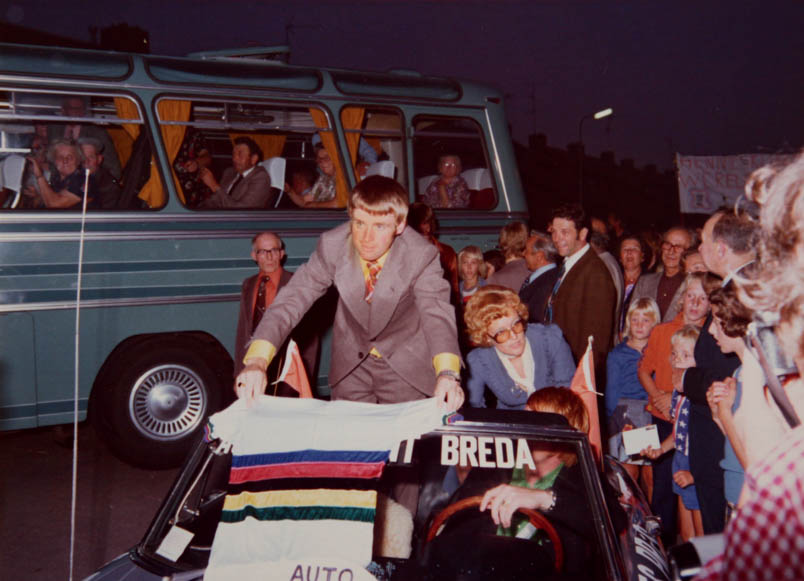
On an evening tour of Ossendrecht, Hennie Kuiper shows the rainbow jersey to his fellow townspeople
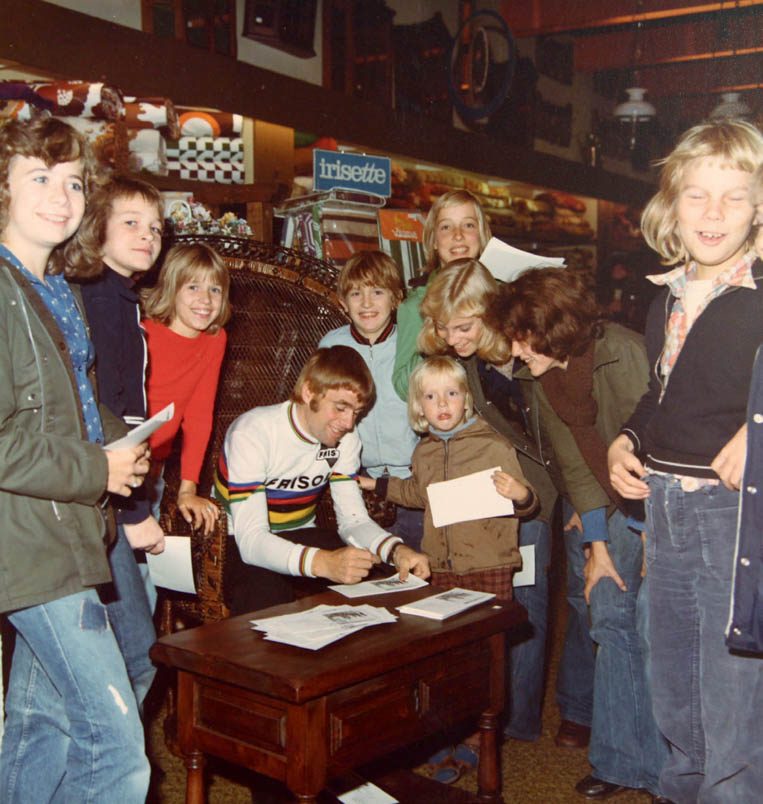
In a furniture shop in Winterswijk, Hennie Kuiper happily signs autograph cards for the local youngsters
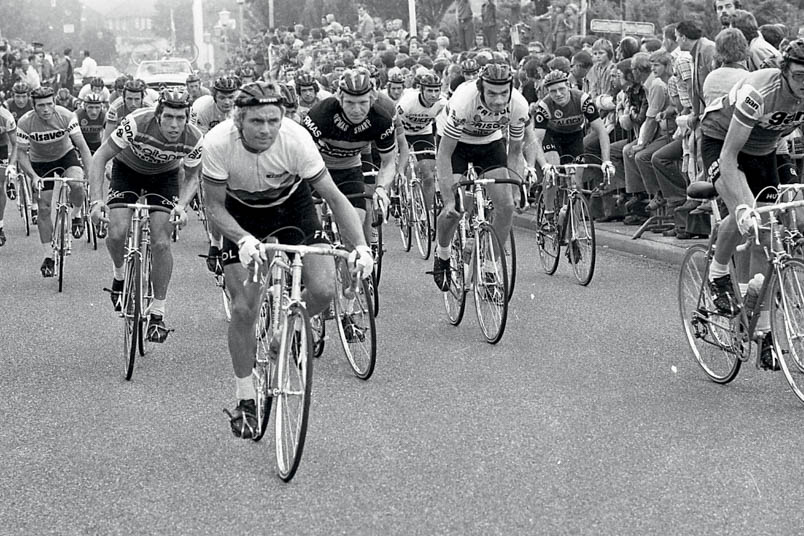
Hennie Kuiper’s first race in the rainbow jersey is the criterium on the Kollenberg in Sittard. Bennie Ceulen is on Kuiper’s wheel. From left to right: Aad van den Hoek, Jan van Katwijk, Tino Tabak, Joop Zoetemelk, Bennie Ceulen, Bernard Thévenet, Hennie Kuiper, Don Allan, Jos Schipper, Henk Prinsen, Jacques Esclassan, Albert Hulzebosch, Bert Pronk and Gerrie Knetemann
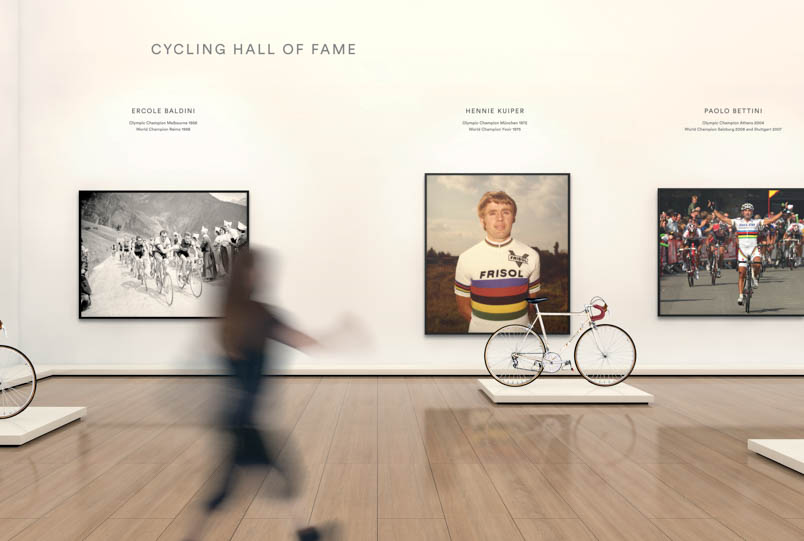
Only a handful of riders have had the honour of being reigning Olympic and world champion at the same time. Hennie Kuiper (centre) is one of them. Ercole Baldini (left) and Paolo Bettini (right) are the other two
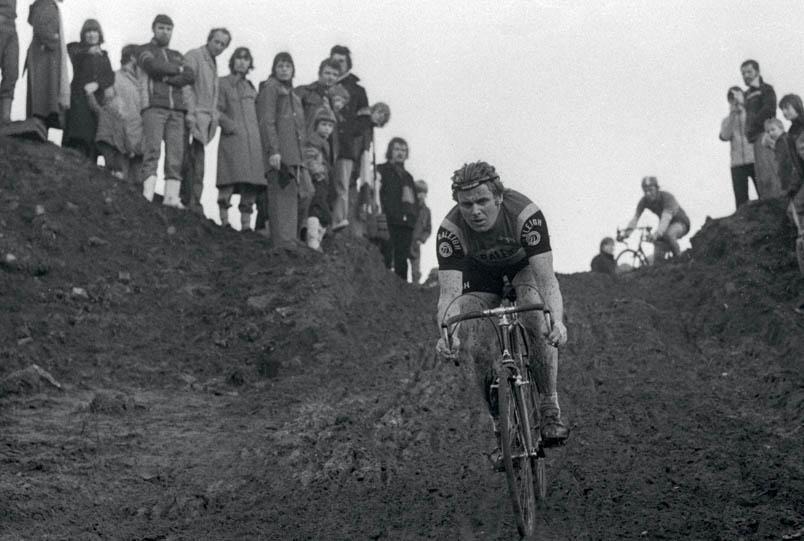
Hennie Kuiper is a highly gifted cyclo-cross rider, who takes the national professional title in both 1974 and 1975. In 1976 he gives it up because he feels that the world road title brings other obligations. Purely for training (he finishes thirteenth), Kuiper does still ride in Oss in January of that year. Cyclo-cross gives Kuiper bike-handling skills that serve him perfectly, particularly in Paris-Roubaix