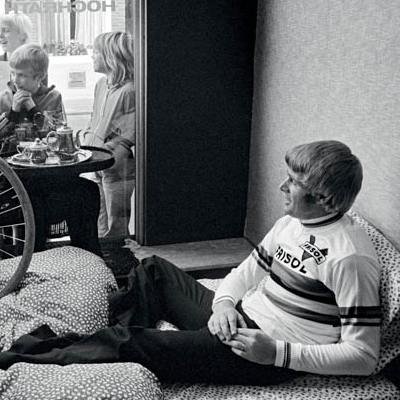
Kuiper and Post: clashing characters
There are no tears when he leaves Frisol. The atmosphere in the team may be friendly enough, and directeur sportif Piet Libregts is a decent, humane sort, but he is no match for the will of team director Nico de Vries. Despite the successes, Kuiper’s above all, De Vries only ever has eyes for one rider: Fedor. As an amateur Fedor was indeed the best in the world, but, as Hennie rightly says: ‘Later, as a professional, he wasn’t honest with himself.’ The move to his new directeur sportif, Peter Post, begins with a period of mutual sizing-up. Kuiper and De Cauwer, who has made the switch to Raleigh along with his team leader, know the stories about Post. They know Post is mad about money, but they have their contracts in their pockets, so on that score there is little to worry about.
The atmosphere in the team is different from Frisol’s. Peter Post is building a team that is meant to play not just a leading role in the peloton, but the leading role. That calls not only for a stronger line-up than Frisol’s, but for a different atmosphere too. Plenty of riders in the team are no strangers to cockiness. The Amsterdammers – Peter Post and Gerrie Knetemann – make themselves heard; the last thing you could call Gerben Karstens is modest. And the Zeelanders – Jan Raas and Cees Priem – leave their mark on the team too, not least through their often coarse language. That kind of talk has no place in Hennie’s vocabulary. That is not how Hennie was brought up. Never has a blasphemous word passed his lips. He soon sees that only one place will satisfy Peter Post: first. Anything else he regards as failure. Post: ‘Second places don’t count. They’re nothing, absolutely nothing.’ Winning, winning and more winning. That is what he demands of his riders, and what Post wants for himself. Winning at everything, to the point of absurdity. That becomes clear, for instance, when the Raleigh riders take a ferry from a race in southern Spain across to the Spanish enclave of Ceuta, in the north of Morocco, to ride a stage there. The riders kill time playing cards: pontoon. Peter Post joins in, and is hungrier to win than anyone. But Hennie turns out to be the star of the table. He twists at just the right moment; sticks at just the right time. He wins and wins and wins. To the growing frustration of the directeur sportif. The ferry has already docked and the passengers are being asked to disembark, but Post refuses to stop. Surely he, the great Peter Post, grandmaster of the card table, cannot lose to Hennie! The big boss of the Raleigh team works himself up more and more. He loathes losing. But he keeps on losing. Seething, he walks off the boat. His day is ruined. Hennie is baffled: it’s only a game, isn’t it? Peter Post simply cannot lose. Hennie puts it in perspective: ‘Having a character like that has plenty of advantages too.’
Keen on money
In his first months at Raleigh, Hennie has a top soigneur in Gust Naessens, a man who has worked with just about every great name in cycling, from Coppi to Merckx. Naessens teaches the young and ambitious Ruud Bakker the tricks of the trade. He works mainly with his ‘champion’, Hennie, for whom he has great respect. Even at that early stage Kuiper discovers just how keen Post is on money. True, every rider is paid his basic salary and his bonuses correctly and on time, but any extra expenses the riders have to cough up themselves. Hennie wants an extra training camp in the spring of 1976? Fine, says Post, but then he pays for it himself. ‘It was your idea, wasn’t it? Then you can settle the bill yourself.’ Naessens, an old hand, is dumbfounded. It is one of the reasons he leaves Post, a man he knows inside out from the winter track. Post the directeur sportif turns out to be a different man from Post the rider.
Kuiper wears the rainbow jersey, but off the bike he does not carry himself like a world champion, just as he did not after his Olympic title. He is still the shy Tukker – as people from Twente are known – who struggles to get his words out. It is just as well that his friend José De Cauwer steps in to speak up for him. On the bike, however, Hennie lets his legs do the talking. And those legs speak plainly. He finishes second in the Ruta del Sol (Tour of Andalusia), behind his teammate Knetemann. He is second again in the Omloop Het Volk, where he silences his Belgian critics – who still do not see him as a true world champion – by claiming the leading role in the race. When Kuiper breaks away in the Omloop Het Volk, Willem Peeters goes with him, but Peeters is riding for his team leader Frans Verbeeck and does little more than sit on the Dutchman’s back wheel. In the peloton behind them are Merckx and De Vlaeminck, among others, who mostly have eyes only for each other – though not so much, as Hennie puts it, that they wear out their brake blocks in this race. Throughout the spring of 1976 Hennie is in the front line everywhere. He wants to show the rainbow jersey at the front of races and refute the biting criticism, above all from the Belgians. Not a worthy champion, him? He has already racked up an imposing list: second in the stage race Paris-Nice, fifth in both the Amstel Gold Race and Liège-Bastogne-Liège, and above all fourth in the Queen of the Classics, Paris-Roubaix, where he and the acknowledged cobbles specialists Roger De Vlaeminck, Francesco Moser and Marc Demeyer form the elite quartet that comes thundering towards the velodrome in Roubaix.
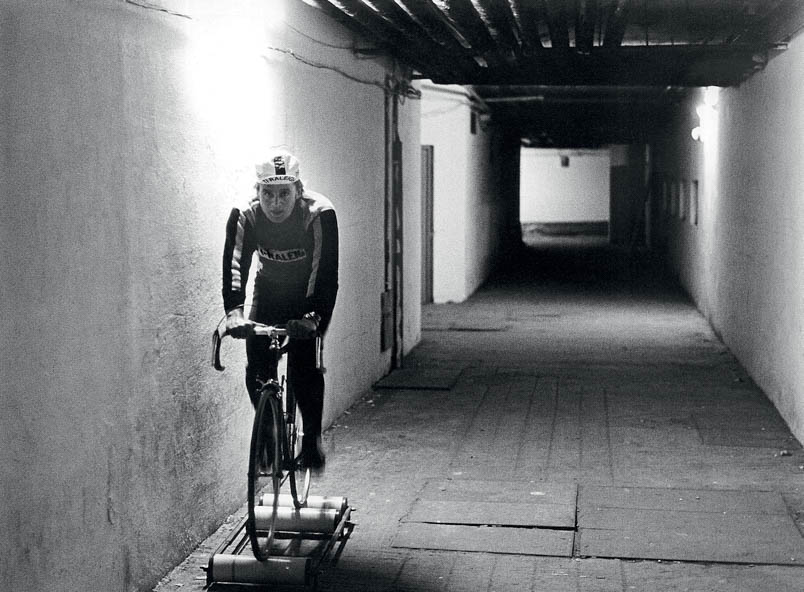
In the hotel basement in Estepona on Spain’s Costa del Sol, Hennie Kuiper prepares for the 1976 season on the rollers. It will be a hard season, for Kuiper above all, predicts directeur sportif Post: ‘Hennie will have to prove that the rainbow jersey was no fluke’
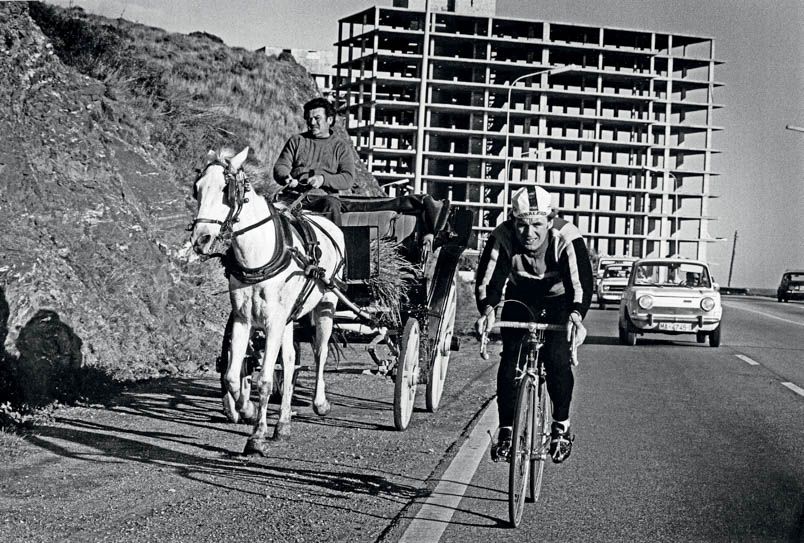
For Hennie Kuiper and the Raleigh riders, the 1976 road season begins on 8 February 1976 in rural Estepona – south-west of Marbella – with a training camp ahead of the Ruta del Sol
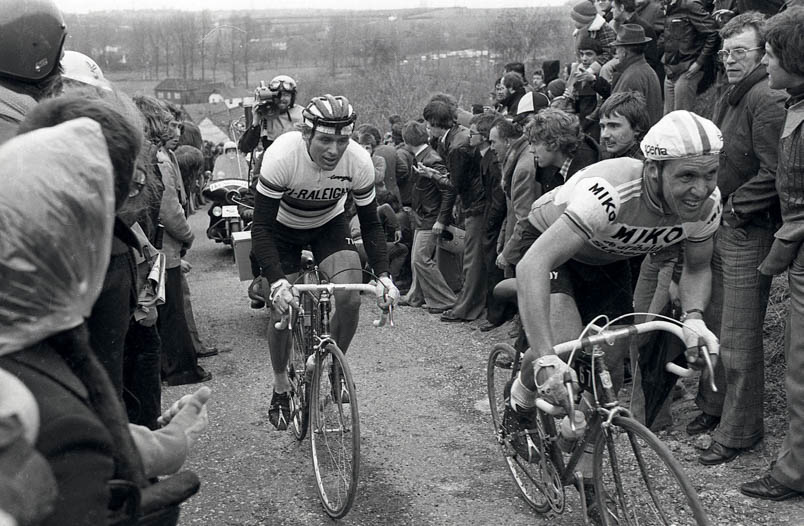
In the first big race of 1976 on Dutch soil – the Amstel Gold Race – Hennie Kuiper is alert from the start, as here behind the Belgian Luc Leman
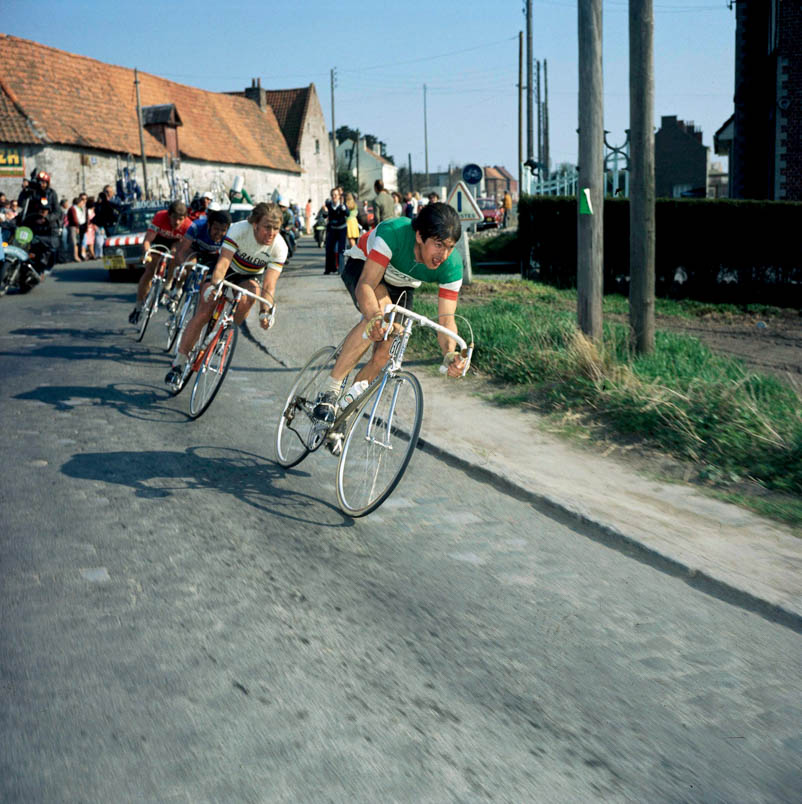
Paris-Roubaix 1976 enters its decisive phase. Francesco Moser opens the throttle. Kuiper follows. Roger De Vlaeminck is third in line, followed by Marc Demeyer
Vuelta
After the classics, the focus shifts to the big stage races. The year before, it had already become clear that the Vuelta suits Hennie. Until shortly before the end of that prestigious stage race he was in contention for overall victory. But a mechanical problem knocked him back down the standings. In 1976 Kuiper starts from a much stronger position. He is part of the Raleigh team, which is establishing itself ever more emphatically as one of the leading outfits in the peloton. His German teammate Didi Thurau, increasingly directeur sportif Post’s ‘blue-eyed boy’, makes a big impression, not only riding seven days in the yellow leader’s jersey but also winning three stages, before Hennie takes over the lead in the general classification from the Portuguese Joaquim Agostinho on stage 17. On the penultimate day the stage heads up a five-kilometre climb to Santuario de Oro. A group of nearly forty riders, including Kuiper and his teammates Bert Pronk and Didi Thurau, heads into the finale. But just as the road really starts to climb, Hennie suffers the same fate as the year before: his freewheel breaks under the strain.
Didi Thurau does not wait for his team leader, who is leading the race, but simply rides on. ‘He rode straight past me.’ Bert Pronk gives Kuiper his bike. But it is not Hennie’s size. At the top of the climb he is still in the yellow jersey, but his lead has shrunk to two seconds. With Thurau’s help he might have limited his losses, but the German is mainly thinking of himself. And when Thurau goes on to win the stage, taking his tally to four, there is no room for criticism. The next day brings the finale: a morning road stage to San Sebastián and a closing time trial. Kuiper gets nervous and lets himself be tempted into doing something foolish in the morning stage. He – the anti-sprinter – hopes to scrape together some bonus seconds on the velodrome in San Sebastián, where the stage finishes, to shore up his position in the standings. But in the jostling on the track he takes a knock and slams his right hip into the railing. The damage: a massive bruise, and no time to recover before the closing time trial, in which he goes down without a chance. For the second year running, Kuiper misses out on the top prize in the Spanish tour. Didi Thurau’s win in the time trial, his fifth stage victory, only strengthens Post’s growing conviction that his great trump card for the future is not world champion Hennie Kuiper, but the German. Hennie rides the Vuelta only once more, in 1983, finishing fifth, just ahead of future Tour winner Laurent Fignon.
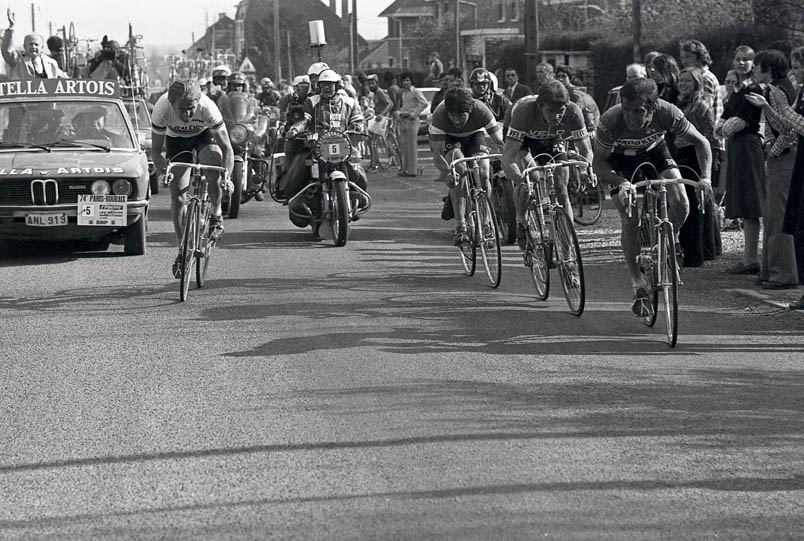
On the right-hand side of the road, deep in the finale, Hennie Kuiper has a go. But Roger De Vlaeminck is watching out of the corner of his eye and sees Kuiper coming. The eventual winner Marc Demeyer is also poised to counter, and Francesco Moser – sitting at the back of the group – is not going to be caught out by Kuiper either
Seizing power in Switzerland
Yet there is still a glimmer of hope of a leading role for Hennie in the Tour de France when, in the last major stage race before the French tour – the Tour de Suisse – he sees off the opposition in impressive style. It comes down to a duel between Michel Pollentier, leader of the Flandria team, and Hennie Kuiper, leader of the TI-Raleigh team. Kuiper lays the foundations of his overall victory on the Gaflei, the brutal twelve-kilometre climb near Vaduz in the Principality of Liechtenstein. On that final climb the riders have to climb 1,000 vertical metres.
Kuiper attacks, having arranged in advance to change bikes on the climb so that he can ride the final section in a lower gear. It is so steep that halfway up his teammate Didi Thurau turns his bike round, heads back down and is determined to abandon. He is stopped by the German cycling reporter Klaus Angermann. ‘But Didi, you can’t do that. We’ve come all this way with a whole crew to film a feature about you.’ The German turns his bike round once more and, sighing and groaning, sets off up the impossible climb after all. All of this is happening far behind Hennie. He signals for the team car. Soigneur Ruud Bakker, riding with Post that day, takes the spare bike off the car at the agreed spot, swaps the bikes and pushes Hennie off again. ‘Push, push, push,’ shouts Hennie. And the tall blond giant throws all his strength and weight into the task. At the summit Kuiper is 37 seconds ahead of the runner-up, his teammate Bert Pronk, but what matters for the overall standings is the 1 minute 17 seconds he gains on Michel Pollentier. It is his first victory of the 1976 season. It is also a majestic one, a win befitting his status as champion.
Two stages later Hennie does have to give up the jersey, but in the closing 23.5-kilometre time trial in Murten, stage winner Pollentier cannot build a big enough margin to deny the Twente rider overall victory. He is the first and, to this day, the only Dutchman to add this ever-demanding tour of the Swiss mountains to his palmarès. André Romero, the little-known Frenchman who was still in the lead in the penultimate stage, drops to sixth overall after a mediocre time trial.
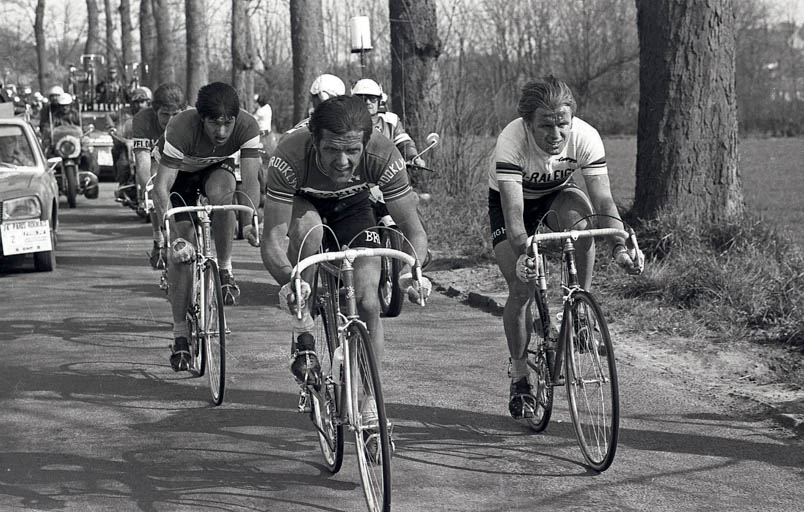
The finale of Paris-Roubaix 1976 is fought out on a knife-edge between – from left to right – Marc Demeyer, Francesco Moser, Roger De Vlaeminck and Hennie Kuiper
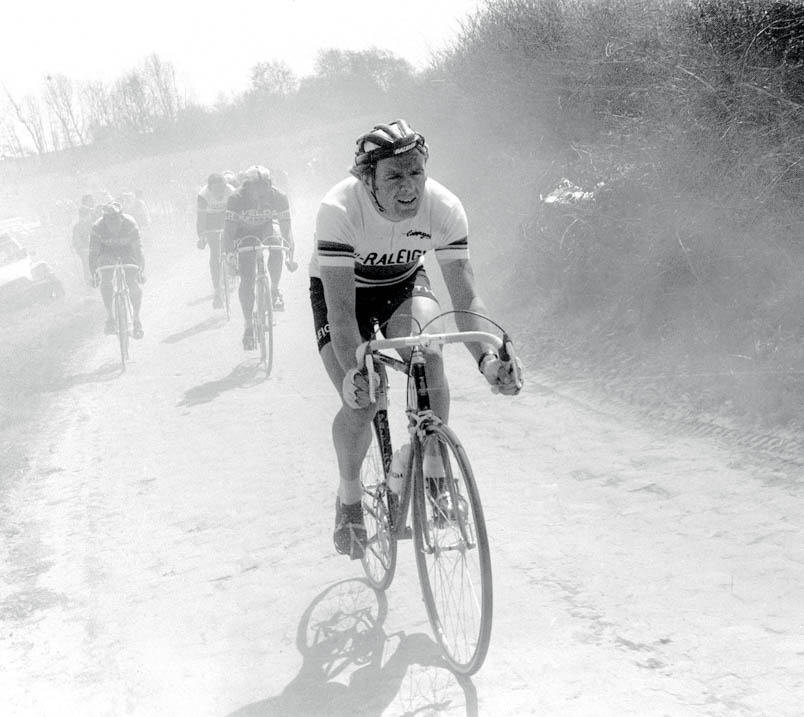
The 1976 edition hardly has typical Paris-Roubaix weather. The drought throws up great clouds of ‘fog’ made of sand and dust. Look very closely and you can see Freddy Maertens and Didi Thurau looming up behind Kuiper
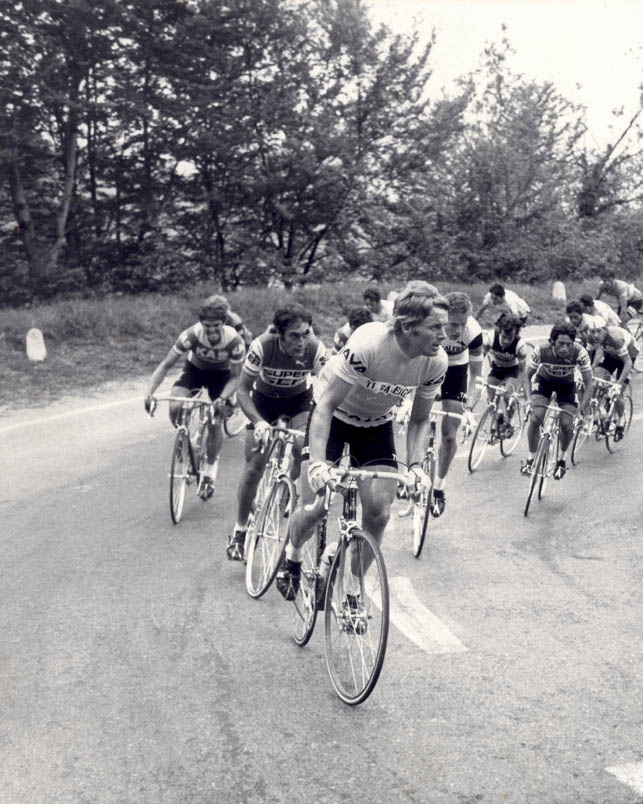
On 15 May 1976, in stage 18 of the Vuelta, Hennie Kuiper, wearing the golden jersey, sets the pace on the road to Santuario de Oro. Behind Kuiper on the left is Luis Ocaña; behind him on the right, the eventual stage winner Didi Thurau
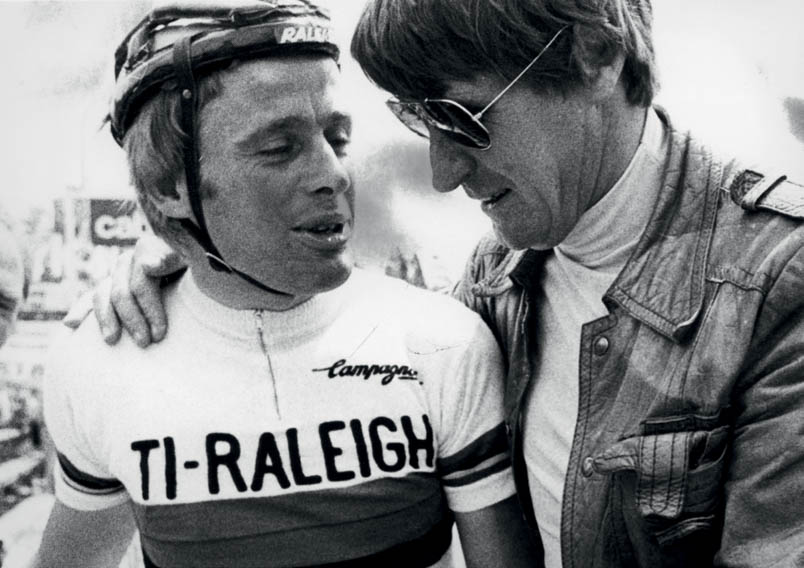
Peter Post puts a fatherly arm around the shoulders of world champion Hennie Kuiper
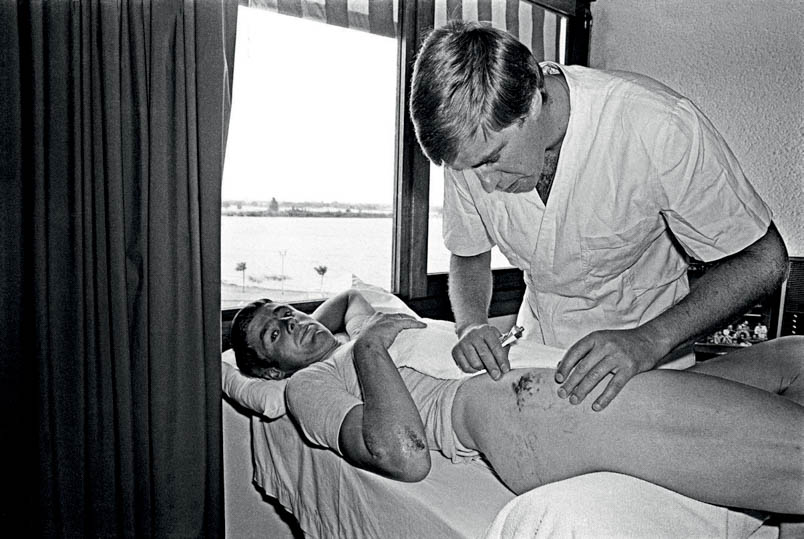
Soigneur Ruud Bakker tends to Hennie Kuiper’s hip, where the traces of several injuries can be seen
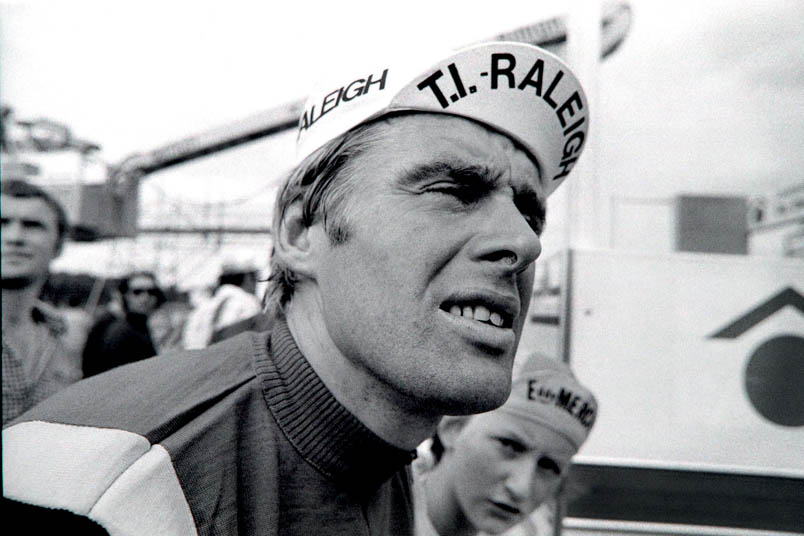
Hennie Kuiper makes his presence felt. Even Eddy Merckx’s fans are spellbound
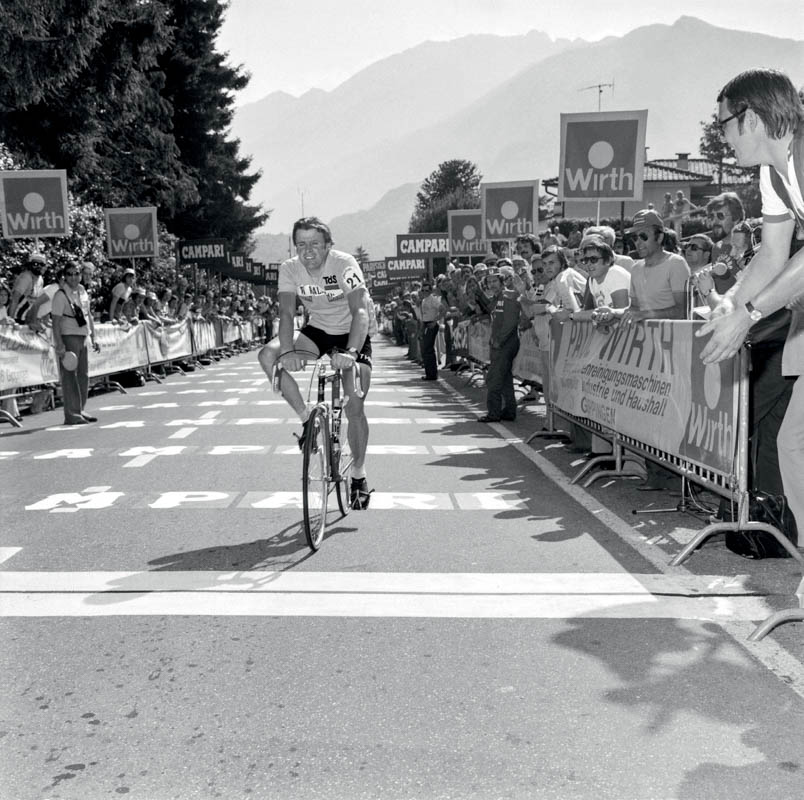
Hennie Kuiper freewheels after the finish of stage four of the 1976 Tour de Suisse, a 108-kilometre stage to Lenzerheide won by his rival Michel Pollentier. In the closing time trial Kuiper will seal overall victory in the Tour de Suisse, the only Dutchman ever to do so
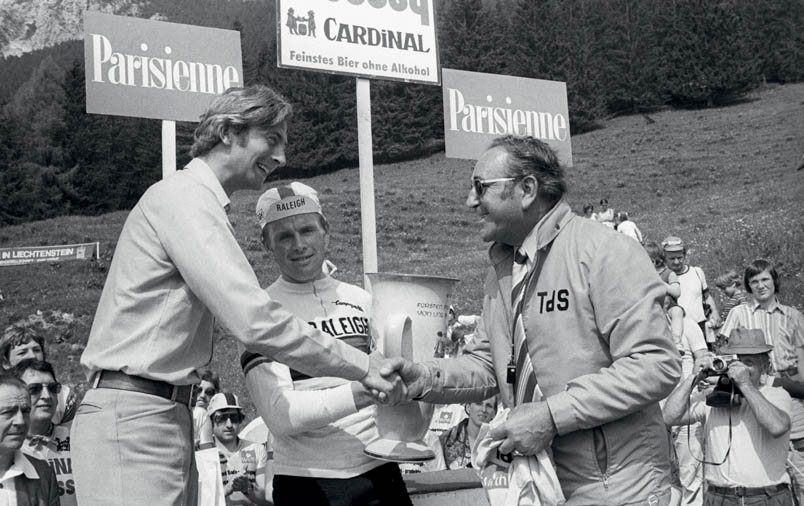
On 12 June 1976 Hennie Kuiper wins the third stage of the Tour de Suisse in Vaduz, capital of the Principality of Liechtenstein, laying the foundations for overall victory. On the podium he is congratulated by Crown Prince Johannes Adam Ferdinand Alois Josef Maria Marko d’Aviano Pius (left, now the reigning Prince of Liechtenstein) and Sepp Vögeli, race director of the ‘fourth grand tour’
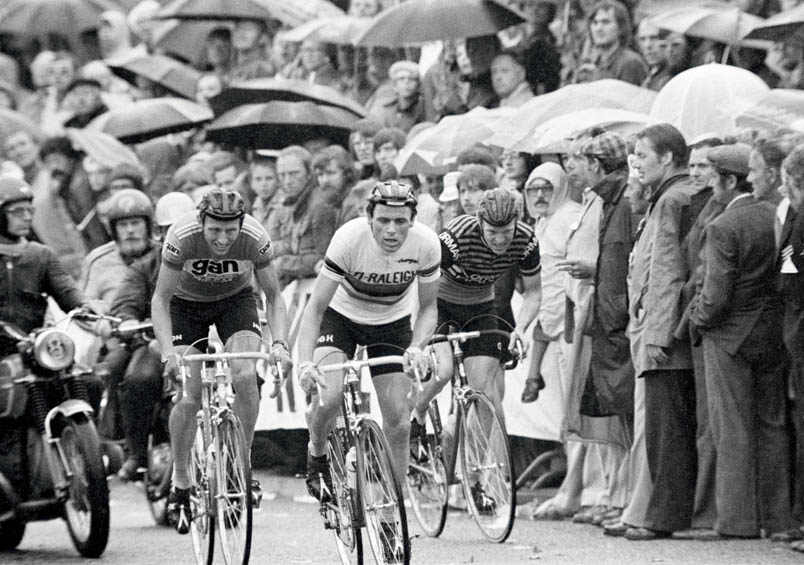
Joop Zoetemelk, Hennie Kuiper and Jos Schipper climb the Hulsberg during the 1976 Dutch national championship in Simpelveld. The course takes in the Hulsberg no fewer than 31 times… Kuiper is clearly ready for the Tour de France