‘Der Didi’: the hero
On the eve of the second stage, as the peloton heads into the Pyrenees, Post makes it clear that defending Didi Thurau’s yellow jersey takes priority. In West Germany ‘der Didi’ is on his way to becoming a hero. The football nation is gathering in front of the television to watch cycling in ever greater numbers. Post follows developments with intense satisfaction. The sponsor’s bosses at Tube Investments in Nottingham let the Amstelveen directeur sportif know that they think the team’s performances in the opening days of the Tour are terrific. The directeur sportif, who always speaks of ‘the firm’ whenever the sponsor comes up, wants to concentrate above all on Thurau. And the interests of Hennie, the team leader? Oh, the Tour still has a long way to go. Hennie’s time will come.
The second stage, from Auch to Pau, is a serious mountain stage straight away. It goes over the Aspin, a second-category climb, and then over the Col du Tourmalet (2,113 metres high) and the Aubisque (1,780 metres): two gruelling first-category climbs. On the Aspin, yellow jersey Thurau still holds his place in the first group, even if the German already has to dig deep to follow the pace. But when the climb to the summit of the Tourmalet begins straight after the descent, he gets into difficulty. Merckx has already had to let go by then, and at La Mongie Thurau is dropped too.
At that moment Hennie is part of a lead group that is thinning out fast. In the end it contains Ocaña, Kuiper, Zoetemelk, Thévenet, Van Impe, Laurent, Delisle, Aja, Galdos and Andiano. It is a golden opportunity for the leaders to put distance between themselves and a good number of rivals. But team discipline demands that they wait for Thurau – for the yellow jersey. That jersey must be defended. Those are the orders of team boss Peter Post. The other leaders look at one another. If Kuiper is not allowed to ride on the front, why should they? It is not in Thurau’s interest for the lead group to ride further away from him, but for Hennie the situation is different. He could do himself a lot of good by following his instinct and attacking. Should Kuiper not, in any case, put his own ambitions for the general classification first?
Obey authority!
In a situation like that, many a top rider would say: ‘I’m not going to sacrifice my own chances for someone like Thurau, who can’t win the Tour anyway, because he isn’t a good enough climber.’ Not Hennie: ‘For me, a deal is a deal.’ He has been taught from childhood to obey authority, and for him Peter Post represents authority in this Tour. ‘De Lange’ – the Tall One, as Post is known in the peloton – does not even need to rein Kuiper in; Hennie is already sitting tight of his own accord.
Thanks in part to Kuiper’s work, Didi Thurau is brought back to the head of the race. Hennie Kuiper – the team leader, a potential winner – in the role of a domestique. And to crown it all, that same Thurau goes on to win the stage. Unbelievable. And all the more unbelievable because Kuiper has a large share in that victory. For after the Tourmalet the Aubisque is still to come. On the descent of that mountain the Frenchman Charly Rouxel attacks. He extends his lead to three minutes and at that moment is the virtual wearer of the yellow jersey. The chase after Rouxel is led by Hennie Kuiper. Thurau’s jersey must be defended, after all. Rouxel is reeled in well before the finish.
Above all thanks to Kuiper’s efforts. But it gets even crazier: Hennie also leads out the sprint for his teammate, who is at the same time his rival. Thurau wins the sprint and has the jersey more firmly on his shoulders than when he began this Pyrenean stage. Above all thanks to Hennie, who as team leader would have done better to husband his strength. Afterwards the glory and the cheering are for the self-centred Thurau. In this situation hardly anyone has eyes for Kuiper. He does not think of his own motto: ‘Cycling means first clearing your opponent’s plate before you start on your own.’ No: Hennie has already eaten a hefty portion from his own plate before his favourite battleground, the Alps, has even come into view.
‘Be too kind and you’ll be taken for a fool,’ as the saying goes. Of course Hennie ought to be making a fuss at that moment. Of course he ought to be the leader not only in name but in presence as well. He knows that. ‘If you want to win, you have to demand the support and the enthusiasm of the team. I did too little of that, partly because I’m not enough of a leader figure.’
Is the directeur sportif not making a mistake by enlisting his team leader in the defence of the jersey? Is he not draining the reserves of his trump card for the overall classification? ‘It’s fine for Hennie,’ Post says, defending his decision when asked. ‘He doesn’t have to do anything, he can sit back until we head into the Alps.’ Rubbish, of course. For Hennie, too, puts in plenty of work defending Thurau’s jersey. Once again Kuiper fails to bang his fist on the table. Once again it is clear: he is no leader. Peter Post is pushing him into a role that does not suit a team leader. In public Post defends himself by remarking that Kuiper has fallen short on several occasions. In Paris-Nice and the Vuelta, among others, he has let victory slip at the last moment. And although all sorts of explanations can be found for that, he does not win, and winning is the only thing Post wants. It is a ‘disaster’ for Kuiper, because now the Thurau card is being played even more emphatically. Looking back, soigneur Ruud Bakker says: ‘In that situation you have to do much more for little Kuiper. With him you can win the Tour.’ Piet van Katwijk, too, believes that at least part of the team should have concentrated exclusively on Kuiper. ‘When you have a team that strong, you can do that: one part working for Thurau, another part looking after Hennie above all.’
Henk Lubberding
Henk Lubberding makes his debut in the professional cycling world in 1977. In the early spring races he shows that he is made of the right stuff. José De Cauwer is team leader Kuiper’s first helper, but when the Fleming has to drop out for whatever reason, the farmer’s son from Voorst is the helper on duty. Especially when the road goes uphill, Lubberding – himself blessed with a talent for climbing – has the job of setting Kuiper up at the front of the group. When the need arises, he is sent to fetch bottles or rain capes from the team car. Henk plays it as cleverly as he can. When the leader no longer needs his cape, Henk does not take it back but stuffs it under his jersey, so that – when another shower threatens – he does not have to make the exhausting trip back to the team car again.
Lubberding still stands by Post’s decision to defend Thurau’s yellow jersey today. ‘You can call it a mistake, but that’s wisdom after the event. When you look back after three weeks of the Tour, you can always find moments where you say: we made the wrong decision there and there. But every time that’s with the benefit of hindsight.’ Thurau’s triumphal procession – and so Raleigh’s – goes on and on and on. For fifteen days ‘der Didi’ rides in the golden garb of honour. After the prologue he also wins in Pau (stage 2) and in Bordeaux (stage 11b, a time trial), before losing the yellow to Thévenet in stage 15. After that he is also a stage winner in Chamonix (stage 16) and in Paris (stage 20a, an individual time trial). But long before the caravan reaches Paris, the German wonder boy is already splashed all over the mass media, in Bild Zeitung and Stern. Day in, day out, he is on show on German television. Post has achieved his aim.

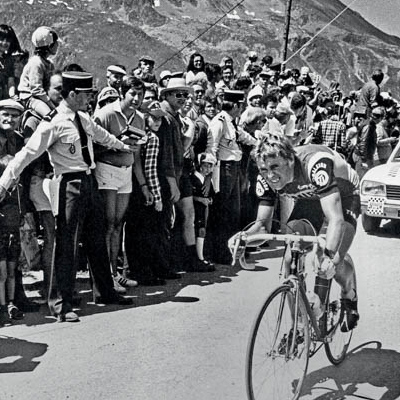
In the high mountains Hennie Kuiper climbs comfortably with the best. From left to right, behind and beside Kuiper: Raymond Delisle, Lucien Van Impe and Julian Andiano

In the Tour time trial to Bordeaux on 5 July 1977 Hennie Kuiper finishes sixth. The digital age has yet to dawn

On 6 July, the day the Tour peloton is granted a rest day in Bordeaux, Hennie Kuiper and Didi Thurau pose with Thurau’s yellow jerseys. The yellow has sat snugly on the German wonder boy’s shoulders since the prologue. Only after the uphill time trial to Avoriaz does Thurau lose the leader’s jersey
TI-Raleigh
In England, at TI, Raleigh’s British parent company, the champagne corks are popping over that commercial success. Raleigh entered professional cycling in 1974 to promote the Raleigh brand on the European mainland. Elsewhere in the world Raleigh is a household name, but in Europe the bike is known almost exclusively in Great Britain. The decision to sponsor cycling was in fact taken as early as the beginning of the twentieth century, but that sponsorship remained largely confined to track racing. The biggest name of that era was Reg Harris, many times world sprint champion (1949, 1950, 1951 and 1954). Right into the seventies, Raleigh is known on the Continent as a rather expensive, stylish bicycle. But TI wants more. Its sights are set not only on the Low Countries – the Netherlands and Belgium – but above all on Germany and France as well. The West German rider Didi Thurau is therefore extremely important.
When the Tour caravan takes a rest day in Freiburg on Quatorze Juillet – 14 July, France’s national holiday – the capital of the Black Forest is one big party. Not because of the French, but because of ‘der Didi’, the ‘Blonde Angel’, as Bild Zeitung has christened him. The TI-Raleigh team is staying at the Cityhotel in the Wasserstrasse. On the rest day a large crowd of supporters stands in front of the hotel, chanting their hero’s name: ‘Di-Di, Di-Di.’ Post revels in it. He got it right, he feels, by staking everything on Thurau.
Post loves flyers, riders like Schuiten before and now Thurau. They are well built, with presence and charm. And yes, it is true: when you study them on the bike, it is as if you are hearing Mozart played, or Bach or Brahms. It is heavenly. Thurau has an enviable pedalling style; he is no ‘grinder’ but an artist on the bike. Set Hennie against that. Of course, he is endearing. He may be small of stature, but with his red cheeks he always looks the picture of health. ‘Bellefleur’, they call him, or ‘Kuipertje’ (little Kuiper), and sometimes ‘Goudkuipje’ (‘little gold tub’). He is a fearless attacker. And that makes him extraordinarily popular, not only in the Netherlands but beyond it too. Who could fail to love Hennie Kuiper? Peter Post, perhaps, but the man from Amstelveen is sensible enough not to let that show in public. Privately, the team boss has other heroes. On the bike, after all, Hennie has nothing of the flyer about him. He is a toiler, a worker, who can always put the hammer down but lacks grace. A rider who, moreover, sits crookedly on his bike. The grace and presence of Thurau are nowhere to be seen in Hennie. Hennie is also a rider who – unlike Thurau – struggles to express himself. ‘With men like Schuiten and above all Thurau, he had something to show off. Not with Hennie, even though he became world champion,’ says José De Cauwer.
Too good-natured
Mechanic Paul Soetekouw has followed Hennie Kuiper for years. ‘As a rider, someone with a tremendous amount of character; as a person, too good-natured for the pros. I have never come across anyone with willpower like Hennie’s. Always keeping going. But for a top sportsman he’s too nice.’ Soetekouw has little regard for Post’s attitude in those days. ‘Some people try to make a fool of Kuiper. Post above all. Usually he does it behind Hennie’s back. When he is driving behind Hennie in the team car, he says: “Look, there goes that Kuiper with his lopsided backside.” And yes, it’s true: Hennie does sit crookedly on his bike. But what does that matter? He rides well, doesn’t he? He’s kind and would do anything for anyone. But there you are, Post has only one great idol: Thurau.’
The Flemish mechanic Gilbert Cattoir, who six years later plays an important part in Kuiper’s heroic victory in Paris-Roubaix, shares his colleague Soetekouw’s view, but understands that Peter Post is horrified by Kuiper’s style. ‘He wasn’t a pretty sight on a bike, crooked in the saddle, his knee sticking out a bit. But he went, all right. And very fast too. Because of the way he sat, he always pushed his saddle out of line.
After every race you had to straighten Hennie’s saddle. But what does that matter? For men like Hennie you do something extra. You go over the bike one more time, you make sure the tyres are at exactly the right pressure, and you push and haul until you drop, as in Hennie’s case in that magnificent Paris-Roubaix.’
Pédaleur de charme
In looks, Thurau is most reminiscent of the Swiss winner of the 1951 Tour, Hugo Koblet, nicknamed ‘Beautiful Hugo’ or, more often, ‘Pédaleur de Charme’. Always well groomed, always with a cloth at hand to wipe the sweat from his brow, and always with a pocket comb in his back pocket so that he could appear on the podium with every hair in place. The hero of cycling’s female fans.
Post swoons at the thought of Thurau. He never does with Hennie. It is so bad that he rarely if ever gives Kuiper a pat on the back. Everyone needs that now and then. Hennie does not get it, however much he means to the team. Post’s attitude in those days is not so much anti-Kuiper as pro-Thurau. He is strengthened in it by the enthusiastic reactions he receives from his British sponsor. The Amstelveen directeur sportif cherishes the secret hope that his darling Didi might yet get over the Alpine cols with the best. Only when that fails does he shift the emphasis back to Hennie Kuiper. By then the caravan has arrived in Morzine, where Thurau is ridden out of the jersey in an uphill time trial by the French idol Bernard Thévenet. The next day, in Chamonix, Thurau does take his fourth stage win, thanks to the groundwork of – once again – Hennie, but it is clear that, with the decisive cols still to come, there are only four candidates left for overall victory: Thévenet, Van Impe, Zoetemelk and Kuiper.
For two weeks the Tour has been ‘locked down’. From the moment Thurau takes the yellow jersey in the prologue, Peter Post – boss of the TI-Raleigh team – has only one goal in mind: to generate maximum publicity through Didi Thurau, the charming jeune premier of the German nation. And so from that moment the race is brought to a standstill. There is nothing but defending; every attack is nipped in the bud. The Raleigh team is strong enough to impose its will on the peloton. It makes the 64th edition of the world’s greatest bike race a rather unexciting affair for neutral spectators. The impartial cycling fan does not really get much enjoyment out of it, unless he is a partisan supporter of Bernard (Thévenet), of Lucien (Van Impe), of Didi (Thurau), of Joop (Zoetemelk) or of Hennie (Kuiper). The last of these above all – Kuiper – can take pleasure in an ever-growing band of supporters. Hennie is becoming the hero of the Netherlands, and that makes Post realise that he must not forget his team leader altogether. But for the time being, in the first fourteen days, Post’s attention is focused almost exclusively on Thurau. In those first fourteen days the Raleigh riders shoot at anything that moves. And as long as Thurau is in the jersey, the red-and-yellow brigade keeps shooting. But now that he has been dethroned and Post realises that the fairy tale of Thurau the climber does not exist, it is the turn of the men who feel at home in the high mountains, among them his own team leader, Hennie Kuiper.

With a towel from Ruud Bakker, Hennie Kuiper wipes the sweat of his brow after a hard mountain stage