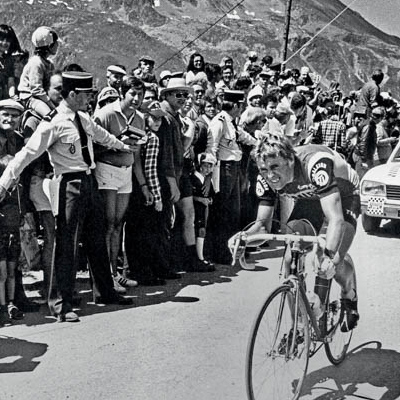
A legendary stage
The stage to l’Alpe d’Huez is crucial. But for Hennie Kuiper there is an extra motive. For him, the stage to the legendary mountain, 1977 edition, really began a year earlier, on Sunday 4 July 1976, when he went under completely, mentally and physically, at the foot of l’Alpe d’Huez. ‘In the 1977 Tour I wanted revenge, above all on myself.’ And he is determined to make his personal punitive expedition a great success. On this day in 1977 Hennie will write the second Dutch chapter in the book that will come to be called ‘The Dutch Mountain’. None other than Joop Zoetemelk has gone before him.
Over the years l’Alpe d’Huez has acquired a magical ring in the Netherlands. That is entirely down to the victories of Dutch riders in the seventies and eighties. Joop Zoetemelk (1976 and 1979), Hennie Kuiper (1977 and 1978) and Peter Winnen (1981 and 1983) each crossed the finish line victorious twice in those years. Steven Rooks (1988) and Gert-Jan Theunisse (1989) are the last Dutch winners on that Alp, which has been known ever since as the ‘Dutch Mountain’. A touch exaggerated, perhaps, for in 2017 we are still waiting for a Dutch successor to Theunisse.
No fewer than 29 times in its history has a Tour stage finished on this mountain. Until 1952 l’Alpe d’Huez plays no part at all in the Tour de France. The idea of bringing the Tour caravan to this mountain in the Isère department comes from cycling fans in Bourg d’Oisans. They draw the attention of the Tour director, at that time Jacques Goddet, to the possibilities of the mountain, whose road is still rideable to beyond Huez. In that period l’Alpe d’Huez is a ski village in the making. In 1952 the moment arrives. Goddet introduces a number of innovations in the Tour. For the first time in history he puts the finish on top of a mountain. Riders have been racing over Pyrenean and, later, Alpine giants since 1910, but the finish has always been in a valley. In 1952 Goddet decides to let the stage end at the summit. So l’Alpe d’Huez gets a first. The Tour director does not stop at that one experiment, but plans two more summit finishes in the same Tour: at Sestrières in Italy and on the Puy-de-Dôme, the lava dome in the Massif Central, west of Clermont-Ferrand. And there is another first. For the first time there is a cameraman in the Tour, following the riders all the way to the top. After the finish the film is rushed to a studio as quickly as possible, and that same evening television-watching France can gape at pictures of a stage raced earlier that day.
Tête de cuir
In 1952 the riders set off for the 251-kilometre stage to l’Alpe d’Huez from Lausanne in Switzerland. The battle does not flare up until fifteen kilometres from the finish. Then, to the great delight of the French following the race, the French climber Jean Robic, winner of the Tour five years earlier, attacks. Robic is an unprepossessing little man who draws scorn in the peloton because every time he starts a descent he plants a leather crash helmet on his head. It earns him a nickname: tête de cuir (leather head). In those years nobody wears a crash helmet. Protecting your head against the consequences of a possible crash is seen as a nuisance and, above all, as childish. A real man does not wear a crash helmet. Risks simply come with the job.
In 1991 the international cycling union wants to make wearing a helmet compulsory, but the professional peloton goes on strike in response. Only in 2003, after the Kazakh Andrei Kivilev dies of his injuries from a crash in Paris-Nice, does the peloton agree, and from then on nobody rides without a helmet.
In 1952, on the first ascent of l’Alpe d’Huez, even Jean Robic has no need of a helmet. After all, there is no descent after the finish. In 1952 the finish line is in the village of Huez, some six kilometres lower down than it is today.
After Robic’s attack the legendary Italian Fausto Coppi launches the counter-attack, catches the Frenchman and then grinds on at one steady pace without giving a moment’s thought to Robic, who is dying a thousand deaths on the campionissimo’s back wheel. Six kilometres from the finish the Frenchman drops off, groaning. Coppi soars in true champion’s style to a majestic victory, just as he is untouchable a day later at Sestrières and later still on the Puy-de-Dôme. Those victories go a long way towards Coppi’s second Tour win; in the final classification he finishes almost half an hour ahead of the runner-up, the Belgian Stan Ockers. Coppi’s impressive victory on l’Alpe d’Huez does not get an equally enthusiastic reception everywhere. The head of cycling at l’Équipe, the sports paper that organises the race, is not at all impressed that absolutely nothing happened before the foot of the mountain. Journalists following the race speak of an ‘exceedingly dull stage’. That criticism means that l’Alpe d’Huez is left off the Tour route for more than two decades.
In 1976 the caravan finally heads back to the top of the Alp. The finish is now a good deal higher up than in 1952. The road is considerably better than it was then. The public at large has discovered l’Alpe d’Huez as a ski resort. Chalets have sprung up here and there. The tourist industry is running at full throttle. The Tour is more than welcome, because – as experience elsewhere shows – a Tour stage gives a ski resort a real boost, and local traders are happy to pay for that. And so in ’76 there are cycling fans on the flanks of the Alpine giant once again.
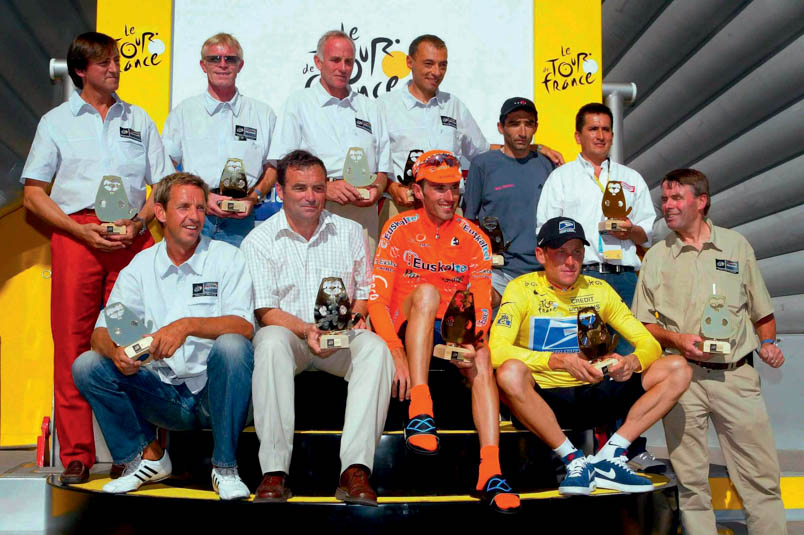
At the 2003 Tour de France, many winners of Tour stages to the top of Alpe d’Huez are honoured. Standing, from left to right: Faustino Coppi (son of, and therefore stand-in for, Fausto Coppi, the first winner in 1952), Peter Winnen (1981, 1983), Joop Zoetemelk (1976, 1979), Roberto Conti (1994), Giuseppe Guerini (1999), Lucho Herrera (1984) and Hennie Kuiper (1977, 1978). Seated, from left to right: Steven Rooks (1988), Bernard Hinault (1986), Iban Mayo (2003) and Lance Armstrong (2001)
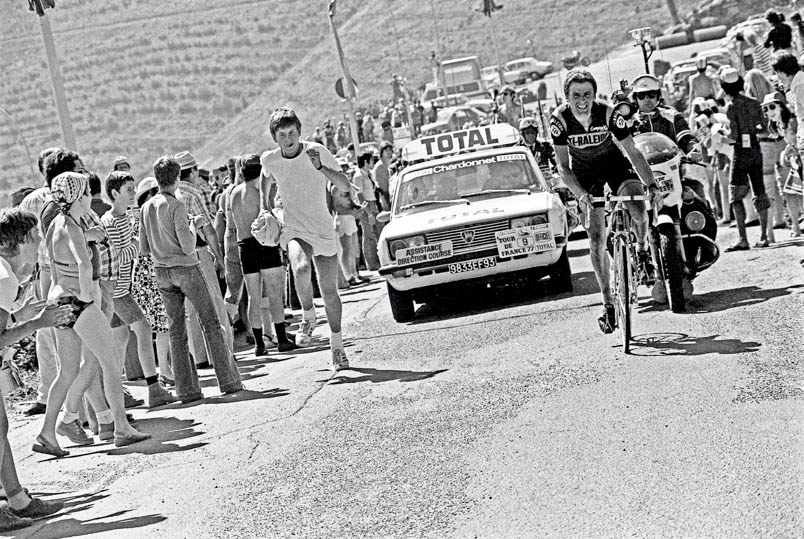
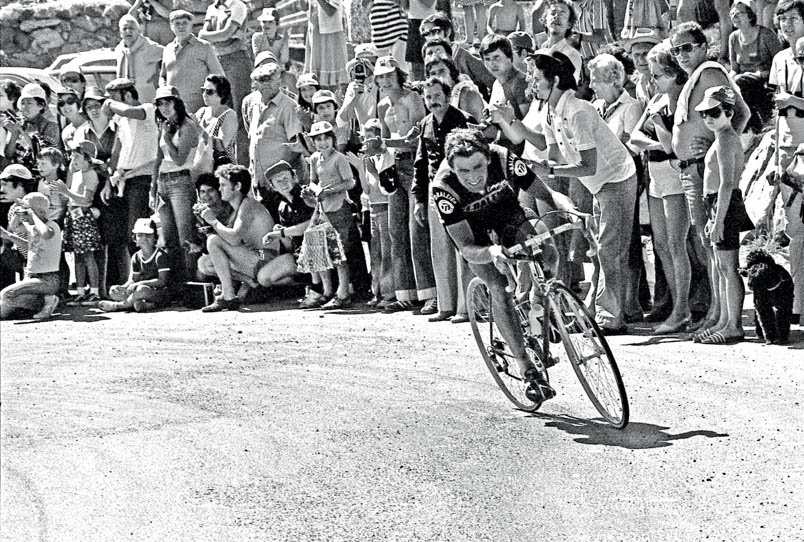
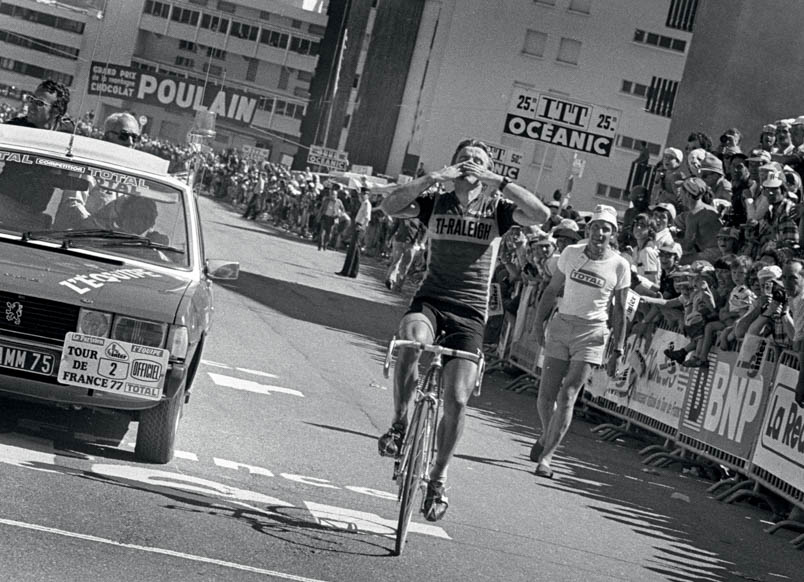
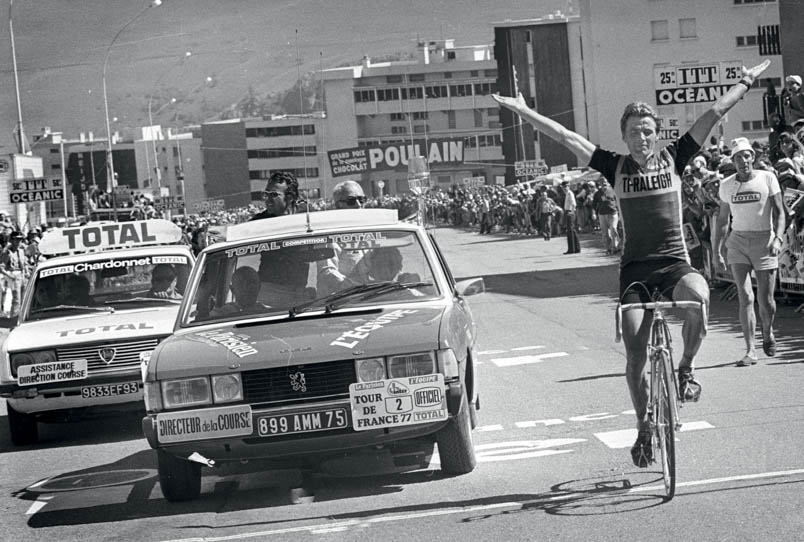
Hennie Kuiper puts in an unrivalled performance on the flanks of l’Alpe d’Huez in 1977. The stage is revenge for the outcome of the same climb in the Tour a year earlier. The emotional release at the finish is immense. The victory is greeted with sweeping, papal gestures and blown kisses. Yet Kuiper is so focused on the stage win that he remains eight seconds short of the yellow jersey
Hennie is ‘parked’
On that day in ’76 Hennie is part of a small group that rides into Bourg d’Oisans, the last village before the mountain, some eight minutes ahead of yellow jersey Freddy Maertens. Hennie sizes up the group. He is the best placed of them and already sees himself in yellow. The Italian Gianbattista Baronchelli has attacked, it is true, but he is no match for the Raleigh team’s leader. He is certain of it: tonight he will head the classification as the proud wearer of the yellow jersey. Kuiper feels good and is supremely motivated. He changes gear. The first hairpin, number 21 (the hairpins are numbered from 1 to 21, starting from the top). But then, as the little group pushes the first steeply rising metres under its wheels, it is as if all the strength drains out of his body. He seizes up completely. Kuiper is ‘parked’, as they say in cycling. It is one long struggle. For every metre he has to dig deep into his reserves. Is it the fear of the still timid Kuiper that, once in the yellow jersey, he will face a mass onslaught from the press? Is it sudden doubt in his own ability? ‘Too low a gear,’ as Peter Post supposes after the stage? That explanation hardly holds water, for if Hennie were pushing too light a gear, he would see his rivals draw away from him only very slowly. But now they are gone in the blink of an eye. No: Hennie seizes up completely. The cause of his failure on l’Alpe d’Huez in 1976 should be sought in the mind rather than in the body.
Jan Janssen, in 1968 the first Dutch winner of the Tour de France, recognises that feeling of panic, of seizing up. It happens to him at the 1964 World Championships. On the course at Sallanches in France he is heading for the finish line with the Italian Vittorio Adorni and the French favourite Raymond Poulidor. It is clear to everyone that one of these riders will soon be pulling on the rainbow jersey. And Jan Janssen is the best sprinter of the trio. So… Then it flashes through Jan’s mind: ‘I can become world champion here. But then what? I’ll have all those French journalists on my back. I don’t speak a word of French.’ Janssen panics completely. He feels as though he is no longer moving forward. With the finish in sight, he seizes up. ‘It lasted until the moment I saw the finish banner hanging there. Then it all fell away from me and I sprinted to the world title. That seizing-up of Hennie’s – yes, I recognise that feeling.’
Road to Calvary
While Janssen regains his self-confidence in ’64, twelve years later Hennie keeps shoving himself up l’Alpe d’Huez like a rank amateur. He sees everyone and everything go past him: not only Joop Zoetemelk, the eventual winner, but any number of riders who would normally finish far behind him in the mountains. In the last kilometre he reaches the low point of his road to Calvary. Under the flamme rouge Freddy Maertens rides past him. Kuiper could not feel more humiliated. ‘Evidently a bit more salt had to be rubbed into the wound.’ But Hennie would not be Hennie if that humiliation did not leave him with a deep desire for revenge. Desire-Believe-Do. It is Hennie’s mantra. The desire to take revenge on himself has been there from the moment of his debacle in 1976. The belief that he can do it has grown by the day since his defeat. And the moment of ‘Doing’, of turning the desire and the belief in it into reality, comes on Tuesday 19 July 1977, on the stage from Chamonix to l’Alpe d’Huez.
The situation on the eve of the seventeenth stage, which runs from Chamonix to l’Alpe d’Huez, is as follows: thanks to his second place in the time trial up to Avoriaz, Bernard Thévenet is in the yellow jersey. He leads Didi Thurau by 11 seconds. The Belgian Lucien Van Impe, winner of the 1976 Tour, is 33 seconds down, and Hennie Kuiper, fourth in the classification, is 49 seconds behind the French yellow jersey. Between Chamonix and l’Alpe d’Huez the riders have 184 kilometres to cover. Before the final climb there are two more first-category cols to come: the Madeleine and the Glandon, mountains with a reputation as ‘silent killers’ because they sap your strength. In short, it is a stage that will demand everything of the riders, and it is not for nothing that it is called the queen stage. Hennie Kuiper is not the only one with big plans for that Tuesday, 19 July. The Belgian climber Lucien Van Impe wants to secure his second Tour victory with a devastating attack. The starting position for the little Van Impe is not as favourable as a year earlier, when he was better supported than he is this year. In 1976, in Cyrille Guimard, he had a directeur sportif who understood him perfectly and guided him superbly. And in the Frenchman Raymond Martin he had a domestique who could stay with the best for a long time in the high mountains. He has to do without that support in the Lejeune team. What is more, Henri Anglade is a directeur sportif who can tell a good story and likes to play the great leader, but who in reality does not excel at reading a race. Van Impe is well aware of all that himself, of course. But he trusts in his own qualities as a climber. In the mountains, after all, you have to do it above all yourself.
The leader of the general classification, Bernard Thévenet, knows that it is a decisive stage for him too. He will confine himself to defending. He sees Van Impe and Zoetemelk as his main rivals; Kuiper is dangerous, admittedly, but he does not think the Dutchman capable of opening a decisive gap on the final climb. On the Madeleine Hennie Kuiper is the first of the favourites to attack. He is called to order by none other than Eddy Merckx. Merckx, who is far from his best form, wants to keep the pace down for as long as possible. ‘Are you mad?’ he shouts at Kuiper. No, Hennie is certainly not mad. His move pulls the group apart.
For the rest of the Madeleine the main protagonists lie low.
A small group led by Henk Lubberding, Christian Seznec, André Chalmel and Jacques Esclassan goes on the attack and will hold out for a relatively long time. Before the stage, Peter Post has designated Lubberding as the man who must go with a breakaway. On the climb of the Madeleine the escapees are reeled in.
Lucien the climber
It is sweltering that 19 July, a scorching 35 degrees. It is also a historic day in the Tour, a war of attrition like no other. The first ten riders reach the top of the Alp one by one. Number ten is already ten minutes down. No fewer than 31 riders cross the line outside the time limit. And the greatest cyclist of all time, Eddy Merckx, finishes almost 14 minutes down. But we are still a long way from that as the scantily clad spectators on the mountainsides wait impatiently for the riders to come through. There is music, there is baguette and there is wine, as so often along the route of the Tour. For the French and foreigners alike it is a party. Of course they come for the riders. But they want more out of the day than the twenty or thirty minutes in which they can watch riders go by on a mountain stage. The pace in the first group is high and is claiming more and more victims. The men without climbing legs – the mountain-haters – dropped back at a much earlier stage. For them this stage is a matter of survival. They hope to reach the finish before the time limit closes. A ‘bus’ is formed: a group of riders who climb the mountains in close formation, far behind the better climbers. The ‘bus’ has a ‘driver’, a rider who sets the pace and calculates as precisely as possible the margin needed to get in on time. But the pace at the front is high, very high.
Rearguard
Paul Soetekouw, driver of the second team car, is uneasy. He urges the Raleigh riders in the little rearguard group – Piet van Katwijk, Aad van den Hoek and the Briton Bill Nickson – to hurry. In vain. The whole group, 31 riders strong, does not reach the finish until after the time limit has closed, and is taken out of the race. Perhaps things would have turned out differently if the Belgian sprinter Rik Van Linden had not been among them. Van Linden is a contender for the green jersey. And because his great rival, the French Peugeot rider Jacques Esclassan, is inside the limit, Tour director Félix Lévitan has no need to show any leniency. Peugeot is, after all, one of the Tour’s main sponsors. And it is always nice to be able to please your most important backer.
None of that is the concern of the men at the front, who are gearing up for the decisive battle. On the Glandon the crowd sees the Belgian Lucien Van Impe pedalling upwards with playful ease. Gone are the gloomy thoughts Lucien had in the weeks before the Tour. Back then the thoroughbred climber was still in a despondent mood. ‘What am I doing there? This Tour de France has only one summit finish. I don’t stand a chance here.’ As the race goes on, his confidence grows. And after the Morzine-Avoriaz time trial, which he wins, the Belgian is certain: I can compete for overall victory. He has only one chance to put his rivals at a disadvantage: the stage to l’Alpe d’Huez. As a born climber he can shake off Thévenet and Zoetemelk and Kuiper. Lucien is ready. Bring on that stage. That self-assurance turns into overconfidence. On the Glandon, where he wants to test his rivals, he sees that nobody can follow him. The gap grows at lightning speed: 20 metres, 100 metres, 300 metres. There are still 50 gruelling kilometres to the finish. What to do? But he feels so strong that he decides to press on. It is all or nothing. Hennie Kuiper sees Van Impe go. ‘I felt strong enough to jump across to him, but I held myself back, mainly because it was still a long way to the finish.’ He saves his strength for the last climb.
It is a wise decision, as will later become clear. For after the descent of the Glandon, not only do fourteen kilometres of climbing to the top of the Alp still await the riders, but in the valley between the mountains there are also some fifteen more or less flat kilometres, where the wind blows hard in their faces. A year earlier – in the duel with Joop Zoetemelk – Van Impe had the support – paid for or not – of Luis Ocaña in a similar situation, but now there is not a single back for him to shelter behind.
At the top of the Glandon Van Impe already has a lead of 30 seconds. Behind Van Impe a game of poker is being played. Zoetemelk and Kuiper cannot be persuaded to cooperate. They want to leave the work to Thévenet. His directeur sportif Maurice De Muer forbids Thévenet to do any more work on the front. Lucien is going splendidly. Thanks to the passive attitude of his pursuers he is able to extend his lead to more than three minutes. He is already dreaming of the yellow jersey at the summit.
Bernard Thévenet begins to get worried. Thévenet decides to ignore De Muer’s words and counter-attack. The two Dutchmen, Joop Zoetemelk and Hennie Kuiper, stick to Thévenet’s back wheel. The Frenchman can ask for support all he likes: he gets no help. He is the race leader, isn’t he? He must lead the defence himself, and it is high time he did. At the foot of l’Alpe d’Huez the situation is unchanged. Van Impe still has a three-minute lead. Early on the climb Joop Zoetemelk makes two more attempts to get away alone, but he is soon brought back into line. It looks like a kind of desperate gamble. ‘I wasn’t in such great form either,’ he recalls forty years later.
En danseuse
In the first kilometres of the climb Lucien Van Impe is able to stretch his margin over his pursuers a little further. Sometimes seated in the saddle and a moment later en danseuse, standing on the pedals, he goes on his way. Slowly but surely, though, Van Impe begins to weaken. The trio behind him start to eat into his lead. Driven on by the yellow jersey, Zoetemelk and Kuiper creep closer too. For Hennie the climb of the Alp is a great celebration. Now he truly belongs among the great stars fighting for victory in the Tour on this mountain. His battle plan is as simple as it is bold: attack, go all out to avenge the humiliating defeat of a year ago. It is no longer a matter of tactics now, but of legs. Does he – Hennie – have more in reserve than the others? Van Impe’s lead is shrinking. A little over six kilometres from the summit there is another time check. Theo Koomen, the sports reporter who is world-famous in the Netherlands, announces jubilantly on Radio Tour de France: ‘Van Impe still has 2 minutes 35.’ Compared with the previous check, that is a gain of almost a minute for the chasers. ‘Van Impe is weakening.’ Anyone who analyses the television pictures from that day can see that the Belgian is toiling. He no longer has the supple pedalling style with which he danced up the mountain at first.
Hennie’s attack
Two or three hundred metres further on, the unbelievable happens: Hennie attacks. It is not the kind of attack we are used to from him – not a gradual raising of the pace – no, Hennie shoots away. In less than a minute Thévenet and Zoetemelk know they are beaten. Kuiper is untouchable today. From the roadside he hears his name being called. Cries of admiration. Wherever he goes, the applause rings out. It is one long triumphal procession. ‘I had goosebumps. Pure emotion.’ Post drives the team car up alongside him. From that quarter too, Hennie – at last – receives recognition. The gap to Van Impe is shrinking at lightning speed. Shortly after his attack Kuiper has already closed in by twenty seconds. Koomen goes wild. ‘Wonderful, Hennie. Keep it up. He looks to be on his way to victory.’ He does not just look it; he is on his way to winning the queen stage. For cycling fans the Van Impe-Kuiper battle is a breathtaking thriller. A French television station takes two more time checks. Kuiper’s deficit is down to 1 minute and 40 seconds. Shortly afterwards: just 58 seconds. The TI-Raleigh team leader is putting on a magnificent show.
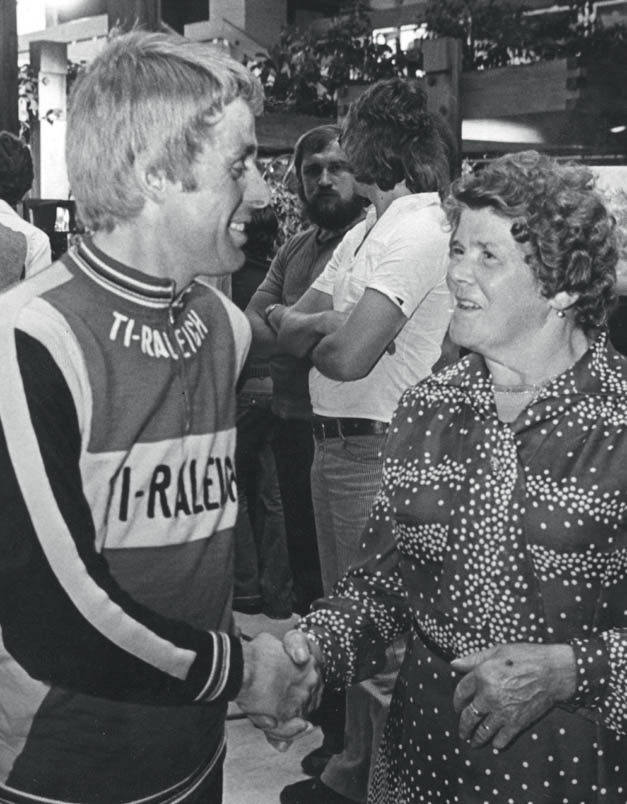
First or second: it makes no difference to mother Kuiper. She is proud of her son: ‘Mooi doan, jong’ (‘Well done, lad’)
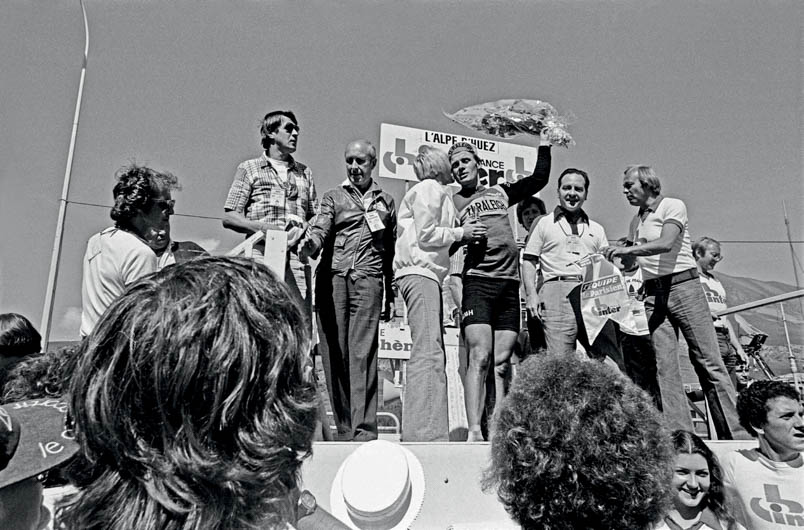
The podium for Hennie Kuiper’s victory ceremony on l’Alpe d’Huez is nothing like what it is today. Still, it is a place to see and be seen. This time the honour of kissing Kuiper falls to the Belgian singer Annie Cordy. On the far left of the podium – in sunglasses – directeur sportif Peter Post stands proudly too
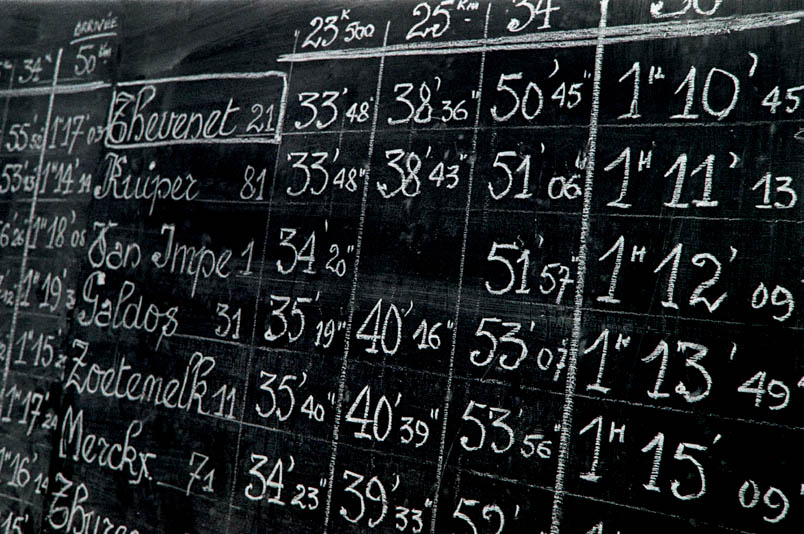
The twentieth stage of the 1977 Tour de France is a 50-kilometre individual time trial to Dijon, the French mustard capital. The gap between Hennie Kuiper and Bernard Thévenet is not large, but it is enough to leave Thévenet’s yellow jersey out of Kuiper’s reach
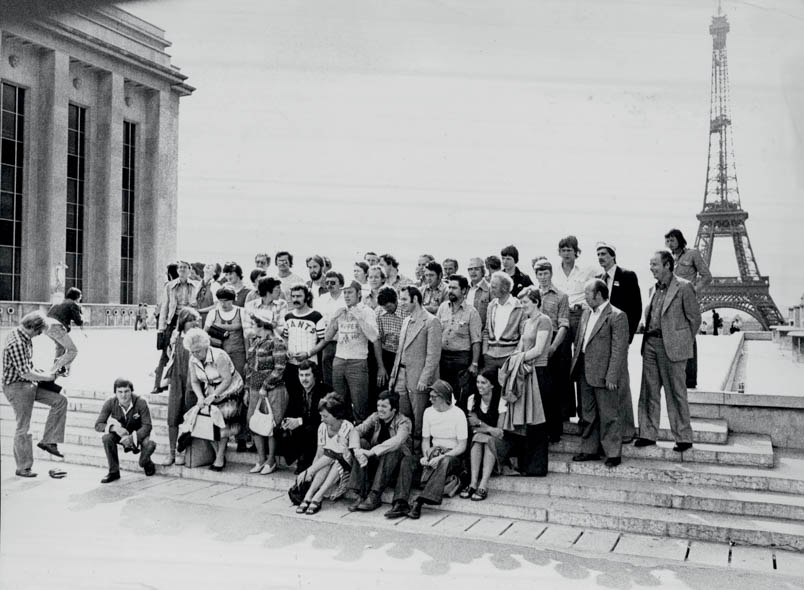
For Hennie Kuiper’s arrival and victory ceremony on the Champs-Élysées, a small army from Twente descends on Paris. On the Sunday of the ‘arrivée’ the Hennie Kuiper fans pose in front of the Eiffel Tower. Right at the front, decked out in a white Raleigh cap with a white handbag at the ready, is Hennie Kuiper’s mother. To her left, the widow of Hennie’s first trainer, Broer Oude Keizer
Van Impe knocked down
And then: a French television car knocks Lucien Van Impe down. The Belgian ends up in a ditch and is helped to his feet by spectators. Late, far too late, directeur sportif Anglade comes rushing up. Van Impe is barely back on his bike when Hennie passes the scene of the incident. Shortly afterwards Van Impe has to get off his bike again. He has a flat rear tyre and his rim is buckled. Directeur sportif Anglade is still at the scene of the accident. By the time he finally reaches Van Impe, Hennie has already disappeared from sight.
Kuiper fights and fights for every metre. Now nothing must go wrong. The French are preoccupied with one thing only: keeping Thévenet’s yellow jersey. The Frenchman’s margin over Kuiper is just 49 seconds. If Hennie has 1 second more than that at the line, Thévenet loses the jersey. A French television commentator, as Thévenet reaches the first houses of Huez: ‘Bernard Thévenet still has the jersey. Kuiper is 44 seconds ahead of him. The margin is big enough for Bernard at the moment.’ Three hundred metres further on, as the Frenchman passes through the centre of the village: ‘On general classification Kuiper and Thévenet are now level. Kuiper has a 49-second lead.’ Hennie Kuiper is one hundred per cent focused on the stage win; on revenge for the humiliating defeat on this same mountain in 1976. He is not thinking about the yellow jersey at all. ‘Peter Post didn’t warn me either,’ says Hennie. Joop Zoetemelk does not think that is an excuse. ‘I always know exactly how things stand in the classification. That’s the rider’s own responsibility. If he doesn’t know, he has only himself to blame.’
Triumph and defeat
Kuiper rides under the flamme rouge. ‘At that moment, somewhere in my subconscious, I can already hear the music playing. I’m savouring every turn of the pedals. The crowds, all those people…’ A soigneur times Hennie’s lead at that moment at almost a minute. He is the virtual wearer of the yellow. 1,000 metres to go. It feels as if all the misery and all the fatigue of the day are washing over him at that moment. He keeps up the pace, but he does weaken a little. Well before the line he waves his arms in sheer delight. Hennie is the king of l’Alpe d’Huez. He has been living for this moment for a whole year.
He wins the stage. ‘This victory is the finest of all my years in the Tour.’ But at the same time he loses the Tour there. By eight miserable seconds… That will only sink in later. For now he wants to drain the cup of victory to the last drop. Never in his rich career will Hennie come closer to winning the Tour than on that 19 July 1977. Never has he been closer to the yellow jersey, which he will never wear in his career. For Hennie, 19 July 1977 is both the day of his greatest Tour triumph and the day of his greatest loss.
There is one rider who is an even bigger loser that day: Lucien Van Impe. There are Belgians who claim that Van Impe would have won that Tour de France if he had not been hit by the French television car. Nonsense. Hennie is the best that day. He is closing on Van Impe very fast; he can almost touch him, so to speak, at the moment the Belgian is hit. Lucien, the best climber in the field, is already wounded prey by then. The cause? There are two causes. The first: he attacks far too early, on the Glandon, with 50 gruelling kilometres still to go. He hopes to take one or two riders with him, but when that does not happen he carries on anyway, instead of waiting for the last climb. Remember: in the classification he is only 33 seconds behind Thévenet. It ought to be very easy for him to gain a minute and a half on Thévenet on that last mountain, which would also give him enough of a margin for the final time trial.
But Van Impe makes a second mistake during his solo ride. He neglects to eat as he builds up his lead in the valley on the way to the final climb. A car cannot run without fuel, and a rider cannot race without food. And so on the climb Van Impe is hit by the notorious hunger knock. When you feel it, it is too late. You cannot put it right by quickly wolfing something down. You feel the strength draining from your legs. That is exactly what happens to Lucien: he weakens, so that first Hennie Kuiper and then Bernard Thévenet pass him.
There is another big loser: Didi Thurau, Post’s hero. He goes under ingloriously on l’Alpe d’Huez and understands that he will never be able to win a Tour. When he crosses the line exhausted, the frustrated Thurau comes to blows with supporters. He is wearing the white jersey of the young riders’ classification, but he refuses to go to the cérémonie protocollaire to collect a new one. Angry and humiliated, he leaves for the hotel, where the TI-Raleigh team is celebrating the triumph of its leader Hennie Kuiper.
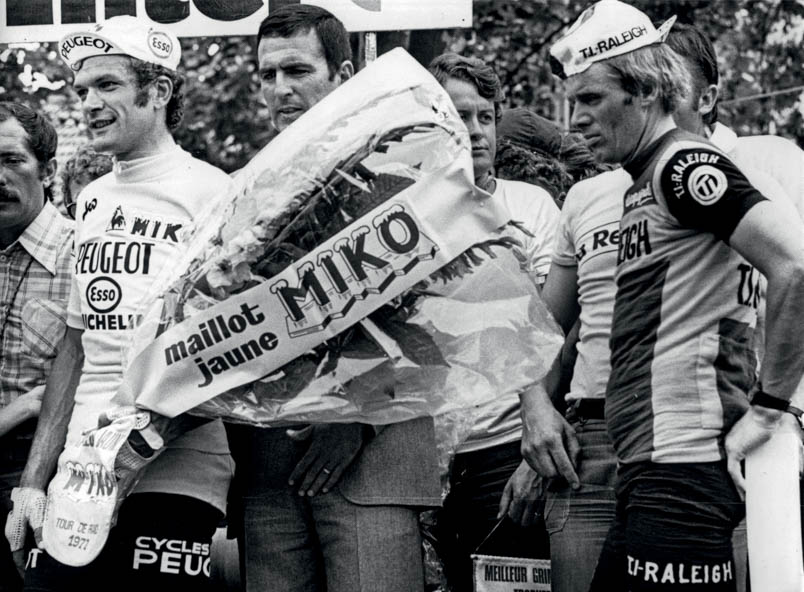
You don’t need a degree to see how fed up Hennie Kuiper is on the podium in Paris. On the left, Bernard Thévenet is fêted by the sponsors; Hennie Kuiper is thoroughly disgruntled
Eight seconds
After that eventful stage, eight seconds still separate Kuiper from Thévenet. It does not seem much, but in the circumstances it is an almost unbridgeable gap, as his adviser José De Cauwer explains. On the way to the final stage in Paris there is only one slim chance left of ousting Thévenet from the top of the general classification: the time trial in Dijon. But Thévenet is in a considerably better position than the Dutchman. He is wearing the yellow jersey, and in terms of morale that is a big advantage. With that jersey on your shoulders you can always do just a little bit more. An added advantage: in the time trial you are escorted by an army of photographers and cameramen on motorbikes, constantly swarming around you for the perfect shot of the – at that point still probable – Tour winner. You benefit from the slipstream of the motorbikes, much more than the number two in the classification, Kuiper, who may have a thoroughly respectable time trial in his legs but usually comes off second best against Thévenet.
On the eve of the time trial Post wages a kind of cold war. He demands extra measures at the doping control. He wants to rule out every possibility of fraud. The French media whip up the public. The soigneurs guard the food and the drinks the riders need during the race. They want to be sure that nobody with bad intentions tampers with them. The mechanics are afraid of sabotage by hotheads. Mechanic Soetekouw and his colleague Jan Legrand take the bikes of the key men up to their bedrooms at night. No risks: that is the watchword. They want to prevent Hennie Kuiper from being put out of the race by sabotage. Legrand, the absolute master among mechanics, goes over Hennie’s bike from top to bottom one more time. Nothing is left to chance. Kuiper fights for all he is worth, and at first is even ahead of Thévenet, but in the end he loses by 28 seconds. In Paris the gap between number one, Thévenet, and number two, Kuiper, is 48 seconds. And that after 22 stages and 4,096 kilometres. The winner’s average speed is 35.419 kilometres an hour.
Mamma Kwiepèr and Valéry Giscard d’Estaing
At the ceremony on the Champs-Élysées there may be a touch of disappointment at the lost Tour, but the overriding feeling is one of pride: our most popular rider has made it onto the podium all the same. Dignitaries and lesser dignitaries jostle around the rostrum to congratulate Hennie. Mother Johanna is drawn closer. She has travelled by coach with the legion of supporters to witness the festive arrival of the Tour’s gladiators. Mother does not, of course, speak a word of French. The hotel’s telephone number is written on her arm. If she gets lost, she is sure to turn up again. But Johanna does not get lost. She finds her way around Paris. Her words, ‘Mamma Hennie Kwiepèr’, are understood everywhere, even though she pronounces them in unadulterated Twente dialect.
In the grandstand she sits – together with the wife of the late trainer Broer Oude Keizer, and armed with her handbag – close to Valéry Giscard d’Estaing, President of France. Hennie is showered with praise. Wonderful, of course, but what pleases him most are the words of his mother Johanna: ‘Mooi doan, jong’ (‘Well done, lad’).
Six factors that explain the defeat
In short, there are six factors that explain why Hennie Kuiper does not win the 1977 Tour.
Factor 1 The German Didi Thurau’s victory in Fleurance means that, for the first time in its history, the TI-Raleigh team has the yellow jersey. For that reason alone Peter Post wants to keep the jersey in the team for as long as possible. He subordinates everything to that, including the interests of his team leader Hennie Kuiper.
Factor 2 For Post, Thurau is the embodiment of the ideal rider. Someone with a lightning attack, an excellent final sprint and a formidable time trial. As a rider, Thurau is a picture. He has tremendous presence, is charming and presents himself well. Hennie is different: a pure attacker, yes, but above all a worker on the bike, very different from the stylist Thurau. Hennie may have an Olympic title and a world title on his honours list, but he wins far less often than Thurau, who rides from one stage win to the next. In private, Post refers to his team leader Kuiper as ‘that little farmer’. It shows little respect, mechanic Paul Soetekouw among others believes. It goes to show that Post does not take Hennie seriously. And this even though that same Hennie has always worked so hard for the team.
Factor 3 For ‘the firm’, as Post calls TI-Raleigh, the German market is extremely important. The charming German Thurau matches the German sports fan’s ideal far more closely than Hennie does. For that reason alone Post wants to focus from the prologue onwards on Thurau’s interests, which are also the interests of the British sponsor. Hennie comes second. What is more: Hennie is enlisted to defend Thurau’s yellow jersey.
Factor 4 Hennie is not assertive. He does not bang his fist on the table when his interests are at stake. So on the stage over the Tourmalet he not only waits meekly until the dropped Thurau can get back on; no, on top of that he manoeuvres the German into the ideal position to finish off that stage with a win.
Factor 5 On the stage to l’Alpe d’Huez Hennie is concerned only with revenge on himself: a revenge that is meant to erase the humiliating defeat of a year earlier. He is impressive on the climb, a majestic winner, but a loser too, because he does not keep an eye on his standing in the classification. His own fault, yes, but Post is also partly to blame, because he too is evidently not thinking about the yellow jersey on the way to the finish. Otherwise he would surely have urged Kuiper to fight for every second.
Factor 6 The last factor is a consequence of all the others. If Kuiper had not so needlessly thrown away 15 seconds on the first stage of the Tour; if Peter Post had not staked everything on Thurau in the first fourteen days; if both Kuiper and Post had realised sooner on l’Alpe d’Huez how close they had come to the yellow jersey, Hennie would have begun the last great task, the time trial, in the yellow jersey and with a lead over Thévenet.
Ah well, if only…
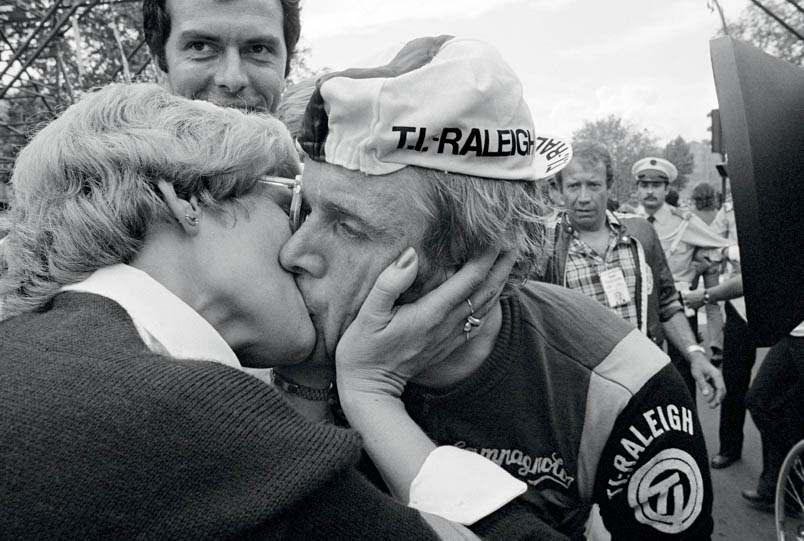
As Hennie finally finishes the 1977 Tour de France in second place, Ine is waiting for him with a smacker of a kiss