The ‘doping’ of Bernard Thévenet
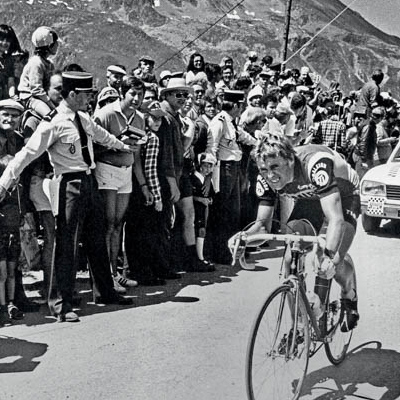
A good year after the 1977 Tour de France – in the autumn of 1978 – the two-time winner (1975 and 1977) Bernard Thévenet makes a confession. He pours his heart out to Pierre Chany, head of the cycling section of the sports daily l’Équipe, the paper that, together with Le Parisien Libéré, was responsible in those days for organising the Tour de France. The gist of Thévenet’s revelations, published in the magazine Vélo, is that he admits to having doped, together with his teammates in the Peugeot team. By his own account, Thévenet had himself prepared with corticosteroids by team doctor François Bellocq over a long period. For Thévenet it led to a great deal of physical misery and a tsunami of negative publicity. The publication in Vélo sends all the media off on the wrong track. Thévenet’s ‘doping’ should not have been regarded as doping in 1977. Time for a reconstruction.
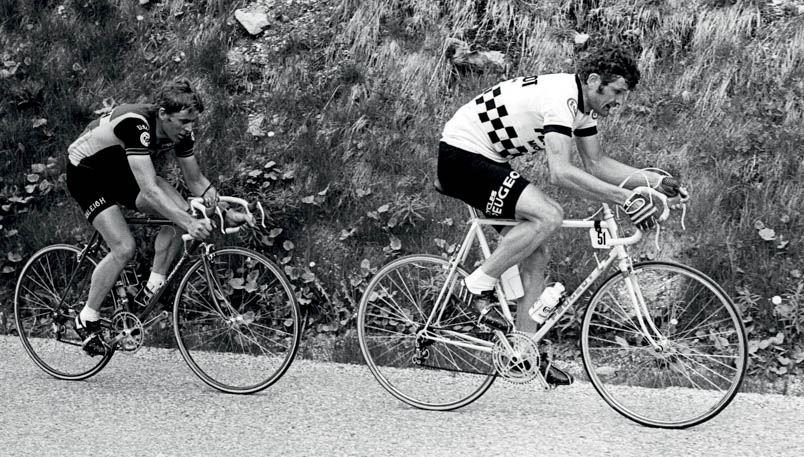
During the 1978 Dauphiné Libéré. The Kuiper-Thévenet duel: utmost concentration from both
Bernard Thévenet has had little joy from his victory in the 1977 Tour. In the winter that follows he is plagued by serious prostate problems. In almost every race of 1978 the Frenchman performs below par. In the Four Days of Dunkirk he suffers bouts of fever; in the Dauphiné Libéré he complains of breathing problems and a suffocating tightness in the chest. In the Tour de France he is a shadow of the rider who a year earlier had kept Kuiper from winning the Tour. At the foot of the Tourmalet, utterly exhausted and disillusioned, he abandons the Tour.
In October 1978 Maurice De Muer, directeur sportif of the Peugeot team, obliges his two-time Tour winner to undergo a thorough examination at the Hôpital Saint Joseph in Paris, the hospital to which the cardiologist Philippe Miserez is also attached. In those years Miserez serves as head of the Tour de France’s medical service, and so is familiar with the world of cycling. Miserez’s diagnosis causes a great deal of unrest in the team. Almost all the riders had submitted to team doctor Bellocq’s regime. ‘The prolonged and copious use of the preparations prescribed for you has seriously disrupted the functioning of the adrenal glands. And that leads to a series of complaints. We refrain from any prognosis about the future of Thévenet the cyclist,’ reads the statement from the doctors treating him.
Among the preparations administered to Thévenet and his teammates, corticosteroid plays a leading role. It is a synthetic product that doctors use to curb inflammation, and it is used among other things in patients with asthma and other chronic lung diseases. It is produced naturally, in minimal quantities, in the adrenal cortex. Cortisone, which is one of the corticosteroids, stimulates the production and storage of glucose, the body’s fuel. The main reason for top athletes to use this substance: it gives more power and suppresses pain, although not all sports scientists accept that it has this beneficial effect for top athletes. The Limburg physician Lon Schattenberg, for many years chairman of the UCI’s medical commission, stresses that corticosteroids do have a positive short-term effect. ‘I can imagine athletes using it in one-day races. It gives a short boost. But in stage races it can be disastrous. With prolonged use you break the body down.’
Dangerous situations
In his conversation with the journalist Chany, Thévenet wants to come clean. ‘I am telling you nothing new when I say that the use of steroids is widespread in top-level sport today. We, in our team, were convinced that we were doing the right thing by preparing ourselves in this way. It gave us an edge over the competition, or so we thought. Looking back, we gave ourselves over to experiments that – as in my case – led to dangerous situations.’
Rumours had been doing the rounds in cycling for some time that Thévenet was indulging to excess in banned stimulants. His confession is therefore big news, not only in France but also in cycling countries such as Italy and Belgium and… in the Netherlands. After all, it was Thévenet who came out on top in his duel with Hennie Kuiper in the 1977 Tour. A confession, even one made almost a year and a half after the 1977 Tour, could, and indeed should, have led to disqualification – if corticosteroids were banned at the time – but that never happened. There are reasons for that, as Hein Verbruggen, former president of cycling’s world governing body, the UCI, explains.
The accusing finger in the Thévenet affair points towards the Peugeot team doctor, Bellocq. Bellocq, who died in 1993, wrote a book (‘Sport et dopage’) about his experiences in cycling. In it he showed himself a strong advocate of treating cyclists with cortisone. Maurice De Muer did not have the best of reputations when it came to doping. The doping historian Dr Jean-Pierre de Mondenard awards De Muer the gold medal in this respect. ‘Between 1970 and 1978, at BIC and at Peugeot, Maurice De Muer had a total of 70 riders in his various teams. Riders were caught for doping in 24 cases.’ An incredible score of 34 per cent!
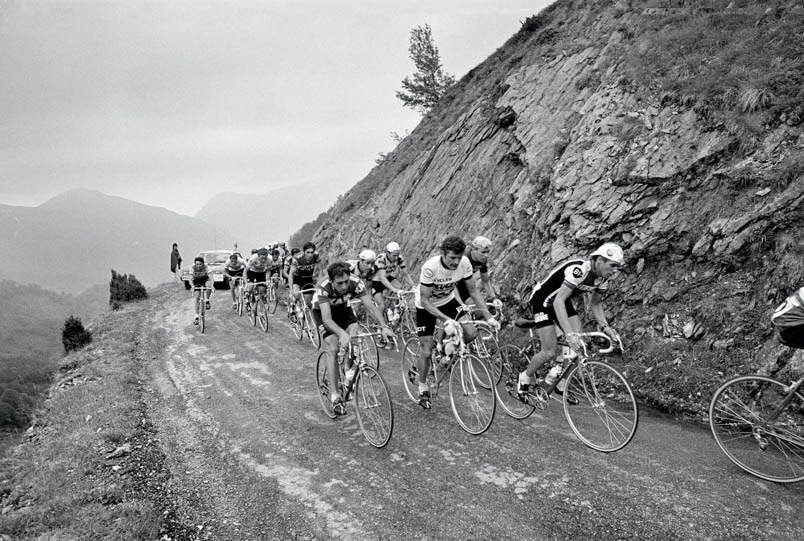
An impressive battlefield on the rugged flanks of the Tourmalet. The big names of the 1977 Tour cannot yet shake one another off. In front: Lucien Van Impe, Hennie Kuiper (on the inside), Bernard Thévenet and Julian Andiano. Right behind them: Miko rider Raymond Delisle and his teammate Joop Zoetemelk. In the third and fourth rows Eddy Merckx and Didi Thurau are hanging on
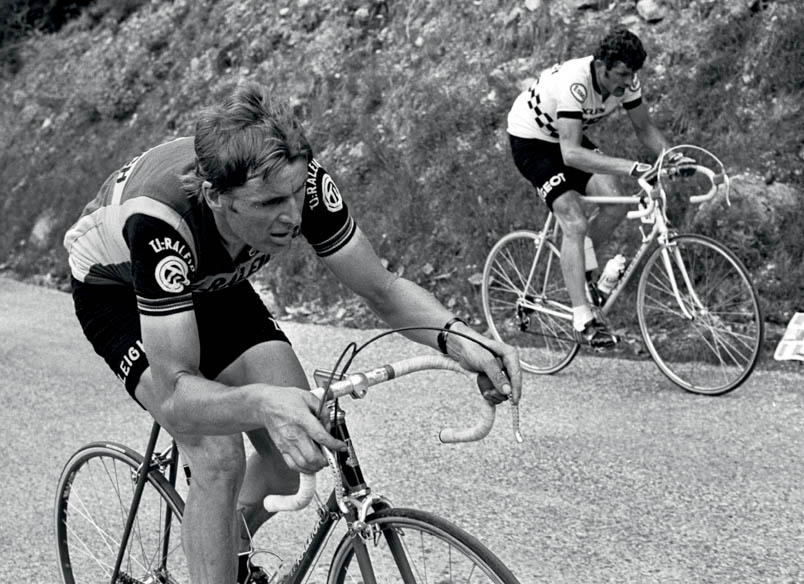
During the 1978 Dauphiné Libéré. In his battle with Bernard Thévenet, Hennie Kuiper takes the other side of the road and edges ahead. Thévenet does not bat an eyelid, for he knows that in the high mountains you must not show a second of weakness
A ruined career
Bernard Thévenet accuses Bellocq of ruining his career. And anyone who looks closely at the Frenchman’s career can understand why. Thévenet’s performance curve follows an erratic course. In 1975 he rides Eddy Merckx out of the yellow jersey and wins the Tour de France. The following year he is the best in the Tour’s warm-up race, the Dauphiné Libéré, but his other results fall well short of the level of the year of his first Tour win. In the Tour de France he even has to abandon. His glory year, 1977, is followed by a humiliating decline. In 1978: not a single victory of any note. In 1979, the year in which he officially starts at Peugeot as joint leader alongside Hennie Kuiper, third place in a criterium is his best result, and in his last years, 1980 and 1981, Thévenet never rises above the level of a second-rate rider. There is no doubt that Thévenet – on the advice of his team doctor – did himself harm. But to what extent do corticosteroids enhance sporting performance?
As far as Harm Kuipers, professor of movement sciences and former world allround speed-skating champion, is concerned, the preparation does not belong on the doping list at all. In an interview with the daily Trouw in 2003, he stated that corticosteroids do not improve sporting performance. Hennie Kuiper does not get worked up about it either. In all those years he never presses for Thévenet to be punished. ‘What good would that do me?’ He would rather not talk about it, either. All that fuss about doping only brings his sport into disrepute. And indeed: it would do Hennie no good. For even if corticosteroids had been on the doping list in 1977, the user would still not be cheating in a sporting sense. Just read what Professor Harm Kuipers says in the interview in Trouw: ‘Corticosteroids do not improve performance.’ It is worth consulting the UCI’s list of banned substances from 1977. That turns out to be not so easy. The Limburg physician Lon Schattenberg is closely involved in the International Cycling Union’s medical affairs in those years. In his personal archive he cannot trace the date on which corticosteroids were added to the doping list. He hesitates, and does not dare to commit himself.
Hein Verbruggen
The Dutchman Hein Verbruggen, former president of the UCI, who died of leukaemia on 14 June 2017, is already seriously ill when the questions about corticosteroids are put to him in the second half of May. He sets to work nonetheless and, after extensive research, concludes that as far as the corticosteroid injections are concerned, Thévenet did not break the anti-doping rules in 1977. ‘Page 26 of the brochure 40 years of fighting against doping states that corticosteroids went onto the UCI doping list from 1980.’
That is six years before the IOC put corticosteroids on its list, as Herman Ram, director of the Dopingautoriteit, the Dutch anti-doping authority, makes clear. Cycling’s world governing body has something of a habit of lagging behind the IOC list, but in this case the organisation is clearly quicker to impose a ban than the IOC. The harmful effects Thévenet suffered may have played a part in this decision. At an earlier stage, in 1975, the IOC had advised against using the substance. Athletes and doctors were asked to report its use, but until 1986 the IOC imposed no sanction for it. Verbruggen adds: ‘Corticosteroids as such have never been banned. The medical reason for their use and the way they are administered determine whether or not there has been a breach of the doping regulations. Even if corticosteroids had been on the list in 1977, it would still be questionable whether Thévenet was in breach.’ Incidentally: corticosteroids may have been on the UCI doping list since 1980, but it would be another twenty years before laboratories were able to prove use of the banned product beyond doubt.
None of this plays any part in judging whether or not Thévenet oversteps the mark when he has himself treated with corticosteroids in the 1977 Tour. The product is not on the list in 1977. It is and remains strange that at the end of the seventies nobody in the media or in Thévenet’s circle thought of checking whether the product in question – corticosteroids – was actually on the doping list. Perhaps the reason is that the journalist who first broke the news, the Frenchman Pierre Chany, described the product as doping. Chany was regarded as an authority. The UCI had no need to defend Thévenet. After all, he had not tested positive in that Tour. For the bigwigs, the ‘Thévenet affair’ was simply not an issue. In strictly formal terms, then, the Frenchman’s victory is undisputed. He was not caught for a single substance in the doping controls. That doubts about his win will always remain – above all because of his confession – is inevitable. Thévenet himself has learned to live with it.
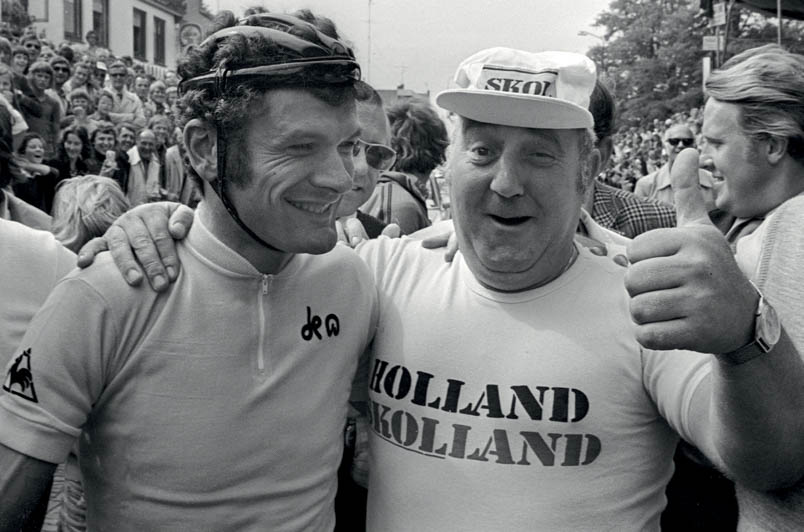
Despite the negative publicity surrounding his Tour win, Bernard Thévenet remains a welcome guest on the post-Tour criterium circuit. At the 1977 Acht van Chaam, Piet Bambergen (the jovial half of ‘De Mounties’) is suddenly his best friend. Thévenet can see the funny side
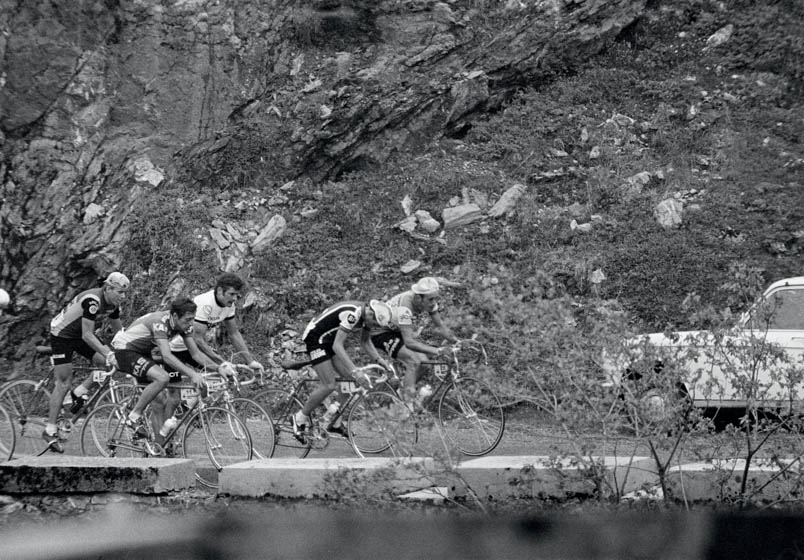
On the Tourmalet the riders climb anxiously with their mouths shut. Climbing with your mouth open is, after all, a sign of weakness. From the front: Pierre-Raymond Villemiane, Lucien Van Impe, Bernard Thévenet, Julian Andiano and Hennie Kuiper (who cheats a little by sticking out the tip of his tongue)