The drama on the Granier
The stage is followed by a rest day on l’Alpe d’Huez. Prime Minister Dries van Agt, who besides being head of government is above all a cycling fanatic, turns up in the Raleigh camp. He feels at home among these men and enjoys every minute. The leader of Post’s team is building up to the next stage: the queen stage of this Tour de France. From Grenoble the peloton is driven over no fewer than eight (!) cols, beginning with the Col de Porte (category 1), then the Col du Cucheron (3), the Col du Granier (2), the Col de Plainpalais (2), the Col de Leschaux (3), the Col de la Colombière (1), the Col de Châtillon (4) and the Col de Joux Plane (1). For the riders less blessed with climbing ability in particular, it promises to be one long ordeal. After the Dauphiné Libéré stage race, Hennie, together with his personal helper José De Cauwer and his teammate Paul Wellens, reconnoitred the route of the seventeenth stage of the Tour in detail. He knows what lies in store and has made a thorough study above all of the last climb, which features in the Tour for the first time in its history: the Joux Plane. On that mountain he wants to make history and settle the Tour in his favour after all. While few in the Tour caravan would still give a penny for Hennie’s chances, he himself is convinced that in this punishing seventeenth stage he can strike.
José De Cauwer still shudders at the memory of that reconnaissance ride with Kuiper and Wellens. Both are good climbers – not in the same class as Lucien Van Impe or the Spaniard José Manuel Fuente, admittedly, but riders who can hold their own at the sharp end of a mountain stage; Hennie better and for longer than Wellens, though even Wellens need not go to bed the night before a mountain stage haunted by the fear of not reaching the finish before the time limit. For De Cauwer the reconnaissance is sheer punishment, which he endures only because it matters to his team leader.
On the morning of the queen stage Kuiper says: ‘Today’s the day.’ ‘Easy, easy,’ urges De Kneet, as Gerrie Knetemann is known. It is very much in his interest that the overall contenders only really open the throttle in the finale of this stage. Gerrie can already see himself grimly riding just ahead of the broom wagon, desperately trying to get in within the time limit. Hennie rides with great alertness and aggression. On the Col de Porte the Frenchman André Romero is first over the top, ahead of Hinault and Kuiper. The pace is fast, very fast. On the Cucheron, the second col, after barely 30 kilometres of racing, Kuiper is first to the top, ahead of Hinault and Zoetemelk. Hinault urges the others: ‘doucement, doucement’, but Hennie has no wish at all to go doucement; he wants to break the whole peloton. Kuiper storms the third col – the Granier – at full tilt too. Once again he is first to reach the highest point, this time ahead of the Frenchman Mariano Martinez and Hinault. At the top there are already riders who have lost half an hour. The young French prospect Hinault keeps an anxious eye on Kuiper. What is he up to today? Hennie is on his way to becoming the first Dutchman to win the mountains jersey. Surely nothing can go wrong now! Hennie hurls himself fearlessly into the tricky descent. At the head of the little group of climbers he steers with pinpoint precision through the bends and along the rock faces. Van Impe does warn him. Too much risk. And then he steers into a drainage gully along the rock face, tries desperately to haul the bike back onto the road and hits the rock face.
Hennie goes down hard: a double fracture of the collarbone.
Henk Lubberding, riding in a chasing group, is the first to reach him. He sees Kuiper leaning against the rock face, his face twisted with pain, his right hand on his left collarbone. Hennie knows how things stand. But as team leader he feels responsible.
The yellow jersey is now definitely out of reach, but there is another jersey, the white one for the best young rider. So he tells Lubberding tersely: ‘Collarbone. It’s over. Take the white jersey to Paris.’ The team leader’s withdrawal means that Henk Lubberding is now free to ride for himself: for the white jersey. He keeps it all the way to Paris; a consolation prize for the team that had hoped for more at the start in Leiden.
For Hennie, the crash shatters his dream. An ambulance pulls up. Tour doctor Gérard Porte has meanwhile established that the left collarbone is indeed broken. Hennie is taken to a hospital in Chambéry. Hennie’s suitcase is standing in the riders’ hotel. ‘What am I supposed to do with that now?’ Post wonders. The Prime Minister, who is a guest that day in the car of Tour director Lévitan, says: ‘I’ll take care of that.’ Hennie Kuiper gets a phone call to say that the head of government is on his way. General commotion in the hospital. When a president comes to visit in France, it causes much more of a stir than it would in the Netherlands. When Van Agt walks into Hennie’s room at the Centre Hospitalier de Chambéry, around ten people are crowding round the injured rider’s bed. ‘They were shooed out, because we wanted a moment on our own. Van Agt gave me a real boost, and I needed it too. When you crash like that, it’s as if the Apocalypse is passing by.’
Hennie recalls the crash of the cyclist Annemiek van Vleuten when, on her way to the gold medal at the 2016 Rio de Janeiro Olympics, she made a steering error on the descent and crashed painfully over a kerb. ‘At a moment like that you’re a heap of misery. The disappointment is bottomless. For her it was the Olympic gold she could no longer win; for me – in the 1978 Tour – it was the chance of overall victory going up in smoke. Jacques Anquetil said to me afterwards: “You could have won that Tour.” If there was one I could have won against Hinault, it was 1978. He was riding his first Tour that year, had no experience yet and didn’t have a really strong team yet. I had prepared very well and was in superb form in the last week.’

Distinguished visitor to the Raleigh team at the Tour de France. Between Henk Lubberding and Hennie Kuiper, Prime Minister Dries van Agt joins them for a meal, and the leader of the KVP (the Catholic People’s Party) is visibly enjoying it

On the descent of the Granier, fate strikes Hennie Kuiper without mercy. Kuiper crashes, lands in a ditch beside the road and knows at once that his collarbone is broken

Tour doctor Gérard Porte tries to stabilise Hennie Kuiper’s left shoulder as far as possible. On the left, BRT reporter Jan Wauters grasps the seriousness of the situation

Hennie Kuiper is wheeled into the hospital in Chambéry. The sense of drama is everywhere

In the operating theatre of the hospital in Chambéry, the X-rays of Hennie Kuiper’s left collarbone are ready and waiting. Tour doctor Gérard Porte has taken off his helmet and tries to put Kuiper at ease


Always with an eye to the sponsor’s interests. Even after the operation in the hospital in Chambéry, Hennie first pulls on a Raleigh shirt for Cor Vos’s camera

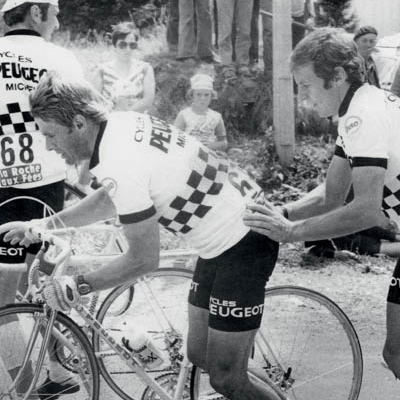
The two partners in Kuiper-De Cauwer Ltd side by side like brothers in the 1978 Tour de France

On a ‘working holiday’ in Guadeloupe. The bow cannot always be drawn tight. So think, from left to right, Peter Winnen and his wife Yvonne (died December 2013), Hennie Kuiper and his wife Ine, and Gerrie Knetemann (died November 2004) and his wife Gré

The TV is on in Hennie Kuiper and José De Cauwer’s hotel room (Tour de France, 1977). But despite glancing at the screen, they are going over the day once more

Ine Kuiper and Jeanne De Cauwer take their husbands’ places in the 1977 Tour. Sadly, Jeanne De Cauwer will not live to grow old. She dies young