The Pollentier affair
After that day of strike action the racing resumes in earnest. Peter Post no longer believes in Hennie’s chances of winning. ‘Maybe he should try to become King of the Mountains,’ he suggests. But first there is still l’Alpe d’Huez to come. In each of the two previous years the mountain has played a leading role for Kuiper: in 1976 a negative one, in 1977 a positive one. He feels fine at the start of stage 16, which runs from Saint-Étienne to l’Alpe d’Huez. It is the usual picture: the weaker brethren are dropped before the real climbs have even begun. At the front the Belgian champion Michel Pollentier is especially active. It is a vintage year for the man from the little village of Keiem. Besides the national title, in 1978 he also has the Giro d’Italia and the Tour de Suisse to his name. Just after Grenoble, heading towards the first serious climb, the Col de Luitel, the Belgian attacks. ‘At that moment I could easily have gone with him, but I decided to stay with the other climbers,’ says Hennie. Pollentier opens a gap of a minute. Behind him the group breaks up. On the climb to l’Alpe d’Huez three riders join forces in pursuit of Pollentier: Zoetemelk, Hinault and Kuiper.
Bernard Hinault is riding his first Tour. He makes a big impression. On the Alpe he accelerates, keeps pressing and drops Joop Zoetemelk. Pollentier remains out of reach. But behind the Belgian a magnificent duel unfolds between the debutant Hinault and the old hand Kuiper. ‘I still had something in reserve.’ He draws on those reserves when the finish is already in sight. Hennie rides Hinault off his wheel. ‘But I was so strong that I let him come back and then attacked again straight away. It’s the first and only time I ever beat Bernard Hinault in a mountain stage. And in a head-to-head duel at that.’ Kuiper reaches the summit in second place, behind Pollentier. His margin over Hinault – eight seconds – is minimal, and Joop Zoetemelk too manages to limit his losses to Kuiper in this stage to 41 seconds. The conclusions are quickly drawn. Now that Pollentier has the yellow jersey and has shown himself at least the equal of Hinault, Zoetemelk and Kuiper as a climber, he is the main contender for overall victory.
The press find a place in the press room and rattle out their stories on their typewriters. As usual for a summit finish on this Alpe, the press have found a home in the church of Notre-Dame-des-Neiges, where the Dutchman Jaap Reuten is the parish priest. The story goes that the priest rings the bells whenever a Dutchman wins, but that turns out not to be true. The bells are rung mechanically; the priest has nothing to do with it. And it is true that the bells have pealed after a Dutch victory. That turns out to be pure coincidence.
Fraud
Suddenly there is a stir. The word buzzes round the press room: ‘There’s a big doping case.’ A little later Tour director Félix Lévitan comes in, climbs onto a table and tells his esteemed colleagues that the stage winner and yellow jersey Michel Pollentier has been caught committing fraud and is being thrown out of the Tour. The ‘Little Man from Keiem’, the rider with the hideous style, has been unmasked as a cheat. It is an open secret that in those days there is a fair amount of fiddling at doping controls, and not infrequently with the knowledge of the testers. The controls may have become somewhat stricter over the years, but there are any number of ways to cheat them.
In the Flandria team, the squad of stars such as Freddy Maertens, Marc Demeyer and Michel Pollentier, the soigneur Jef D’hont has devised an ingenious system for deceiving the testers. He has designed a shirt with a system of tubing fitted on the inside. The tube is connected to a condom filled with clean urine. The condom sits under the armpit of the rider being tested, who – when asked for urine – presses his arm inwards, so that the clean urine is delivered through the tubing. A doping official is always present when the sample is taken, admittedly, but the chance of the tube being noticed is negligibly small. What is more, most testers are not too particular. As a rule they are more cycling fans than testers.
The riders who have to report for the control on l’Alpe d’Huez are out of luck. For not only does a delegate of the Union Cycliste Internationale (UCI) turn up at the doping control, but so does Dr Alain Calvez, who represents both the French cycling federation and the Ministry of Youth and Sport. Michel Pollentier, who is both stage winner and the new yellow jersey, reports for the compulsory doping control after the ceremony. In front of the small caravan that serves in those years as the room where samples are taken, there is a queue of four riders. They have been picked by drawing lots to provide a urine sample as well. Pollentier had asked for, and been given, permission to go and change at the hotel first. In those years Jef D’hont is a soigneur with the Flandria team. In his memoirs he describes Pollentier’s arrival at the hotel. ‘Suddenly there he was in the hotel. Michel asked me to get a “pear” (the condom – ed.) ready for him. He told me that, on Freddy Maertens’s advice, he had taken something that might mean he would not get through the doping control. I resisted, but gave in all the same. I did everything for my riders! I fitted a pear with clean urine and Michel left for the doping control.’
In an interview with the Gazet van Antwerpen, Alain Calvez describes the interior of the little caravan. ‘You came into a small waiting area, and next to it was the room where the doctor and the medical inspector were. The medical inspector sat at a table beside the door and I had positioned myself between the cupboard and the washbasin in the corner of the camper. After Pollentier, who was now wearing a loose-fitting tracksuit, had reported to the medical inspector, I asked him whether he was able to pee. He answered, as riders usually did: “I’ll try.”’ This is the period when amphetamine is popular in endurance sports such as cycling. Athletes, and cyclists above all, are wily when it comes to ways of cheating the control. Calvez knows exactly who he is dealing with. ‘Riders often came up with the excuse: “I can’t pee when someone’s watching.” Many a doctor would then turn round, and the rider could take the opportunity to empty clean urine he had brought with him into the pot. Then it could happen that you got a result back from the laboratory saying that no urine, but water, had been found in the pot.’ So Alain Calvez is on his guard. As the rules require, Pollentier lets his trousers drop to his ankles. He pulls his top up a little. Calvez holds the pot into which Pollentier is to pee. But the new yellow jersey does not pee. It goes on and on and on. At first Calvez still thinks: ‘Ah, he’s stressed from the effort. He’s in yellow for the first time and he’s won the stage.’ Calvez, who earlier that day caught the Frenchman Antoine Gutierrez with a small bottle of clean urine in his trousers, has no suspicions yet.
By now directeur sportif Fred De Bruyne has come into the caravan. ‘Why is it taking so long, Michel? Is something wrong?’ Pollentier answers: ‘No, it just won’t come.’ De Bruyne, who is in on the plot, tries to create a distraction. He reels off a series of anecdotes, but Calvez stays alert. Then De Bruyne suggests finishing the control at the hotel. The medical inspector is inclined to agree. Calvez: ‘But I dug my heels in and said “Non.” I wanted no part in practices like that.’ De Bruyne kept on and on. Pollentier needed a massage and he hadn’t eaten yet. ‘In the middle of De Bruyne’s tirade I noticed that the pot was suddenly filling up. But I couldn’t see Pollentier urinating! Reflexively I reached under his penis with my hand and found myself holding a rubber tube. I was stunned!’ The doctor has discovered a highly ingenious system. The tube is taped under the penis and runs up past the anus and under the top to a condom beneath the armpit. Calvez: ‘I gave the tube a yank. Urine sprayed everywhere.’ Calvez pulls up the top and uncovers the ingenious system of tubing. He hands everything over to the medical inspector and reports the fraud in writing. At Calvez’s request Pollentier then provides a regulation sample, which – as will later emerge – contains amphetamines.
What is to be done with Pollentier? For a breach of the doping regulations the rules lay down a penalty of ten minutes added to the rider’s time, a fine and a suspended ban. In the case of fraud, exclusion follows. The commissaires and the Tour management confer at length. Throwing a yellow jersey out of the Tour! That would set an unheard-of precedent. But Calvez holds to his principle: it is fraud, and only one punishment fits it: exclusion. Jean Court, president of the commissaires’ panel, phones the Union Cycliste Internationale. The deliberations lead to a decision. There is no saving the cheat Pollentier. He is removed from the Tour. Joop Zoetemelk becomes the new yellow jersey.
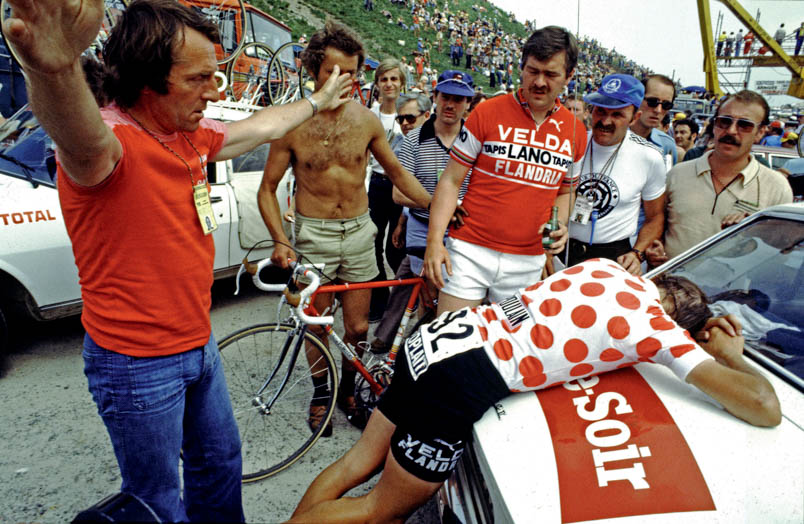
Utterly ‘wrung out’, Michel Pollentier collapses onto the bonnet of a car after the climb of l’Alpe d’Huez. His directeur sportif Fred De Bruyne (left) tries to calm the situation with theatrical waves of his arms
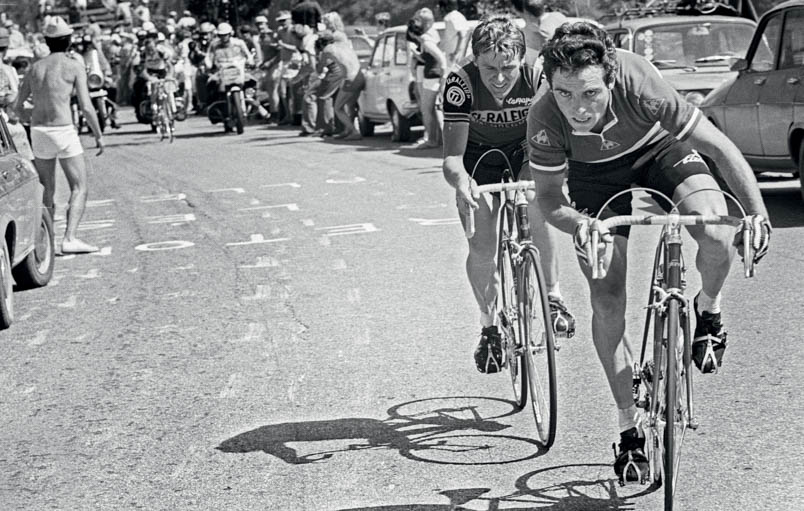
Hinault and Kuiper make Zoetemelk crack: he can no longer keep up with the pace
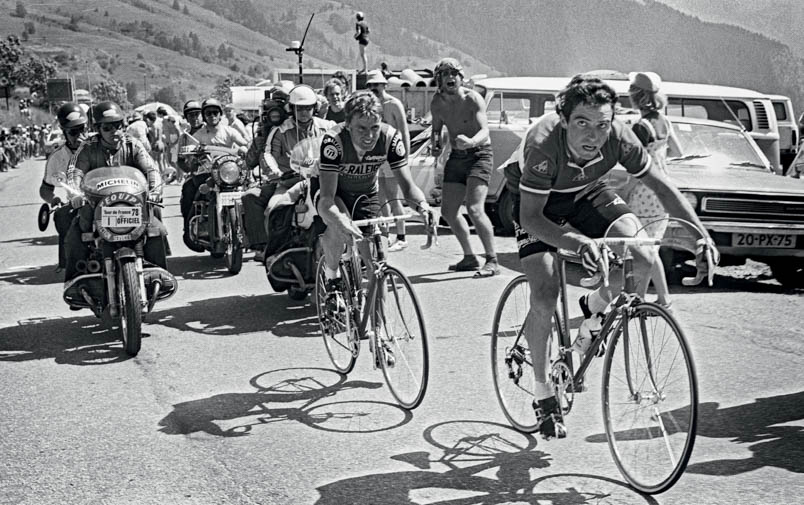
Bernard Hinault casts an almost anxious glance towards the village of Alpe d’Huez and gauges the distance to the lone breakaway Michel Pollentier. Hennie Kuiper holds his attack back a little longer
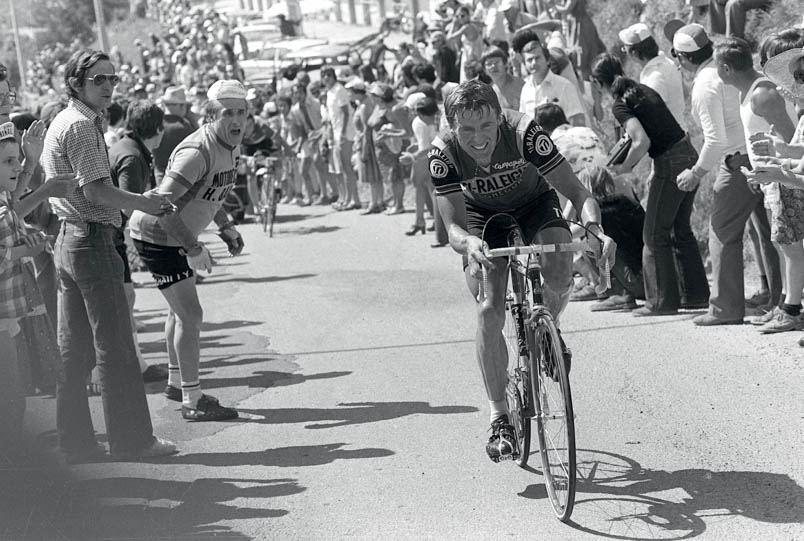
That is just how strong Hennie Kuiper is on this day. He toys with Bernard Hinault on the slopes of l’Alpe d’Huez. Kuiper rides away from Hinault, deliberately lets him come back, and then puts distance between them once again
Kuiper’s second
The stage victory goes to Hennie Kuiper. Rightly so, of course. Winning on this famous Alpine summit for the second year running is something very special. The first time – in 1977 – is the most remarkable victory, because it is revenge for the humiliating defeat of a year earlier. Hennie Kuiper regards the second win as the most important in sporting terms. Beating Hinault, after all, is something exceptional. He points to the photographs of the duel with Hinault. ‘You can see the concentration, Bernard Hinault’s suffering. It’s written all over them. Really special.’ A pity that this second victory remains overshadowed by Pollentier’s sensational doping affair. The affair ranks among the most notorious doping incidents in the history of cycling. It keeps people talking for a long time. Even as late as 2017.
In 2004 the former NOS reporter Jean ‘De Neel’ Nelissen makes short cycling features for Mart Smeets’s Tour programme De Avondetappe. Nelissen visits the Belgian former rider Michel Pollentier at his tyre business in Nieuwpoort and talks to him about his doping on l’Alpe d’Huez. Despite the doping, Pollentier still regards himself as the rightful winner of that stage. During the interview Pollentier sits at his desk. Behind him hangs the pennant he received as stage winner after the finish of the stage to l’Alpe d’Huez. There is not a trace of remorse. He is still proud of what he achieved on that hot day in the summer of 1978.
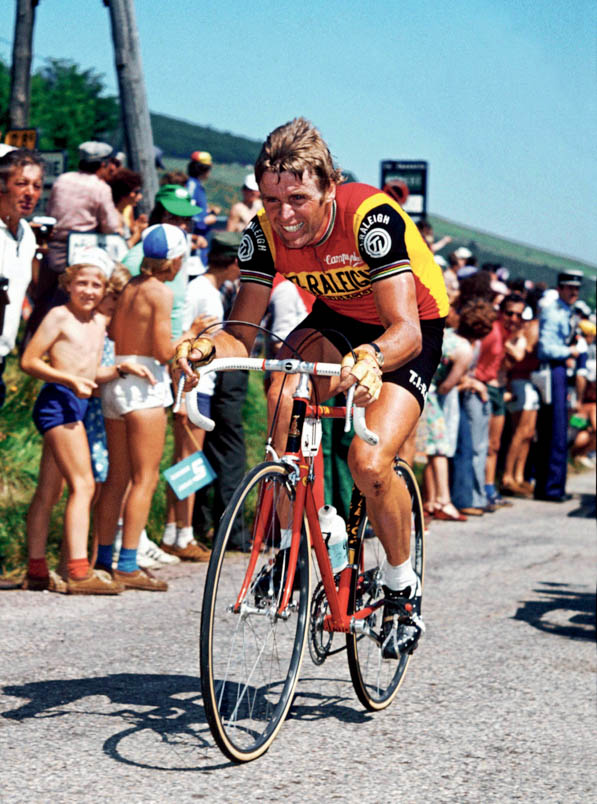
Hennie Kuiper the climber at the top of his game. His ability is underlined, in both 1977 and 1978, by his stage wins in the Tour stages to the summit of l’Alpe d’Huez