MONUMENT 4
Milan-San Remo 1985
Hennie Kuiper, now 36, hopes to do well in the first great classic of the season, Milan-San Remo. It is not really a race for Hennie, since the sprinters usually play the leading role there. But Kuiper loves this endless journey along the Italian coast; he revels in the tifosi, the passionate Italian fans. That much is clear as early as 1973, his debut year as a professional, when he travels to Milan for the start of his first Primavera. ‘It was a tremendous experience: all those people standing there, all those shops emptying out to cheer the riders on, and all that applause ringing out everywhere.’ Hennie feels no stress at all. ‘I just thought it was wonderful. And then you hear the voice of the race director, Vincenzo Torriani. “Ancora due minuti dalla partenza.” It’s about to begin – an atmosphere like nothing else.’ The attacks start from the gun. The pace is over 50 kilometres an hour straight away. There are still 285 kilometres ahead of them. ‘When I was a good way down the road, I saw a sign hanging on a tree: San Remo, 225 kilometres.’ That year ‘Kuipertje’ (little Kuiper) wears the jersey of Ha-Ro, the development team for Rokado. Karl-Heinz Muddemann takes the young Dutchman under his wing. ‘Hennie heute muss du bei De Vlaeminck bleiben. Er gewinnt.’ (‘Hennie, today you have to stay with De Vlaeminck. He’ll win.’) Kuiper: ‘Karl-Heinz may not have been such a great rider, but he had his head screwed on all right.’ It is an era when team leaders can still hang on to their domestiques’ jerseys, saddles and shorts for kilometres on end, unpunished, to save their strength. Hennie watches it all in utter bewilderment. ‘Everyone did it, except Merckx and Gimondi. I stayed with De Vlaeminck all the way to the Poggio.’ In the finale Roger De Vlaeminck proves irresistible. Hennie finishes 58th, six seconds down.
Kuiper is in form early in the ’85 season. Despite his advancing years there are spells when he races as he did in his best years. ‘The older you get, the greater your love for the job and for the bike. You know how to train, and you can easily find it in you to train even harder.’
Tirreno
For Kuiper, ‘project Milan-San Remo’ begins with the stage race Tirreno-Adriatico, which traditionally precedes the first great Italian classic. Many teams choose this race to prepare for the early classics season, because the weather in Italy is usually kinder than in Paris-Nice, the Tirreno’s counterpart, which is raced over the same period. But in 1985 it turns out quite differently. When the riders rub the sleep from their eyes on Monday 11 March to get ready for the start of the fourth stage, polar conditions reign. Today’s stage runs from Urbisaglia, an ancient Roman village in the Marche, to Porto Recanati, in the same province. The distance, 192 kilometres, is no problem; the conditions are another matter altogether. The rain lashes the backs of the riders as they ride to the start. The temperature barely creeps above 0 degrees. The peloton grumbles and makes a dash for the espresso machines in the little cafés around the start. Damn it: what is this?
Two old hands take a sober view of the situation. They have reached the venerable racing age of 38 and 36 respectively: the two Dutchmen, Joop Zoetemelk and Hennie Kuiper. ‘Bad weather?’ Too bad. Cold? ‘Stop whingeing: ride!’ Inhuman? ‘Don’t exaggerate. Race! It comes with the territory. This is our job.’ Joop and Hennie are the great role models of Dutch professional cycling. They ride to the start of the same race in silence, but they set out on this polar expedition from perspectives that could hardly be further apart. Joop is racing to win this Tirreno; Hennie braves the grim conditions so that later that week he can line up in Milan for the Primavera as well prepared as possible. He is not going for the win, but for the training.
The brave souls who do not climb off wrap themselves in every item of clothing they can lay their hands on. Joop thinks back to his old trade, speed skating, and protects his body and muscles with a skating suit. He gets into a breakaway with the Portuguese Acacio Da Silva and the American Greg LeMond, after that stage closes to within a few seconds of the lead, and strikes in the uphill time trial on the penultimate day.
Zoetemelk prevails, but the whole peloton ails
For it stays bitterly cold, even on the last day, when the peloton has to get through a tough 196-kilometre stage around San Benedetto del Tronto. Kuiper has stayed in the race. He is determined to finish this Tirreno, come what may, and he is counting on reaping the rewards at the end of the week, in Milan-San Remo, of the hardships he has endured in this stage race. It is grim. But Hennie does not give in; he goes to the very limit. Frozen to the bone and exhausted, Hennie reaches his hotel after the stage. These are still the years when riders have to do their own washing. ‘I arrived cold and soaked through. On the way I’d put on three rain jackets to protect myself against the cold and the pouring rain. It was freezing in those hotels, which were built for summer guests. Tiles everywhere, nothing warm.’ Kuiper jumps into the shower. ‘I still had all my clothes and rain jackets on. I turned on the tap, and slowly but surely I peeled off the layers: I hosed the first jacket clean, then the second, then the third, and finally my racing kit. Then I crawled straight out of the shower into bed.’ The next day Kuiper is lying under the blankets when the directeur sportif, Roger Swerts, comes into the room. ‘Well, well… Kuiper not training today, then?’ Hennie shakes his head. ‘No, Kuiper isn’t training today. In a while I’ll go out for an hour for some fresh air.’ He spends most of the day in bed, resting and reading a little. It is his final preparation for the Primavera.
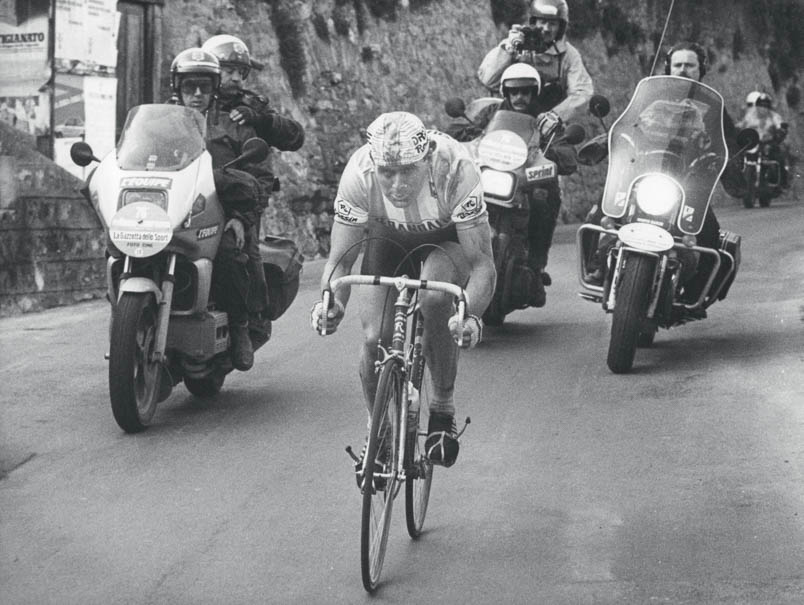
Hennie Kuiper alone on his way to victory in Milan-San Remo
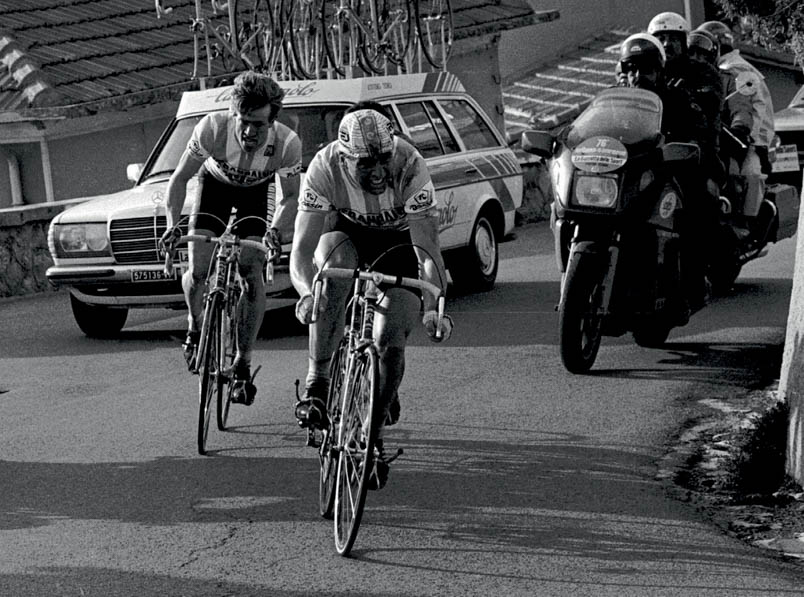
The finale of Milan-San Remo begins on the Poggio. Hennie Kuiper has caught Teun van Vliet and Silvano Riccò (hidden behind Kuiper)
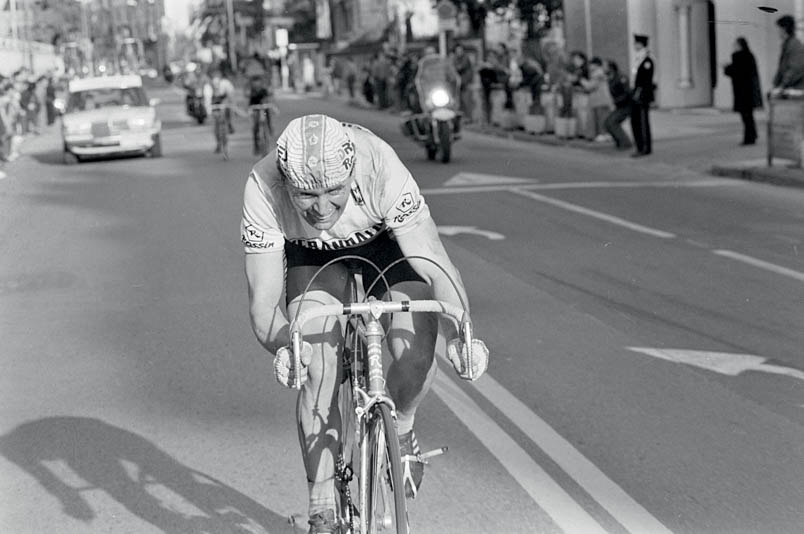
Hennie Kuiper slowly but surely pulls away from Teun van Vliet, who stays on Silvano Riccò’s wheel
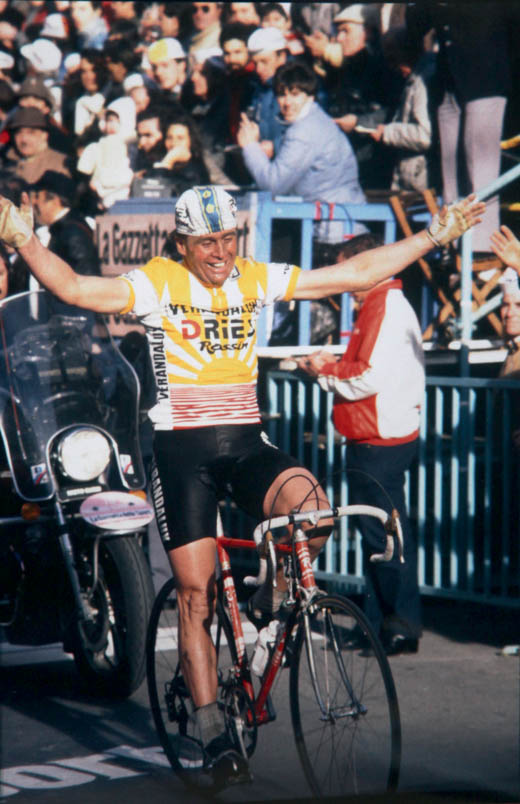
The fourth of the five Monuments is in the bag: on the Via Roma in 1985, Hennie Kuiper wins the Primavera, Milan-San Remo
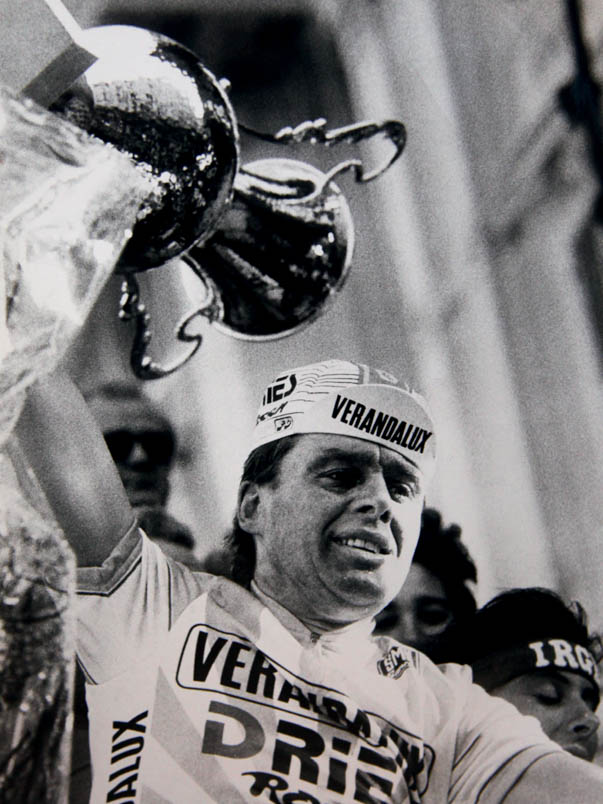
There stands a winner! Hennie Kuiper raises the Milan-San Remo trophy
‘Kuiper pulled a fast one’
The winner of Milan-San Remo 1985 is Hennie Kuiper. ‘But,’ say many critics, ‘he wasn’t the best in that race. That was his teammate Teun van Vliet.’ The received wisdom runs: ‘Kuiper pulled a fast one.’ Anyone who goes by the pictures of the finale of this Primavera is indeed inclined to think that Hennie stitched up his teammate Teun. That Teun van Vliet was in top form that day is beyond dispute. But a reconstruction of the facts shows that on 16 March 1985 Hennie Kuiper produced a performance of real stature too. He is no opportunist, and he pulls a fast one on nobody – not in the finale of that Milan-San Remo either. High time to set the record of that day straight. Italy has been in the grip of a severe cold spell for more than a week when the riders are called to the start of the Spring Classic on 16 March. Many of them have barely recovered from the hardships of the ‘polar’ Tirreno, and now in Milan it is bitterly cold again. The riders are well wrapped up: balaclavas, gloves, leg warmers and thick socks. The spectators at the roadside shrink shivering into their coat collars as race director Torriani drops the starting flag.
As the caravan crosses the Po plain, the riders see snow lying here and there. Only near Genoa, where the route runs along the coast, does it feel a little warmer, though the riders have to push harder on the pedals into a stiff headwind. With 60 kilometres to go, a big crash. Hennie manages to stop in time. ‘But then – bam! – Wladimiro Panizza flew into the back of me. Both wheels were buckled. I needed new equipment.’
The mechanic jumps out of the car and hurries to Kuiper’s teammate Jan Bogaert, who also needs two wheels. Kuiper, who at first thinks the wheels are for him, shouts: ‘What about me?’ The mechanic rushes back to the car, returns with two wheels and gets Kuiper going again. By now the peloton has long since disappeared from view. Hennie is minutes down. In his chase after the peloton he gets help at first from another rider, but in the end he has to do the job alone. At a certain point he sees a long ribbon of following cars behind the peloton, and then it is only a matter of time before he gets back on, right at the foot of the Capo Berta, one of the key obstacles in this race. ‘I needed a moment to recover. Meanwhile I could see riders being blown out of the main bunch left and right. So I wasn’t in such bad shape after all.’
From the Capo Berta it is not so very far to the Cipressa, another hill. ‘Fons De Wolf attacked there. Eric Vanderaerden was the top favourite, and he had all his Panasonic teammates working to bring De Wolf back.’ Kuiper sees it all unfold on the slopes above him. He is not yet at the front; he tries to work his way up, and then has the good luck to be overtaken by a rider from the Spanish Zor team who is setting off after the leaders. Kuiper: ‘I’d watched Paris-Nice on television the week before and seen that the Zor team were riding very well. The moment that Zor man came past me, I latched on. That rider took me all the way up to the top.’ Up there Hennie sees that Vanderaerden’s team has spent all its strength in the chase after De Wolf. ‘After the descent of the Cipressa we headed for the Poggio. There came a straight stretch, the front group bunched up a bit, and I thought: this is going nowhere. I’ll just try something.’
The peloton, by now just under 40 strong, is being led by the Panasonic man Ludo De Keulenaer, who is sacrificing himself for Vanderaerden. On a gentle left-hand bend Hennie squeezes his way forward on the left-hand side of the road. The Italian Silvano Riccò, of the small Dromedario team, sees it happen and quickly jumps onto Hennie’s wheel. Kuiper is in luck: De Keulenaer takes the bend rather wide. There is just enough room for Kuiper to launch his attack between a low wall and De Keulenaer. Kuiper shifts onto the 12, the biggest gear, and hammers on. Riccò reacts at once. Moments later two riders join them: Teun van Vliet and Patrick Versluys. The latter is soon dropped. Working together as one, the remaining trio head for the Poggio, almost always the executioner of Milan-San Remo. Normally the Poggio is no hump for a professional to be afraid of. The climb is only four kilometres long, and its average gradient of 3.7 per cent is not much to speak of either. That the final selection is nonetheless so often made here is because by then the riders already have some 275 kilometres in their legs.
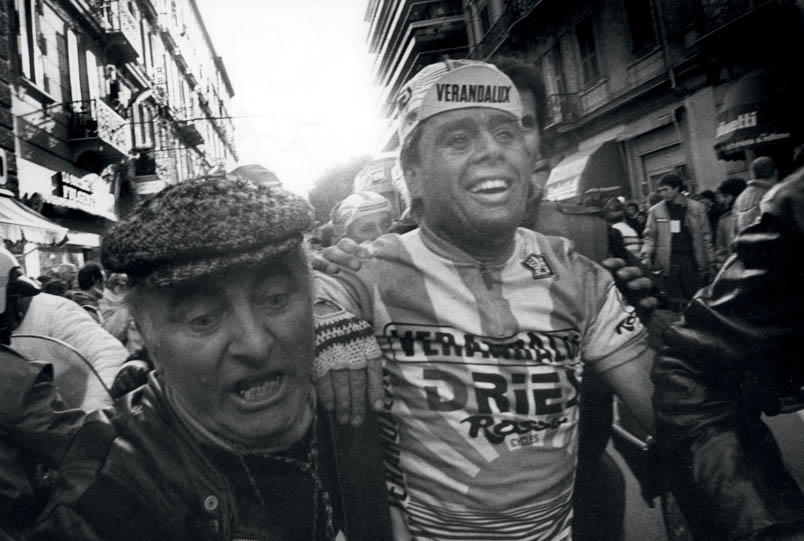
Hennie Kuiper’s joy is beyond words. The Italian commedia dell’arte around the winner immediately breaks out in full force
Teun van Vliet
Teun van Vliet feels superb on this day. He drives up the hill at an incredible pace, with a gasping, wheezing Riccò on his wheel. Commentating on Dutch television, Mart Smeets says: ‘Kuiper is letting a gap open – very tactical.’ But that is not the case at all. Hennie: ‘I simply couldn’t follow him.’ In hindsight, that is precisely what proved Van Vliet’s undoing. For the Poggio demands a particular approach. Whoever shoots his bolt too early, as Teun van Vliet does, comes up short in the real finale. ‘Your legs fill up,’ Hennie knows from experience, ‘and then for a while you just can’t make headway.’
Kuiper himself is riding in third place. His friend De Cauwer: ‘And that’s typical Kuiper. He doesn’t say: I can’t win any more, I give up. No, he wants to fight for third place as well.’ Once over the top, Hennie looks back. He sees motorbikes in the distance. But are those the motorbikes in front of the peloton, or behind it? They turn out to be the ones in front of the peloton. Kuiper then realises that there is still a wide gap between him and the chasers. Ahead of him are the two leaders. ‘Those two were hanging there; they weren’t pulling any further away from me.’
The descent begins. Between Kuiper and the Van Vliet-Riccò duo rides the Campagnolo service car. It makes a welcome target for Hennie. He knows the descent like the back of his hand. And he is a good descender. He goes into the bends flat out. Hennie still remembers it precisely: ‘I could do that because we had such a strong headwind. It kept slowing you down.’ Kuiper’s wild ride to the foot of the Poggio ends in the leaders’ wake. He reaches a flat stretch of road. Races on the 12 up to Van Vliet and Riccò, passes them on the left and immediately opens a small gap. ‘The idea was that Teun would get on my wheel, but that didn’t happen. When I looked round, I saw there was a gap between me and the other two. Then I thought: now I have to press on.’ Van Vliet has no idea how good he is that day. ‘I even still had my jacket in my pocket. I didn’t want to throw it away, thrifty as I was. I didn’t realise I’d ridden up so fast. It was only at the top that I noticed.’ Van Vliet decides to take the descent calmly. ‘I wanted to wait for Hennie, so that he could lead out the sprint for me. But when Hennie got up to us, he went straight off. I was completely taken by surprise. I really hadn’t expected that.’ Teun van Vliet cannot, and may not, go after Kuiper. He cannot run the risk of Riccò catching the two teammates out at the last. Hennie first, Teun second: two riders from the modest Verandalux team. Could it be any better?
At first they both agree that it could not. Kuiper: ‘Teun started off so well. He said: “If it turns out later that I’ve never won a big race, then I didn’t deserve to win Milan-San Remo today either.” Teun crossed the line cheering. But everything changed after he’d rung home. “You’ve been had,” they’d told him. And then stories appeared in the media saying I’d betrayed him. But that is absolutely untrue. For sixteen years I did the job of a professional rider. And I say to anyone who’ll listen: in sixteen years I never pulled a fast one on anybody.’ Kuiper is sorry for Van Vliet’s sake, too. ‘I respected that lad from day one. As a newcomer he won a stage of the Tour of the Netherlands straight away, and in impressive fashion. In the team I got to know him as an ambitious rider who was prepared to work incredibly hard, always went at it full tilt and never made excuses when things weren’t going so well.’
‘Looking back, all that fuss was very unpleasant for me. When you win a race as big as that after such a tough build-up in the Tirreno, and after that hellish chase I had to ride once Panizza had crashed into me, you expect praise, not sweeping criticism.’ The fact remains: with this Milan-San Remo Hennie claims his fourth Monument. No other Dutchman can say the same. 36 years old: the quartet is complete. And 1985 is a year for the Dutch veterans in any case. For alongside the old Kuiper, the even older Joop Zoetemelk (38) crowns his season with victory in the Tirreno and… the world championship. Who would dare talk of ‘worn-out’ riders now?
The strongest in Flanders
There follows another Monument that he very nearly wins for the second time: the Tour of Flanders, in that same year of 1985. That day – in atrocious weather – he is indisputably the best. Hennie is stung by the criticism after Milan-San Remo and wants to show that his win there was no fluke. Not that he still has anything to prove, but even so… On 7 April, after a skid in the mud that bends his left toe clip, he rides from the fourth peloton up to the first, helped by his teammates Gery Verlinden and Jos Jacobs. On the Koppenberg he has to get off in the crush. That had happened before, in the 1981 edition, which he went on to win. So there is no question of panic for Hennie. But Kuiper is intensely focused on getting to the top of the Koppenberg as fast as possible, so that he can set off after the leaders.
In 1985 there are no crowd barriers yet. Organisers, professional photographers and spectators stand in the gutter at the roadside. One overzealous spectator, a young man in a yellow jacket, tries to help stranded riders by pushing them off. To do so he runs across the cobbles of the narrow lane, from left to right, in between the riders. An official briefly tries to stop him. In vain. Just as he is about to cross the road again to help a rider get going, he steps into the path of Kuiper, who by now is on foot, bike on his shoulder, on his way to the top. Hennie reacts furiously. He lashes out hard at the man, but misses his face by a few millimetres. It is not something Hennie would normally do, but it shows the drive of the 36-year-old rider. Afterwards the incident reignites the debate over whether the Koppenberg belongs in a race of the highest level at all.
Hennie then clambers to the top on foot, sets off in pursuit and, helped by Vanderaerden, who had also been stranded, gets back on in record time. Hennie is untameable today. He attacks and is caught. Attacks again and is again called to order. Attacks for the third time, and once more his fellow escapees reel him in. It is enough to make you despair. He attacks yet again, and this time, on the Varentberg, his rivals have no answer. He opens a gap of 35, 40 seconds. Hennie thunders on towards the Muur. He is in magnificent form. Then Roger Swerts comes up in the team car. He says: ‘Hennie, you must wait. It’s still a long way to the line. There are two more coming up.’
Closing in are two riders of repute from Peter Post’s Panasonic team: the Belgian Eric Vanderaerden and the Australian Phil Anderson. ‘I was riding out of my skin, but I still decided to wait. Stupid. I should have kept going. On the Muur I’m at the front, and then I pull my foot out of the toe clip. There went my chances.’ It is a consequence of the toe clip he bent earlier. Kuiper sees Vanderaerden go. Anderson does manage to get across to Kuiper, and then will not come off his wheel. In the last kilometre Anderson sprints away from him. It is a double triumph for Post’s team: 1. Vanderaerden, 2. Anderson at 41 seconds, 3. Kuiper at 1 minute 1 second. After Flanders he rides a strong Paris-Roubaix, finishing eighth. He does so in a race in which he is chasing all the time. Every rider who is dropped from the front of the race is overtaken by Kuiper. His eighth place in this Paris-Roubaix, his third place in the Tour of Flanders and his win in Milan-San Remo mean that he, Eric Vanderaerden and, to a lesser extent, Phil Anderson form the trio who define the spring classics.
Bordeaux-Paris
In 1985 the focus is above all on the monster race Bordeaux-Paris, a ride of no less than 585 kilometres, the last 380 of them behind the derny. As early as January, at a gathering of his Verandalux team, Hennie makes it known that he wants to ride Bordeaux-Paris. There is astonishment, but gradually understanding grows. If anyone can cope with that marathon, it is Kuipertje: the relentless diesel who cannot be worn down. He chooses as his pacer Joop Zijlaard, the café owner whose sheer bulk makes a windbreak like no other. Behind his hundred kilos you are perfectly sheltered from the wind, and that is of the utmost importance on the stretch from Poitiers to Paris, when the dernys act as windbreaks and pacemakers for the small band of brave men who take on this cycling marathon.
By 1985 Zijlaard already has an impressive record. As a pacer, with various riders behind him, he has collected national titles by the handful and won European championships, and he is a many-time winner of the Critérium des As. Bordeaux-Paris is familiar ground to him. By the time he rides with Hennie Kuiper, he has already guided Jan Breur (1976), Tino Tabak (1977), Jan Krekels (1978), Peter Gödde (1980), Willy De Geest (1981), Cees Priem (1982) and Martin Havik (1983) to Paris. But never yet has Zijlaard had a winner behind his mudguard. This time, he believes, it will be different. In Hennie Kuiper he has a potential winner. The preparation is Kuiper through and through. Long, hard training sessions at high intensity. It starts right after Ghent-Wevelgem, when Joop Zijlaard waits for Hennie immediately after the 260-kilometre classic and takes him another 100 kilometres behind his 80 cc Motobécane. On top of his ‘normal’ training – which clocks up as much as 300 kilometres a day – Hennie also imposes an iron training regime on himself during the Four Days of Dunkirk. After the stages Zijlaard appears on the scene to chastise the body once more in endless training rides.
Kuiper and his sponsor Verandalux leave nothing to chance. They bring in Herman Vanspringel as an adviser. In the Netherlands Vanspringel is best known as the rider who lost the yellow jersey to Jan Janssen in the closing time trial of 1968. Since then he has built up a reputation as a Bordeaux-Paris specialist. No fewer than seven times he has beaten all comers in this marathon. Vanspringel is the ideal counsellor, and Hennie eagerly soaks up his knowledge. Pacer Zijlaard knows what is asked of him: to ride as steadily as possible. For a rider it is sheer suffering, but for a pacer it is far from easy either, Zijlaard explains. ‘On a derny you ride a fixed wheel. So for almost 300 kilometres you can never keep your legs still. And you can’t shift your position either. Because if you do, the rider is out in the wind, and that can be fatal.’
Things go reasonably well for the Zijlaard-Kuiper pairing. They are still well placed when, 140 kilometres from Paris, an incident throws Kuiper and Zijlaard’s whole battle plan into disarray. The riders turn into a left-hand bend under a viaduct. The Belgian René Martens, who has taken a small lead, keeps to the left-hand side of the road and so only just manages to avoid a number of stationary cars blocking the way. Zijlaard and Kuiper, riding behind Martens, take the right-hand – and correct – lane. But Christian Larcher, pacer to the Frenchman Hubert Linard, is also in the left-hand lane; trying to avoid some traffic islands, he manoeuvres so clumsily that he rides into pacer Zijlaard’s side. The Rotterdammer goes down and Kuiper somersaults over him. Within five kilometres Hennie loses a minute. Zijlaard: ‘Behind the dernys the riders push monstrously big gears. When you have to get going again after a fall like that, your cadence is shot. You can’t get back into your rhythm.’ Kuiper agrees. ‘I couldn’t feel any tension in my muscles at all any more.’
In just under 40 kilometres the pair lose no less than six minutes and even drop back to ninth place in the race. In the end the Zijlaard-Kuiper pairing finishes fifth (of the 13 starters), 18 minutes 54 seconds behind the winner, René Martens. The disappointment is huge. Hennie had pictured it so very differently. Afterwards there is criticism of the strategy adopted by Kuiper and his advisers. Hennie should have had a teammate with him to neutralise the attacks of Martens, Duclos-Lassalle and Linard, rather than having to do it himself. Moreover, Hennie was riding a 55-tooth chainring, whereas the conditions (read: little wind) favoured a 56. The winner, Martens, did ride a 56-tooth chainring. Finally, Kuiper was the only man in the top five not riding a disc rear wheel, so that, unlike his rivals, he was not making the most of the aerodynamics.
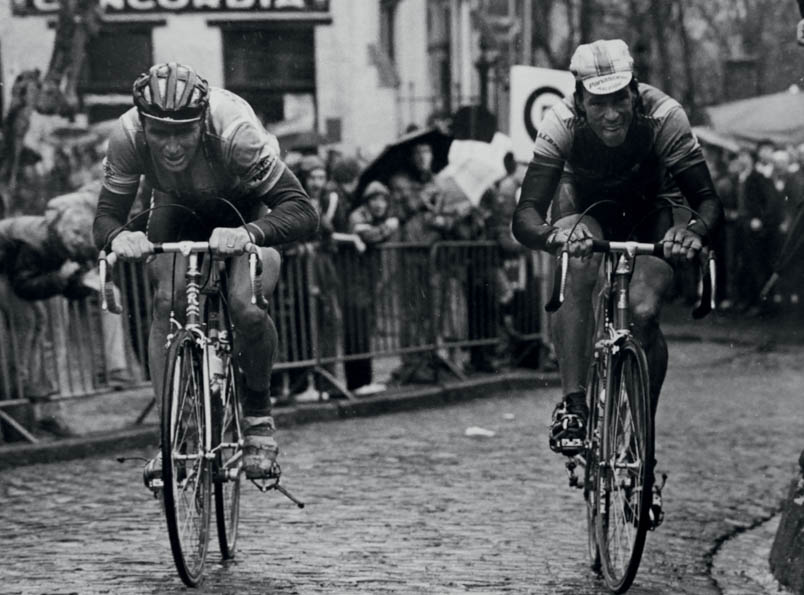
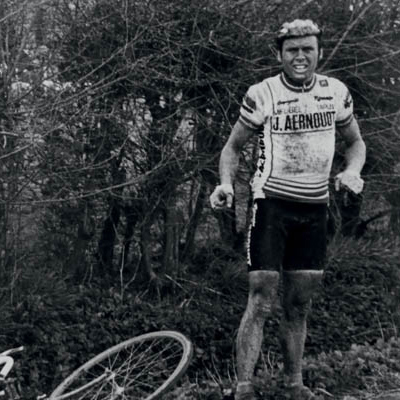
The moment Hennie Kuiper loses the 1985 Tour of Flanders on the Muur van Geraardsbergen. You can clearly see that the toe clip is not round his left shoe but underneath it. Kuiper has lost control of the pedals. Phil Anderson will take advantage
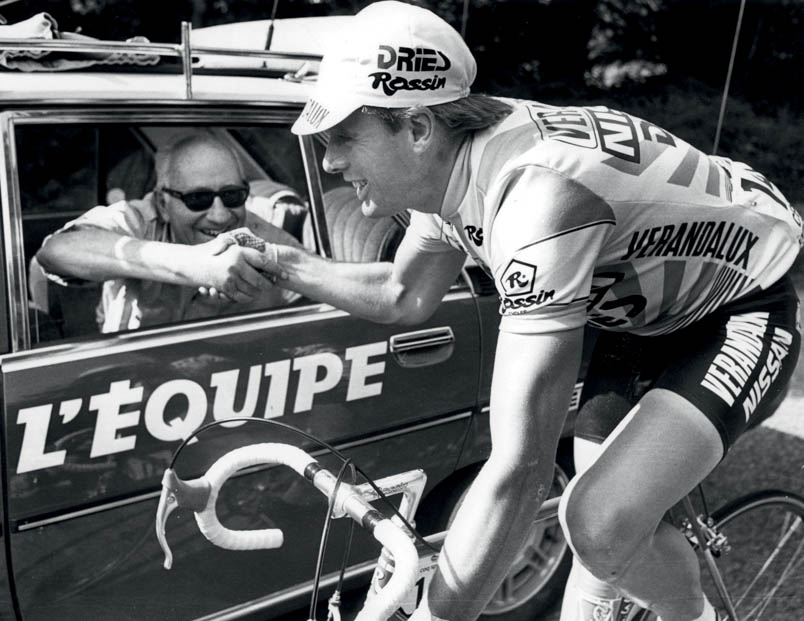
Jacques Goddet, joint head of the Tour de France with Félix Lévitan since 1963, has a warm relationship with Hennie Kuiper, whom – just like his more pedantic counterpart Lévitan – he regularly compliments and comes over to shake by the hand
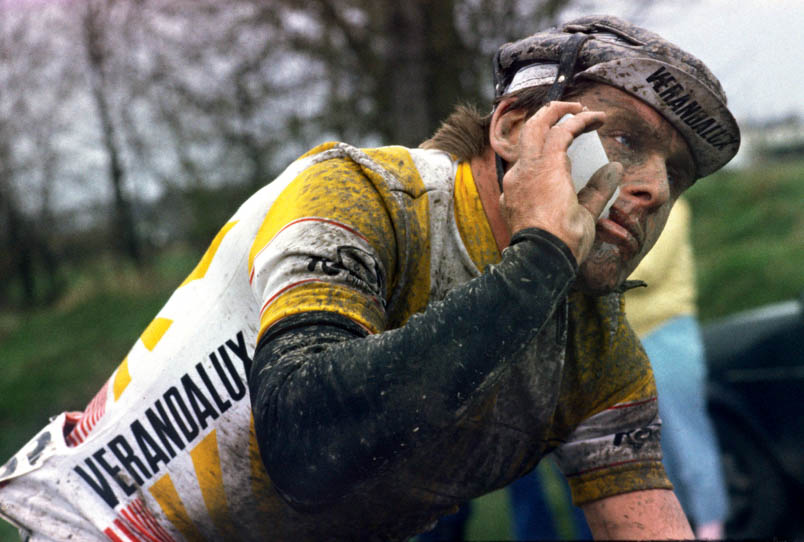
1985: Hennie Kuiper refuels in Paris-Roubaix. He finishes eighth
The form deserts him
In the weeks that still separate Hennie from the Tour de France, it becomes clear that his great spring form has vanished completely. In the Tour Kuiper never rises above the level of an extra. Stage after stage he drags himself laboriously to the finish. In the fourteenth stage, from Autrans-Méaudre to Saint-Étienne, Hennie Kuiper finishes ahead of just two riders. After only 26 kilometres, on the Col de Romeyère, he is dropped like a beginner, but even then he will not hear of giving up. He crosses the line 155th, burnt out, almost half an hour behind the winner, the Colombian Lucho Herrera. The next day he does not start. ‘The battery was flat.’ Hennie Kuiper is overtrained. Instead of nurturing his spring form, he has needlessly driven himself into the ground. ‘I should have rested, but I did the opposite.’ It is an emotional farewell, there in the Hotel Tereinus du Forez. As his Verandalux teammates say goodbye to their road captain one by one, Hennie can barely hold back his tears. Then he says: ‘I’m going home and I’m never coming back to the Tour de France. After eleven Tours, that’s enough.’
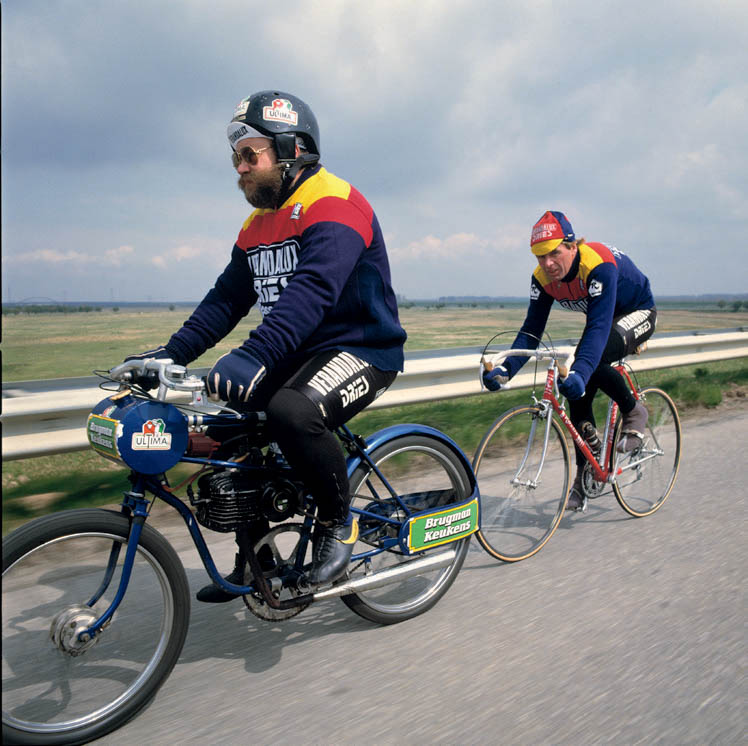
Behind the broad back of Joop Zijlaard, Hennie Kuiper trains for the monster ride Bordeaux-Paris
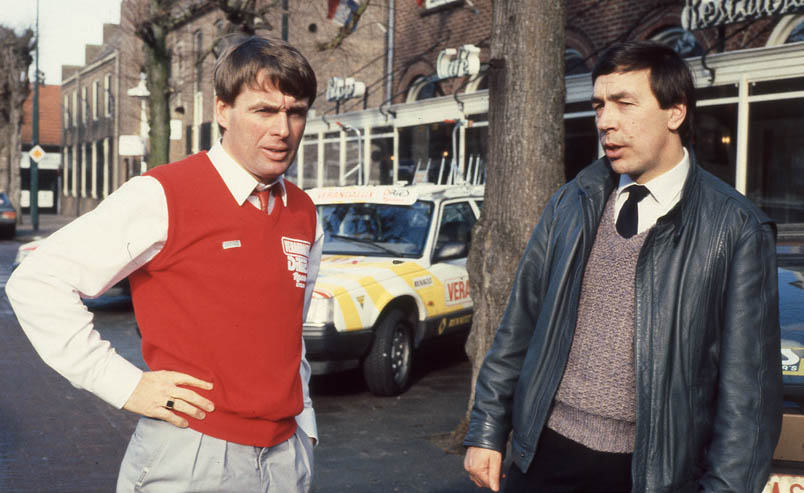
Hennie Kuiper takes advice from Herman Vanspringel before setting off on the 585.6-kilometre derny race. Vanspringel has won Bordeaux-Paris seven times: 1970, 1974, 1975, 1977, 1978, 1980 and 1981
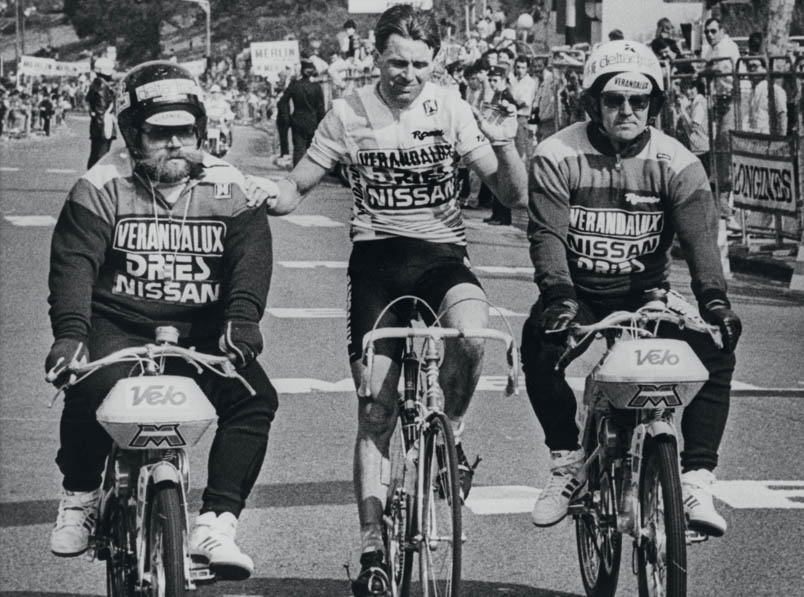
Hennie Kuiper comes in fifth in Bordeaux-Paris 1985, flanked by Joop Zijlaard on the left and Dick Verdoorn on the right