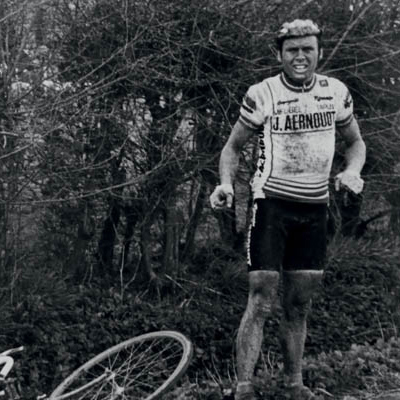
MONUMENT 3
Paris-Roubaix 1983
HENNIE’S RESULTS
| 1973 | 31st at 27:36 |
| 1974 | 42nd at 23:46 |
| 1975 | 29th at 16:28 |
| 1976 | 4th, same time |
| 1977 | 10th at 1:39 |
| 1978 | 6th at 4:26 |
| 1979 | 3rd at 0:40 |
| 1980 | 14th at 10:38 |
| 1981 | 6th, same time |
| 1982 | 15th at 2:38 |
| 1983 | 1st |
| 1984 | 9th at 6:16 |
| 1985 | 8th at 3:30 |
| 1987 | 11th at 3:12 |
Ten times already Hennie Kuiper has stood on the start line of the Queen of the Classics, Paris-Roubaix; on 10 April 1983 he lines up for his eleventh edition. For years Kuiper has thought of Paris-Roubaix as ‘his’ race. The journey through the Hell of the North has every ingredient of the kind of jousting ground he loves. Only a rider with unimaginable perseverance and an equally unimaginable willpower can come through such an ordeal. The distance – usually somewhere between 255 and 265 kilometres – is long enough to rule out the less gifted from the outset. The course, which for a large part of the way – some sixty kilometres – runs over raw lumps of stone, grinds the riders down. To ride Paris-Roubaix is to suffer. The jolting and juddering over the cobbles batters the joints. Wrists, backsides and of course legs are put to the most extreme test. The weather often plays a decisive part, above all when it has rained and the mud from the sodden fields slides across the road. The flying clods of earth turn the riders’ faces into masks of clay; they fall, curse, get back up and, all but tireless, set off in pursuit once more. Again and again. Over and over.
And yet… There is a breed of rider who ranks Paris-Roubaix above every other race. Take Jan Janssen, who won it in 1967 – three years after Peter Post became the first Dutchman to triumph there, at a record average of 45.129 kilometres per hour that would stand for a long time. Janssen finished eighth in 1964 and knows exactly why the race went so blisteringly fast that earlier year. ‘We had a force 7 wind, sometimes 8, right at our backs.’
‘In 1967 it was different,’ Janssen recalls. ‘The weather was bad: lots of rain, lots of punctures and crashes. I stayed upright. It was a race of attrition. Ten of us went into the finale. On the velodrome in Roubaix I won the sprint, thanks in part to the experience I’d gained on the winter track.’ For Jan Janssen, victory in Paris-Roubaix is one of the gems of his honours list.
Hennie loves the race, though until that 10th of April 1983 he has never managed to finish it as the winner. He still remembers 1973, his first Paris-Roubaix, in the colours of the modest Ha-Ro team. ‘It was an exciting experience, and a gruelling one. One moment I was riding alone, the next I was in a little group with others. I had no idea what position I was in, but those French people kept on cheering me. “Allez, mon petit.” I thought they were doing it just for me. Later I realised they were cheering everybody. The weather was terrible, but I didn’t give up.’ When he reaches the velodrome almost half an hour after the winner, Eddy Merckx, in the wake of Luis Ocaña, the attendants are already getting ready to shut the gate. But Hennie could not care less. He is as proud as Punch to have reached Roubaix in the tracks of the greats. At a respectful distance, admittedly, but still.
‘I just rode off for the sake of it’
A year later, in Paris-Roubaix, he and the Belgian Staf Van Roosbroeck launch a long breakaway. ‘Why? Because I enjoyed it. I wasn’t thinking about winning, or about finishing close up, at all. No, I just loved being out in front for a long time in a race like that. You get applause, people cheer you on. And then I get goosebumps. Are they doing that for me? I didn’t always ride to win. I did crazy things, because I enjoyed them.’ In 1975 he does the same. He simply races on through that dreaded Hell, with no plan, no idea behind his attempts to escape. ‘I just rode off for the sake of it. I’d see how far I got.’
In ’76 it gets serious, much more serious. He is wearing the world champion’s rainbow jersey, and he feels that his new status obliges him to show himself in the front line. ‘In Belgium they were still wondering whether I was a worthy world champion. Well, if you really want to get me going, that’s the kind of thing to say.’ By nature he is very reserved. ‘When I had to fetch my case from the carousel after a flight, I was often the last. You often end up waiting a while afterwards anyway. So what’s the point in elbowing your way to the front to get your case off the carousel a bit sooner? But if you provoke me, I’ll answer with my legs. Like I did in Paris-Roubaix 1976.’ Kuiper races attentively, riding in fifth position, and then sees Walter Godefroot wind up the pace. ‘I thought: the group’s going to break up. And sure enough. Five of us got away. Godefroot punctured. From then on there were just four of us: Francesco Moser, Roger De Vlaeminck, Marc Demeyer and me.’ He finishes, almost as a matter of course, last of the quartet: but even then it is clear that ‘Kuipertje’ (little Kuiper) is capable of a leading role in the Queen of the Classics too. He shows it more often in the editions that follow. After his three years of riding ‘for the sake of it’, he misses the top ten only twice up to 1983: in 1980 and in 1982.
Incidentally, in 1984 (9) and 1985 (8) he is back in the top ten. In 1987 he only just misses out: 11th. It is only because injuries keep Kuiper out in 1986 and 1988 that he does not finish in the top ten more often still. In 1988 especially, his last year as a professional, he is in fine fettle in the spring classics. After his frame breaks on the Paterberg in the Tour of Flanders he is given a bike that does not fit him. He pushes himself too hard and picks up a saddle injury that keeps him out of Paris-Roubaix a week later.
Wound up
In 1979 Hennie Kuiper makes the podium. He finishes third, after a race that makes him realise that he will have to make his training even more Spartan than it already is if he is ever to win Paris-Roubaix. In the finale the same quartet is racing as in 1976: De Vlaeminck, Moser, Demeyer and Kuiper. First De Vlaeminck punctures, then Demeyer. Moser and Kuiper in the lead – but then Kuiper feels a tyre slowly going down. He waits for his directeur sportif, Maurice De Muer, to come to his aid. He is so wound up that he lifts his bike and hurls it into the fields. He is barely back in the saddle when De Vlaeminck catches him. ‘That man was riding so incredibly hard that I could only take one turn on the front. That’s when I realised: I’ll have to train much harder still.’
Desire-Believe-Do. The sacred mantra runs through Hennie’s head once more. The Desire to win Paris-Roubaix for real this time is born there and then. The Belief that he truly can has grown since his third place. The Doing is a matter of waiting for the perfect chance.
Three years later, in 1982, he is completely ready for the ‘Doing’. He has pushed his training to the limit. From the first kilometre he can feel it: this could be my day. My legs are good and I feel strong. Overconfident as he is, he then makes a cardinal error. At the feed, Kuiper grandly waves away the musette with an air of: ‘I don’t need that’. Then his concentration slips for a moment and he rides straight over a sharp stone: puncture. No matter. New wheel. ‘It was so easy: I rode back up to the front whistling. But then, straight away, that was it. It felt as if someone was hanging on to my saddle the whole time. I was hit by the hunger knock and ended up finishing fifteenth.’ High time for the ‘Doing’.
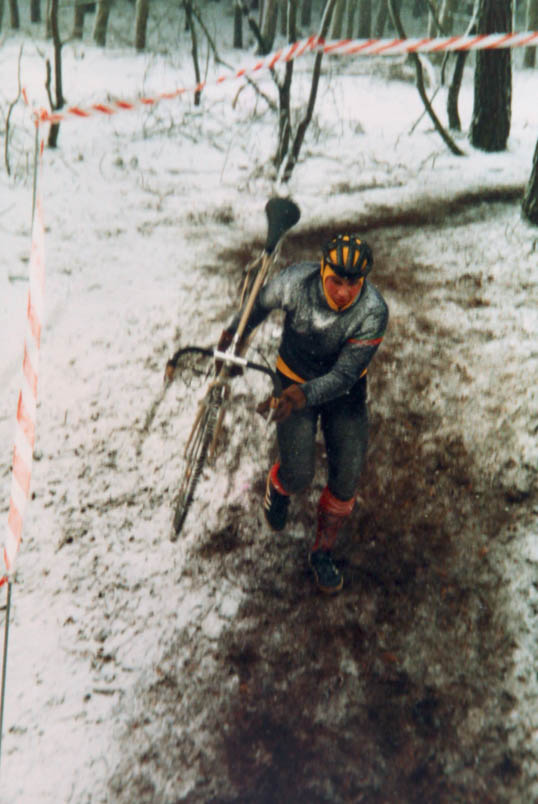
Professional dedication sees Hennie Kuiper getting himself ready early in 1983 for his big goals, as here at the Interclubcross in Heerle (between Bergen op Zoom and Roosendaal). The stamina and bike-handling skills he builds up in cyclo-cross will stand him in excellent stead in Paris-Roubaix
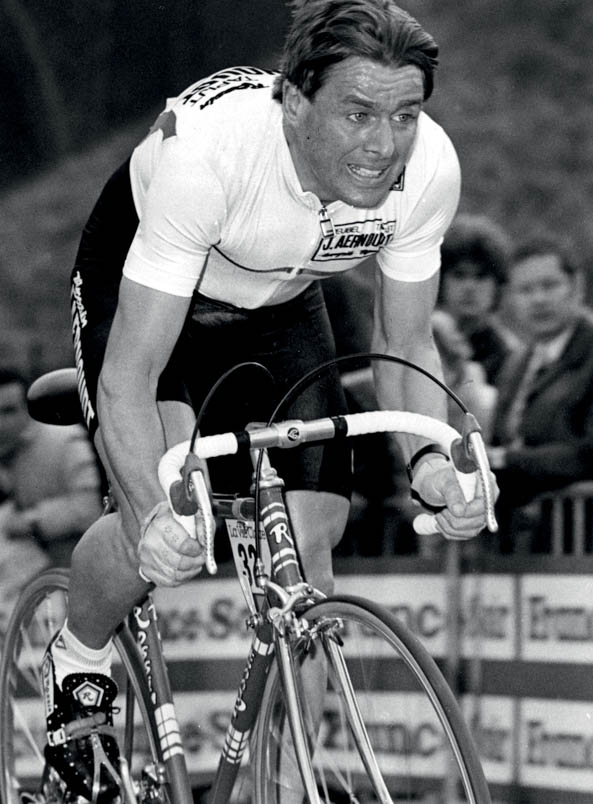
In 1983 Hennie Kuiper shows his strength straight away. He rides a creditable prologue in Paris-Nice and finishes tenth, 11 seconds behind the winner, his teammate Eric Vanderaerden
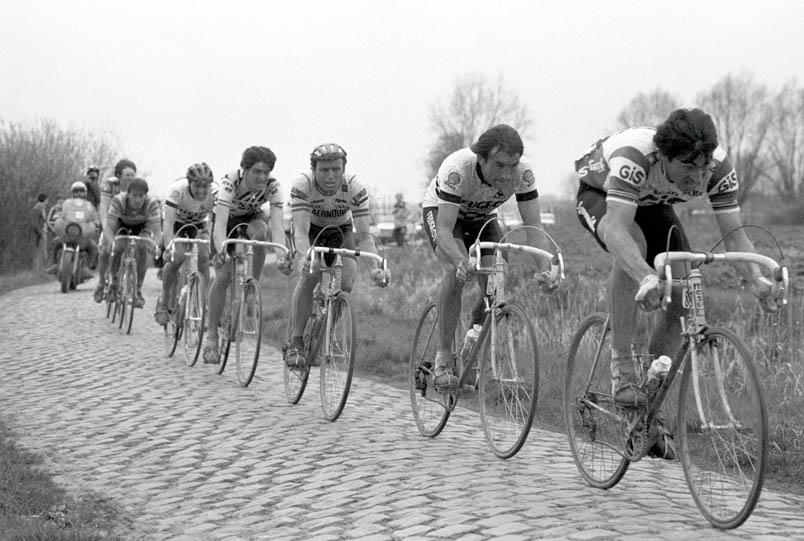
And they’re off! Francesco Moser sets a punishing pace. Gilbert Duclos-Lassalle follows. Then Hennie Kuiper. Then Marc Madiot. Then Stephen Roche. Then Alain Bondue. Then Ronan De Meyer

Mud. Muck. Mire. Sludge. Slurry. Slime. Ooze and gunge and gloop and filth. It’s all there in Paris-Roubaix 1983…
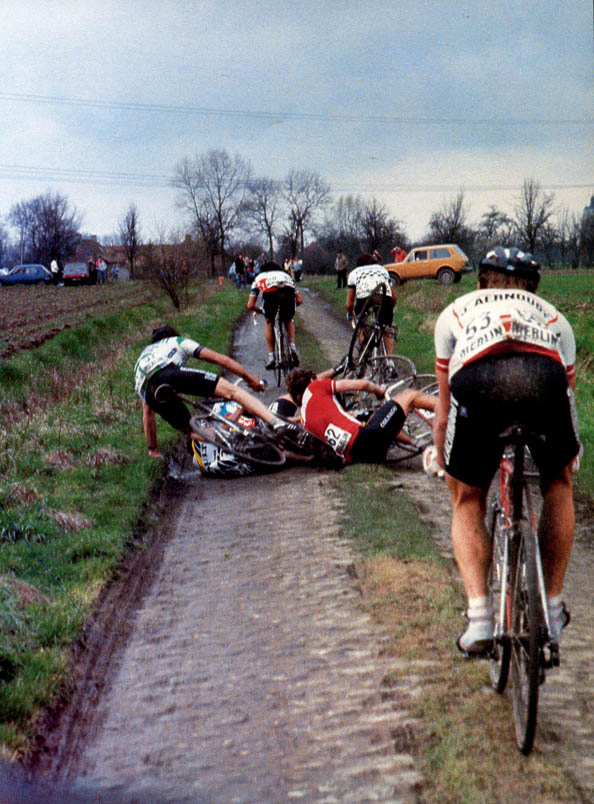
A crucial breaking point in the race. Francesco Moser and Gilbert Duclos-Lassalle press on flat out while behind them Alain Bondue, Patrick Versluys, Ronan De Meyer and Marc Madiot take a close look at the cobbles. Kuiper avoids a fall, but has to wait with one foot on the ground before he can set off after Moser and Duclos-Lassalle
More driven than ever
From the first day of 1983 Hennie has only one goal: Paris-Roubaix. He slaves away in endless training sessions. Kuiper is hardly one to spare himself at the best of times, but now he is driven as never before. Yet the sponsor’s director, Aernoudt, threatens to disrupt his perfect preparation.
It all has to do with the semi-classic Ghent-Wevelgem, which in those years falls between the Tour of Flanders and Paris-Roubaix. So: the Tour of Flanders on the first Sunday of April, Paris-Roubaix the Sunday after, and between the two, on the Wednesday, Ghent-Wevelgem, a race that mostly suits the sprinters. Now, as luck would have it, the sponsor’s gigantic furniture palace lies on the Ghent-Wevelgem route. For Jacky Aernoudt it is the chance to show off his professional cycling team. He expects to see all his stars file past his palace. So he orders the team management to line up in Ghent with the strongest possible team. José De Cauwer protests. ‘Kuiper has to perform well in Paris-Roubaix on Sunday, and Ghent-Wevelgem has no place in his preparation. What would a non-sprinter be doing there?’ Aernoudt insists. ‘All the same, I want Kuiper in the team.’ And again José refuses. It goes on like this for a while, but De Cauwer sticks to his refusal. ‘Then I’ll see you in my office on Monday,’ the director replies menacingly. De Cauwer shrugs. He has won the argument for now; the rest is up to Hennie. On the day of Ghent-Wevelgem, Kuiper takes the whip to himself in a seven-hour training ride. He races through the Zeeland countryside in a big gear. A day later he repeats that inhumanly hard exercise. When he gets home, he is so exhausted he can barely get the front door open. He showers, forces down a meal and sinks onto his bed, utterly drained. When José rings him, he says: ‘I’m completely shattered.’ ‘Excellent,’ replies his directeur sportif. ‘You’ll be good on Sunday. You’ve got two days to rest. Just crawl into bed and it’ll all be fine.’
THE COBBLED SECTORS OF PARIS-ROUBAIX 1983
81st edition
Start: Compiègne
Finish: Vélodrome de Roubaix
274 km
Number of cobbled sectors: 33
Total length: 53.7 kilometres
| 2900 metres | Neuvilly > Inchy |
| 200 metres | Viesly |
| 1800 metres | Viesly > Quiévy |
| 3700 metres | Quiévy |
| 1600 metres | Saint-Python |
| 1300 metres | Saulzoir > Verchain Maugré |
| 1700 metres | Verchain > Quérénaing |
| 1300 metres | Quérénaing > Artres |
| 2900 metres | Artres > Aulnoy les Valenciennes |
| 2400 metres | Forêt d’Arenberg |
| 1700 metres | Wallers |
| 2900 metres | Erre > Wandignies Hamage |
| 2300 metres | Marchiennes > Brillon |
| 2400 metres | Tilloy > Sars-et-Rosières |
| 1100 metres | Orchies (Chemin des Prières) |
| 600 metres | Orchies (Chemin des Abattoirs) |
| 3100 metres | Auchy > Bersée |
| 3000 metres | Bersée > Mons en Pévèle |
| 200 metres | Phalempin |
| 700 metres | Phalempin |
| 1800 metres | Phalempin > Martinsart |
| 1100 metres | Martinsart |
| 400 metres | Avelin |
| 1100 metres | Avelin > Antroeuilles |
| 1400 metres | Le Pont-Thibaut > Ennevelin |
| 500 metres | Le Pont-Thibaut > Ennevelin |
| 1600 metres | Cysoing > Bourghelles |
| 800 metres | Wannehain > Camphin en Pévèle |
| 1900 metres | Ferme de Creplaine > Camphin |
| 2300 metres | Carrefour de l’Arbre |
| 1100 metres | Carrefour > Gruson |
| 400 metres | Gruson |
| 1500 metres | Chéreng > Hem |
The Forest of Wallers
The weather holds out little promise for this Paris-Roubaix. From the cobbled sectors of the Hell come reports of waterlogged fields, mud-caked roads and steady, relentless rain. The peloton braces itself for a hard day. The Aernoudt riders form a protective shield around Hennie Kuiper. He has to save his strength as much as he can, at least until the Forest of Wallers, where the first great selection traditionally takes place. That impossible cobbled sector, which really does run straight through a forest, was brought into the race by the former rider Jean Stablinski, a Frenchman of Polish descent. The Stablewski family – as the surname was originally spelt – had once left Poland for the mining country of northern France, in search of a better life. Young Jean was sent down the mines at 14, later discovered cycling and grew into a rider who became world champion in 1962, won stages in the Tour, the Vuelta and the Giro, was crowned French national road champion four times, and on top of all that won the Amstel Gold Race. In short: a rider of standing.
As a rider he had come to know the country around Roubaix well. The famous cobbled sectors of the Hell, such as Carrefour de l’Arbre, Cysoing and Mons-en-Pévèle, he knew from his own experience. He raced on roads that ran above the very mines in which he had worked. It is not a pretty place, but it makes you a rider.
After his career he had a golden tip for Albert Bouvet, who at l’Équipe shared responsibility for drawing up the route. ‘Go and take a look at La Drève des Boules d’Herin,’ he advised the organisers of that hellish ride. They were sold at once. Since 1968 the Forest of Wallers – for that is the place in question – has been part of the route almost every year. La Drève des Boules d’Herin is 2.4 kilometres long and on the official route map bears the name Trouée d’Arenberg. The peloton dreads it. Anyone who is not in the first group when the race enters the Forest can forget about the rest of the day. It is – in bad weather above all – an inferno of falling riders and broken frames, of riders cursing and raging, and above all of a great deal of suffering. In 1998, for example, Johan Museeuw broke a kneecap there, and three years later the Frenchman Philippe Gaumont broke his thigh bone.
In 1983 the peloton charges towards the notorious cobbled sector at full gallop, as it always does. Kuiper’s teammate Adrie van der Poel asks whether they are nearly at the forest. ‘It’s a while yet,’ comes the answer, but barely a hundred metres further on the man who gave it sees that he was wrong. A rusty level-crossing barrier hangs above the little railway line on which coal was carried in days gone by. That barrier more or less marks the entrance to the forest. Hennie moves swiftly up to the front and joins the first group of about twenty riders thundering over the cobbles. Adrie is just too late, and can only watch in dismay as the first group rides away from him.
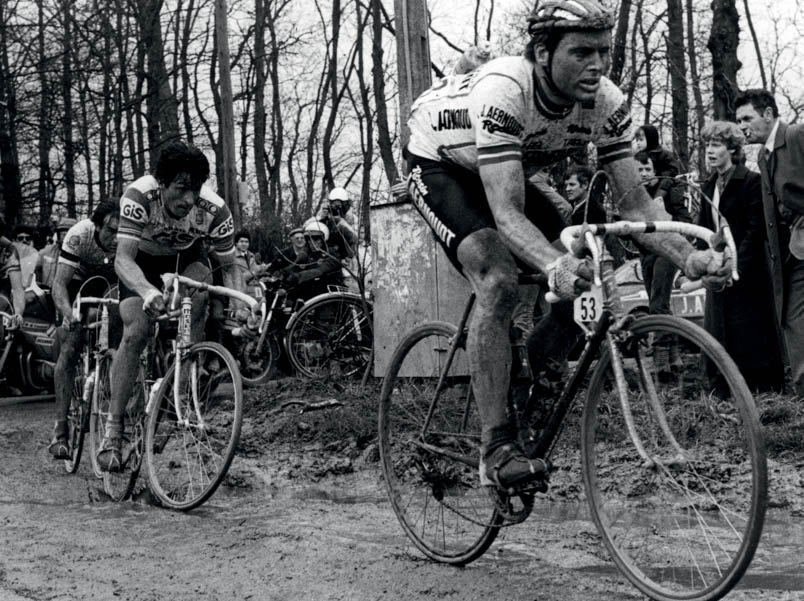
Kuiper, Moser and Duclos-Lassalle: this is racing!
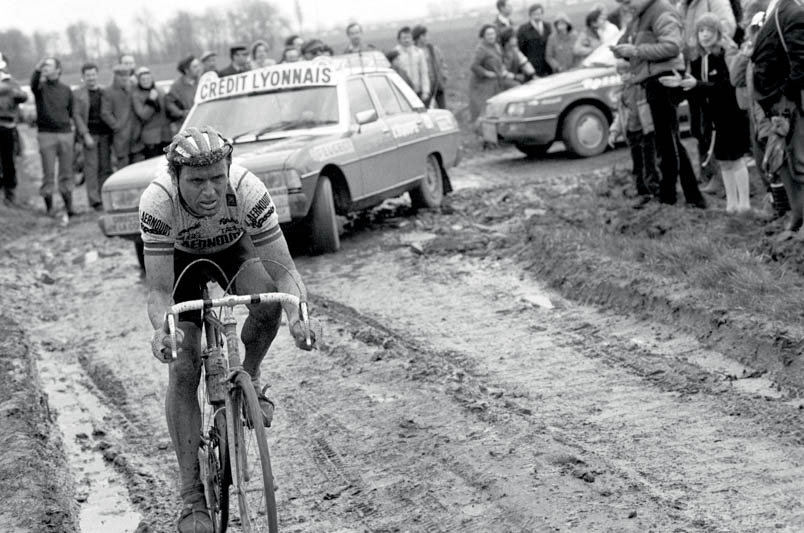
Hennie Kuiper alone and determined. Very determined. Very, very determined
Acknowledged cobbles specialists
Once again, the familiar scene: riders bouncing, wheels buckling, even frames breaking. Sixteen riders survive the first climax of the Hell. Among them are acknowledged cobbles specialists such as Francesco Moser, Marc Madiot, Gilbert Duclos-Lassalle, Stephen Roche, the local favourite Alain Bondue, Ronan De Meyer and yes, Hennie Kuiper too. ‘Riders kept dropping off all the time,’ Hennie recalls. ‘After the Forest it was every man for himself, and that suited me. Thanks to my experience in cyclo-cross I’ve always been able to ride well on cobbles. Moser and Duclos kept sprinting to be first onto each new cobbled sector, but I let them get on with it. I couldn’t win that little sprint in any case. And I felt so strong that I thought: they’re not going to get away.’ Then the little group turns onto a muddy cobbled sector. One rider goes down and others tumble over him. Bondue, Patrick Versluys, De Meyer and Madiot are the victims. Kuiper, riding a little behind the group, sees it happen, manages to stop in time, puts a foot down and waits until the fallen riders have scrambled to their feet, pointed their bikes the right way again and set off. Hennie: ‘I ride past and see Moser and Duclos in the distance, riding away flat out. I rode across to them at my own pace, and afterwards Ronan De Meyer and Madiot managed to get back on too.’
Then it is Hennie Kuiper’s turn to go down. On a greasy cobble he feels the bike slide out from under him. Madiot, riding behind him, only just manages to avoid him. ‘I didn’t panic for a moment. I picked up the bike and set off after the lead group, with a French television car alongside me. Those journalists were timing the gaps between the lead group and me. I was closing in on those front men very fast.’ Hennie’s heart is pounding. He is closing on the lead group. Everything in his eager body is screaming: at them and past them. ‘But then I said to myself: easy, Hennie. Stay calm.’
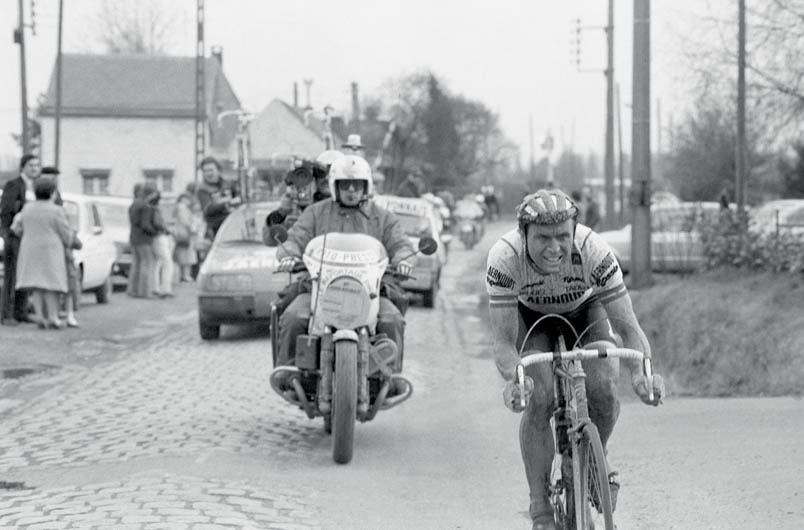
Hennie Kuiper has pulled away from his rivals, but in the background mechanic Gilbert Cattoir is not yet at ease. As a precaution he hangs out of the car, ready to step in. That is awkward, because Kuiper’s spare bike is in the middle of the roof. Cattoir wants to swap the bikes round, but directeur sportif Fred De Bruyne calms him: ‘We’re nearly there…’
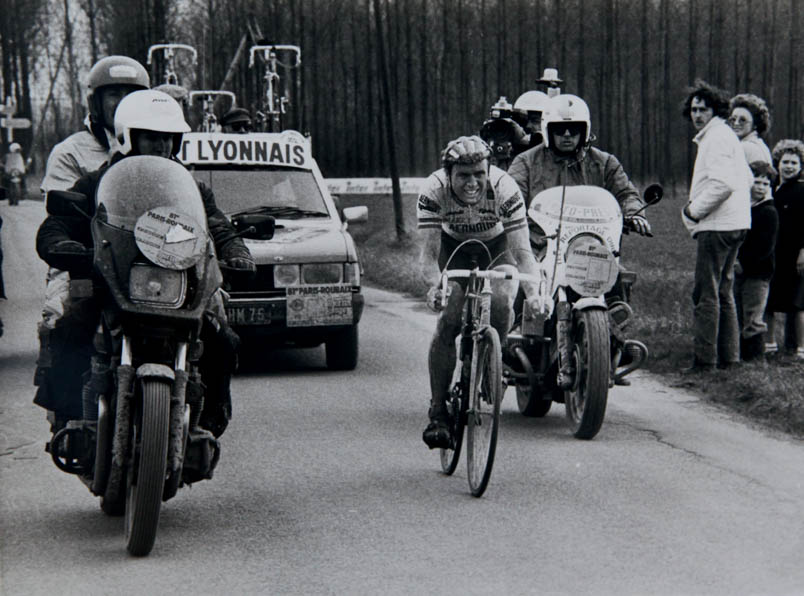
Hennie Kuiper, in his characteristic style – sitting crooked on the bike – opens the throttle wide in the finale of Paris-Roubaix 1983
Carrefour de l’Arbre
He has promised himself to hold back his attack until Carrefour de l’Arbre, that vicious cobbled sector which Bernard Hinault rates as harder than the Forest of Wallers. It must not go the way it went the year before, when he forgot to eat, got the hunger knock and finished in an anonymous fifteenth place. That cried out for revenge – revenge on himself. And now the moment had come. ‘I hadn’t reconnoitred the course this time. I knew well enough what was waiting for me. In the days when I was resting after that punishing training, I went through it all again on video. I knew what I had to do.’ Hennie joins the little group of four, who are working together as one to widen the gap to any chasers.
And then comes Carrefour de l’Arbre, the place where it has to happen.
He shifts into a big gear, rides to the front, and has Duclos-Lassalle on his wheel. Hennie does not attack – no, he simply keeps opening the throttle a fraction more. Agonisingly slowly, but irresistibly, he rides away from his breakaway companions. Metre by metre he gains ground. The men behind him are gasping for air. Kuiper the diesel thunders on, at a single, steady, unrelenting pace. He is racing on sheer power, and utterly convincingly. The cobbles are treacherously greasy, but Hennie picks his line with assurance: now right on the crown of the cobbled road, now on a tiny strip of tarmac that separates the raw lumps of stone from the sodden fields. He races along the row of poplars, past the little café where he has to come off the cobbles again. The lead grows. Is Hennie on his way to victory in his favourite classic after all? Then, on the very last cobbled sector, near Hem, the road bends to the right. Kuiper steers across to the far side, to the narrow strip of tarmac beside the cobbles. In a flash he sees someone kneeling there with a camera. He gambles that the man will jump aside, but the man has eyes only for the shot of a lifetime he hopes to take. There is nothing for it but to ride through that puddle. He steers, and feels the bike drop. There is a hole in the road, full of water. The back wheel thumps through it. Five, six metres further on the wheel locks. In the thick of the finale he comes to a standstill, and feels the chasers breathing down his neck. The TV viewers – those in the Netherlands above all – cry out in horror. Ooooohhh… What a disaster! Hennie looks at the bike and sees that the jolt in the pothole has rolled the tyre off the rim and jammed it somewhere between brake and rim. He lets the bike drop onto the verge.
He needs a bike! A new bike!
That bike is on the car of directeur sportif Fred De Bruyne. Three spare bikes are mounted on the roof: Eric Vanderaerden’s in pole position on the right, Adrie van der Poel’s on the left and Hennie Kuiper’s in the least favourable spot of all: the middle. After all, it takes longer to get at a bike in the middle than at one on either side. So the bike of the rider from whom least is expected gets the middle position on the car.
Gilbert Cattoir
The Fleming Gilbert Cattoir is the mechanic on duty. Together with directeur sportif Fred De Bruyne he decided where the bikes would go. ‘Fred and I had said: we’ll put Kuiper’s bike in the middle. He hasn’t ridden all that well this season. De Cauwer, the assistant, knew how good Kuiper was, but we didn’t.’ During the race the mechanic tries to change the arrangement. ‘When Hennie had got away, I say to Fred: dammit, Kuiper’s bike is in a bad spot. Let’s swap them round.’ But Fred brushes it aside: ‘Leave it, we’re nearly there.’
A few kilometres further on, it happens. ‘And there’s this man standing there with his Kodak, for God’s sake.’
The car is not on the spot straight away. There are still two other following cars between Kuiper and De Bruyne’s team car. Precious seconds tick away. Hennie looks round impatiently for the car. Brimming with adrenaline, he claps his hands furiously – an image etched into the memory of every cycling fan. There is no question of panic; only of the need to act fast. De Bruyne, on the other hand, does panic. Mechanic Cattoir first snatches two wheels from the roof, then sees that what Hennie needs is not wheels but a bike. De Bruyne pulls the wheels out of his mechanic’s hands, runs to the bike and starts tugging frantically at the frame and the jammed tyre. Luckily Cattoir keeps a cool head and acts like lightning. ‘I got that bike off the roof from between the others and ran to Hennie as fast as I could; he saw me coming. Quick… quick… quick…’ These are breathtaking seconds, which set pulses racing among everyone involved, the spectators and the TV viewers. They want to will Hennie forward with their eyes. Damn it, faster, because Moser and company are coming! Seconds seem like minutes. In reality the whole operation, from the moment Hennie rides through the pothole until he has hauled himself back up to speed on the tarmac a good hundred metres further on, takes exactly 49 seconds. The great hero: Gilbert Cattoir.
A RECONSTRUCTION FROM THE TV FOOTAGE
| 00 seconds | Hennie rides into the pothole |
| 05 seconds | Hennie off the bike. Sees that the tubular has rolled off the rim |
| 07 seconds | Hennie sees it is hopeless, drops the bike on the verge |
| 08 seconds | Hennie claps his hands furiously. Where is the team car? |
| 17 seconds | De Bruyne arrives with wheels. Tugs at back wheel and tubular |
| 27 seconds | Cattoir arrives with a new bike |
| 28 seconds | Hennie is on the bike. Cattoir pushes him off and keeps pushing as he runs. ‘Push, push,’ Kuiper urges him |
| 33 seconds | Hennie and the pushing Cattoir have to get round a motorcyclist parked on the narrow strip of tarmac |
| 39 seconds | Cattoir keeps pushing with all his might. Hennie shifts into a bigger gear and in one fluid movement tightens the strap of his right toe clip |
| 42 seconds | Hennie leaves the cobbled sector and reaches a tarmac road. Cattoir gives one last hefty push |
| 49 seconds | Hennie tightens his left toe-clip strap and is back in his rhythm |
Once Kuiper is on his way again, word comes that the Moser-Duclos-Lassalle duo are still 17 seconds behind. So at the moment of the incident Kuiper must already have opened a gap of more than 1 minute on his breakaway companions. There are six kilometres still to go.
Francesco Moser, 34 years after that particular Paris-Roubaix, remembers little of the incident. The Italian, who has since made a big name for himself as a winemaker, would rather talk about the three years in a row in which he emerged in grand style as the conqueror of the Hell of the North. In 1978 and 1979 he got the better of Monsieur Paris-Roubaix, Roger De Vlaeminck; in 1980 he consigned Gilbert Duclos-Lassalle to second place.
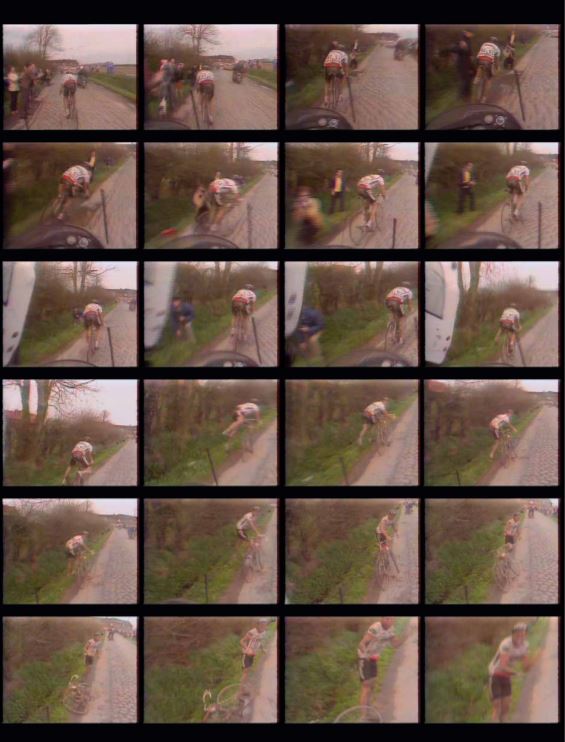
The cause of the hold-up in the finale of Paris-Roubaix. Hennie Kuiper takes the right-hand bend. Looks for a line beside the road surface on the left. And has to swerve round a crouching amateur photographer. His back wheel slams into a deep, invisible hole filled with water. Tyre off! Kuiper throws the bike onto the verge. And claps his hands to get new equipment as fast as possible
Moser: ‘You must never give Kuiper any room’
Moser naturally knows Hennie Kuiper the rider well. ‘In two races I would dearly have loved to win, he got the better of me: at the 1972 Olympic Games, when I couldn’t bring him back after he’d attacked, and at the 1975 World Championships, where every time I tried to jump across to him I had one of his Dutch teammates on my tail.’ He knows you must never give Hennie Kuiper any room. ‘Once he’s gone, you don’t see him again. And that was the case in 1983 as well. I didn’t know he’d had bad luck. Nobody told us he’d lost so much time, and we never really had him in our sights either. No, he was gone, and then you knew it would be very hard to bring him back.’ So it proves that Sunday. Hennie is unstoppable. ‘The moment I reached the tarmac, I threw the chain onto the 13, and a moment later onto the 12.’ That gear proves big enough to take him back up to top speed. ‘I threw everything I had left into it. The last little hill, at Hem, I flew up.’
Normally a professional would not think twice about an obstacle like that, but after a gruelling race of more than 250 kilometres it is a very different matter: it can feel like an hors catégorie climb. Hennie rides under the flamme rouge, the signal that he has entered the last kilometre. Beside him he sees the red car of race director Félix Lévitan loom up. The small figure in the leather cap leans forward and speaks these words to the speeding rider: ‘Monsieur Kwiepèr. Mes félicitations. Vous êtes fantastique aujourd’hui.’
Hennie turns onto the ramp leading to the track. He sees supporters standing there. ‘When you’re really good, you see everything.’ Then he reaches the concrete of the Roubaix velodrome and, jubilant, begins his final lap before the packed stands. Kuiper praises the part that mechanic Gilbert Cattoir played in his great victory. ‘Gilbert won Paris-Roubaix for me.’ He is the man who keeps a clear head at the decisive moment. Unlike the ever-nervous directeur sportif De Bruyne, he does not waste time wrestling with the broken bike. He arrives with the spare bike and pushes Kuiper off with all his might, along the extremely narrow strip of tarmac beside the cobbles. ‘I could do that because I still had a cyclo-cross rider’s fitness,’ Cattoir explains. ‘Up until the winter before, I’d been racing cyclo-cross. And you have to train for that, to be able to run fast. That came in very handy in that incident with Hennie.’ For a good hundred metres Cattoir pushes Kuiper as hard as he can. ‘Gosh, I was shattered. I ran back to the car, and I’d only just got in when I saw the chasers, Moser and Duclos-Lassalle, coming. If we’d needed ten seconds more to get Hennie going, they’d almost have been on him. It was a good thing I was so fit.’
There is indeed no disputing that Cattoir played a large part in Kuiper’s victory. Without him, Kuiper might well have been left stranded within sight of the finish. None of that alters the fact that on 10 April 1983 Hennie produced a historic performance of which he himself, first and foremost, may be proud. In hindsight he may even be grateful to the amateur photographer who forced him into that near-fatal manoeuvre through the pothole. For that incident lends his victory a heroic dimension. Without that ‘damned’ photographer we would never have lived through such a nerve-racking bike change. It would still have been a magnificent triumph, but one without the heroics.
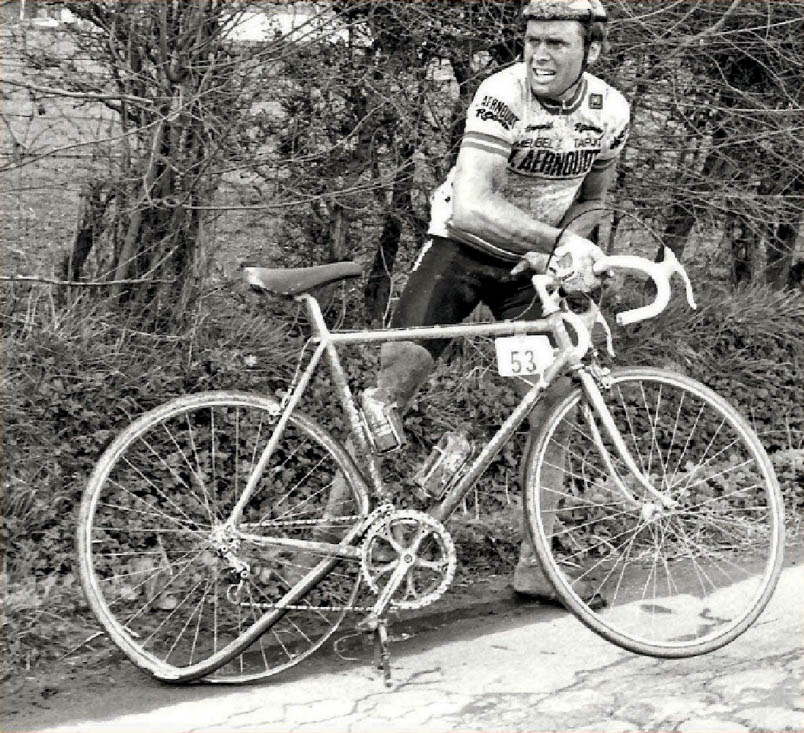
The myth of the puncture laid to rest for good. Kuiper did not puncture in the finale of Paris-Roubaix. The tyre came off the rim
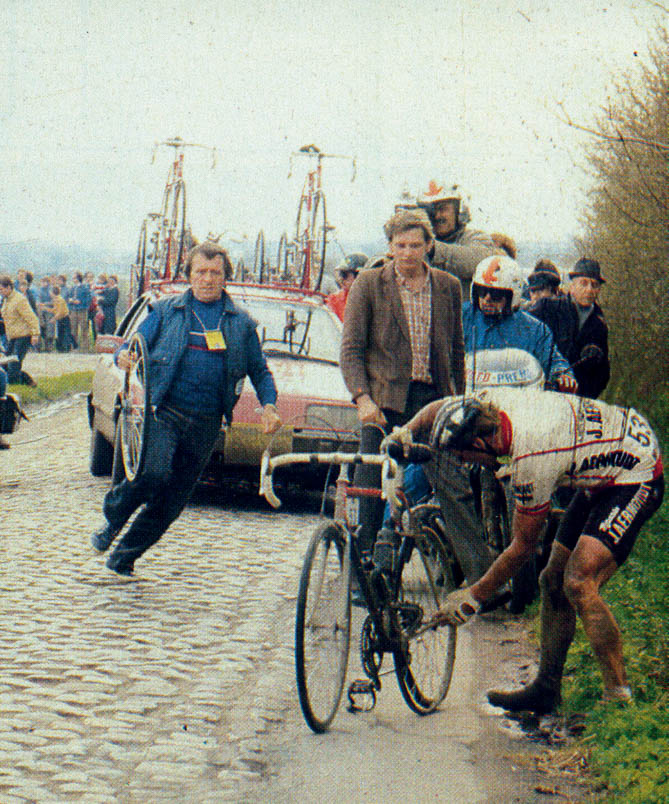
Hennie Kuiper grabs his bike and is already trying to free the back wheel, because Fred De Bruyne is on his way with a new wheel
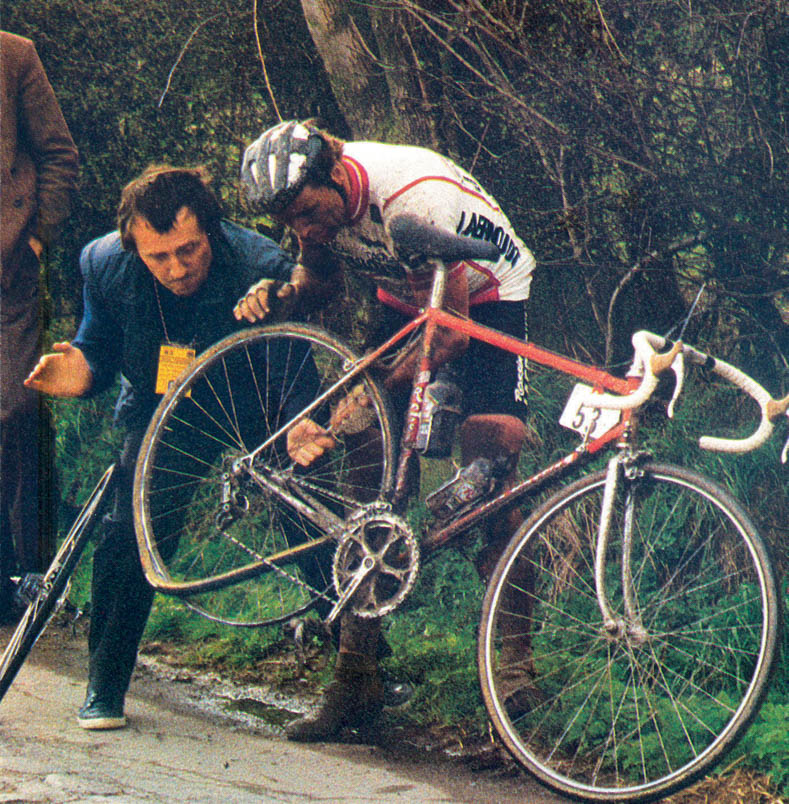
Fred De Bruyne hammers away with all his might to free the wheel, but does not succeed
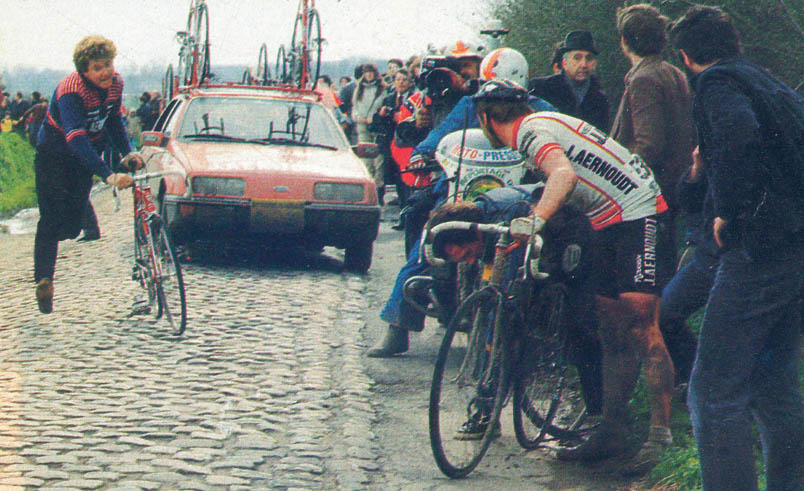
Gilbert Cattoir understands what really is needed in the circumstances: a new bike. He has taken the middle bike off the roof of the team car and comes flying in with seven-league strides, feet clear of the ground
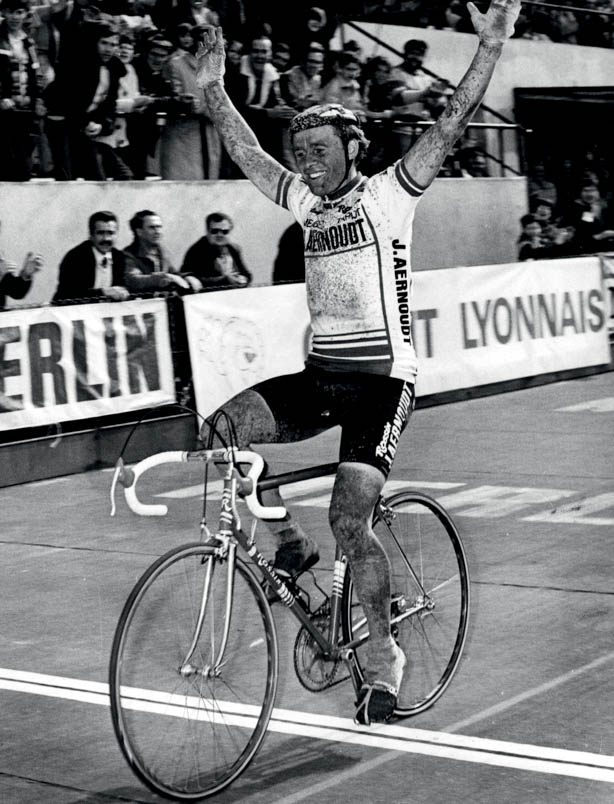
Eternal glory for Hennie Kuiper. Victory in Paris-Roubaix 1983 will in part colour the rest of his life
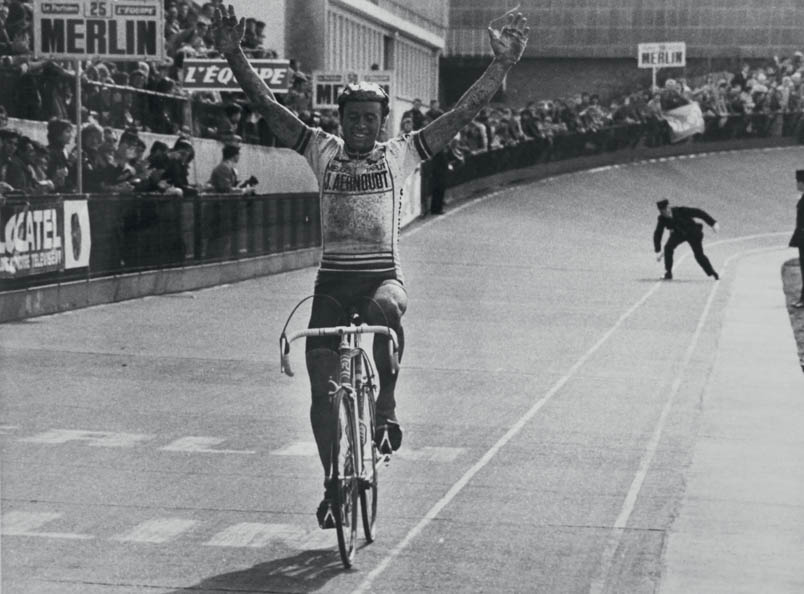
Hennie Kuiper’s 1983 victory on the Roubaix velodrome is part of the Dutch sporting heritage. In a vote for the Sporting Moment of the Century in December 1999, Kuiper’s win competed with, among others, the Olympic volleyball gold of Atlanta 1996, Reinier Paping’s victory in the Elfstedentocht skating marathon, Richard Krajicek’s Wimbledon triumph and Fanny Blankers-Koen’s four gold medals in London 1948
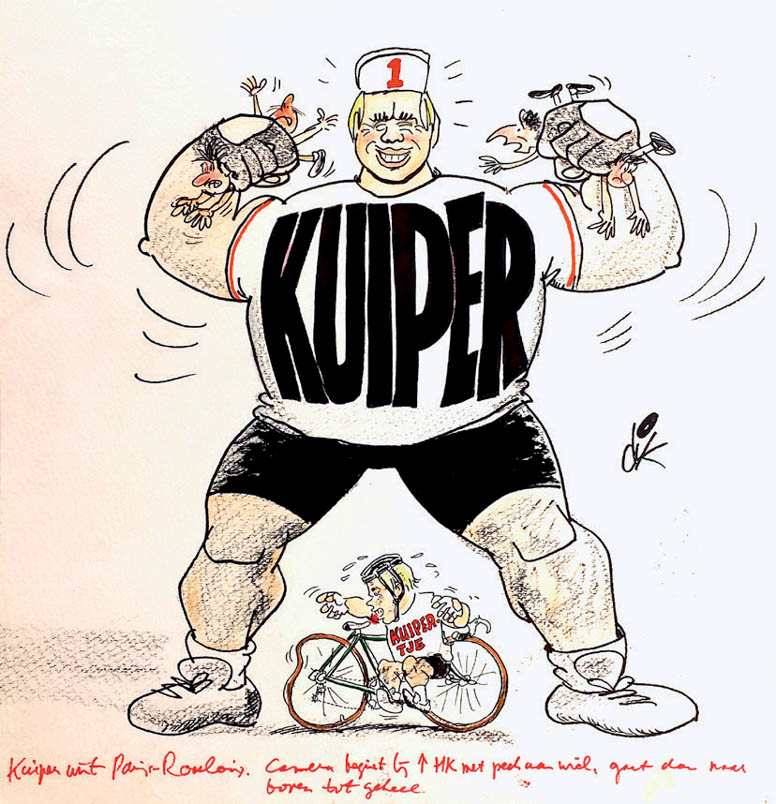
Cartoonist Dik Bruynesteyn portrays Hennie Kuiper as a real strongman who has crushed the opposition
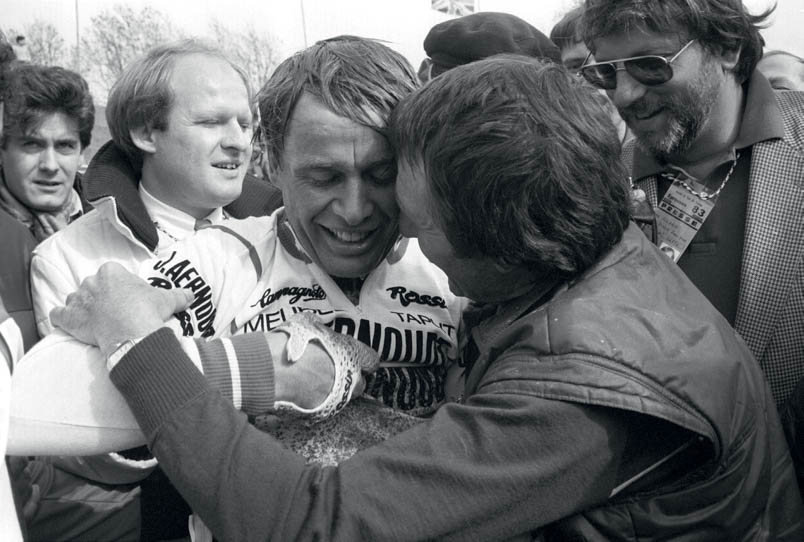
Fred De Bruyne is quick off the mark to share in the celebrations around Hennie Kuiper in the infield of the Roubaix velodrome
Trofeo Baracchi
After his heroic victory in Paris-Roubaix, Kuiper may not have a top season, but his list of results is still worth a look. In the Tour of Lombardy (4), the Vuelta (5) and Liège-Bastogne-Liège (6) the 34-year-old shows that he is still a force to be reckoned with. He has to leave the Tour de France when his father dies. Most striking of all is his performance in the Trofeo Baracchi, the two-man time trial he always longed to win, but which he fails to add to his palmarès in 1983 as well. The first time he takes part, in 1975, when he can display his brand-new rainbow jersey, he rides with Gerrie Knetemann, his future teammate at TI-Raleigh. The pair finish third, 3 minutes 1 second behind the winning pairing of Francesco Moser-Gianbattista Baronchelli. Freddy Maertens and Michel Pollentier finish 51 seconds down, still ahead of Kuiper-Knetemann.
After that, no fewer than three times, Hennie comes up short in the second place he knows so well. In 1978, with Joop Zoetemelk as his partner, Hennie proves the stronger of the two. But at the finish the winning pair, Roy Schuiten-Knut Knudsen, are 24 seconds faster than the two Dutchmen. Four years later, with the pure specialist Bert Oosterbosch, he again takes second place, at a finish beside the Leaning Tower of Pisa. The pairing of Daniel Gisiger-Roberto Visentini proves faster. Kuiper is second once more, just 24 seconds down. He is deeply frustrated. Out on the road Oosterbosch confidently takes charge. After all, he is the better time triallist, isn’t he, the specialist? But then you don’t know Hennie. He takes over the lead, and Bert – brave little red-headed Bert – goes completely to pieces. He is glad just to have held Kuiper’s wheel. ‘Never again.’ Adrie van der Poel puts his name down for the 1983 Trofeo. ‘Then I’ll ride with you,’ Van der Poel tells Kuiper. People lean on Adrie hard, José De Cauwer above all. ‘Don’t do it, Adrie, that Kuiper will ride you into the ground.’
It is not Hennie who rides Adrie into the ground, but the other way round. At least, for 85 kilometres Van der Poel is the stronger. Then he weakens, and once again it becomes clear how strong the body of that eternal diesel Kuiper is. ‘I’ve never suffered so much in my life as in the last ten kilometres of that Trofeo Baracchi, on Hennie’s wheel.’ Once again a pairing that includes Hennie is placed second, 1 minute 10 seconds behind the Swiss-Italian duo of Daniel Gisiger-Silvano Contini. ‘That wasn’t down to me,’ says Van der Poel, but to directeur sportif Fred De Bruyne. ‘As usual in those days, we were riding those submarine bikes. They were supposed to be the most aerodynamic. A few minutes before the start De Bruyne came running up to tell us he’d had new wheels fitted on Hennie’s bike and mine. Well, didn’t we know it. Twice we had to stop on the way because spokes had come loose. That cost us the win.’ José De Cauwer is furious afterwards. ‘Those lads should simply have raced on the wheels they’d been training on all week. Then nothing would have gone wrong.’
Business is going badly for the sponsor, Jacky Aernoudt. In the autumn it is announced that the team is to fold. On 28 February 1984 Jacky Aernoudt is declared bankrupt, but in the months before that Hennie has already found another sponsor in Joop Steenbergen, managing director and owner of Kwantumhallen, who appears in the peloton with a team under that name. Peter Post, watching his Raleigh team drain away, scornfully dubs it the ‘pots and pans team’. Steenbergen had been sitting in front of the television in April when the breathtaking Paris-Roubaix from which Hennie emerged triumphant was broadcast. ‘I want that too,’ Steenbergen cried. In Jan Raas, who had angrily turned his back on Peter Post, he finds an ideal partner. Raas signs the riders and sees Kuiper as a key piece in the new team. ‘I got on well with Jan. He was the one who called the shots at Raleigh.’
That things end in failure at Kwantum is because Raas, for reasons nobody can fathom, suddenly made Lomme Driessens directeur sportif. Driessens was no high-flyer; he played the high-flyer, had the gift of the gab, but could not build a team. By the time he arrives at Kwantum, he is already winding down. So nothing comes of it with Lomme. Yet in 1984 Hennie comes very close to another great Paris-Roubaix. A lead group of sixteen riders forms, with no fewer than five Kwantum men in it: Leo van Vliet, Hennie Kuiper, Ludo Peeters, Jacques Hanegraaf and Adje Wijnands. Numerical superiority like that ought to lead to an unequivocal triumph. But the men do not ride for one another. They are rivals among themselves. Kuiper, contritely: ‘Yes, I was the team leader. I should have taken charge. But I didn’t. I just don’t have it in me.’ And so the Irishman Sean Kelly makes off with the win.
Hennie Kuiper is not really happy at Kwantum. It bothers him terribly that there is so much jealousy between the Kwantum (Raas) and Panasonic (Post) teams. When soigneur Rudy Bergmans asks him to strengthen the Belgian Verandalux team, he is quick to jump at the chance. It is a team that includes, among others, the Belgians Jos Jacobs and Gery Verlinden and the Dutchmen Teun van Vliet, Jan and Adri van Houwelingen and, later that season, Gert Jakobs as well. The directeur sportif is Roger Swerts, once one of Eddy Merckx’s mainstays and an old acquaintance of Kuiper’s.
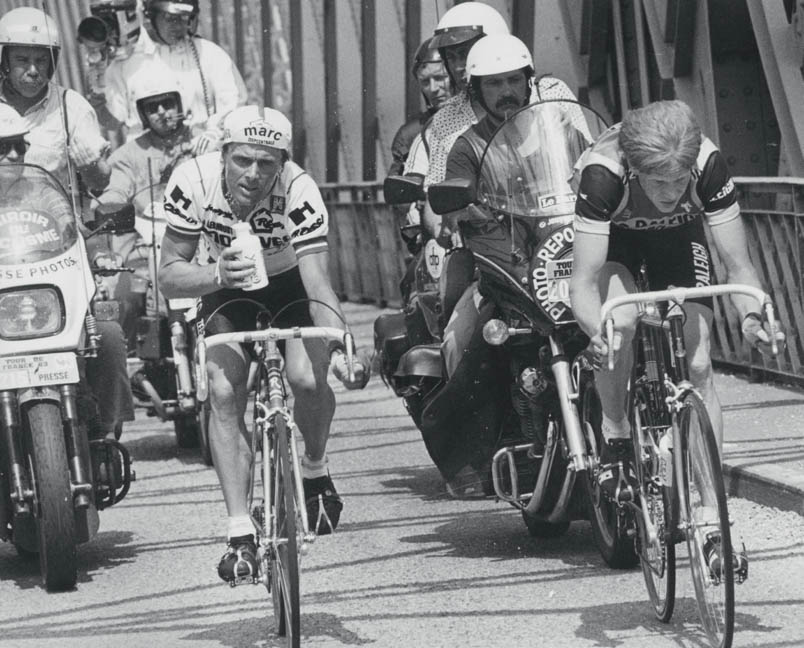
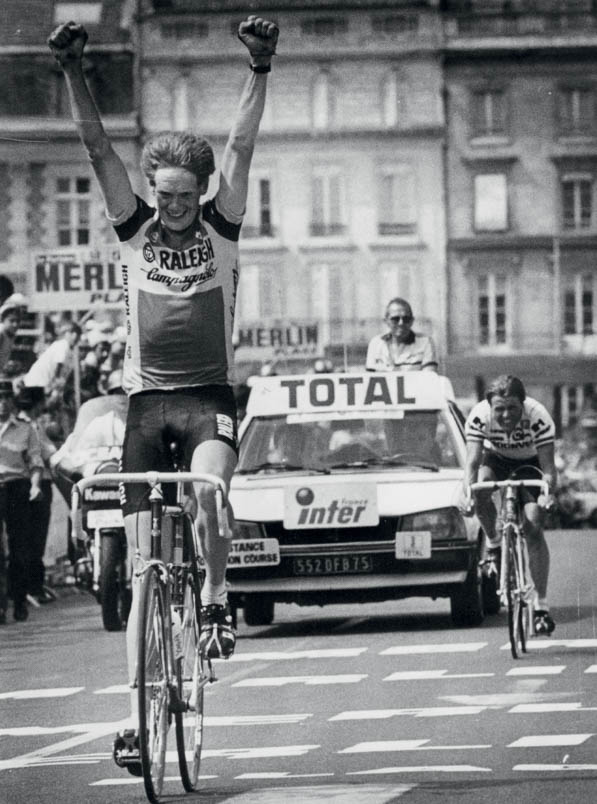
In the 1983 Tour Hennie Kuiper puts on another strong show when he is alone at the front with Bert Oosterbosch in the finale of the stage to Bordeaux. In the sprint in that ‘Dutch’ stage town, Kuiper has to let Oosterbosch go first
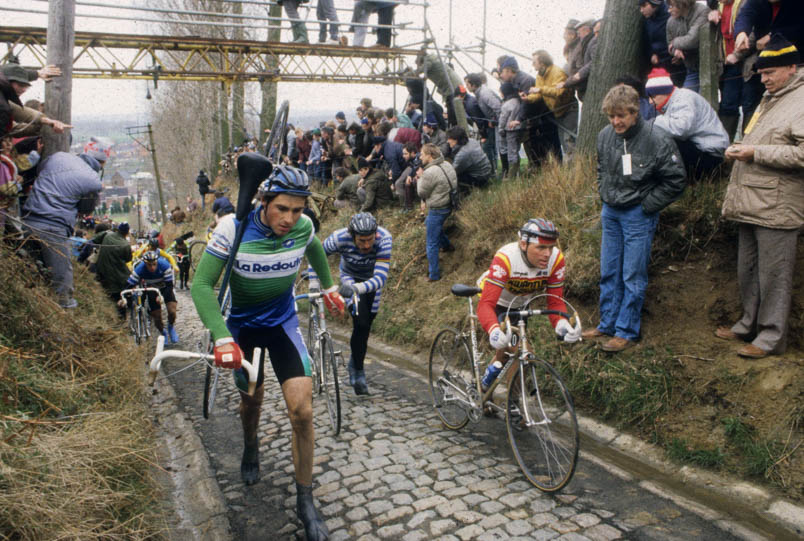
1984, in the Tour of Flanders. Het Parool reporter Harrie ten Asbroek (white card round his neck) has found a spot on the Koppenberg to watch Hennie Kuiper come up on foot. On the left, Alain Bondue has his bike across his shoulders. Behind Hennie, Urs Freuler clumps along
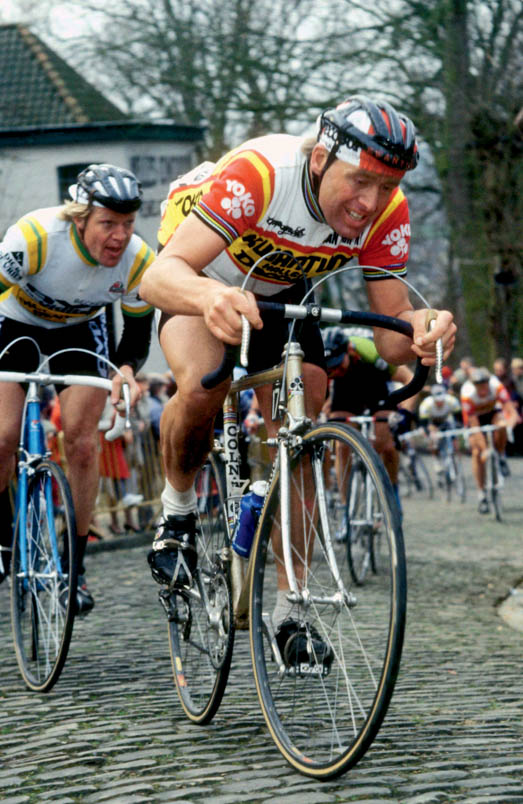
Hennie Kuiper battles his way up the Muur van Geraardsbergen in the 1984 edition of Vlaanderens Mooiste (Flanders’ Finest), with Jos Schipper following in his footsteps
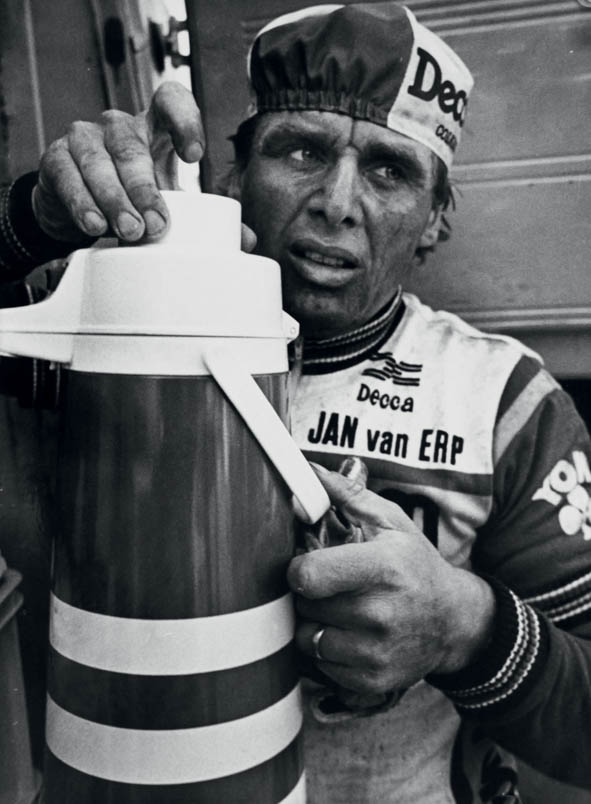
Few can withstand the elements like Hennie Kuiper. But chilled to the bone, even Kuiper falls prey to a craving for the thermos flask