The Monuments
For a rider who races for the overall classification, the big stage races are the high point of a racing life. The order is fixed. At number one is the Tour de France. Then comes the Giro d’Italia, and the Vuelta is ranked third. All the other stage races, however attractive some of them may be, are held in lower esteem. The classics riders have a similar ranking. Five great one-day races stand out above all the rest. They are known as the five Monuments, and they owe their place in that category mainly to their age.
In the chronological order of the cycling season, they are:
Milan-San Remo. Always raced on or around 19 March, the name day of St Joseph. Nickname: La Primavera (the Spring). First edition: 1907. Distance (depending on the route): about 290 kilometres;
Tour of Flanders. Race date: first Sunday in April. Nicknames: Vlaanderens Mooiste (Flanders’ Finest) or the Hoogmis (the High Mass). First edition: 1913. Distance: about 265 kilometres;
Paris-Roubaix. Race date: second Sunday in April. Nicknames: the Hell of the North or the Hellish Classic. First edition: 1896. Distance about 260 kilometres;
Liège-Bastogne-Liège. Race date: last Sunday in April. Nickname: La Doyenne. First edition: 1892. Distance about 260 kilometres;
Tour of Lombardy. Race date: second Sunday in October. Nickname: the Race of the Falling Leaves. First edition: 1905. Distance about 240 kilometres
Only three riders in the history of cycling have managed to win every Monument at least once. Towering above them all, of course, is Eddy Merckx, who took 19 victories in all across the various Monuments, including seven (!) in Milan-San Remo. The other two riders with every Monument to their name are also Belgians: Rik Van Looy and Roger De Vlaeminck.
Among the Dutch, it is not the national king of the classics, Jan Raas, who comes closest to that select little circle, but Hennie Kuiper. Raas’s honours list lacks victories in Liège-Bastogne-Liège and the Tour of Lombardy. Hennie Kuiper is missing only La Doyenne, although he came close with second place in 1980. Four of the five Monuments grace his impressive palmarès.
Besides Kuiper there are five more riders who have won four of the five Monuments. The Irishman Sean Kelly won each of the other Monuments more than once. Only the Tour of Flanders is missing from his list. No fewer than three times Kelly finished second in Flanders’ Finest: in 1984, 1986 and 1987. The Frenchman Louison Bobet, like Hennie, lacks Liège-Bastogne-Liège. The Belgians Germain Derijcke and Fred De Bruyne never won the Tour of Lombardy, though De Bruyne came close with second place in 1955. Since 2019 (when he won Paris-Roubaix), the Belgian Philippe Gilbert, twice winner of the Tour of Lombardy, has lacked only Milan-San Remo. He has already finished third in Milan-San Remo twice: in 2008 and 2011.

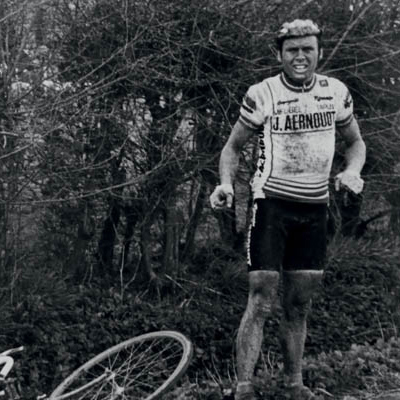
The Monuments of cycling produce epic images. But on stage 5 of the 1980 Tour, from Liège to Lille, it is slippery and treacherous too as the race crosses the cobbled sectors of Paris-Roubaix. Hennie on the front with Ludo Delcroix on his wheel and, behind them, Bernard Hinault, who would go on to win the stage ahead of Hennie

In 1983 the hellish ride through the North ends in ultimate glory for Hennie Kuiper. He rattles over the rain-soaked and therefore treacherously slippery cobbles of the Forest of Wallers