MONUMENT 0
Liège-Bastogne-Liège 1980
Liège-Bastogne-Liège has no place in the list of Kuiper’s Monument victories. After all, he never wins it. But because the 1980 edition is heroism through and through, because Hennie races to a heroic second place behind a magnificent Hinault on that Siberian Sunday, 20 April 1980, and because that second place is also the prelude to his transformation from stage racer into one-day specialist, La Doyenne belongs among Hennie’s Monuments after all: as ‘number zero’. Like almost every rider who races for a living, Hennie Kuiper has already endured his share of spine-chilling hardships by the time he lines up for the great Ardennes classic of 1980. The most extreme, without a doubt, was the fifth and final stage of the 1977 Tour of Belgium, the 213-kilometre stage from Fléron to Jambes. On the fourteenth of April that year it is bitterly cold. It has been pouring all week. The muddy fields of Flanders are sodden, and anyone racing, as on this day, through the pine forests of the Walloon Ardennes feels as if he is standing under an ice-cold shower that never stops. The riders seek shelter behind one another’s dripping bodies, not least because it looks as though Walter Planckaert can no longer be knocked off the top of the standings. This is before heat patches have made their appearance, when overshoes did not yet offer the protection they have offered since the turn of the millennium, when eyes were not yet shielded from rain, snow or sleet by glasses, futuristic or otherwise, and when there was no thermal clothing to be had.
We – two journalists, Peter Ouwerkerk of Het Vrije Volk and Joop Holthausen of Het Parool – are following the race in an Austin 7, the size of an overgrown Dinky Toy. Ahead of us, through the veils of rain, you can just make out the hunched backs of the suffering peloton. The temperature falls; the rain stops. On the tops of the hills the temperature drops below zero. Ominous clouds hang over the riders. Surely it isn’t going to… Yes, it has been forecast: a chance of snow showers in the Ardennes. But it’s the middle of April! Some riders have had enough. The overall is settled anyway. There is nothing more they can do. Better to climb off than risk catching a cold or flu in this bloody awful weather. You can hear the peloton cursing. And then the snow comes, hesitantly at first and then in earnest. In front of us riders slither across the road; on the descent many a rider ends up on the verge. You see riders taking shelter at farms or reporting straight to the team car for a seat. Riding on is sheer madness. To the right of the road, through the driving snow, the figure of a rider in the red-and-yellow kit of the famous TI-Raleigh team comes into view. He is leaning over his bike, frozen stiff, his teeth chattering. We slow down. ‘Stop, stop. Please,’ comes the plea. Good grief: it’s Hennie Kuiper, the team leader for the stage races. A hard man. It must be really bad if he wants to call it a day… And it is bad. So bad that besides Kuiper another 33 men seek refuge in the warm cars before the finish. Of the 67 riders who set off from Fléron that morning, only 33 cross the line in Jambes on their bikes.
His teeth are chattering
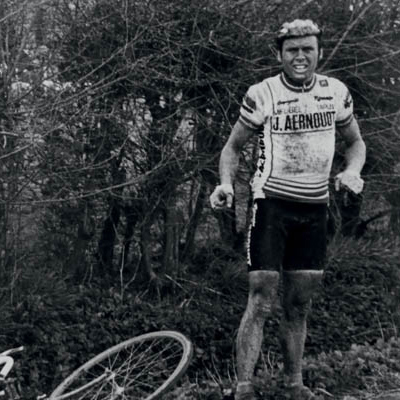
Hennie seems turned to stone. The cold has settled deep in his body. Can he come with us? We look at each other. Yes, we do have a little back seat. And if his filthy, soaking-wet racing kit ruins the upholstery, well, we can live with that. But a frozen rider plus a complete bike in this Dinky Toy?
But poor Hennie is shivering so badly… Right, we’ll give it a go. The wheels come out. The handlebars are turned sideways, Hennie is installed on the back seat and slowly but surely we push the bike in between the front seat and the frozen rider. To this day we don’t understand how we managed it. We must more or less have folded the front fork and the rear stays in two, or we would never in a million years have got that bike on board.
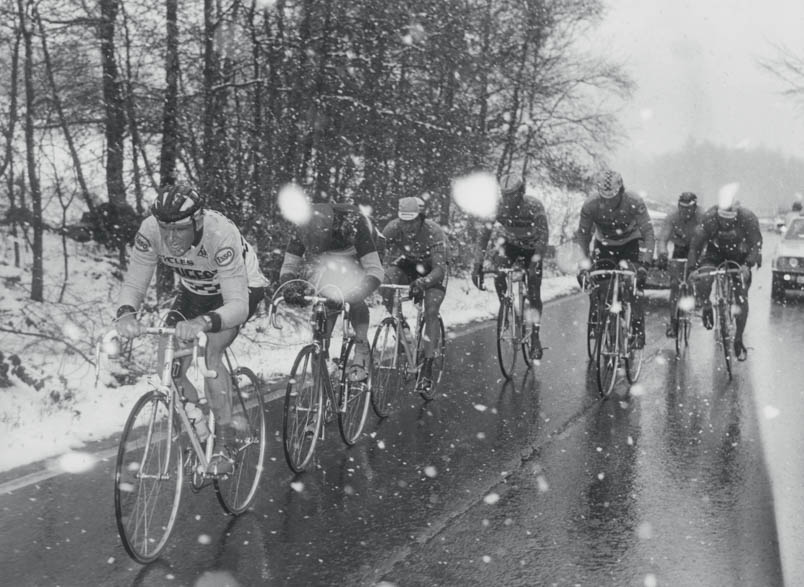
The horrors of Liège-Bastogne-Liège 1980. With sheer willpower Hennie Kuiper braves every hardship. Behind Kuiper, Henk Lubberding makes himself as small as possible
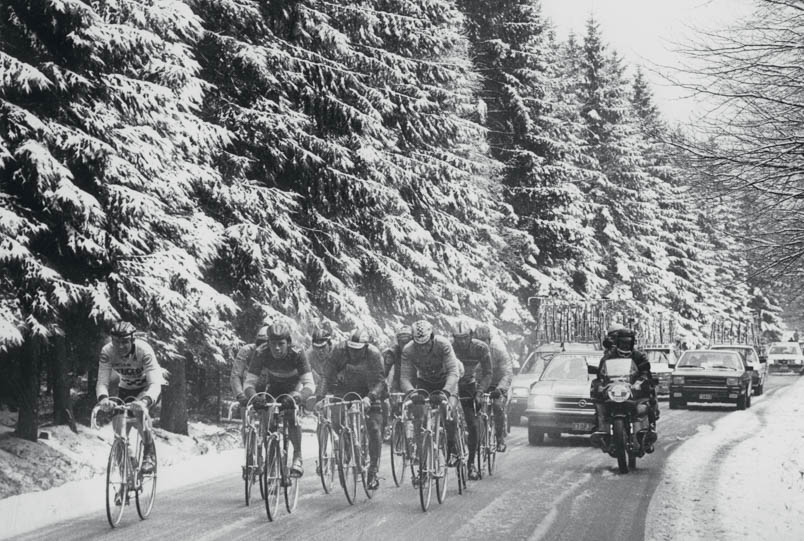
The snow has stopped for a moment, but conditions are barely any better. On Hennie Kuiper’s wheel, Henk Lubberding briefly comes up for air. At the front right of the group rides Kuiper’s teammate Gilbert Duclos-Lassalle
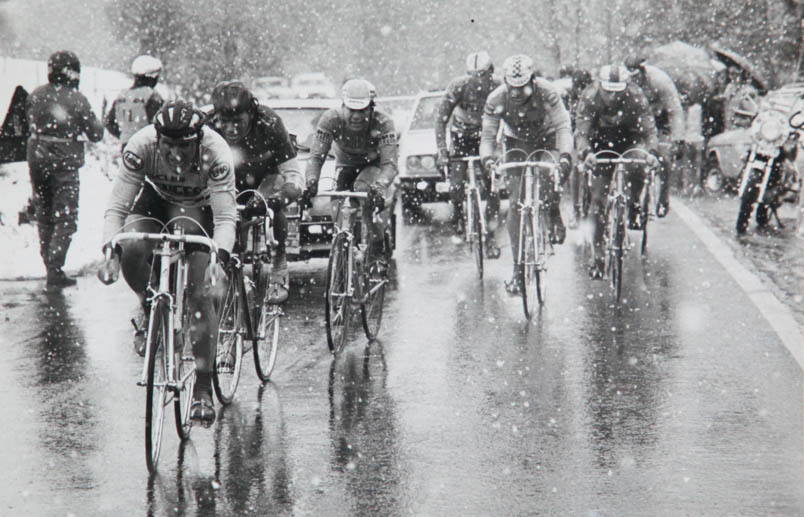
Hennie Kuiper leads the group chasing Bernard Hinault. Henk Lubberding is glad he can follow Kuiper’s tracks in the snow
Hertekamp genever
Our passenger is chilled to the bone. Haven’t we got anything to drink, something to warm him up? We rummage under our seats. This morning the sponsor Hertekamp gave us a ‘food parcel’. Besides a few provisions, it contains a little bottle of that genuine Hertekamp genever, the Belgian gin.
‘Here you are, Hennie, this’ll warm you up.’
And blow me, ten minutes after Kuiper has got the contents down him, his teeth stop chattering. That does the trick. Hennie even gets a tiny bit merry. A little later: ‘You haven’t got another one of those bottles, have you?’ We dive under the front seat again. After all, we were each given one of those precious Hertekamps. Hennie’s wish is our command. Another little bottle. We hear the contents gurgling down into the battered rider’s body. From then until the line in Jambes, Hennie gives us no trouble at all. We hand him over, safe and sound, to the Raleigh team. No, since that fourteenth of April 1977 there is nothing you can tell Hennie about the cold, nor about how to fight it effectively.
Inhuman? Yes!
On Sunday 20 April 1980 the weather is ‘too bad even to put your dog out,’ says Ludo Peeters as the riders stand shivering on the start line in Liège. At that moment the thermometer reads four degrees. Ice-cold rain drips onto the riders’ shivering bodies. ‘But at that point it was still perfectly possible to race,’ says Hennie. Dozens of riders think otherwise. Many turn round straight after the start: ‘Impossible,’ they decide. ‘This can’t be healthy.’ And it isn’t. The ice-cold rain turns to sleet. The freezing water is already squelching in the riders’ socks. Jerseys and shorts are soaked through. The temperature drops towards zero. When the snow, hesitant at first but more and more insistent, turns the landscape and the trees white, this edition of the world’s oldest cycling classic takes on an apocalyptic dimension. The Italians who have not yet taken refuge in a following car shout en masse ‘sciopero, sciopero’: ‘strike, strike’. But the heavily thinned peloton – chilled to the bone – keeps hauling itself up and over the Ardennes hills. Fingers stiffen with the cold. Some riders can no longer bend their fingers and are unable to work the brake levers in the usual way. They brake with their wrists as best they can, and push the gear lever – mounted on the frame in those years – up or down with the heel of the hand.
Inhuman? Yes! Madness? Yes! But the riders keep pedalling, at first still chasing the lone escapee, Rudy Pevenage, then braving the cold, the snow and the freezing rain together. Cyrille Guimard, Hinault’s directeur sportif, gives his team leader a dry jersey, gloves – which he has just dried on the heater of the team car – and a balaclava. He urges him to eat. And Bernard stuffs himself with as much food as he can. He realises that in these conditions he needs extra fuel.
Of course Kuiper is among the survivors. By Bastogne, the turning point, well over a hundred of the 174 starters have already unpinned their race numbers. Not Hennie. Of course not. ‘I have iron discipline.’
But did you never think: they can get stuffed, I’m packing it in, this is ridiculous?
No, as it happens. Quite the opposite. Because if the result is not quite what he had in mind, he is angry with himself. ‘Then I ask myself whether I really did enough for it.’ On that twentieth of April 1980 he has no need to ask himself that question. But what about the cold? ‘Yes, it was cold that day. But don’t even get me started on that.’ These days he still thinks back now and then to that grim battle in the Ardennes. ‘They always used to say: you cope well with the cold. Perhaps that was true in those years, but nowadays I’m always cold as soon as the weather turns a bit worse. And in my case that has nothing to do with getting older: it’s fear of what I went through that day.’ On the day itself Hennie Kuiper thinks of only one thing: racing. He feels – despite the cold, or perhaps thanks to it – in his element. He is determined to get a good result. The group approaches the Stockeu climb, traditionally one of the key moments in this Ardennes classic. The road narrows there, so it is a matter of getting well placed before you start the climb. That means jostling. ‘That’s not for me,’ Kuiper knows. ‘It always costs me a lot of stress and energy.’
Even so, he manages to get himself into a good position, until he sees the road blocked by a television motorbike. The motorcyclist has waited too long to pull away, and Hennie Kuiper has to take a foot out of the toe clip. He comes to a standstill. That is fatal on a climb, because it is hard to get going again. By the time he is finally back on his bike, the men who matter have already disappeared from view. That means a chase after that group, and energy lost that you need so badly in these Siberian conditions. ‘I was so wound up, so angry.’
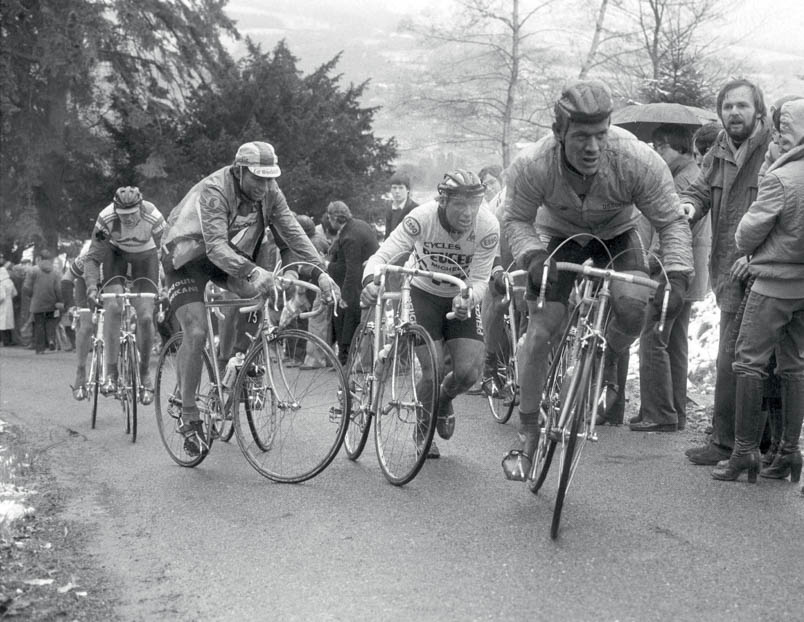
On the steepest part of the Stockeu Hennie Kuiper loses the battle through no fault of his own. He has to get off his bike when a motorbike blocks his way. Ronny Claes, in front of Kuiper, is still standing on the pedals, but Kuiper is briefly reduced to a foot soldier and loses the fight with Hinault. To Kuiper’s left, Pierre Basso is struggling to hold a straight line. To Basso’s left, Fons De Wolf is standing on the pedals
Peeing in their shorts
On all sides the soigneurs of the big teams do their utmost to ease their riders’ suffering a little. Ruud Bakker, soigneur of the Raleigh team, fills the bottles not only with liquid food but mixes in cherry brandy and the cold remedy Antigrippine as well. Bert Pronk has tucked a little bottle of cognac into his jersey and takes a swig from time to time, to stay warm on the inside at least. Riders don’t stop to pee; they simply do it in their shorts, as Frits Pirard, who finishes 19th, explains. ‘Twice, even. At least it warms you up nicely for a moment.’ But the icy ordeal goes on. It is more a matter of survival than of racing.
While Kuiper goes flat out in the chase, here and there fellow riders – overcome by the cold – take refuge in farmhouses to warm up behind the stove. ‘I got back on to the first group on the Haute Levée. And there I saw that two riders had got away in the meantime: Bernard Hinault and Ludo Peeters.’ The Belgian Peeters cannot hold Hinault’s wheel and drops back to the group. The Frenchman, sporting a red hat, is on his way to something great. Here is a campionissimo at work, a rider who belongs in the line of absolute greats such as Fausto Coppi and Eddy Merckx. At first Kuiper’s little group still offers some resistance, and Hinault struggles to stretch the gap to a minute. ‘It’s a pity I was behind when Hinault attacked. I would have liked to go with him. I’m not saying I would have beaten him, but I would have liked to give him a fight. When he didn’t yet have much of a lead, I thought the Raleigh riders would close the gap. That didn’t happen. They couldn’t close it. I can blame myself for waiting too long to jump across.’
There is no answer to the Hinault of that 20th of April. Jaw set in determination, the Frenchman turns a frighteningly big gear towards Liège. In the preceding weeks he had heard and read a great deal of criticism. For where had the great Bernard been this spring? His 1980 honours list was still almost blank. One measly win in the Critérium National de la Route. That was all. Yes, there had been a few placings in the Amstel Gold Race (5), Paris-Roubaix (4) and the Flèche Wallonne (3). They had made Bernard angry. In La Doyenne he would show them what cycling really is. And how! In the end he extends his lead to an impressive margin of 9 minutes 24 seconds. On the last big climb, La Redoute, Kuiper rides away from the other survivors in the company of the Flemish neo-pro Ronny Claes. In the duel for second place Hennie gets the better of Claes. They are among the 21 riders who eventually reach the finish of this 66th edition of Liège-Bastogne-Liège.
Hinault achieves one of his most impressive triumphs that day, but in the light of the coming Tour de France it is a Pyrrhic victory. Afterwards he realises that he rode too big a gear in La Doyenne. His knees have been overloaded. In the Giro d’Italia, which he wins, there is little sign yet of the damage done in the Ardennes classic. But in the Tour de France, where the weather is very bad for days on end, the damage shows all the more. On the stage to Lille, where, spurred on by a rock-solid Hennie Kuiper, he makes a huge effort, he strains his knee again. He wins this cobbled stage, ahead of Kuiper, but it costs him the Tour. It is the end of the story for Hinault. That same week he has to leave the Tour, which leaves the way clear for Joop Zoetemelk to win it. Kuiper, second overall, poses no threat in the Alps to Joop, who has a strong team around him. To this day Hinault still feels the effects of that heroic ride through the Belgian Ardennes on 20 April 1980. He says he sometimes has nightmares. In his dreams he is taken back to that Siberian race. He has kept a souvenir of that icy ride: Hinault still has numb fingers. When it freezes, he cannot work on his farm without gloves.
Jan Jonkers, one of the brave Dutchmen, who survived the polar trek to Liège in sixteenth place, still suffers from tingling fingers more than three decades later. Six Dutchmen eventually reach the finish line on that memorable day. Hennie Kuiper (2), Johan van der Velde (9), Henk Lubberding (13), Jan Jonkers (16), Bert Oosterbosch (17) and Frits Pirard (19) are the Dutch heroes of the most bizarre Liège-Bastogne-Liège in history. But almost all of them have had to pay the price for that ice-cold adventure later in life.
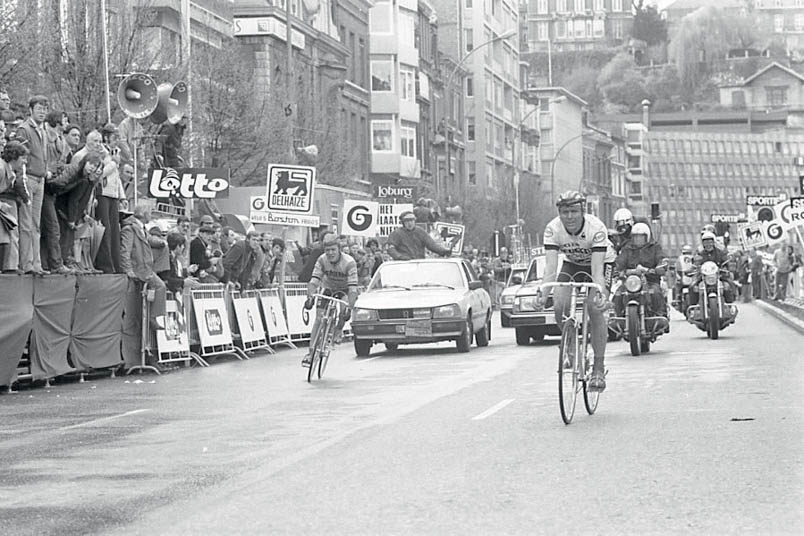
Almost ten minutes after Bernard Hinault has crossed the line as winner of Liège-Bastogne-Liège 1980, Hennie Kuiper beats Ronny Claes in the sprint for second place