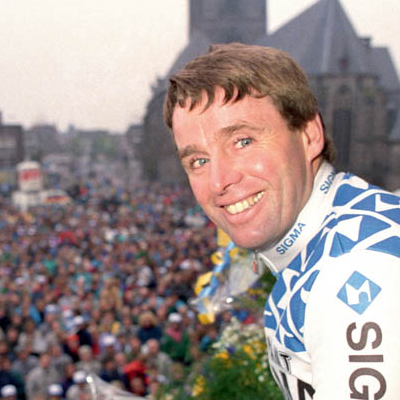
‘Not a worn-out horse’
Despite everything, Hennie Kuiper is still a big name. The Flemish former rider Willy Teirlinck rode alongside Kuiper in the professional peloton for years. He knows what he is getting in the Dutchman. The 39-year-old brings experience and fighting spirit. Over the past few seasons he has also proved himself a mentor to young teammates. Kuiper fits Teirlinck’s picture exactly. Two years earlier Teirlinck started a cycling team with the sponsor Sigma, and 1988 is to be the year of the breakthrough. He presents a squad with no fewer than three team leaders: the veteran Hennie Kuiper; the Dane Søren Lilholt, junior world road champion in 1983; and the Belgian Etienne De Wilde, who rises well above the ordinary on the road and on the track alike.
Here and there the signing of Kuiper draws some criticism. Too old and no longer capable of results, so the talk goes. But Teirlinck defends his choice with gusto. ‘Most people think that at 39 the Dutchman must be a worn-out horse. But thanks to the fitness tests carried out in Leuven we now know that Hennie is far from worn out. What’s more, when it comes to mental attitude he is the exception to the rule. He lives and works for his profession alone, so I have no hesitation in putting him forward as team leader.’
Kuiper puts his signature to the contract Teirlinck offers him a little too soon. He wants security for the ’88 season, and the prospects are excellent. But no sooner has he given Teirlinck his ‘I do’ than his friend José De Cauwer, directeur sportif of the ADR team, comes along with an offer too. Kuiper would dearly like to take it up. He asks Teirlinck to release him from the contract. ‘Teirlinck wouldn’t let me go. Of course I could have signed for De Cauwer anyway, but I didn’t. You have to take responsibility and take your signature seriously.’ Hennie devotes himself above all to the team. ‘I had agreed beforehand that in three races I could go my own way: the Tour of Flanders, Paris-Roubaix and the Amstel Gold Race.’
Through the frame
In the Tour of Flanders the 39-year-old performs unusually far beyond expectations. He is first up the Oude Kwaremont. That bodes well for what is to come. Five riders reach the top with a lead: Sean Kelly, Marc Sergeant, Eddy Planckaert, Phil Anderson and Hennie Kuiper. On the very next climb, the vicious Paterberg, disaster strikes. Hennie hears the crack. His bike gives way beneath him. The frame has snapped. All his dreams go up in smoke. He waits for help, but it takes no less than seven minutes for the team car to reach him. The cars had been held up by a crash involving Eric Vanderaerden. And on the narrow roads through the Flemish countryside it proves impossible to get past the cars and riders. When Hennie finally gets his spare bike, it has a saddle on it that is anything but comfortable. Kuiper does not complain. He is in top form, so he sets off in pursuit. By now his deficit is far too great, but – frustrated as he is – he is determined to get back to the front, come what may. The fiery Kuiper forces himself on. By the time he crosses the line, his backside is raw.
Kuiper is injured. He still pins his hopes on Paris-Roubaix, the race in which he hopes to show himself among the front-runners one more time, but the wound on his backside is too serious for him to endure the jolting over the cobbles. He also has to let Liège-Bastogne-Liège and the Amstel Gold Race pass him by. During an examination at St Elisabeth Hospital in Tilburg, Dr Theo van Vroonhoven (himself an Olympic hockey player for the Netherlands at the Games of 1960, 1964 and 1968) finds that he has a fistula on his backside. An operation is needed. It forces him into almost two weeks of inactivity once again.
In the meantime Kuiper receives a royal honour (Knight of the Order of Orange-Nassau), but above all he is looking forward to getting back to racing. That happens in the three-day Tour de l’Oise, where on 13 May he lines up with the Sigma team for the start of the first stage. But Hennie does not get far. He has to abandon the race on the very first stage because of an inflammation of the tissue in his thigh. The Dutchman is admitted to hospital in Senlis. Another operation follows. ‘The injury got worse within a few days. I couldn’t carry on. But it wasn’t a long-drawn-out affair. Within a week I wanted to be back on the bike.’
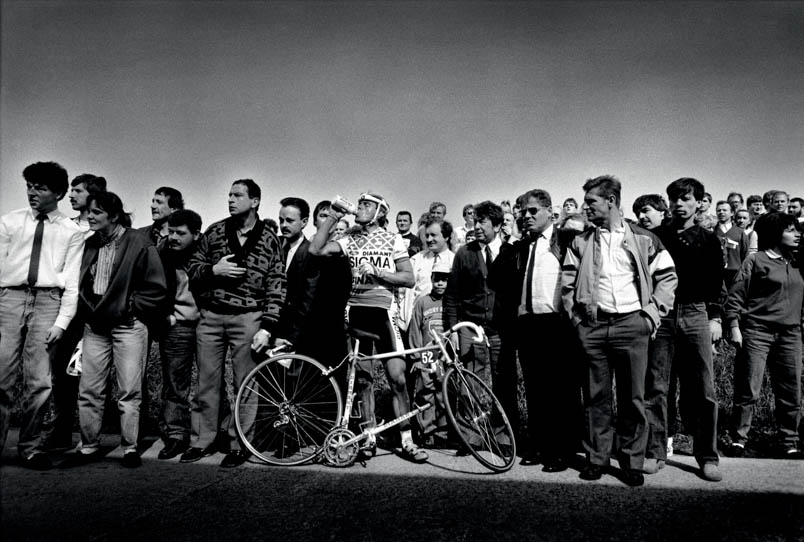
The end of a glorious career has come, in every respect. In the Tour of Flanders Hennie Kuiper’s frame breaks in two. Standing at the side of the road, he has to wait seven minutes before he can continue: his chances are gone. For a moment the crowd has no eyes for him
Supporters
And who should appear in Senlis as guardian angels? The Zeelanders Tony and Marjo Obrie. They are the most devoted supporters of Hennie’s long career. They make sure he wants for nothing and take care of the transport. The couple from Zeelandic Flanders met Hennie in 1978, when he was recovering from the collarbone he broke on the descent of the Granier in the Tour de France. During that recovery Hennie was in Zeelandic Flanders to fire the starting gun at a race. There the Zeelanders spoke to the Twente man from Brabant for the first time. The Obries and Kuiper hit it off at once.
In the autumn of 1978 the Zeelanders pay a visit to Hennie and Ine at home in Putte. Marjo Obrie: ‘We had always been Hennie’s supporters, though we were supporters from a distance. But from the autumn of 1978 we spent more and more time with him. Wherever Hennie rode, we were there.’ That presence ranges from kermesse races to classics and stage races. Especially in the smaller races, where there are often no mechanics or other team staff, the Obries become more and more important to Kuiper. The couple stand by the course with spare wheels and take on the soigneur’s duties. ‘They had a jug of coffee with them and sandwiches. They took the washing home and brought it back to the next race. It was wonderful,’ Hennie recalls.
Tony – a forklift driver by trade – steers the car skilfully across the neighbouring countries to the races where their favourite is riding. Over the years the couple have covered thousands of kilometres in the wake of their idol. And they never stay overnight. ‘There was no money for that,’ as Hennie well knows. Even in the years when Hennie, as directeur sportif of first Stuttgart and then Motorola, roams across western and southern Europe, the couple from Zeeland keep on following Kuiper. To this day they stay in touch. The operation in Senlis, however minor, once again sets Kuiper back in his preparation for the Tour de France. For two years in a row he has had to miss La Grande Boucle: in 1986 his team was not deemed worthy of a place at the start; in 1987 directeur sportif Roger Swerts left him out of the selection.
This year Kuiper is determined, come what may, to be on the start line, which this time is in Pontchateau. It is six years since he last played a part in the Tour. In 1982 he finished ninth, but since then Hennie has never again come to the fore in the event in which he once shone so brightly. ‘You can think of me as road captain,’ he says on the eve of the Tour. ‘I can let my teammates benefit from my great experience, but I also hope to show something myself on one of the days.’
He is not at ease about it. His form is not at its best, after being forced to rest twice because of those operations. ‘In the Tour of Asturias it got worse every day. Luckily I rode reasonably again in the Midi Libre.’ Hennie knows better than anyone that ‘reasonably’ is not enough to play even a modest part in the Tour. As a rider you are then condemned to hanging on, and that is a position utterly at odds with the standing of a champion like Kuiper.
After the Midi Libre he went to Font Romeu in the Pyrenees for a training camp. There, with his teammates Marc Mertens, Armando Ceci, Paul Haghedooren and Adrie Kools, he spent a week slogging through long and gruelling training rides. It does lift his form somewhat, but his remark ‘I hope my form will improve a bit more in the first stages’ makes one fear the worst. It will be his last Tour de France, he announces. But at the same time he lets it be known that he wants to tack on one more season, a final one. A season without the Tour, a farewell tour at the age of 40. That it will never come to that, he does not yet know when he arrives in Normandy for his twelfth Tour de France.
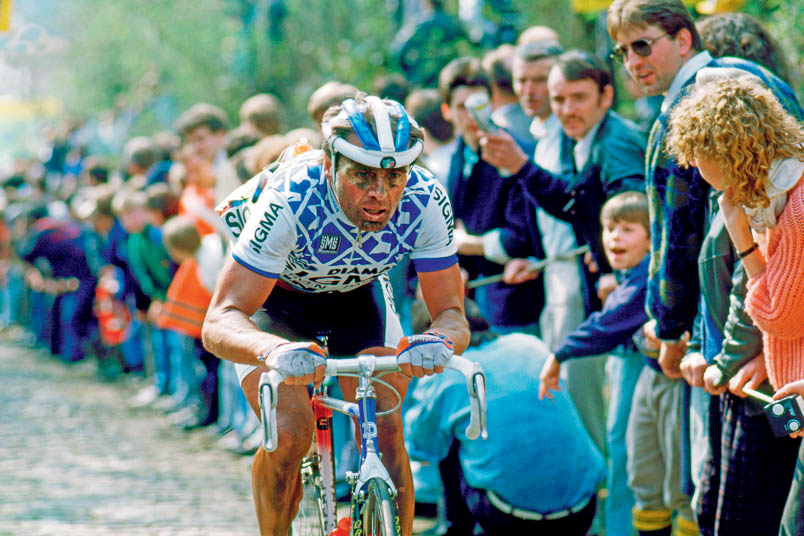
On a spare bike, Hennie Kuiper carries on the fight in the 1988 Tour of Flanders. Giving up is a word he does not know. He finishes 48th
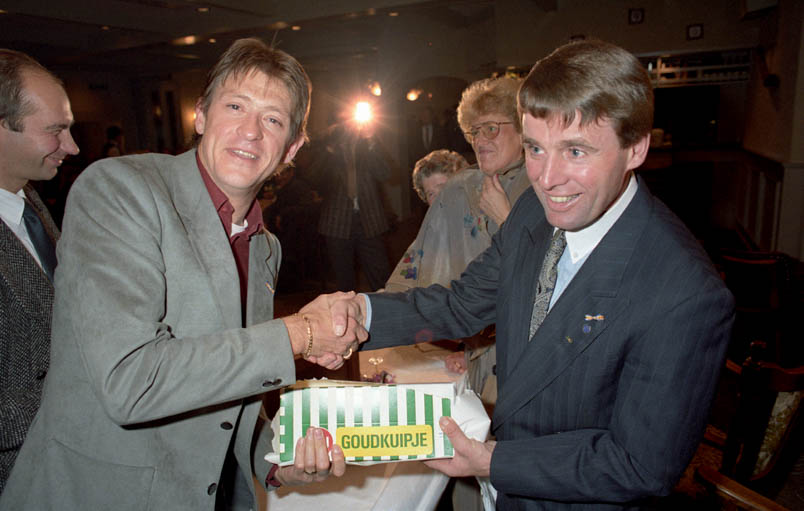
Always up for a joke. At Hennie Kuiper’s farewell to racing in Oldenzaal, Gerrie Knetemann presents him with a family-size pack of Goudkuipje cheese spread: Goudkuipje (‘little gold tub’) was one of Hennie Kuiper’s nicknames in the peloton
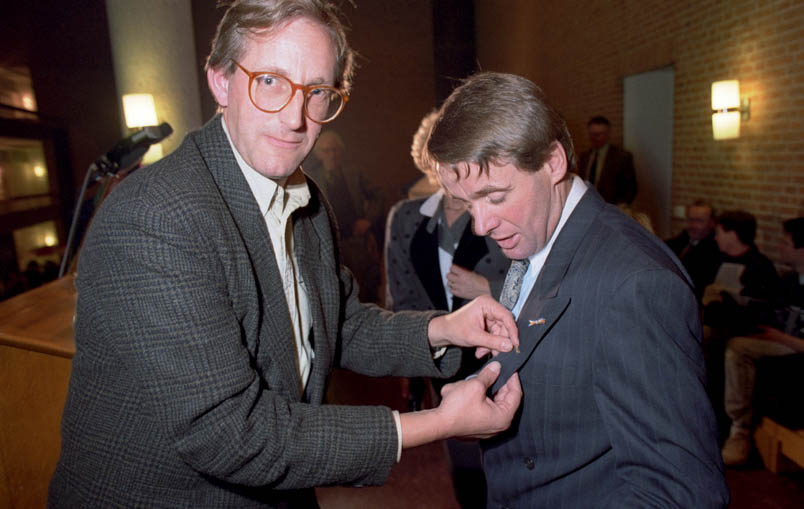
In Oldenzaal the Dutch Sports Press association (NSP) honours Hennie Kuiper for his friendly way of dealing with journalists. NSP chairman Johan Woldendorp of Trouw presents the NSP pin. In April 2000 Woldendorp dies suddenly, in a restaurant, surrounded by his cycling colleagues. Woldendorp dies on the very eve of Paris-Roubaix…
‘As raw as a steak’
That Tour is ill-starred for Hennie Kuiper. On the third stage, from Nantes to Le Mans, he is caught up in a mass crash after 168 kilometres. True, he comes off better than the Swiss Pascal Richard, who has to be taken away with concussion, but the damage is considerable nonetheless. It looks as though a huge, coarse rasp has been run down the left side of his body. Over large areas the skin has been stripped away. ‘I’m as raw as a steak,’ he sums it up graphically afterwards.
He finishes at the tail of the peloton and then has himself driven to hospital to be patched up. It does nothing for his already shaky form. Riding somewhere near the back of the peloton, he had heard everyone braking and had braked too, but took a blow when someone rode into him. ‘And do you know who landed on top of me? Milan Jurčo, a rider who weighs no less than 92 kilos. That’s why I was hurt so badly.’ The next morning Kuiper draws plenty of stares at the start of the fourth stage. Four stitches in his left elbow, bandages round both knees and his whole body covered in plasters. But Kuiper refuses to be beaten and in the closing kilometres of the stage he even tries to get a breakaway going.
In the days that follow it is a matter of gritting his teeth. He holds on reasonably well as far as the foot of the Alps, but in the two Alpine stages he loses almost forty minutes in all to the stage winners. It is clear: the tank is completely empty. With the very last reserves left in that wiry body, he races on towards the Pyrenees. He spends most of the rest day before them in bed. It does little good. The next day, when the finale of the stage from Blagnac to Guzet-Neige puts two first-category cols in the riders’ path, Hennie is struggling from kilometre one. Even on the fairly flat approach he can barely hold the pace. On this day Hennie Kuiper bears no resemblance whatsoever to the driven, ambitious diesel who for a whole career had been able to hurt his rivals. Every little climb that still separates the riders from the first Pyrenean giants is an ordeal. Laboriously the deathly tired Kuiper body toils upwards, protesting against gravity, begging for mercy.
First to be dropped
The peloton starts the first real climb, the Col d’Agnes, en groupe. As soon as the tarmac tilts upwards, there is one rider who drops off immediately: Hennie Kuiper. His reaction is disbelief, bewilderment.
‘I thought: what’s this?’
A while later things go a little better. He catches up with other dropped riders and reaches the finish before the time limit closes. For Kuiper it is a humbling experience. When his wife Ine turns up at the Tour, he says: ‘I’ve got news for you. Nobody knows yet, but I’m stopping.’ In the end he finishes 95th, 1 hour 49 minutes 37 seconds behind the winner, Pedro Delgado. He would have liked it to be different. ‘I would have loved to get into a fine breakaway just once. It just wasn’t to be.’
He ends the season by taking part in the Coca-Cola Trophy in Germany, in which he wins the sixth and eleventh stages: criteriums in Sindelfingen and Heilbronn. Kuiper finishes second overall, just as in 1986. A grand farewell still awaits him in Oldenzaal, laid on by his cycling club OWC. More than twenty thousand people give the hero of Twente a rapturous ovation. The book on Hennie Kuiper the rider can be closed for good. But he will not leave the sport of cycling.
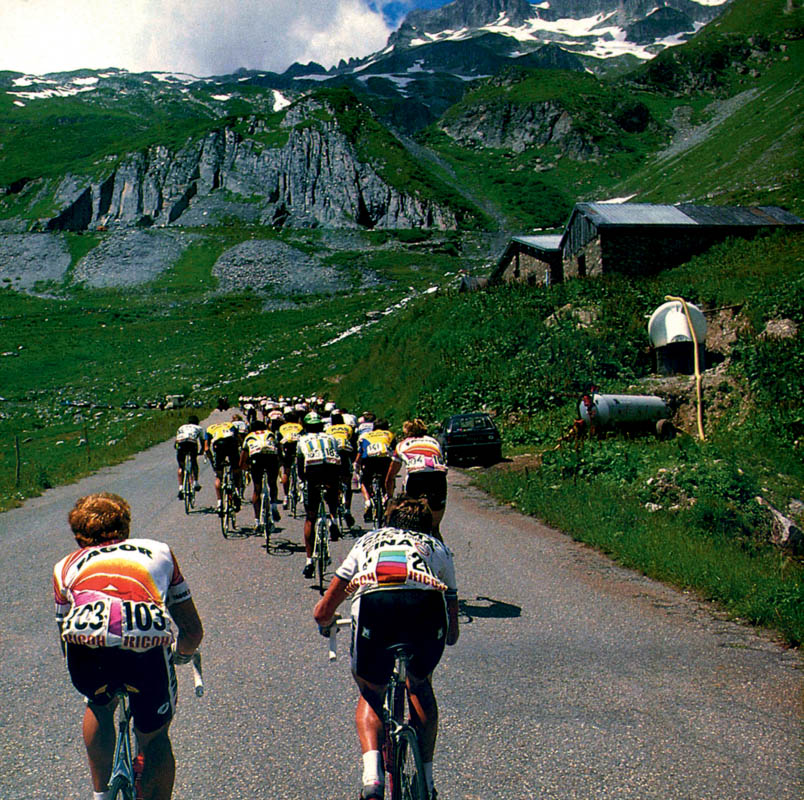
The brutal realisation sinks in that the end of an imposing career is near. When the 1988 Tour turns onto the Col d’Agnes, Hennie Kuiper and Charly Bérard (left) are the first two to be dropped. Kuiper is dumbfounded: what is this? He sees the whole peloton ride away and cannot hang on to Eduardo Chozas (183) and Malcolm Elliott (104)