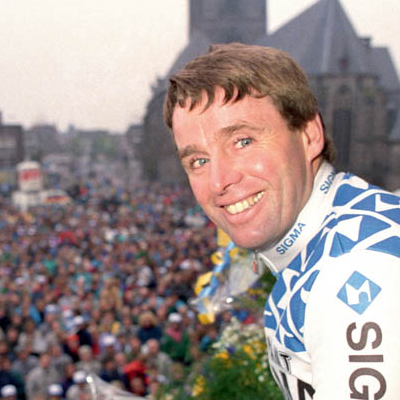
A new chapter in life
When Hennie Kuiper takes part in the series of races for the Coca-Cola Trophy in Germany in his last season, 1988, he is approached by Winfried Holtmann: among many other things publisher and editor-in-chief of the Sindelfinger Zeitung, businessman, and organiser of the six-day races in Stuttgart and Dortmund. ‘When you hand in your licence as a professional cyclist, I’ll put together a professional cycling team and I want you to be its directeur sportif.’
From rider of character to directeur sportif. It is a new chapter in the life of Hennie Kuiper.
The revenge of De Cauwer, Hennie’s partner
As Hennie Kuiper begins his first spell as a directeur sportif, his friend José De Cauwer, who has been a directeur sportif since 1981, is in his second season in charge of the ADR team. That team has several top riders. In 1988 Dirk Demol won Paris-Roubaix for it. Frank Hoste, Fons De Wolf, Johan Museeuw and Eddy Planckaert form the core of the team for 1989. The American Greg LeMond, former world champion and former Tour de France winner, is a new signing. He was the victim of a hunting accident in early ’87, from which by ’89 he has all but recovered. For the Belgian team he is the big trump card for the Tour de France.
For Peter Post’s Panasonic team the 1989 Tour gets off to a glorious start. The time-trial specialist Erik Breukink beats the opposition in the prologue in Luxembourg (7.8 kilometres) and pulls on the first yellow jersey. The second race against the clock, the fifth stage from Dinard to Rennes, is a serious one: 73 kilometres. Breukink, the man Post is counting on for success, starts immediately before LeMond. That means he sets off two minutes ahead of the American. Shortly before the start De Cauwer says to Post: ‘When Greg catches Breukink later on, you’ll have to pull over with your team car to let me through.’ Post laughs him off. ‘Ha, ha, ha. Erik will put minutes into your LeMond. I’ll never have to let you past.’ Post is sure of himself. After all, apart from one good time trial in the Giro, LeMond has not yet shown his old level anywhere. De Cauwer knows how good LeMond is at that moment. He has studied him closely over the past weeks. Breukink may have the reputation, but LeMond is stronger. At every time check he gains on the rider who started ahead of him. De Cauwer: ‘And then I see Breukink riding a long way ahead of the car, in the distance. I drove up to LeMond and urged him on: “Catch Breukink. Please, please. Do it for me.”’
The American is back to his old form. He passes Post’s car and then flies past Post’s protégé Breukink. The Belgian may now take his place behind his rider; Peter Post has to drop back. De Cauwer: ‘In that Tour the organisers had given us Citroëns as team cars. I overtake Post, slow down when my car is level with his, and see that he’s talking to the mechanic in the back of the car. I drove smack into the side of his car. I heard the commissaires: “ADR, you may pass, you may drive behind your rider.” But before I was past Post I gave him one more good bump.’
De Cauwer remembers only too well all the humiliations he and his pal Hennie had to endure when they were both part of Post’s Raleigh team. De Cauwer: ‘How do you think you feel then, as a little Belgian up against that big Amsterdammer with his light-blue trousers and spotless white shoes? How big do you feel then? It was my ultimate revenge. That’s why I say: never hurt anyone, because it always comes back to you.’
De Cauwer’s big trump card, Greg LeMond, goes on to win that Tour, incidentally, after a breathtaking finale, ahead of the great favourite, Laurent Fignon.
Stuttgart
Hennie knows nothing of this. At the start of 1989, full of ambition, he joins Winfried Holtmann’s project in Germany, which is intended to spread the name of the city of Stuttgart. The city is cycling-minded and has plans to bring the World Championships there. For that, publicity is needed. And what scores better than a cycling team of your own? Besides, German cycling urgently needs a home-grown team. A standard-bearer such as Rolf Gölz is financially out of reach for the young team in its first year. Kuiper has to make do with twelve neo-pros, ten Germans and two Dutchmen: Ralph Moorman and Kees Hopmans. But he is in good heart, and in the very first days of 1989 he makes his entrance in the circle of directeurs sportifs. As a rider Hennie is an acknowledged great, but as the head of an extremely modest team without a single star, he enjoys no standing whatsoever. ‘At the directeurs sportifs’ meetings they looked straight through me.’
After the first season it is clear: the team needs strengthening. The squad is expanded to twenty riders. Hennie works himself off his feet. He is busy with the team day and night. In the night after his birthday, 3 February, he is still fitting a bike rack to his car at half past one, because the next day he has to leave for a training camp in the south of France. No effort is too much for him. On the bike he was always one to plough on, and as a directeur sportif he is no different. The team now has a good deal more substance than in the first year. Riders such as Erwin Nijboer, Peter Arntz, Adje Wijnands, Udo Bölts and Ludo Peeters bring experience and quality. It leads to success, but not to full recognition from the big teams and their directeurs sportifs. Even victories in the Three Days of De Panne (Erwin Nijboer) and two stages of the Vuelta (Erwin Nijboer and Bernd Gröne) can do little to change that.
Telekom
At the start of the project, the plan is to build the Stuttgart team up over three years into an outfit ready to take part in the Tour de France. At the end of the second season it looks as though there are enough sponsors to make that financially possible. Kuiper receives an important phone call. On the other end of the line is someone from the advertising agency Profile in Hamburg, who tells him he is a nephew of Herr Kahl, the sponsor’s boss who helped Hennie to his first professional contract in 1973. It leads to a long conversation with Hennie. The upshot is that Kuiper can proudly say: ‘I have a new sponsor. Next year I’ll be leading a team that carries the name Telekom on its jerseys.’
Not only does his team need a further boost in quality; the team management needs strengthening too. It is too much for one man. Kuiper looks around in his own Twente circle. His choice falls on Herman Snoeijink, a teacher, also born in Denekamp, who never rode as a professional but as an amateur racked up the incredible total of 365 wins. The pair, Kuiper and Snoeijink, know each other from the interval training at the very beginning of their careers under Broer Oude Keizer. Herman Snoeijink still remembers how he, Hennie Kuiper and clubmate Tonny Bruns were completely wrecked after every session. For Hennie that intensive training is an important building block of his Olympic title in ’72, and those endless training sessions form the basis of his career as a professional; for Herman it leads to his unprecedented string of victories in the amateur category. Snoeijink opts for a permanent job in teaching. ‘I wanted to stand in front of a class. That meant I couldn’t ride stage races abroad. I couldn’t get time off for them.’
That shared ‘suffering’ under the Oude Keizer regime forges a bond between Kuiper and Snoeijink. It is no surprise that the seasoned former professional thinks of Snoeijink two decades later when he is looking for an assistant. In ’91, though, the teacher is able to get time off to work alongside Kuiper as assistant directeur sportif. Snoeijink: ‘Hennie asked me not only as a directeur sportif but also because I had a lot to offer when it came to training. I said “yes” to his offer because I could get special leave from teaching. It took some doing, but it worked out. It meant that if things went wrong with the cycling, I could go back to teaching.’ The teacher comes face to face with Kuiper the directeur sportif. As a rider – as team leader first of TI-Raleigh and then of teams such as Peugeot and Verandalux – he was no leader; nor is he one as a directeur sportif. Kuiper is neither a Guimard nor a De Muer, let alone a Post. He is earnest, tries to keep everyone happy, but above all wants to avoid trouble at all costs. Snoeijink sees him at close quarters. ‘As a directeur sportif Hennie had one great quality: he was very good with people and he managed to motivate riders individually extremely well. That is a quality that suits a directeur sportif.’
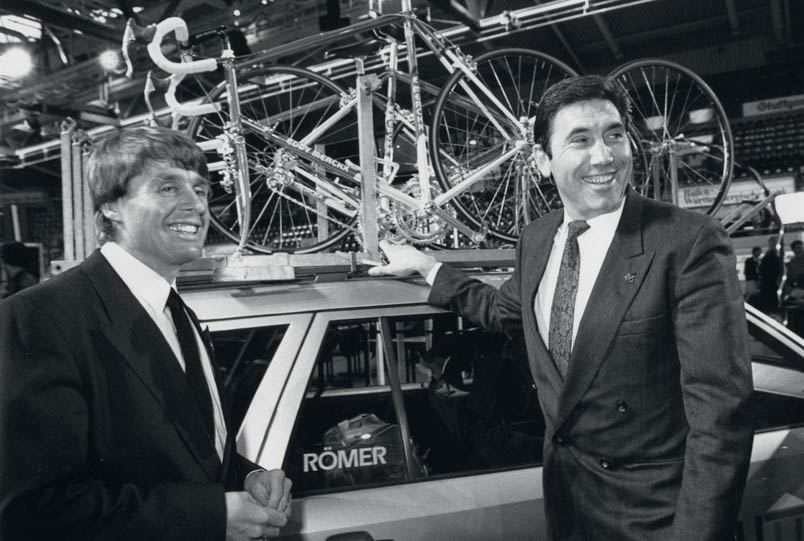
As directeur sportif of the Stuttgart team, Hennie Kuiper crosses paths once again with Eddy Merckx, who supplies the German team with its bikes
Paperboy
He watches Hennie at work and notes how great the difference is between the Kuiper of his early days and the Kuiper of now. ‘I sometimes think back to the time when the two of us, as lads of twelve or fourteen, delivered the Twentsche Courant; me in the village of Denekamp, Hennie out in the countryside. That wasn’t easy for Hennie.’ Hennie had taken over the job from his brother Frans. ‘It was on those roads that he learnt to ride through mud,’ says another brother, Gerard, the eldest of the Kuiper family. ‘It was only eighteen newspapers, but it was still quite a job. Because there were no tarmac paths to the farms. Especially in autumn and winter you had to cycle from farm to farm along the narrow cart tracks, which had often turned into quagmires. That experience must have come in handy later in Paris-Roubaix.’
The eighteen readers who relied on Hennie for their daily news had to pay their subscription money to the delivery boy every week. Snoeijink, who delivered the papers to fifty subscribers, recalls: ‘We had to hand the money in to an elderly lady with glasses and an extremely stern look. I’ll never forget going in there the first time. I was first in line to settle up. That went fine, no problem. Then it was Hennie’s turn. At the sight of that stern woman he froze completely. The way he stuttered then said a great deal. But when I saw him as a directeur sportif, and later followed him at his talks and in the Hennie Kuiper Museum, then I say: magnificent. I take my hat off to him for the way he has developed.’ That may all be true, but Hennie Kuiper looks back on his first spell as a directeur sportif with mixed feelings: ‘I started in that role far too early. Really I was still too much of a rider. If I could do it again, I certainly wouldn’t go about it that way. It was too soon after my career. It would have been better if I’d started as an assistant in a big team.’
No new sponsors
Yet in principle things look very good at the start of his third season as directeur sportif. The name Stuttgart may have gone from the jerseys, but the logo and name of the big provider Telekom perhaps offer good prospects for the future. And then, suddenly, a spanner is thrown in the works. Manager Holtmann is looking for two more companies which, like Telekom (brought in by Kuiper), are willing to put 1.2 million Deutschmarks on the table to finance the team. That is certainly needed, because relatively expensive riders such as the Swiss Urs Freuler have been signed. Gerard Veldscholten has been taken on as well. But no new sponsors come forward.
The team does indeed wear jerseys bearing the name Telekom, but it is in financial distress. To make matters worse, manager Holtmann, who has bitten off more than he can chew, suffers a heart attack and is out of action for a considerable time. By then the season is in full swing. The financial situation is alarming. Against Telekom’s sponsorship contribution (1.2 million) stands expenditure of 1.6 million.
Holtmann’s wife, a financial expert at IBM, goes through the paperwork. She sounds the alarm and says to Telekom: ‘There are two options. Either I pull the plug on the cycling project or you take over everything, the benefits and the burdens.’ Behind the back of Hennie Kuiper, the man who set up the whole team and who, of all people, brought Telekom in, a whole new plan is hatched. Holtmann, the manager, is ill. Telekom wants to take a new direction. Kuiper is summoned to Stuttgart, where behind the table he makes out Telekom directors and… Walter Godefroot, the former rider. He knows at once which way the wind is blowing. The whole Holtmann structure of the Stuttgart cycling team is dismantled. The staff are dismissed, including the team’s sporting management: Hennie Kuiper and Herman Snoeijink. His successor Godefroot walks into a ready-made set-up. ‘Not being allowed to carry on with the project was one of the greatest disappointments of my life as a directeur sportif.’
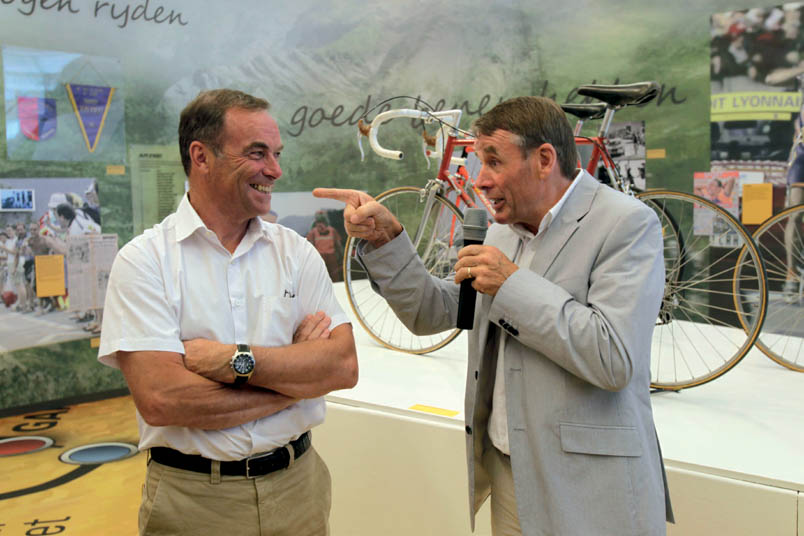
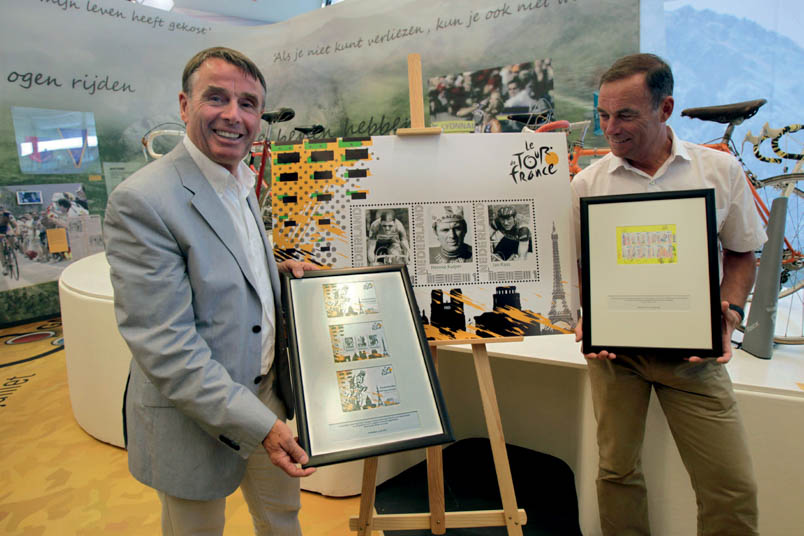
Hennie Kuiper in a completely different role: as an entertainer. At the presentation of special stamps marking the Grand Départ of the 2010 Tour de France from Rotterdam, Kuiper unveils a framed stamp booklet devoted to ‘Dutch cycling successes’. Bernard Hinault shows the PTT Post stamps with the Grand Départ design