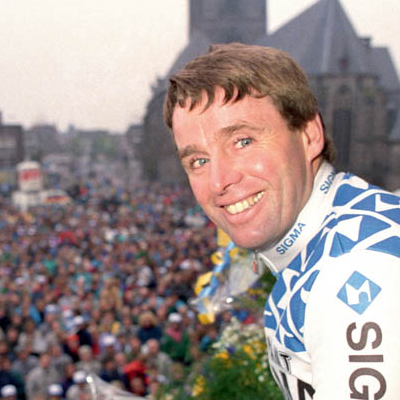
The tragic death of Fabio Casartelli
For Hennie Kuiper 1995 turns out to be a remarkable year, but not in a good way. One event hits him, and the entire cycling world, hard: the death of the Motorola rider Fabio Casartelli. The Italian had made a big name for himself in 1992 as Olympic champion. That Olympic title also struck a deep chord with Hennie. Twenty years earlier, after all, Kuiper himself had ridden to Olympic gold in Munich. In the race in Barcelona Casartelli had beaten Erik Dekker. It earned him a contract for 1993 with Ceramiche Ariostea, the ceramics manufacturer whose riders included Bjarne Riis, Rolf Järmann, Pascal Richard, Alberto Elli and the future cycling commentator Davide Cassani.
In 1994 Casartelli rides for ZG Mobili and then, after two fairly anonymous years, ends up at Motorola in 1995. Kuiper knew him as a gentle rider. ‘He never really got used to the world of the professionals. Then Maximo Testa, the Italian cycling doctor we worked with, recommended him to us. We took him on and saw possibilities of achieving something with him.’ Casartelli is selected for Motorola’s Tour team. Although the American team has not achieved any really striking results, on 18 July it prepares in good heart for the queen stage, an extremely tough Pyrenean stage over six fearsome cols, from Saint-Girons to Cauterets.
The first col of any significance is the Col de Portet d’Aspet: not extremely difficult, but hard enough to send the many non-climbers in the peloton back into the depths of the field. The descent is a tricky one, not because the bends are hard to take, but because the steep road tempts riders into extremely high speeds. The plunge to the foot of the mountain goes at a breathtaking pace. Fast, faster, fastest. Sharp steering past rock faces and ravines. The riders race into the 34th kilometre. The road turns left, a difficult bend on a very steep descent. Braking is almost impossible. And then… One man slides out, towards the white concrete blocks, the barrier between road and ravine. Like skittles, six riders behind him go crashing to the ground. At full speed. Two riders slide between the rocks into the ravine. The other five, among them Johan Museeuw and Erik Breukink, lie stunned and/or injured on the hot tarmac. At the back lies a rider in a Motorola jersey. His head has struck a white concrete post. A post whose very purpose – how bitter the irony – is to save lives. He has bounced back onto the road and lies in a foetal position on the tarmac. Blood is pouring from a head wound.
Erik Breukink realises it at once: ‘That doesn’t look good for that Motorola lad.’
That ‘not good’ is a euphemism he only learns hours later at the finish, from Jeroen Wielaert, reporter for the Dutch broadcaster NOS, when he is told that Casartelli has died. Breukink is shaken by the news, as everyone in and around the peloton is shaken that day. ‘God damn it,’ is the first thing the ONCE rider manages to utter in his despair. Then, for a moment, there is silence. It takes several seconds before Breukink can collect himself.
Sometimes the Tour de France has black days. Pitch black.
Hennie Kuiper is at the wheel of the team car. On Radio Tour he hears what he so often hears. ‘Chute dans le peloton.’ Crash in the peloton. Sadly, it is part and parcel of bike racing. But anxiety grips him by the throat when he arrives at the bloody scene three, four or perhaps five minutes later. ‘I could see that it was very, very serious.’ He is there for a moment, goes back to the car, and sees that Casartelli’s body is changing colour.
Panic. Fear. Tour doctors on the scene. The air ambulance arrives and Casartelli is lifted away towards the hospital in Tarbes. Below, he leaves the others behind, stunned and dazed. Between a little hope and a great deal of fear. Two other injured riders are brought up out of the ravine: the German Dirk Baldinger with a broken pelvis, and the Frenchman Dante Rezze, who besides severe bruising has also broken his left thigh bone. The Italian Giancarlo Perini escapes with wounds here and there on his body.
The reporter for NOS Radio Tour de France, riding on the back of Raymond Nackaerts’s motorbike, is Jacob Bergsma. ‘I still remember that descent of the Portet d’Aspet very well. Raymond and I passed the accident at walking pace, because the descent had been neutralised. I didn’t see very much, because Raymond had a terrible dread of crashes; he wanted to go on, away from that place of disaster, he didn’t want to see it. At that point we didn’t yet know how fatal the outcome would be for Casartelli. It was extremely hot that day. The tarmac was simply melting. On the motorbike you would sometimes slide right away and scrape a piece of tarmac off the road surface just like that. I remember that once we had left the accident behind us, on the descent of the Portet d’Aspet, Raymond said to me: “Good that they’re neutralising this descent, otherwise there could have been deaths today.” Only much later did we hear on Radio Tour that Casartelli had died. Everyone was devastated. I had only one reaction: I cried…’
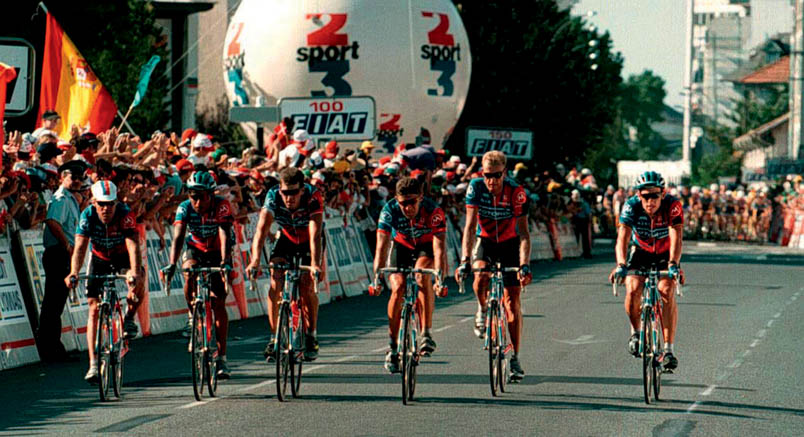
In the background the peloton waits to let the Motorola team cross the line in Pau as a team. From left to right: Steve Bauer, Alvaro Mejia, Frankie Andreu, Andrea Peron, Stephen Swart and Lance Armstrong. It was Peron who was told by Casartelli’s wife, in a telephone call, to ‘ride on’. Casartelli’s room-mate is allowed to cross the finish line first, a metre ahead of the little group, so that the ‘stage win’ is credited to Casartelli
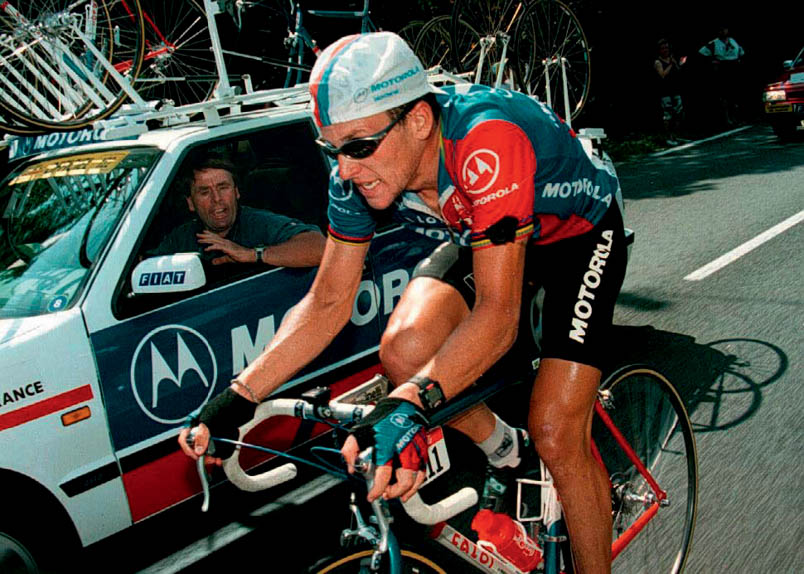
On 21 July, on the 18th stage finishing in Limoges, Lance Armstrong rides so ferociously hard that Hennie Kuiper, in the car, has to hold him back rather than urge him on. Armstrong wants only one thing: to be able to dedicate the stage win to Casartelli. He wins in brilliant style. Note Armstrong’s left sleeve: the Motorola team are wearing a kind of mourning band in the form of a black patch
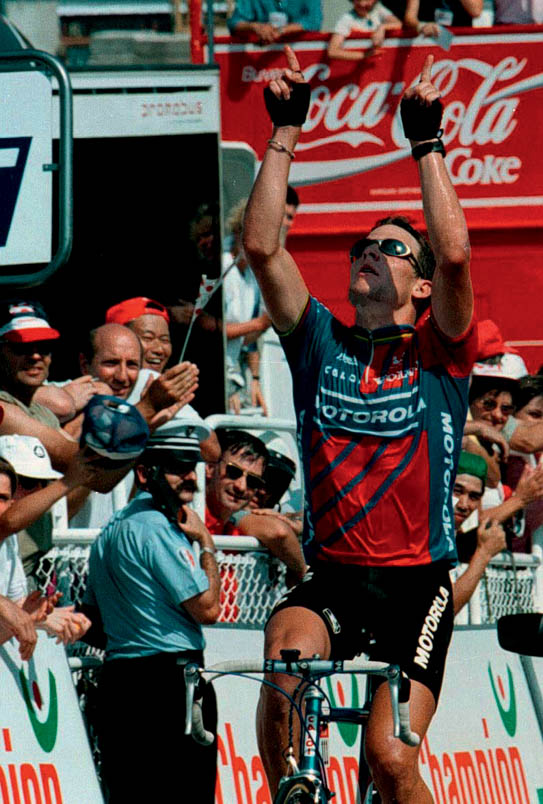
In Limoges Armstrong – pointing to the sky on the finish line – dedicates his victory to Fabio Casartelli
Sad news
The Tour goes on. At the front rides the Frenchman Richard Virenque. He is unaware of the tragedy that has unfolded on the Col de Portet d’Aspet. By now the helicopter has reached the hospital in Tarbes. A few minutes later the sad message comes over Radio Tour:
‘Le coureur Casartelli est décédé dans l’hôpital de Tarbes.’
Casartelli was not wearing a helmet. In those days it was not yet compulsory. His helmet was lying in the back of Kuiper’s car. Tour doctor Gérard Porte declares that a crash helmet would not have helped him, because he was struck full in the face and had no chance of survival whatsoever. That view is later contradicted by the examining doctor, Michel Disteldorf. Disteldorf’s examination shows that there was a violent impact on the top of the skull, causing several skull fractures, but that there were no facial injuries. In his opinion a number of the injuries could indeed have been avoided by wearing a crash helmet. For Casartelli it is too late.
Hennie Kuiper: ‘I was in a complete trance. The stage went over all those cols, over the Tourmalet. None of it registered with me. In the end we arrived at Luz Ardiden. That was shocking. The music was still blaring out. Virenque went up onto the podium and was celebrated as if nothing had happened. The Coca-Cola girls kissed the way they always did. It was unreal.’ The Motorola riders spend that night in Pau. Hennie Kuiper and Jim Ochowicz visit the hospital. ‘There was Fabio, laid out in a small room. Those were hard moments for us.’ Afterwards they go back to the hotel. ‘The whole team was devastated. Utterly crushed. But we had to make a decision that same evening. What were we going to do? Stop? Carry on?’
Team doctor Maximo Testa keeps in touch with Casartelli’s wife, Annelisa. The dead rider’s Italian teammate, Andrea Peron, has already been told by Annelisa: ‘You must carry on.’ Within the team, opinions are divided. The younger riders want to carry on; the older, more experienced ones are in favour of stopping. Then George Noise, the head mechanic, speaks up. ‘Lads, we have to carry on. That way we can support each other. In cases like this, that’s what the family want too.’ The team agrees to Noise’s proposal.
Ochowicz, the manager and directeur sportif, travels to Italy to attend the funeral on behalf of the team. Hennie Kuiper is now the man in overall charge at Motorola. The day after the disastrous stage, a mountain stage from Tarbes to Pau over 237 kilometres is on the programme. But there is no racing. Casartelli’s bike, with a black ribbon tied to it, stands on top of Kuiper’s car. It will stay there all the way to Paris. The riders wear black ribbons. The peloton rides towards Pau in silence, with a solemn, measured pedal stroke. It is a tribute to the dead rider. Hennie: ‘We took eight hours over that stage. I can remember very little of it. Everyone was shaken.’ With the finish in sight, the rider and later TV commentator Davide Cassani, of the MG Maglificio team, makes a proposal. ‘We’ll let the Motorola boys ride on ahead, side by side over the line.’ And so it is done. The six Motorola riders cross the finish line together. Broken. There is no music. There is no ceremony.
There is a fitting silence. And the crowd respectfully shares in it.
The next day shows once again that Lance Armstrong also has another, almost forgotten side. This is not the later Armstrong of the deception and of the almost tyrannical order that teammates must dope themselves. This is the Lance of the fight against cancer, the man who has been a comfort to thousands of patients and who raised millions of dollars for cancer research. When Hennie Kuiper comes to Armstrong’s room the next morning, the American tells him: ‘I’m stopping. I’m completely shattered.’ The directeur sportif replies: ‘You can’t do that. We all decided together to go on to Paris. You mustn’t drop out.’
Lance Armstrong sticks with the team and finishes in Bordeaux. The day after that comes the stage from Montpon-Ménestérol to Limoges. A group of riders gets away. Lance Armstrong is in it, more determined than ever. Kuiper: ‘He attacked. He was unstoppable. Lance just kept on going. I was a directeur sportif for eight years. Never did I have to hold one of my riders back, but that time, with Lance, I had to step in and urge him to calm down. He was so aggressive. The sparks were flying. He wanted to win for his friend.’ And he does win for Fabio. In the final metres two fingers point to the sky. It is Armstrong’s tribute to a much-loved teammate. On the day of Casartelli’s funeral all the flags at the start and finish fly at half mast. The sponsor Motorola also has the flags lowered to half mast at all its offices worldwide. Later, on Motorola’s initiative, money is raised for a fund for his widow Annelisa and for a fund to pay for the education of their son Marco. At the spot where he fell on the Col de Portet d’Aspet a monument has been erected with a hole in it. Every year on 18 July the sun shines precisely through that hole at the moment when Fabio Casartelli had his fatal fall. Rays of sunlight mark the place of the tragedy.
It takes Hennie Kuiper, a man of deep feeling, months to come to terms with Casartelli’s shocking death. 1995 has not exactly been a happy year for Hennie. On 5 April his marriage is dissolved, and on 18 July Fabio Casartelli dies.
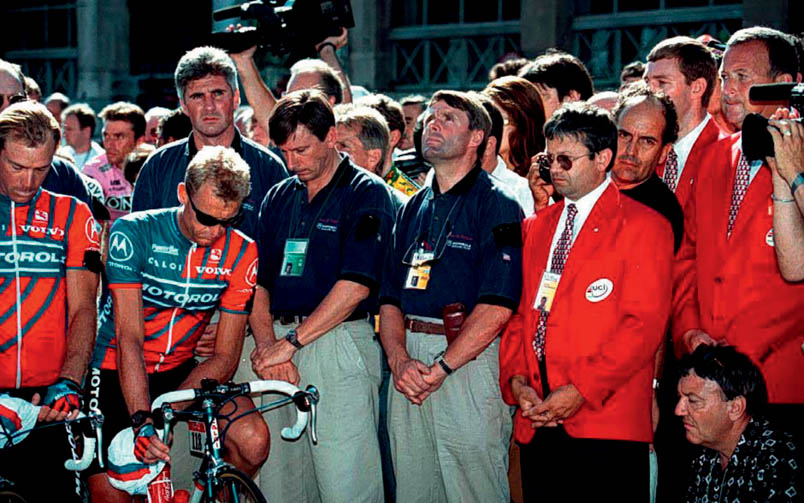
In Pau a minute’s silence is held for Fabio Casartelli. Hennie Kuiper has his eyes turned to the sky. On the far right UCI commissaire Wim Jeremiasse bites his lip. To Hennie’s right Paul Sherwen bows his head and Alain Bondue stares into the endless distance. Casartelli’s teammates are the Canadian Steve Bauer and the New Zealander Stephen Swart, who wear a black patch on their left upper arms as a mourning band
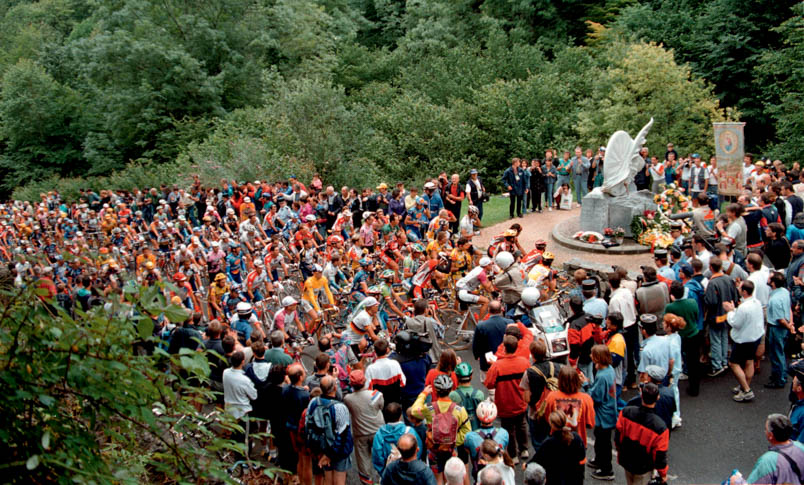
In the 1996 Tour the entire peloton, together with the Tour de France’s following caravan, pays a great tribute to Fabio Casartelli. On the Portet d’Aspet a white winged monument preserves the memory of the Olympic champion
Testicular cancer
For Hennie Kuiper 1996 is to be the last year of his career as a directeur sportif. Lance Armstrong shows his class in the spring, when the Flèche Wallonne is held on 17 April 1996. Armstrong reaches the top of the Mur de Huy alone, having dropped Didier Rous on the climb. Armstrong makes a very strong impression. But fortunes can change. Later that year, Hennie Kuiper is driving to the World Championships in Lugano. The phone rings. On the other end of the line is Jim Ochowicz. ‘Hennie, are you driving?’ ‘Yes,’ comes the answer. ‘Then pull over for a moment. I have something to tell you.’ Kuiper steers his car onto the verge. Ochowicz: ‘Lance has testicular cancer.’ It is another shock. It is already known that Motorola is pulling out of the cycling team, and the whole cycling world already knows that Lance Armstrong has signed a contract with the French sponsor Cofidis, but this news hits Hennie Kuiper hard.
After Stuttgart and Motorola, a new adventure as directeur sportif with another backer in 1997? Such jobs are not there for the taking. Nor is he frantically chasing a team. Kuiper has taken a look around him. He sees grey-haired men at the wheel of the team cars. Does he want to grow that old? Slowly but surely the idea gains ground that it is time to take a new path, but still within his own world: sport. But which way will it go? Time will tell.
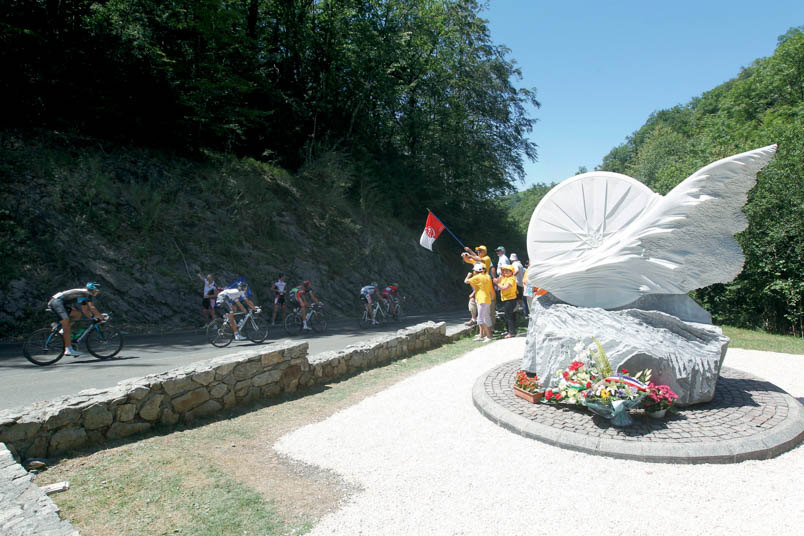
The 97th Tour de France starts in 2010 from the Erasmus Bridge in Rotterdam and on the 15th stage, from Pamiers to Bagnères-de-Luchon, crosses the Portet d’Aspet. There, a silent witness to a recent tragedy in cycling, stands the monument in memory of Fabio Casartelli. The five riders shooting past are, from left to right: Thomas Lövkvist (Sky), Jakob Fuglsang (Saxo Bank), Christophe Moreau (Caisse d’Epargne), Mario Aerts (Omega Pharma-Lotto) and… Lance Armstrong (Radioshack)