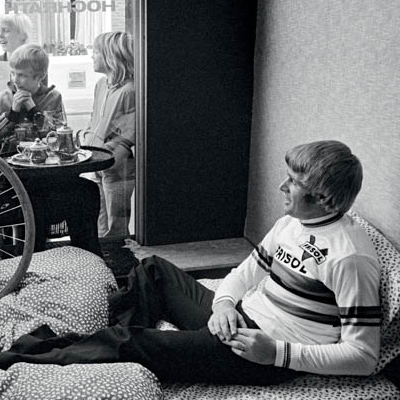
Tour 1976: joy and sorrow
Hennie Kuiper sets out on his second Tour de France with a wonderful feeling. He has shown that he is not forever the rider who ‘just misses out’, as he did earlier in the Omloop Het Volk, in Paris-Nice and in the Vuelta. After his win in the Tour de Suisse, he even manages, at the national championship the weekend before the Tour starts, to beat Joop Zoetemelk uphill in the duel for third place. Now team boss Peter Post, too, is beginning to regain his faith in what Kuiper can do. Could he, after all…
The TI-Raleigh team leader has prepared conscientiously for the world’s most important cycling event. Besides the ambition to show the rainbow jersey prominently, he brings with him the experience of one year of Tour cols. He gets himself briefed on how hard the mountains he has not yet ridden will be. But for Hennie, the stage to be ridden on Friday 9 July matters more than anything else. On that day his parents celebrate their fortieth wedding anniversary. Their cycling son has a special present in mind: a stage win, which he wants to dedicate to his father and mother. ‘For me, that came before everything.’
The fairy tale of Bornem
Hennie Kuiper holds his own well in the first days of the Tour. On Monday 28 June the caravan makes an excursion from Le Touquet into Belgium. By then Freddy Maertens is already wearing the yellow jersey for the fourth day. Besides the prologue and the time trial in Le Touquet, the Flandria team leader has also been too strong for the opposition on the first stage, to Angers. On home soil he wants to continue his triumphal progress. And so stage 4 – to Bornem – is circled in red in the route book. José De Cauwer knows every metre of the finale of that stage. He lives on the other side of the Scheldt. The stage finishes five kilometres from his house. And although the pace in the finale is high despite the scorching heat, some seventeen kilometres from the end Hennie asks De Cauwer to ride up to the head of the group. De Cauwer knows that the peloton has to ease off for a moment if an attack is to have any chance of success.
With him: the Swiss Eric Loder. From that quarter he can expect no help. Loder has only one job: to stick to the Dutchman’s back wheel, so as to give the peloton the chance to come back and allow the sprinter Maertens to underline his supremacy in front of his home crowd. Kuiper’s friend José starts blocking at once when his team leader attacks. But the Flandria train of yellow jersey Freddy Maertens makes its presence felt at the head of the peloton, urged on by its leader. In that train are renowned pace-setters such as Marc Demeyer, Herman Vanspringel, Herman Beyssens and Michel Pollentier. The speed in those last kilometres is so ferocious that the peloton breaks into five pieces. But all that combined power proves not to be enough to bring the world champion to heel. What Kuiper achieves in those last fifteen kilometres is incredible. Photographer Tonny Strouken, riding pillion on a motorbike ahead of the leaders, says: ‘I had never seen anyone ride that fast.’
In the final sprint Hennie – wonder of wonders – beats the Swiss ‘limpet’. The Dutchman does stray from his line, but the commissaires do not think the offence serious enough to take his victory away from him. His helper, De Cauwer, however, reaches the finish behind the peloton. Three kilometres from the line the Fleming punctures. He comes in a minute and a half after Kuiper, but he could not care less. His protégé is the winner; nothing else counts. It is the first Tour stage Hennie has won in his career; it is also Raleigh’s first stage win in an almost endless series. Over the period 1974-1983 Raleigh will win no fewer than 47 Tour stages, and the team will be the strongest in nine team time trials. The run ends only when the British sponsor withdraws from cycling as main sponsor at the end of 1983.
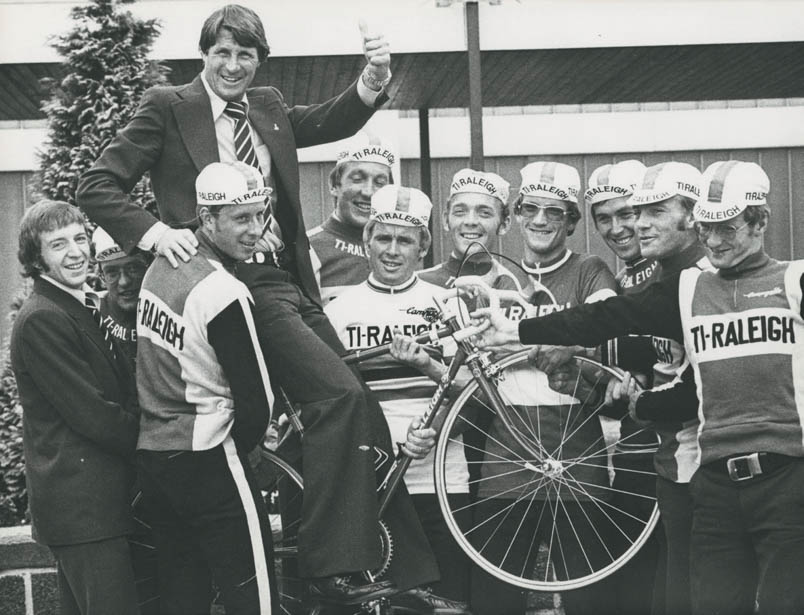
The 1976 Tour team hoist directeur sportif Peter Post into the air, bike and all. From left to right: José De Cauwer, Gerrie Knetemann, Ko Hoogendoorn, Aad van den Hoek, Hennie Kuiper, Piet van Katwijk, Jan Raas, Gerben Karstens, Jan van Katwijk and Bert Pronk
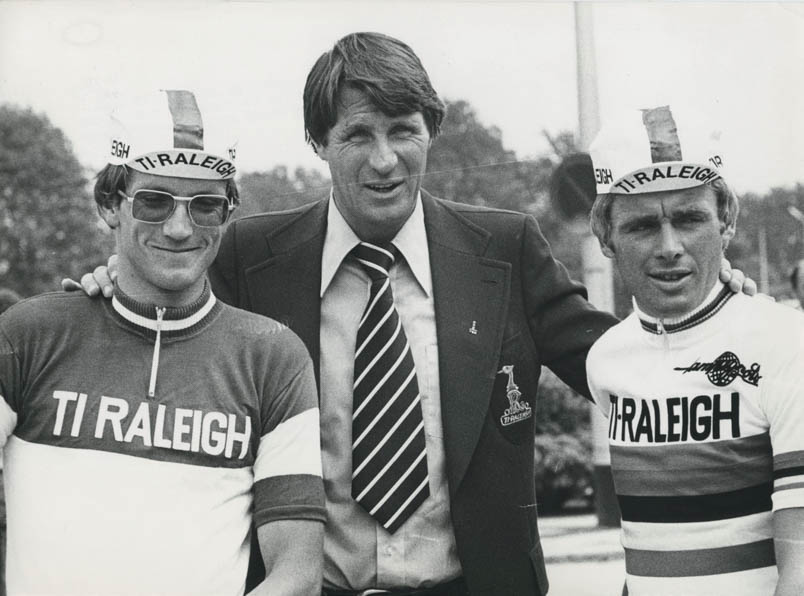
Peter Post shows off his aces, Jan Raas and Hennie Kuiper. Post is certainly not one to deny his roots: on his lapel he wears a pin marking the 700th anniversary of the city of Amsterdam
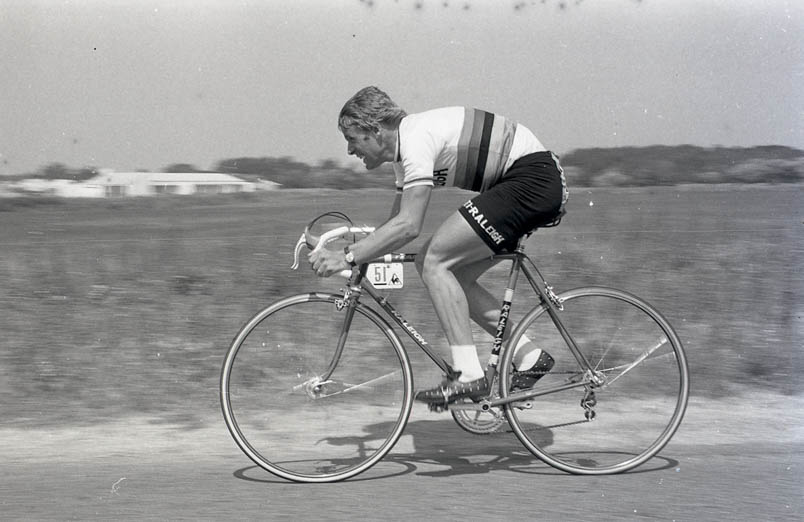
Hennie Kuiper starts the 1976 Tour de France with the ‘lucky number’ 51. Eddy Merckx (in 1969 and 1971), Luis Ocaña (in 1973) and Bernard Thévenet (in 1975) also wore that number when they won the Tour. In the 8-kilometre prologue around Saint-Jean-de-Monts, Kuiper finishes 23rd
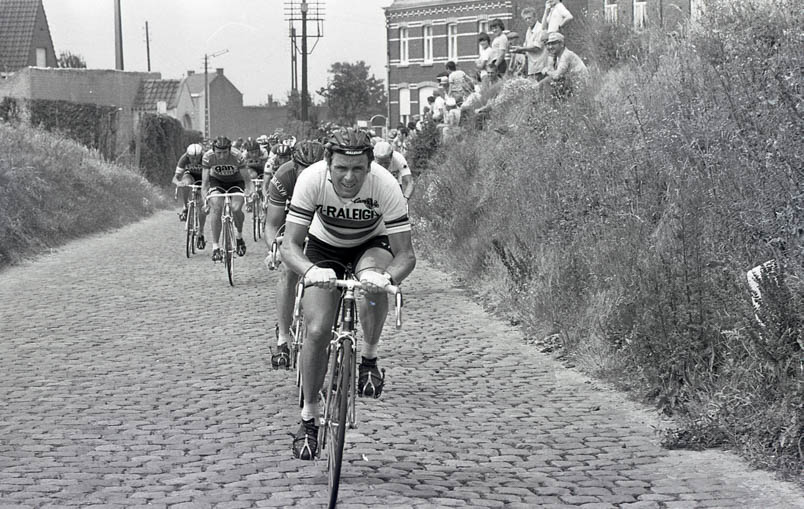
In the fourth stage of the 1976 Tour, Hennie Kuiper leads the main bunch. To Kuiper’s left, Michel Pollentier and Joop Zoetemelk lie in wait
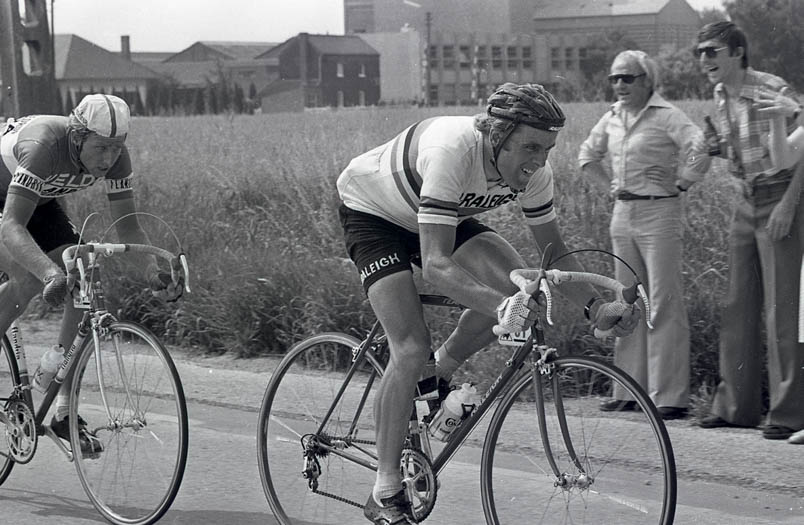
In the finale of the Tour stage to Bornem, Hennie Kuiper sees his chance. The Swiss Eric Loder is just glad to be able to hold his wheel
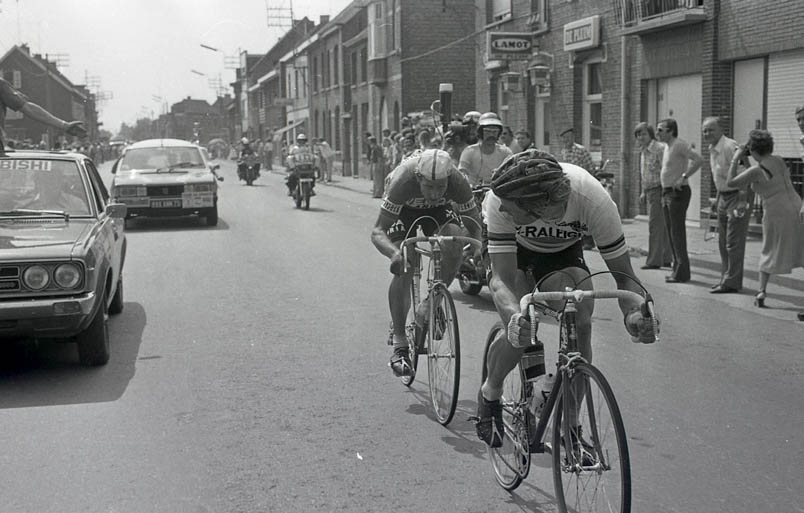
The main pack is hard on the heels of Kuiper and Loder. Kuiper weighs up the lead and reckons it should be possible
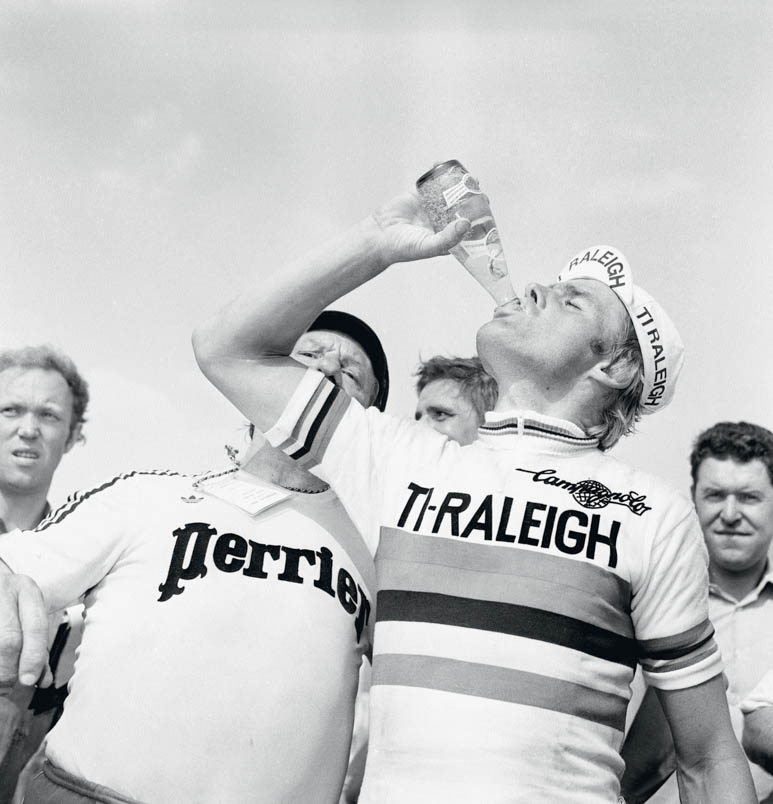
The win in Bornem is greedily toasted with a bottle of Perrier. Left: Joop Holthausen
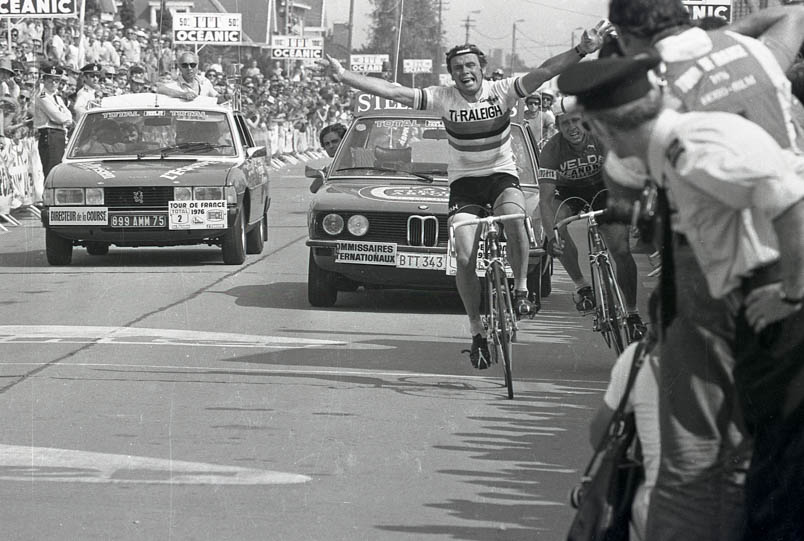
In the sprint in Bornem, Hennie Kuiper beats his breakaway companion Eric Loder. It is not only Hennie Kuiper’s first stage win in the Tour de France, but also the first Tour stage win for Peter Post’s illustrious TI-Raleigh team
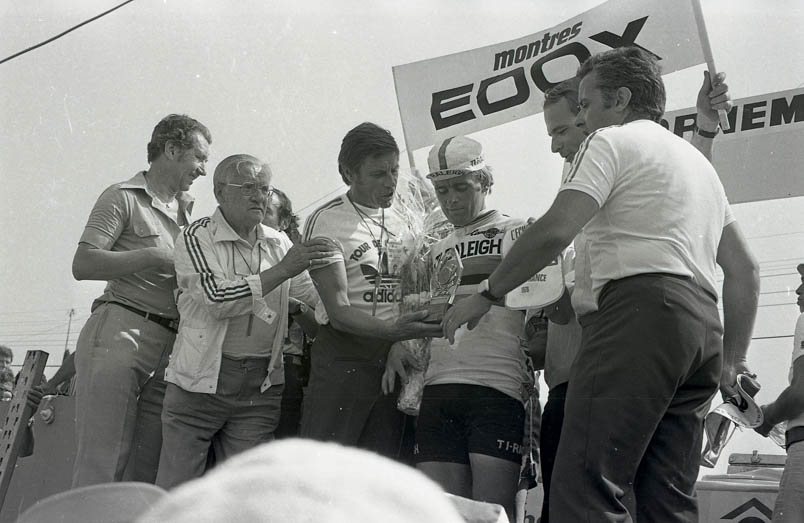
A new world opens up for Hennie Kuiper. On the podium of the Tour de France he is pulled this way and that
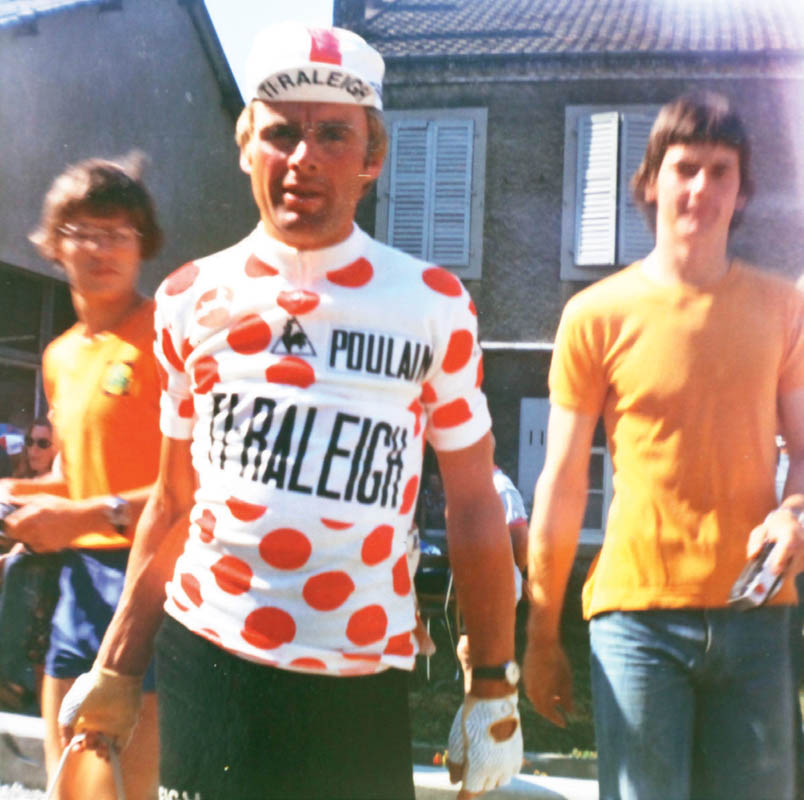
On the stage to Mulhouse, Hennie Kuiper manages to take the polka-dot jersey. In 1976 he gets to wear it for exactly one day
Loss as a source of inspiration
Hennie squanders his strength in the first half of the Tour. He sprints for the points on little climbs, chasing the polka-dot jersey. On the stage to Mulhouse, when the riders are driven over the Col du Calvaire and the highest mountain in the Vosges, the Grand Ballon, Hennie gets his wish. He gets to wear a leader’s jersey in the Tour – if only for a single day. His real goal, however, is the yellow jersey, and for his decisive attack he chooses the stage that, for the first time since 1952, climbs to the top of the ski resort of l’Alpe d’Huez. There he suffers a humiliating defeat. That defeat becomes the source of inspiration for his glorious triumph in 1977.
The day after his defeat on the stage to l’Alpe d’Huez in 1976, he launches a reckless attack. He wants to ride his frustration out of his system, but fails to see that he is wrecking himself. ‘There was no directeur sportif Post saying to me: “Stop!”’ There is no teammate who can rein him in. Directeur sportif Peter Post may present himself, with Amsterdam bravado, as the great Tour de France expert, but he knows little about the event. Mechanic Paul Soetekouw remembers that he and soigneur Ruud Bakker have to go round cafés begging for ice cubes to cool the drinks in the bottles. There are no cool boxes. Nobody has thought of them, not even Peter Post, who as a rider earned a comfortable living on the winter track and far less on the road. Post started the Tour himself only once, in 1965. But long before the real field of battle – the mountains – came into view, he abandoned the race.
In Raleigh’s first Tour, Post surrounds himself with good people. He speaks no French, but he has appointed the Belgian tram driver Jules De Wever as his assistant, and De Wever is perfectly bilingual. Post makes Peter Bonthuis, his administrative support and fixer, assistant directeur sportif, and fills the gaps in his knowledge wherever he needs to. When the riders head into the mountains, they ask the directeur sportif for advice on which gears to fit. Post first consults José De Cauwer, who knows just about everything there is to know about technical matters. Once he has the information, he impresses on De Cauwer that their conversation must stay confidential.
The big shot
In the evenings at dinner Post plays the big shot, announcing with total conviction which gears his riders should use the next day. No wonder Post cannot give Kuiper sound advice when Hennie attacks so rashly on the way to Montgenèvre, on a stage that takes in the Lautaret and the Izoard. Post is (still) too inexperienced. Small wonder, then, that in the finale of that stage Kuiper – exhausted as he is – has to let the big stars go: Lucien Van Impe, Bernard Thévenet and Joop Zoetemelk, who wins a mountain stage for the second day running. It is little short of a miracle that Kuiper still finishes seventh on that stage, but he has had to dig deep into his reserves for a performance that brings him not a gain but a loss against a number of important rivals. To make matters worse, two teammates finish outside the time limit: the brothers Jan and Piet van Katwijk. The cause: the high pace set by the attacking Kuiper on this stage. ‘You do good things, but stupid things too,’ he concludes afterwards.