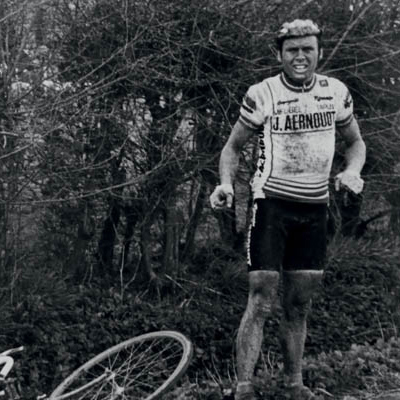
MONUMENT 1
Tour of Flanders 1981
Before the start of the 1981 season, directeur sportif Fred De Bruyne is counting mainly on Hennie Kuiper the stage racer. True, the Dutchman, like Roger De Vlaeminck, is given the status of protected rider, but for the big one-day races both De Bruyne and the sponsor’s director Willy van Doorne are counting first and foremost on their great Flemish trump card, Roger De Vlaeminck. Kuiper’s friend and assistant directeur sportif José De Cauwer knows better. It was he who set in motion the metamorphosis of Kuiper the stage racer into Kuiper the classics rider. De Cauwer is dying to know whether the new approach to training will pay off. There is no better test than the Tour of Flanders, known for as long as anyone can remember in Catholic, cycling-mad Flanders as the Hoogmis, the High Mass.
As so often, the Koppenberg is on the route in ’81 too. That steep hill in the Flemish countryside, strewn with rough lumps of stone, is cursed by 95 per cent of the riders. Bernard Hinault speaks of a hump that reduces the sporting value of Vlaanderens Mooiste – Flanders’ Finest – to a lottery. ‘In my day it was a monstrosity,’ says Hennie. ‘Nowadays the riders are better prepared and go up it in lighter gears. Back then a sprocket with 23 or 25 teeth was the lightest you could fit, combined with a 42-tooth chainring.’ There is another factor that makes it a little easier nowadays: the stones are laid somewhat more evenly. Even after the turn of the century the Koppenberg remains a controversial obstacle that can distort a race, but it is no longer as bad as it was in the seventies and eighties of the last century.
The trick
It is still the case that when a rider falls on the Koppenberg, the riders behind him usually have to get off and are forced to continue to the top on foot. ‘Sometimes they resort to all sorts of tricks too,’ Hennie knows. ‘When the team leader is already on his way to the top, a helper lets himself fall, then puts his bike across the road and so creates a blockade.’ Kuiper has fallen victim to that kind of practice more than once. In 1981, too, he has to go up on foot when he sees the road blocked by falling riders. That means a chase of sometimes dozens of kilometres before you are back in the main field. ‘Once, together with Francesco Moser, I had to race for an hour and a half to get back to the front of the race.’
On the eve of the 1981 Tour of Flanders the riders sleep in a hotel owner’s villa. The hotel is overbooked, but the patron considers it an honour to receive the gentlemen of the peloton in his smart private residence. They are not just anybody, after all: the hugely popular Roger De Vlaeminck and the universally respected Hennie Kuiper. And all under the direction of the famous former TV commentator and one-time top rider Fred De Bruyne. De Vlaeminck and Kuiper understand each other. The respect is mutual.
The mood in the team could not be better. DAF has made an impression in Paris-Nice. De Vlaeminck has won two stages, and the very young talent Adrie van der Poel, second overall, has added a third victory. Kuiper is deeply impressed by the way De Vlaeminck prepares. To the outside world he may be a ‘joker’, but when it counts, he works towards every race in deadly earnest. Jokes and larks now and then, but above all great professionalism. The team is primed for the High Mass, De Vlaeminck first and foremost. The professional peloton knows it too, which is why he is watched closely. Every move is answered at once.
It is a time of great animosity between the young Flemish riders Fons De Wolf and Daniel Willems, both dubbed the ‘crown princes’ of Belgian cycling. Since Eddy Merckx’s retirement the people have been praying for a successor. As soon as a rider’s legs lift him a little above the crowd, the cycling-mad media stamp him ‘crown prince’. When there are two ‘crown princes’ riding in the peloton, it is not hard to predict what happens next: the two of them are at each other’s throats. They race against each other more than they try to win themselves. The 1981 Tour of Flanders is no exception. If De Wolf attacks, Willems jumps on his wheel, and vice versa. The decision comes, as so often, on the Muur, not Kuiper’s ideal battleground. The climb is too steep and too short for him. On that 5th of April 1981 he claws his way up with difficulty. At the top of the Muur, by the little chapel, Hennie is the last of the big group still able to hold his place at the front. The rest of the field, Van der Poel among them, is left behind in disarray.
A little under twenty kilometres from the line, just after the last climb of the day, the Bosberg, the crown princes are at each other’s throats again. De Wolf attacks, Willems goes with him and even takes a turn on the front. Kuiper sees it happen. He jumps across. ‘I thought: if I get away with those two and Roger sits tight, the others will have to work to bring me back, and then Roger can go clear afterwards.’
When Hennie takes over at the front of the princely duo, they are mainly watching each other. Neither will give the other an inch. Hennie looks round and sees that the pair are concerned only with each other. In the blink of an eye he has fifty metres. A little later he looks round once more. The gap is a hundred metres. The international cycling elite ought to know that from that moment on it is very hard to bring Kuiper back. He bends low over the handlebars and goes flat out. Behind him Roger De Vlaeminck nips every attack in the bud. It looks easy, but it is anything but. Counter-attacks from Sean Kelly, Jan Raas and Jean-Luc Vandenbroucke, among others, force De Vlaeminck to the limit time after time. ‘Directeur sportif Fred De Bruyne was terribly nervous. I could tell from my pace that the others really wouldn’t be able to come back.’
Kuiper keeps up a murderous pace. ‘I rode the soul out of my body.’ He crosses the line overjoyed. For the first time in his cycling life he wins a classic. But my God, the pain in his chest, in his lungs. ‘I had forced everything: my airways, my lungs. That’s where the pain came from.’ Even the climb the organisers have built into the finale that year can no longer break the rhythm of the born-and-bred Tukker, as people from Twente are known. He rides a big gear, covers an impressive number of metres with every turn of the pedals and passes his first unofficial exams as a classics rider with flying colours. With thanks to Roger De Vlaeminck, who shields the break impeccably. Hennie understands that better than anyone. It is also the first thing he says. ‘Thanks, Roger, but next Sunday, in Paris-Roubaix, I’ll ride for you.’
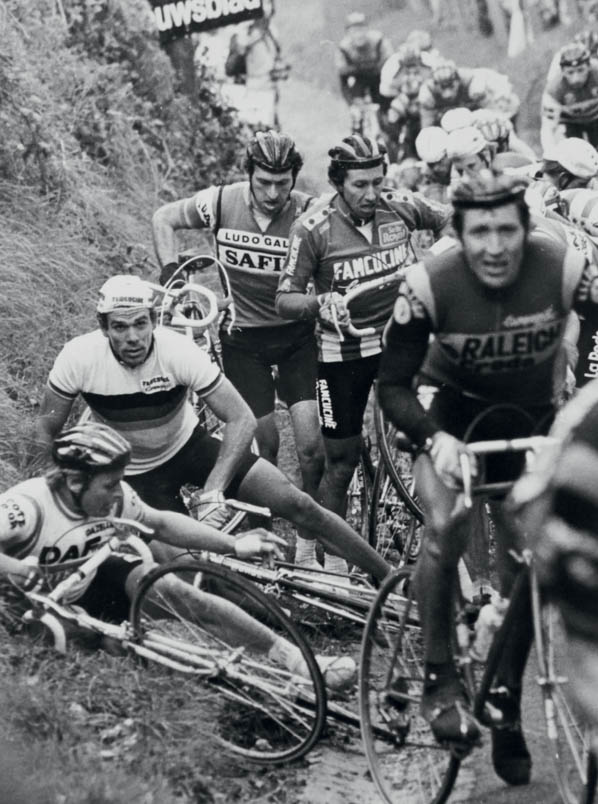
In the 1981 Tour of Flanders Hennie Kuiper and the German champion Gregor Braun – almost inevitably – come down on the Koppenberg. Aad van den Hoek still has one foot on the ground but is trying to get going again. In the Koppenberg crush that is impossible
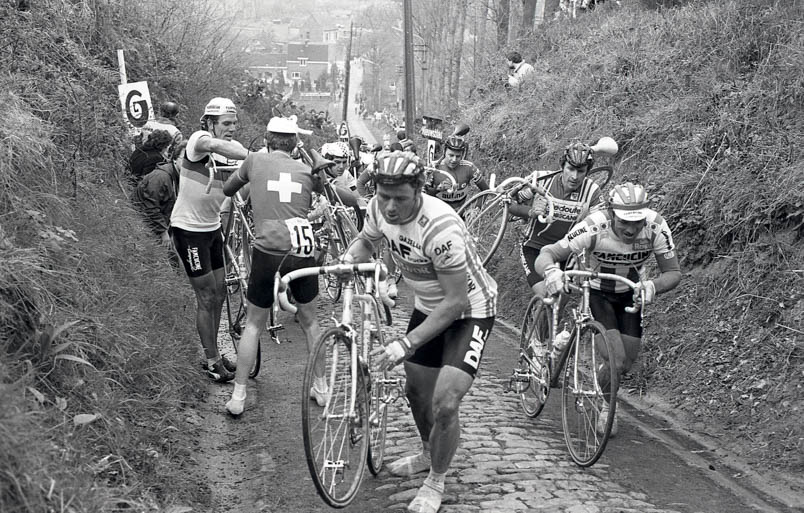
On the Koppenberg Hennie Kuiper is turned into a cyclo-cross rider, like the rest of the group. Gregor Braun has scrambled out of the verge again, but his frame gets tangled up with that of the Swiss rider Godi Schmutz
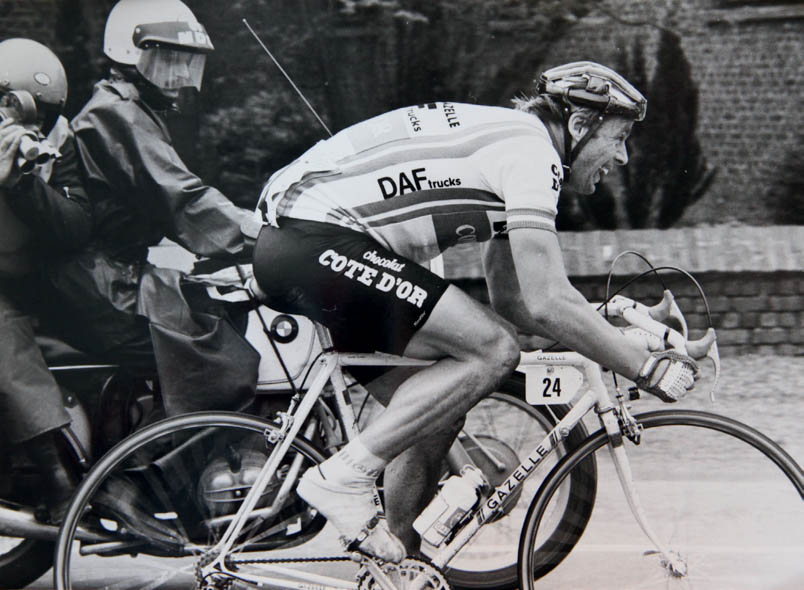
Hennie Kuiper realises it can be done: he can win his first Monument. His expression speaks volumes
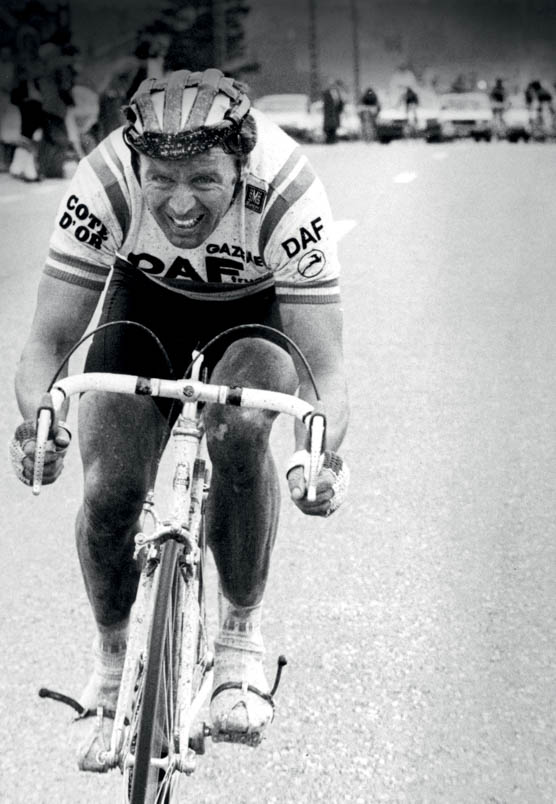
Champion Willpower puts the competition in the Tour of Flanders decisively behind him. ‘I rode the soul out of my body’
‘Ride, Hennie: ride’
‘Kuipertje’ (little Kuiper) keeps his word. Roger De Vlaeminck, Francesco Moser, Bernard Hinault, Guido Van Calster, Marc Demeyer and he form the decisive lead group, heading over the bone-jarring cobbles of Hell towards the deliverance of the velodrome in Roubaix. ‘Ride, Hennie, ride,’ De Vlaeminck urges his teammate again and again. The fast Fleming wants to keep the pace so high that an attack becomes all but impossible. Hennie rides so hard that he all but tears the cobbles out of the roads of northern France, but in the end it proves to be in vain. De Vlaeminck is in fact making a cardinal error. He should have let Kuiper attack. ‘If I get away, Hinault has to come and fetch me. That costs strength, and Roger could have profited from it. But Roger was too nervous.’ Too nervous, at any rate, to make the right decisions. When the six of them swing onto the track for the final sprint, Kuiper lets them get on with it. As a non-sprinter he would only get in their way.
De Vlaeminck is, on paper, the best sprinter, but once again he makes mistakes. Hinault confidently takes the lead and rides to the line at one high, unbroken pace. De Vlaeminck cannot get past him. Hennie has nonetheless paid off his debt to his teammate. In two big races in a row he proves that he belongs among the very best in the classics. The metamorphosis is complete. The first Monument is in the bag!
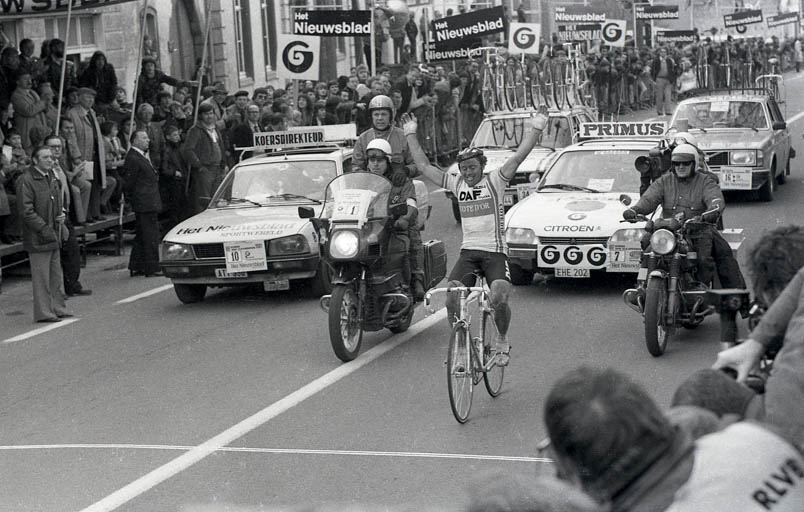
Hennie Kuiper’s victory salute on the finish line in Meerbeke comes with a great sense of satisfaction
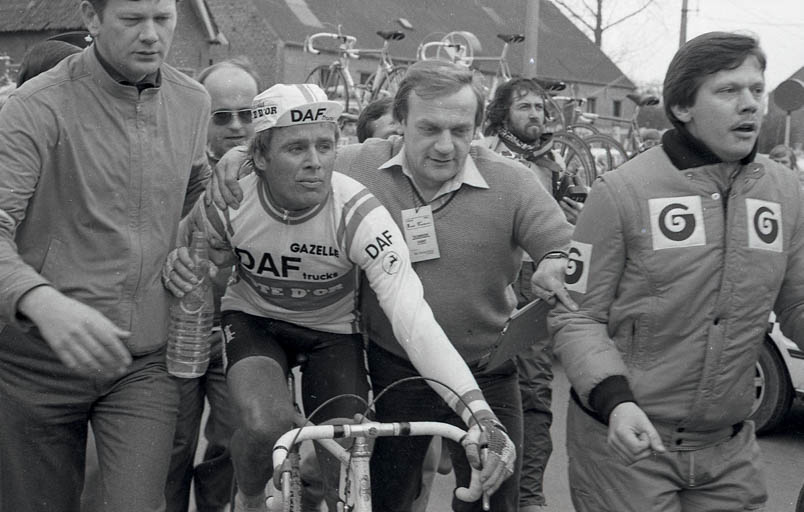
The media frenzy is about to break over the winner of the 1981 Tour of Flanders. But there is always jack of all trades André Meganck (to Kuiper’s right) to escort the champion to the Flemish commentators
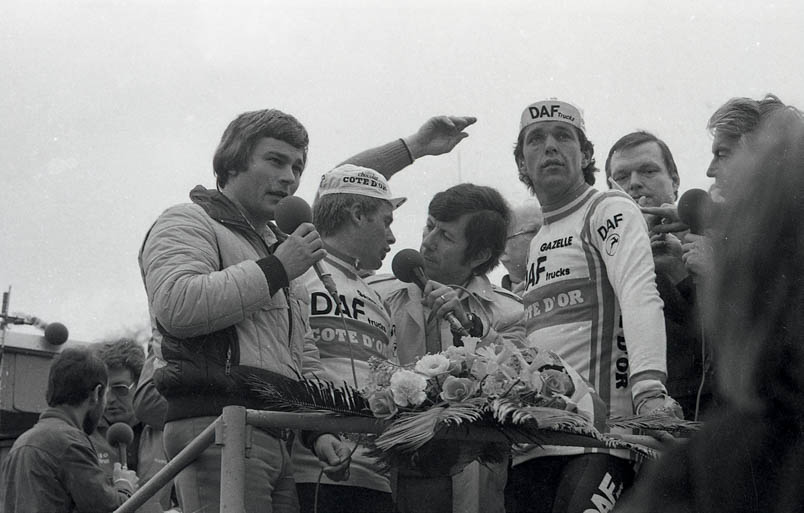
The look in Roger De Vlaeminck’s eyes is almost the same as on the podium of the 1975 World Championships: gazing beyond infinity. Louis De Pelsmaeker and Jean Nelissen only have eyes for the winner, Hennie Kuiper