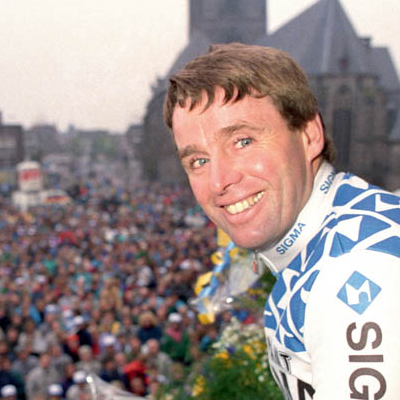
Motorola and Armstrong
Assistant directeur sportif Snoeijink can go back to the classroom. He is a teacher once more. For Hennie the uncertainty does not last too long. A phone call from the former rider and Motorola assistant directeur sportif Noël Dejonckheere provides the answer. Would Hennie be willing to talk to the American Jim Ochowicz? The subject: the role of (co-)directeur sportif of the American Motorola team. It is the start of a new, exciting period. Jim Ochowicz, a former cyclist married to the speed-skating sprinter and former world champion Sheila Young, founded the all-American 7-Eleven team in 1981; it worked with amateurs at first, but from 1985 joined the professional ranks. In 1991 Ochowicz gets a new sponsor: Motorola. Ochowicz is looking for a well-known name to run the team with him, and then hears that Hennie Kuiper is available. He makes contact through Dejonckheere.
A special rider
At the end of his first Motorola year, 1992, Kuiper gets a special rider in the team: Lance Armstrong, who had competed in the Olympic Games in Barcelona earlier that year. From day one Armstrong proves to be a personality who knows what he wants. His first race as a professional is the Clásica San Sebastián, a tough race in the Basque Country. Hennie Kuiper saddles the debutant with typical domestique’s work. ‘I told him: “You have to fetch water for the team leaders; if there are punctures, you help the men get back into the peloton, and whatever happens you have to finish the race.”’
It is hot that day. So Armstrong often has to fetch water for the team leaders. It is gruelling, exhausting work. The debutant is spent. He drops back to the team car and says to Kuiper: ‘I’ve had it. I’m getting off.’ Hennie shakes his head. ‘No, you’re not getting off. You can’t do that. We agreed that you would finish the race.’ Armstrong thinks for a second and then answers: ‘OK.’ He goes back to find his place in the peloton. The sky clouds over. Thunder starts to rumble and the wind gets up. Rain lashes the road. The weather is foul. When Kuiper, following the peloton, reaches the finish, the bikes are loaded onto the cars. ‘Come on, let’s go,’ calls a mechanic. ‘No,’ says Hennie, ‘there’s still a rider to come.’ Two police motorcyclists with flashing lights approach the finish. Between them, in the middle of the road, one lone rider: Lance. ‘It was a beautiful day today,’ he says when he has crossed the line in 111th and last place. By then the winner, Raúl Alcalá, has been in for 26 minutes 56 seconds. ‘I had the whole road to myself and an escort as well. What more could you want?’ Afterwards Kuiper the directeur sportif goes to see Armstrong in his hotel room. ‘How did you like your introduction to the pros? That was tough, wasn’t it?’ The rider fixes him with a piercing look and then says in a determined tone: ‘I want to come back here one day, and then I’ll win this race.’
Three years later, in 1995, he beats his Italian breakaway companion Stefano Della Santa in the sprint in the Clásica, and so keeps his promise. He had already drawn attention to himself much earlier. A week after finishing last in his first race, the Clásica San Sebastián, he is one of a trio of breakaways who light up the Championship of Zurich. With the Russian Viatcheslav Ekimov and the Belgian Jan Nevens he rides to the finish line, where the Russian relegates him to second place.
A doping cheat without a conscience?
Kuiper admires the Armstrong of those days. But isn’t Armstrong the rider who is to a great extent responsible for the blackest pages in the history of cycling? Wasn’t he the doping cheat without a conscience who forced teammates to pump themselves full of stimulants?
Hennie Kuiper was with him through the first five years of his professional cycling career. ‘In that time I never noticed anything to do with doping. Of course I condemn what he did afterwards. It is right, too, that those Tour wins were taken away from him. He brought that on himself, but the people running cycling should have taken jerseys away from other riders as well, and that didn’t happen. As far as Armstrong is concerned, we mustn’t forget that he has his good sides too. He raised many, many millions with his foundation for the fight against cancer. He gave young cancer patients an unforgettable day by making a fuss of them with the team. And as a rider he produced tremendous performances in my years as directeur sportif. That is on the other side of the scales.’
Were there no signs during Kuiper’s time as directeur sportif that Armstrong was up to no good? ‘No. Lance was always very self-centred. Everything had to revolve around him. From the very start he always wanted to be the centre of attention,’ says Kuiper. Armstrong reminds him of his rival from 1977, Didi Thurau. But whereas his verdict on Thurau is negative – without the German, Kuiper would have won the 1977 Tour – the Twente man’s verdict on the Armstrong he knew as directeur sportif is positive. ‘I had a fantastic time with Lance. He took the whole team to a higher level.’ By then that team already includes a number of names that fire the imagination. Riders such as the Australian Phil Anderson, the Mexican Raúl Alcalá, the Canadian Steve Bauer and the Americans Andy Hampsten, Frankie Andreu and George Hincapie.
The American Jim Ochowicz may be the directeur sportif, with Hennie Kuiper as his direct assistant, but the team revolves around one man only: Lance Armstrong. ‘He was always very domineering,’ says Hennie. ‘Right from his first year with us he had demands. He would call Jim Ochowicz – whom he always called “Och” – over and want different handlebars one time, different equipment the next and different clothing the time after that. It was always in a domineering tone. And that was accepted, because Lance didn’t just behave like someone special; he was special.’ In 1993 he shows that there is a great rider in him. On the eighth stage of that year’s Tour de France, Hennie Kuiper has an important guest in his car: General Charles G. Boyd, a Vietnam veteran, who follows Armstrong’s breakaway with deep emotion on the stage from Châlons-sur-Marne to Verdun, the place where a great and extremely bloody battle was fought in the First World War. In Verdun Armstrong takes his first stage win in the Tour de France.
Four days later he leaves the Tour, as agreed beforehand. Ochowicz and Kuiper do not want to burn out the young talent too soon. He is still too young and inexperienced to cope with such a gruelling task yet. That he is an exceptional rider nonetheless, the 21-year-old Texan proves at the World Championships in Oslo. In the finale he gets the better of acknowledged greats such as the renowned Spaniard Miguel Indurain and the East German star Olaf Ludwig. Lance Armstrong’s name is made for good. In 1994 things do not really go smoothly between Armstrong and the Tour de France. He leaves his second Tour de France, now in the rainbow jersey, early because of personal problems. On the fifteenth stage the American fails to appear at the start. ‘He slipped away in the night without saying goodbye,’ says Hennie. But that was Armstrong: always going his own headstrong way.
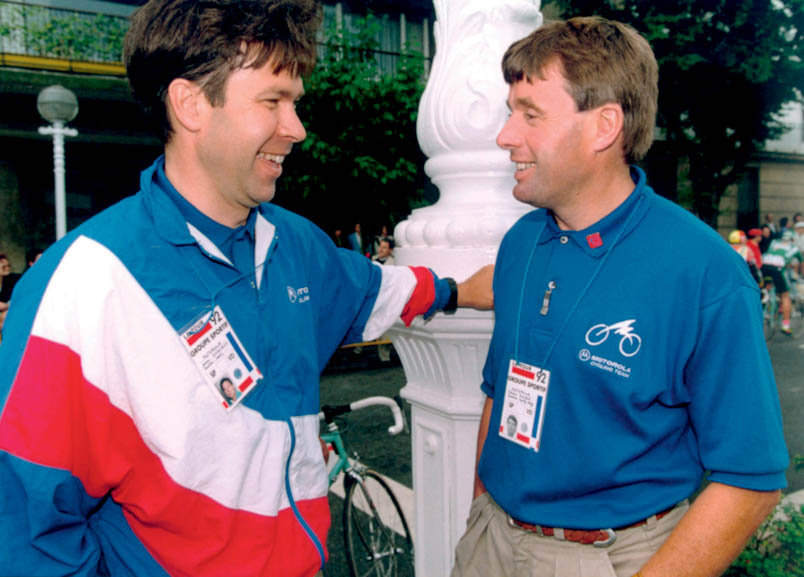
When Walter Godefroot takes over the T-mobile team like a bolt from the blue, Noël Dejonckheere puts Motorola, Jim Ochowicz and Hennie Kuiper in touch. Ochowicz and Kuiper hit it off
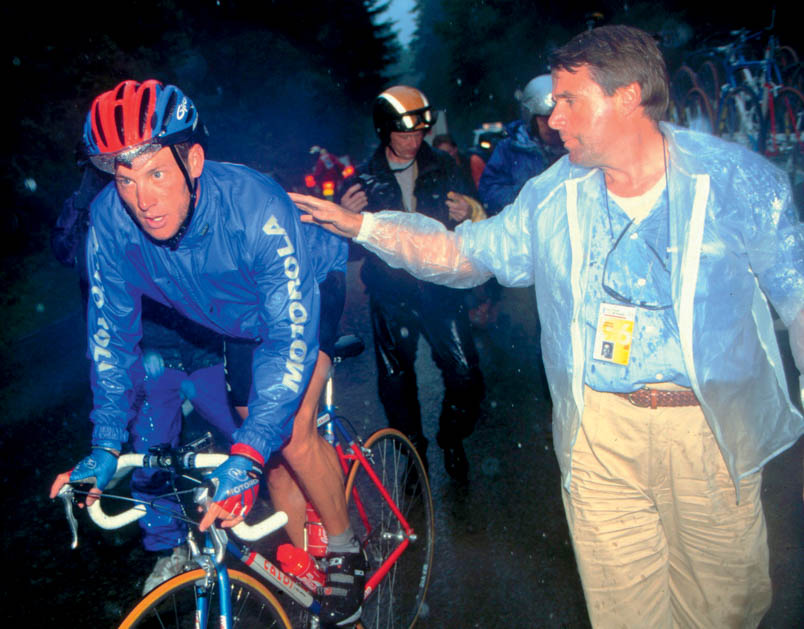
On the day Michael Boogerd wins his first Tour stage in the pouring rain of Aix-les-Bains, Lance Armstrong leaves La Grande Boucle. Directeur sportif Hennie Kuiper puts a hand on Armstrong’s shoulder. Three months later Armstrong receives the devastating diagnosis: ‘testicular cancer’…
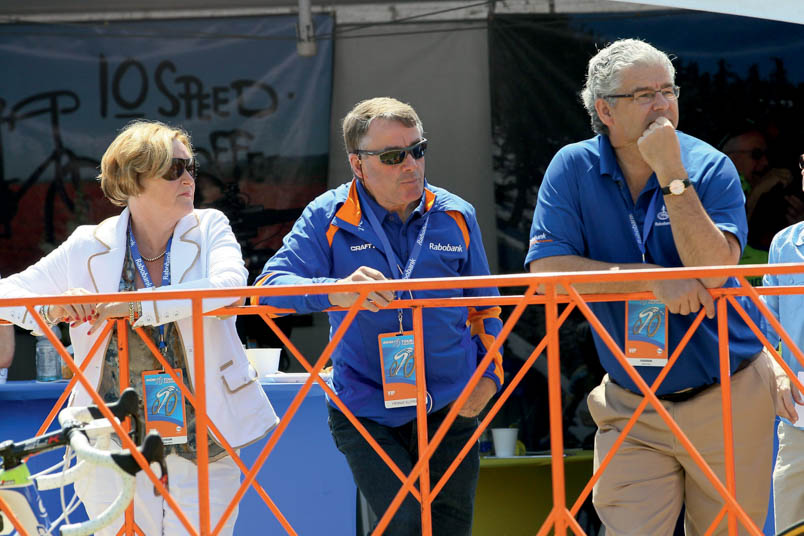
After Motorola, Hennie Kuiper takes on PR work for Rabobank, as here with his wife Marianne at the Tour of California, where he becomes friends with Ronald Blok, who rolls out the Rabo concept on the American west coast with great success
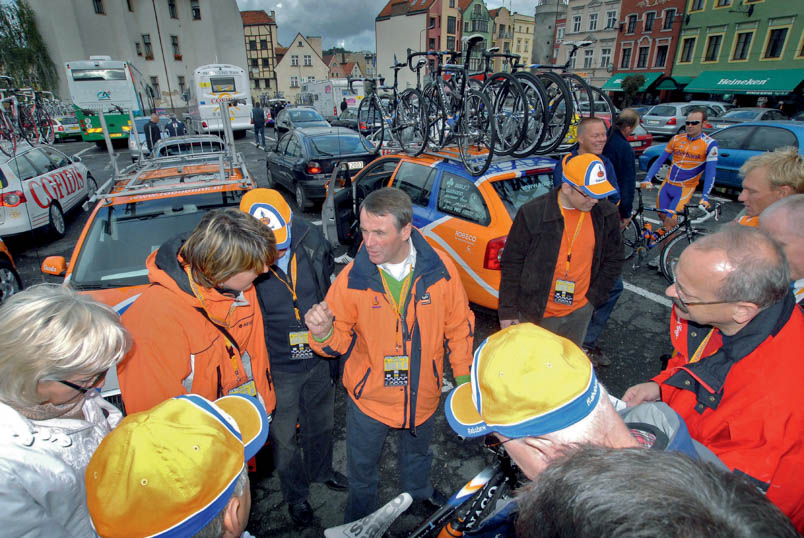
In September 2007, in Jelenia Góra during the Tour of Poland, Hennie Kuiper shows Rabobank guests around the Rabo cycling team before the start of the final stage to Karpacz. On the far right are Rabo sprinter Graeme Brown and attacker Bram de Groot